
A private pilot certificate issued by the FAA under 14 CFR § 61.19 is valid for life and carries no expiration date. That surprises most people who assume a license works like a driver's license with a renewal deadline stamped on it. The correct industry term is "pilot certificate," though "private pilot license" is widely used and understood. Knowing how long a private pilot license is valid is only half the answer. The other half covers the medical, flight review, and currency requirements that determine whether you can legally act as pilot in command on any given day.
A U.S. private pilot certificate is issued without an expiration date and remains valid indefinitely. This is the direct answer to the question most pilots and student pilots search for. The certificate itself does not expire, but that fact alone does not mean you can walk out to the ramp and fly whenever you want.
The key distinction is between certificate validity and privilege currency. Your certificate is a permanent document. Your privileges to exercise it depend on meeting separate, ongoing requirements. Think of the certificate as your credential and currency as your permission to use it on a specific day.

Certificates issued after April 1, 2016, carry no printed expiration dates, which eliminated a long-standing source of confusion. Legacy certificates issued before mid-1945 did carry expiration dates and are no longer valid under modern rules. If you hold one of those older documents, you need a reissued certificate to fly legally.
A few specific circumstances can void your certificate entirely, separate from currency lapses:
Pro Tip: Keep a digital copy of your pilot certificate stored in a secure cloud folder. If your physical card is lost or damaged, you can request a replacement through the FAA's Airmen Inquiry system without any lapse in validity.
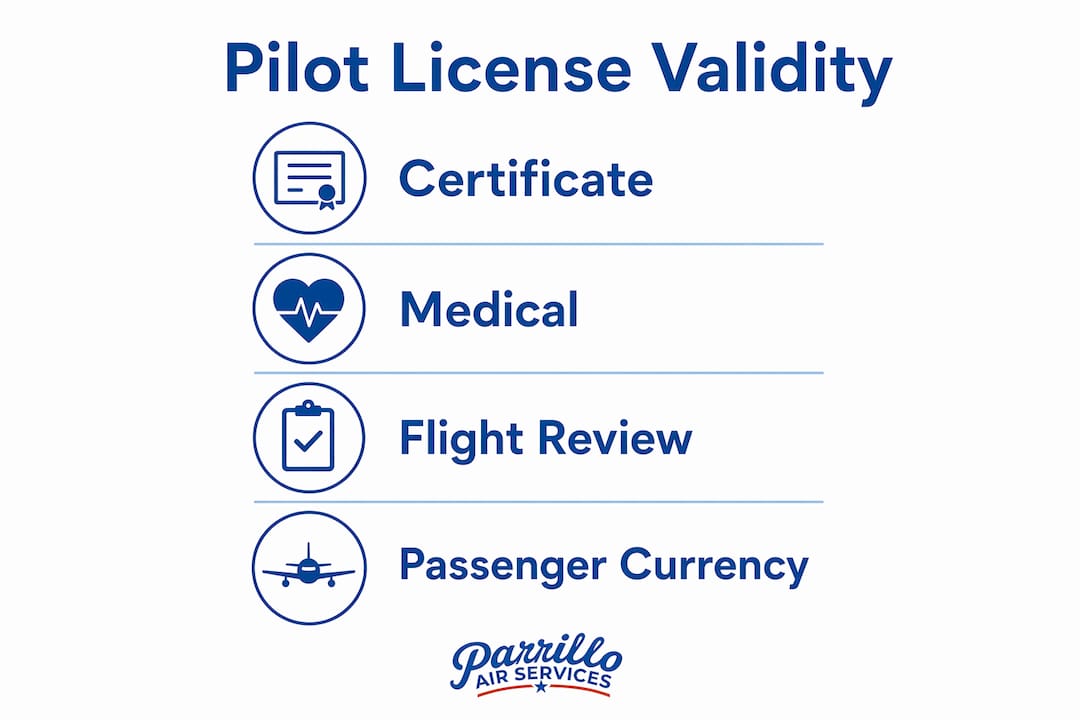
The private pilot license duration is indefinite, but your ability to fly legally depends on three active requirements: a valid medical certificate, a current flight review, and recent flight experience.
Most private pilots need a Class 3 medical certificate to exercise their privileges. The FAA renews Class 3 certificates every 24 calendar months for pilots under age 40. For pilots 40 and older, that interval shortens to 12 months. Missing a renewal date means your privileges lapse immediately, even though your pilot certificate itself remains valid.
BasicMed is a legitimate alternative for many private pilots. Under BasicMed, you complete a medical education course and visit a state-licensed physician every 48 months instead of an FAA Aviation Medical Examiner. BasicMed does carry operational restrictions, including a limit of 250 knots indicated airspeed and a 18,000-foot MSL altitude ceiling, but it works well for most general aviation flying.
The FAA mandates a flight review every 24 calendar months per 14 CFR § 61.56. That review consists of at least one hour of ground instruction and one hour of flight with a certificated flight instructor. The instructor does not issue a pass or fail grade. Instead, they endorse your logbook once you demonstrate competency. If you do not meet the standard, the review simply does not get logged, and you schedule more training.
Carrying passengers adds one more requirement. Three takeoffs and landings in the preceding 90 days are required to act as pilot in command with passengers aboard. Night passenger currency requires those three takeoffs and landings to be performed at night, defined as the period from one hour after sunset to one hour before sunrise.
Pro Tip: Set calendar reminders 60 days before your medical certificate and flight review deadlines. That buffer gives you time to schedule appointments without scrambling at the last minute.
The minimum flight hours required under FAA Part 61 is 40 hours. Part 141 approved schools can certify students in as few as 35 hours. In practice, most students log 60–75 hours before passing their checkride. That gap between the legal minimum and the real-world average reflects the complexity of building genuine airmanship, not just meeting a checklist.
Calendar time varies widely based on how often you fly:
| Training schedule | Typical hours per week | Estimated time to certificate |
|---|---|---|
| Full-time (5 days/week) | 10–15 hours | 2–4 months |
| Part-time (2–3 days/week) | 4–6 hours | 6–9 months |
| Occasional (weekends only) | 1–2 hours | 10–12 months |
Frequency is the single biggest factor in how long training takes. Flying 3–5 times per week allows skills to compound rather than reset between sessions. A student who flies twice a month often spends the first 30 minutes of each lesson relearning what was forgotten since the last flight.
Other factors that affect the flight training time commitment include:
The private pilot license duration from start to certificate is a function of commitment, not just calendar time. Consistent, frequent flying produces faster results and better pilots.
The validity of a private pilot license is permanent under normal circumstances, but several conditions can strip your ability to fly legally. Understanding these pitfalls protects you from an accidental violation.
"Certificate validity is just the legal baseline. Privileges are what actually put you in the left seat. Letting a medical certificate or flight review lapse does not mean your certificate is gone. It means you cannot legally use it until you meet the requirement again."
The most common reasons pilots lose their ability to fly include:
The distinction between certificate validity and privilege currency is critical. A lapsed medical or overdue flight review does not erase your certificate. Once you meet the requirement again, your privileges are restored without reapplying for a new certificate.
Maintaining an active private pilot certificate requires a simple but consistent routine. The pilot license renewal process is not a single event. It is an ongoing cycle of medical visits, flight reviews, and logged currency flights.
Follow these steps to stay current year after year:
Pro Tip: Use a free logbook app like ForeFlight or Garmin Pilot to set automatic alerts for medical and flight review deadlines. Paper logbooks are legal, but digital records make deadline tracking effortless.
A private pilot certificate never expires, but the privileges attached to it require active maintenance through medical certification, flight reviews, and currency flights.
| Point | Details |
|---|---|
| Certificate validity | A U.S. private pilot certificate is valid for life under 14 CFR § 61.19 and carries no expiration date. |
| Medical requirement | Class 3 medical certificates renew every 24 months under age 40 and every 12 months at age 40 or older. |
| Flight review deadline | FAA requires a flight review every 24 calendar months per 14 CFR § 61.56 to maintain flying privileges. |
| Passenger currency | Three takeoffs and landings in the prior 90 days are required before carrying any passengers. |
| Privileges vs. certificate | Lapsed currency suspends your privileges but does not cancel your certificate. Meeting the requirement restores them. |
Pilots sometimes fixate on the certificate as the finish line. I understand the feeling. Earning a private pilot certificate takes real effort, and holding that plastic card feels like proof of something permanent. It is permanent. But the certificate is just the credential. Currency is what actually determines whether you are safe and legal to fly.
I have seen pilots return after a two-year gap and assume their skills are where they left off. They are not. The FAA's 24-month flight review requirement exists precisely because proficiency degrades without practice. A pilot who flies regularly is a fundamentally different pilot than one who flies twice a year and calls it good. The medical requirement adds another layer of accountability. Aviation physiology changes, and the AME visit is a structured check on whether you are still fit to operate an aircraft.
My honest advice: treat currency requirements as a minimum floor, not a target. Fly more than the regulations demand. Schedule your flight review as a training session, not a compliance checkbox. The pilots who stay sharp are the ones who stay engaged with the craft year-round.
Parrillo Air Services offers FAA Part 61 flight training programs designed for pilots at every stage, from first-time students earning their private pilot certificate to active pilots working through biennial flight reviews and currency requirements.

The instructors at Parrillo Air Services in Lynchburg, VA, work around your schedule and focus on building real proficiency, not just logging hours. Whether you need to complete a flight review, restore lapsed passenger currency, or start your private pilot certification from scratch, the team provides personalized instruction backed by FAA-compliant training standards. Reach out to Parrillo Air Services to learn how their programs fit your goals.
No. A U.S. private pilot certificate issued under 14 CFR § 61.19 is valid for life and carries no expiration date, unless it is surrendered, suspended, or revoked by the FAA.
Your pilot privileges lapse immediately. You cannot legally act as pilot in command until you renew your Class 3 medical or qualify under BasicMed.
The FAA requires a flight review every 24 calendar months per 14 CFR § 61.56. The review includes at least one hour of ground instruction and one hour of flight with a certificated flight instructor.
No. A lapsed flight review suspends all pilot-in-command privileges, including solo flight. You must complete a new flight review before acting as pilot in command again.
The FAA minimum is 40 hours under Part 61, but most students complete training in 60–75 hours. Training duration ranges from 3 to 12 months depending on how frequently you fly.
Private Pilot License: Privileges, Pathways & Next Steps | Parrillo Air Services
Parrillo Air Services
Private Pilot License Steps: Your 2026 Certification Guide
Parrillo Air Services
What Is a Recreational Pilot Certificate? 2026 Guide
Parrillo Air Services
Why Pilots Need Medical Certificates: 2026 Guide
Parrillo Air Services