
A pilot medical certificate is an official federal credential proving a pilot meets the physical and mental health standards the FAA requires for safe flight. The FAA issues these certificates under 14 CFR 61.23, which makes them a legal prerequisite before any pilot can act as pilot in command. Understanding why pilots need medical certificates goes far beyond checking a regulatory box. It connects directly to career planning, flight safety, and the long-term health habits that keep pilots flying for decades.
Medical certification for pilots exists because pilot incapacitation in flight is one of the most dangerous scenarios in aviation. A pilot who suffers a sudden cardiac event, vision failure, or severe cognitive impairment at altitude puts every person on board at immediate risk. The FAA requires medical certificates to screen out those risks before they reach the cockpit.
The certification process is governed by the FAA's Office of Aerospace Medicine. Pilots visit an Aviation Medical Examiner, known as an AME, who conducts a physical evaluation and reviews medical history. The AME then issues or denies the certificate based on FAA standards. This system creates a documented, recurring health checkpoint tied directly to a pilot's legal authority to fly.

Medical certificates are not a one-time hurdle. They expire and must be renewed, which means pilots face regular health evaluations throughout their careers. That renewal cycle is intentional. It catches conditions that develop over time, such as cardiovascular disease, vision deterioration, or sleep disorders, before they become flight hazards.
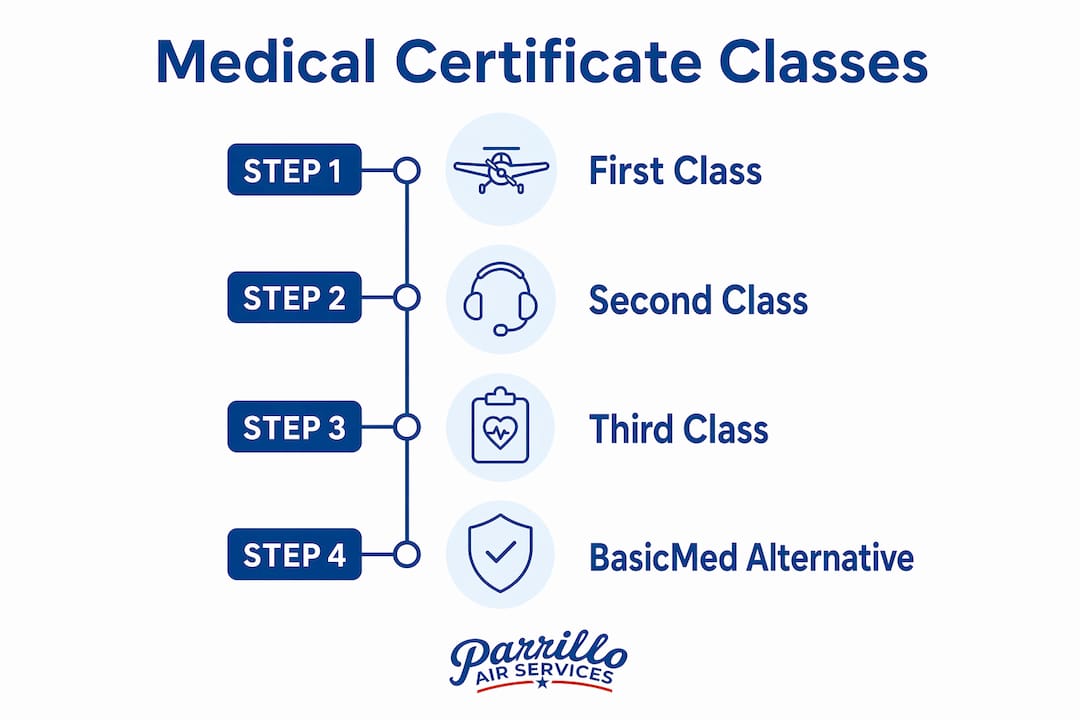
Pilot medical requirements vary by certificate class, and each class corresponds to a specific level of pilot operation. The FAA issues three classes, each with different standards and validity periods.
First Class is required for Airline Transport Pilots. It carries the strictest physical standards and the shortest renewal cycle. Pilots under 40 renew every 12 months. Pilots 40 and older renew every 6 months.
Second Class is required for commercial pilot operations. It renews every 12 months regardless of age. The standards sit between First and Third Class in terms of strictness.
Third Class covers private pilots, recreational pilots, and student pilots. It has the longest validity: 60 months for pilots under 40 and 24 months for pilots 40 and older.
One detail many aspiring pilots miss: a First Class certificate downgrades automatically over time. After the First Class validity period expires, the same certificate grants Second Class privileges. After the Second Class period expires, it grants Third Class privileges. This extends the certificate's usefulness for private flying but does not preserve commercial or ATP authority.
| Certificate class | Required for | Validity under 40 | Validity 40 and older |
|---|---|---|---|
| First Class | Airline Transport Pilot | 12 months | 6 months |
| Second Class | Commercial pilot operations | 12 months | 12 months |
| Third Class | Private, recreational, student | 60 months | 24 months |
| BasicMed | Limited private operations | 48 months (physician exam) | 48 months (physician exam) |
BasicMed is an alternative pathway for private pilots who meet specific criteria. BasicMed requires a prior FAA medical certificate issued after july 14, 2006, a valid U.S. driver's license, an online medical education course every 24 months, and a physician exam every 48 months. BasicMed does not apply to commercial or ATP operations.
Pro Tip: If you plan to pursue an airline career, apply for a First Class medical certificate before you invest in flight training. Discovering a disqualifying condition after spending tens of thousands of dollars on training is a risk you can eliminate early.
The exam process begins before you walk into the AME's office. Pilots must complete FAA Form 8500-8 through the MedXPress web application before the appointment. MedXPress collects your medical history, current medications, and prior certificate information. The AME reviews this form during the exam.
The physical evaluation covers several areas:
Disclosure is not optional. Pilots must fully disclose all health conditions and medications on Form 8500-8. Hiding a condition or omitting a medication is a serious compliance violation. It can result in certificate denial or revocation, and in some cases, federal enforcement action.
If the AME cannot issue a certificate on the spot, the application may be deferred to the FAA's Aerospace Medical Certification Division. This is not an automatic denial. It means the FAA needs more information before making a decision.
Pro Tip: Bring a complete list of all medications, including over-the-counter drugs and supplements, to your AME appointment. Incomplete disclosures are the most common reason for delays and deferrals.
Passing a medical exam is the legal floor, not the performance ceiling. Fatigue, dehydration, and poor sleep degrade cognitive performance, contributing to a meaningful share of aviation incidents. Fatigue-related error rates are statistically highest between 2–6 AM and 2–4 PM, which maps directly onto overnight cargo flights and early-morning departures.
Cardiovascular disease is the leading cause of medical certificate loss for pilots over 40. This makes heart health a career-defining variable, not just a personal concern. Pilots who neglect cardiovascular fitness in their 30s often face certificate challenges in their 40s, precisely when their careers should be reaching peak earning potential.
Mental health is a growing focus in aviation medicine. The aviation industry is shifting toward normalizing mental health discussions to prevent impairments that threaten both safety and livelihoods. The old culture of hiding psychological struggles to protect a certificate is giving way to a more transparent approach, partly because the FAA has expanded pathways for pilots managing treated mental health conditions.
Pilot health is career insurance. Every hour of sleep you protect, every workout you complete, and every stress management habit you build directly extends the years you spend in the left seat.
Practical health behaviors that support flight safety include:
Medical certificate denial is not the end of a flying career for most pilots. The FAA provides a formal pathway called the Special Issuance certificate under 14 C.F.R. § 67.401. This pathway allows pilots with certain medical conditions to fly with additional requirements, such as periodic testing, specialist evaluations, or operational limitations.
Common conditions that lead to Special Issuance include treated hypertension, controlled diabetes, certain cardiac arrhythmias, and some mental health diagnoses. Pilots operating under Special Issuance certificates fly under similar day-to-day conditions as those with unrestricted certificates, but they carry additional documentation and face more frequent renewals.
The most effective strategy for aspiring pilots is early evaluation. Applying for a First Class medical early in the training process identifies potential disqualifications before you invest in expensive flight hours. A student who discovers a correctable vision issue or a manageable cardiac condition before training can address it proactively rather than facing a career disruption mid-program.
Pro Tip: If you receive a deferral or denial, consult an aviation attorney or an AME who specializes in Special Issuance cases before giving up. Many conditions that initially trigger denials are manageable with the right documentation.
Key strategies for managing medical certification over a career:
Pilots who treat medical certification as a recurring career management task, rather than a periodic inconvenience, consistently navigate the system with fewer disruptions. The commercial pilot certificate requirements at the commercial level make proactive health management even more critical, since a lapse in Second Class certification directly grounds a commercial operation.
Medical certification is the legal and physical foundation of every pilot's career, and managing it proactively separates pilots who fly for decades from those who face avoidable career interruptions.
| Point | Details |
|---|---|
| Three certificate classes | First, Second, and Third Class certificates correspond to ATP, commercial, and private operations respectively. |
| BasicMed as an alternative | Private pilots meeting specific FAA criteria can use BasicMed instead of a traditional medical certificate. |
| Full disclosure is mandatory | Hiding conditions or medications on FAA Form 8500-8 risks certificate denial or federal enforcement. |
| Special Issuance opens doors | Pilots denied a standard certificate can often qualify for Special Issuance with additional documentation. |
| Early evaluation saves money | Applying for a First Class medical before training begins prevents costly surprises mid-program. |
Pilots who treat their medical certificate as a formality are misreading what it represents. I have seen aspiring pilots invest months of time and significant money into training, only to discover a disqualifying condition they could have identified in a single AME appointment. That is not bad luck. That is a planning gap.
The medical certificate is the clearest signal the FAA sends about what it values: a pilot who is physically and mentally fit to make life-or-death decisions at altitude. The exam itself is a snapshot. What matters more is the daily discipline that keeps a pilot healthy between exams. Cardiovascular fitness, sleep quality, stress management, and honest mental health care are not lifestyle bonuses. They are professional obligations.
The industry's shift toward open mental health conversations is long overdue. For years, pilots avoided seeking help because they feared losing their certificates. That culture cost the industry talented pilots and, in some cases, contributed to accidents. The FAA's expanded Special Issuance pathways for treated mental health conditions reflect a more realistic understanding of human health. Pilots should use those pathways without shame.
My strongest advice to anyone starting flight training: get your First Class medical before your first flight lesson. Not after. Before. Know exactly what you are working with. Then build the health habits that protect that certificate for the next 30 years.
— Gm
Parrillo Air Services, based in Lynchburg, VA, guides aspiring pilots through every stage of FAA certification, including the medical requirements that determine which certificate classes you can hold. Understanding regional airline hiring requirements means knowing exactly which medical standards apply to your career goals before you begin training.

Parrillo Air Services offers FAA Part 61 flight training from discovery flights through commercial and flight instructor ratings. The school's instructors help students plan their medical certification timeline alongside their training program, so there are no surprises when it counts. If you are ready to take the first step toward a professional aviation career, explore flight training programs at Parrillo Air Services and get a clear picture of what the path ahead looks like.