A recreational pilot certificate is an FAA-issued license that permits holders to fly single-engine aircraft under specific conditions and with restricted privileges. The Federal Aviation Administration created this certificate as a middle ground between the student pilot and private pilot levels, though its practical role in 2026 has narrowed considerably. If you are weighing your options as an aspiring pilot, understanding what this certificate covers, what it costs, and how it compares to the sport pilot and private pilot certificates will save you time and money before you ever step into a cockpit.
The recreational pilot certificate is defined by the FAA as a pilot certification that authorizes flight in single-engine aircraft under visual flight rules during daylight hours. It sits between the student pilot certificate and the private pilot license in the FAA's certification hierarchy, and it carries a specific set of privileges and limitations that make it distinct from every other certificate level.
To qualify, you must meet the following recreational pilot license requirements:
Minimum age: 17 years old at the time of certification
Medical certificate: A valid third-class FAA medical certificate, issued by an FAA Aviation Medical Examiner
Knowledge test: Pass the FAA recreational pilot written exam
Flight time: Complete a minimum of 30 flight hours, including at least 15 hours of dual instruction and 3 hours of solo flight
Endorsements: Receive required sign-offs from a certified flight instructor (CFI)
Checkride: Pass an FAA practical exam with a designated pilot examiner
The 30-hour minimum is the legal floor, not the realistic ceiling. Most students need closer to 40 hours to reach the proficiency level required to pass the checkride. Budget for that gap from the start.
One of the most persistent myths about pilot medical exams is the vision requirement. Many aspiring pilots assume perfect eyesight is mandatory. The FAA medical exam focuses on overall health, and correctable vision is accepted, meaning glasses or contacts qualify you without issue. This misconception stops more people from pursuing aviation than almost any other factor.
Pro Tip: Schedule your FAA medical exam with an Aviation Medical Examiner before investing in ground school or flight lessons. Confirming your medical eligibility first protects your training investment.
Ground school covers FAA regulations, aerodynamics, weather, navigation, and aircraft systems. You can complete it in a classroom, through an online provider like Sporty's Pilot Shop or King Schools, or through a structured program at a flight school such as Parrillo Air Services. The written knowledge test must be passed before your checkride, and most students complete it midway through their flight training.
The recreational pilot certificate comes with a defined set of rules about where, when, and how you can fly. Understanding these limits upfront prevents surprises after certification.
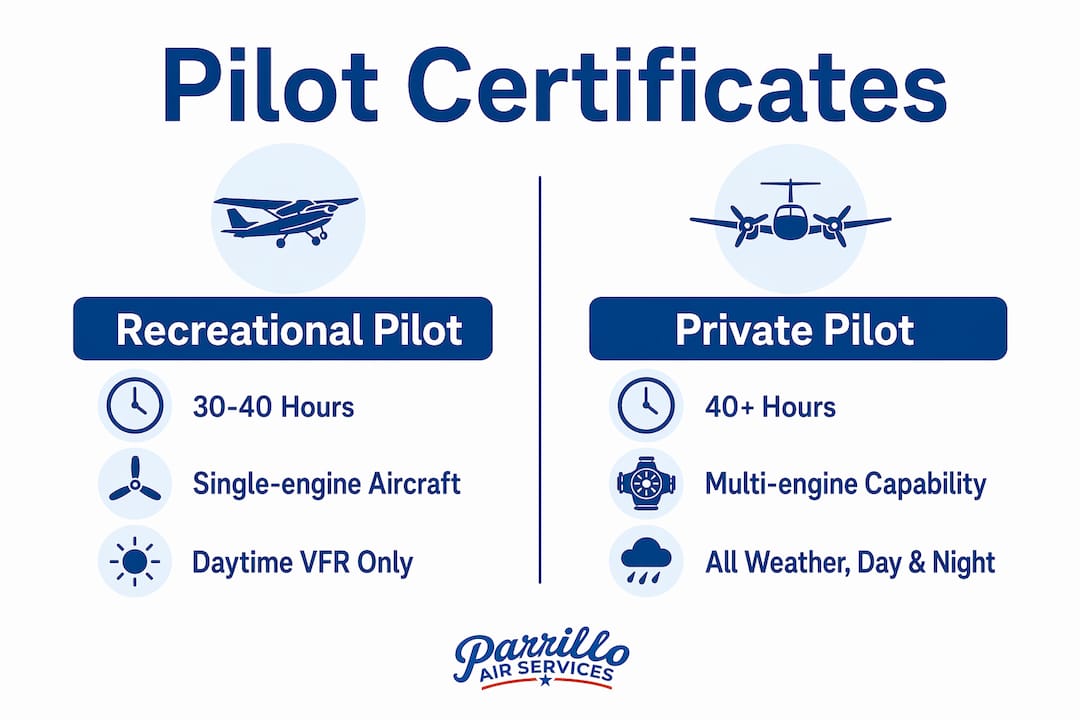
Recreational pilot privileges are restricted to single-engine aircraft with a maximum of 4 seats and no more than 180 horsepower. You may carry one passenger, fly only during daytime hours under visual flight rules, and operate within 50 nautical miles of your home airport. Night flying is not permitted without additional training and endorsements.
| Privilege or restriction | Recreational pilot |
|---|---|
| Aircraft type | Single-engine, up to 4 seats, max 180 hp |
| Passengers | 1 passenger maximum |
| Flight conditions | Daytime VFR only |
| Operating radius | 50 nautical miles from home airport |
| Controlled airspace | Not permitted without instructor endorsement |
| Commercial operations | Not permitted |
These restrictions are not permanent walls. Instructor endorsements can expand your privileges in specific areas, such as flying in controlled airspace, operating at airports with an operating control tower, or carrying more than one passenger. Each endorsement requires demonstrated competency and a CFI sign-off. Think of the base certificate as a starting point that a qualified instructor can help you build on.
Pro Tip: If you plan to fly into or out of airports with control towers regularly, get the controlled airspace endorsement early in your flying career. It opens up far more routing options and makes your certificate genuinely practical.
Recreational pilots cannot fly for hire, provide flight instruction, or conduct any commercial operations. This restriction is absolute and does not change with endorsements. If earning money from flying is any part of your long-term goal, the recreational certificate is not the right endpoint for you.
The difference between pilot certificates matters most when you are deciding where to invest your time and money. Here is how the three entry-level certificates stack up on the factors that affect hobbyist pilots most directly.
| Factor | Sport pilot | Recreational pilot | Private pilot |
|---|---|---|---|
| Minimum flight hours | 20 hours | 30 hours | 40 hours |
| Medical requirement | Driver's license | Third-class FAA medical | Third-class FAA medical |
| Aircraft horsepower limit | 120 hp | 180 hp | No limit |
| Passenger limit | 1 | 1 | No limit |
| Night flying | Not permitted | Not permitted | Permitted |
| Cross-country range | Limited | 50 nm radius | Unrestricted |
| Commercial operations | Not permitted | Not permitted | Not permitted |
The sport pilot certificate requires no FAA medical certificate and only 20 hours of minimum training, which makes it the lower-barrier option for most hobbyists. The recreational certificate requires a third-class medical and 30 or more hours, yet delivers only marginally more capability than sport pilot. That gap explains why fewer than 150 recreational pilots are currently active in the United States as of 2026. The certificate is approaching obsolescence in practical terms.
The private pilot license, by contrast, requires 40 hours minimum and the same third-class medical, but it removes nearly every operational restriction. You can fly at night, cross state lines, carry multiple passengers, and operate in all classes of airspace. For pilots who want to fly with family on weekend trips or eventually pursue instrument or commercial ratings, the private pilot license is the certificate that actually delivers those capabilities.
The cost of recreational pilot certification typically falls between the sport and private pilot levels, reflecting the training hour difference. Expect to spend roughly $6,000 to $9,000 depending on your location, aircraft rental rates, and how many hours you need beyond the minimum. Private pilot training commonly runs $10,000 to $15,000. The savings from stopping at recreational are real but modest, and they come with meaningful restrictions attached.
Upgrading from a recreational certificate to a private pilot license is possible. It requires additional flight time, a new knowledge test, and a separate checkride. In practice, most pilots find it more economical to pursue the private pilot license directly rather than paying for two separate checkrides and two rounds of exam preparation.
The recreational pilot certificate fits a narrow but genuine set of circumstances. Here are the scenarios where it makes the most practical sense:
Local leisure flying with one passenger. The certificate is designed for low-altitude daytime flights in uncongested areas with a family member or friend. If your flying goals begin and end with weekend sightseeing near your home airport, the certificate covers that use case completely.
Lower upfront cost and time commitment. Ten fewer minimum training hours compared to private pilot translates to real savings on aircraft rental and instructor fees. For someone testing whether flying is a hobby worth pursuing long-term, the recreational certificate offers a lower-cost entry point.
A stepping stone toward advanced training. Some pilots use the recreational certificate as a structured milestone on the way to a private pilot license. Completing a checkride at any level builds confidence and familiarity with the FAA testing process.
Flying in rural or uncongested areas. The 50-nautical-mile radius restriction is less limiting if you live near open airspace and have no need to reach major metropolitan airports. Pilots based in rural Virginia, for example, can cover a wide geographic area within that radius.
Hobby flying without career ambitions. If you have zero interest in commercial aviation, flight instruction, or advanced ratings, the recreational certificate provides legal authorization to fly without the full commitment of a private pilot program.
The certificate's declining popularity reflects a structural problem. Flight schools, including most FAA Part 61 providers, have fewer resources and standardized curricula for recreational pilot training. Many CFIs are more experienced teaching toward the private pilot standard, which means recreational students sometimes receive instruction calibrated for a higher certificate anyway.
The recreational pilot certificate is a legitimate but increasingly niche FAA credential that suits local, daytime, single-passenger flying and little else in 2026.
| Point | Details |
|---|---|
| Certificate definition | FAA license for single-engine, daytime VFR flight with restricted privileges. |
| Training minimum | 30 hours required by the FAA; expect closer to 40 hours for checkride readiness. |
| Medical requirement | Third-class FAA medical required, unlike the sport pilot certificate. |
| Active holders | Fewer than 150 active recreational pilots in the US as of 2026. |
| Best alternative | Private pilot license removes most restrictions for a modest additional investment. |
The recreational pilot certificate made more sense before the sport pilot certificate existed. When the FAA introduced the sport pilot certificate in 2004, it undercut the recreational certificate on almost every dimension that matters to hobbyists: fewer training hours, no medical exam, and a simpler path to the cockpit. The recreational certificate never recovered from that competition.
What I find most telling is the active holder count. Fewer than 150 recreational pilots in a country with tens of thousands of active general aviation pilots is not a niche. It is a near-extinct category. Flight schools know this, which is why most do not actively market recreational pilot programs. When you call a flight school and ask about training options, you will almost certainly be steered toward sport pilot or private pilot tracks.
My honest advice: if you want the lowest barrier to flight, pursue the sport pilot certificate. If you want real freedom in the air, including night flying, unrestricted cross-country travel, and a foundation for instrument or commercial training, go directly to the private pilot license. The recreational certificate occupies a middle ground that serves almost no one well. The extra cost and time to reach private pilot level is worth every dollar compared to paying twice for two separate checkrides.
The one exception I would acknowledge: if you have a specific, documented reason to need a 180-horsepower aircraft but cannot pass the medical requirements for a private pilot certificate, the recreational certificate with appropriate endorsements could fill that gap. That is a genuinely rare situation, but it exists.
— Gm

Parrillo Air Services, based in Lynchburg, VA, offers FAA Part 61 flight training programs for pilots at every level, from first-time flyers to those pursuing commercial and instrument ratings. Whether you are deciding between a recreational certificate and a private pilot license, or you are ready to commit to a full training program, the instructors at Parrillo Air Services provide personalized guidance built around your schedule and goals. The school's structured approach means you train efficiently without cutting corners on safety or proficiency. Explore flight training programs at Parrillo Air Services and take the first step toward your pilot certificate with a team that knows how to get you there.
A recreational pilot certificate is an FAA-issued license that authorizes flight in single-engine aircraft with up to 4 seats and 180 horsepower, limited to daytime VFR conditions within 50 nautical miles of the home airport. It requires a minimum of 30 flight hours and a third-class FAA medical certificate.
The FAA minimum is 30 flight hours, but most students need closer to 40 hours to reach the proficiency level required to pass the checkride. Budget for the higher number when planning training costs.
The private pilot license requires 40 minimum hours but removes nearly all operational restrictions, including night flying, unlimited cross-country range, and multiple passengers. The recreational certificate saves roughly 10 training hours but limits you to one passenger, daytime flight, and a 50-nautical-mile radius.
Yes. Recreational pilots must hold at least a third-class FAA medical certificate, which distinguishes them from sport pilots who can use a valid driver's license as a medical substitute.
Yes. Recreational certificate holders can train for a private pilot license by completing additional flight hours, passing a new knowledge test, and completing a separate checkride. Most pilots find it more cost-effective to pursue the private pilot license directly rather than upgrading later.
Commercial Pilot Certificate Requirements | Parrillo Air Services - Lynchburg, VA
Parrillo Air Services
Student Pilot Certificate Guide | Parrillo Air Services - Lynchburg, VA
Parrillo Air Services
How to Get Your FAA Student Pilot Certificate Fast | Parrillo Air Services
Parrillo Air Services
What Is the FAA Knowledge Test for Pilots?
Parrillo Air Services