
Flight training investment is the upfront financial and time commitment required to earn FAA pilot certifications, structured as a capital investment that generates substantial career earnings over time. For aspiring pilots, understanding what this investment covers, what it costs, and what it returns is the difference between treating flight school as an expense and treating it as one of the highest-return career decisions available in 2026. The airline pilot career pathway runs from a Private Pilot License through Commercial and ATP-CTP certifications, with total costs ranging from $80,000 to $140,000 for a zero-to-airline program. The numbers are significant. The returns are more so.
Flight training investment covers every dollar spent acquiring the certifications, ratings, and flight hours required to reach professional pilot status. The industry term for this is human capital investment, and aviation is one of the clearest examples of that concept producing measurable financial returns.
The cost structure breaks down by certification level:
Private Pilot License (PPL): A typical PPL includes aircraft rental ($9,000 to $13,000), flight instructor fees ($3,000 to $5,000), and ground school and exam fees, bringing the total to $15,000 to $20,000. That range reflects the minimum hours required by the FAA, not the average student who often needs more.
Instrument Rating: Adds roughly $8,000 to $15,000, depending on aircraft type and training pace.
Commercial Pilot License (CPL): Costs between $27,000 and $55,000, covering the additional flight hours, multi-engine training, and checkride fees.
ATP-CTP and Type Ratings: Required for airline employment, these add $5,000 to $10,000 on top of the commercial pathway.
The full zero-to-airline cost ranges from $80,000 to $140,000, with accelerated academy programs sometimes exceeding $200,000. That wide range exists because program type matters enormously. University aviation programs like those at Embry-Riddle Aeronautical University or University of North Dakota carry higher tuition but include structured curricula. Independent Part 61 schools like Parrillo Air Services offer more scheduling flexibility and often lower per-hour costs. Accelerated academies compress training timelines but charge premium rates for that speed.
| Cost Component | Estimated Range |
|---|---|
| Private Pilot License | $15,000 to $20,000 |
| Instrument Rating | $8,000 to $15,000 |
| Commercial Pilot License | $27,000 to $55,000 |
| Multi-Engine Rating | $5,000 to $10,000 |
| ATP-CTP Training | $5,000 to $10,000 |
| Total (zero to airline) | $80,000 to $140,000+ |
Pro Tip: Budget 15 to 20 percent above any quoted training cost. Checkride retakes, weather delays, and additional hours for proficiency are common, and students who do not plan for them often stall mid-program.
Training pace also shapes total cost directly. Flying two to three times per week keeps skills sharp and reduces the re-learning that inflates billable hours. Students who train sporadically pay more in the end, not less.
The return on flight training investment is exceptional by any professional career standard. Pilots who complete a zero-to-airline program typically break even within three years on an $80,000 to $120,000 initial outlay. That break-even speed, combined with rapid salary growth, produces a lifetime net present value estimated at $4.27 million and an internal rate of return of approximately 60%.
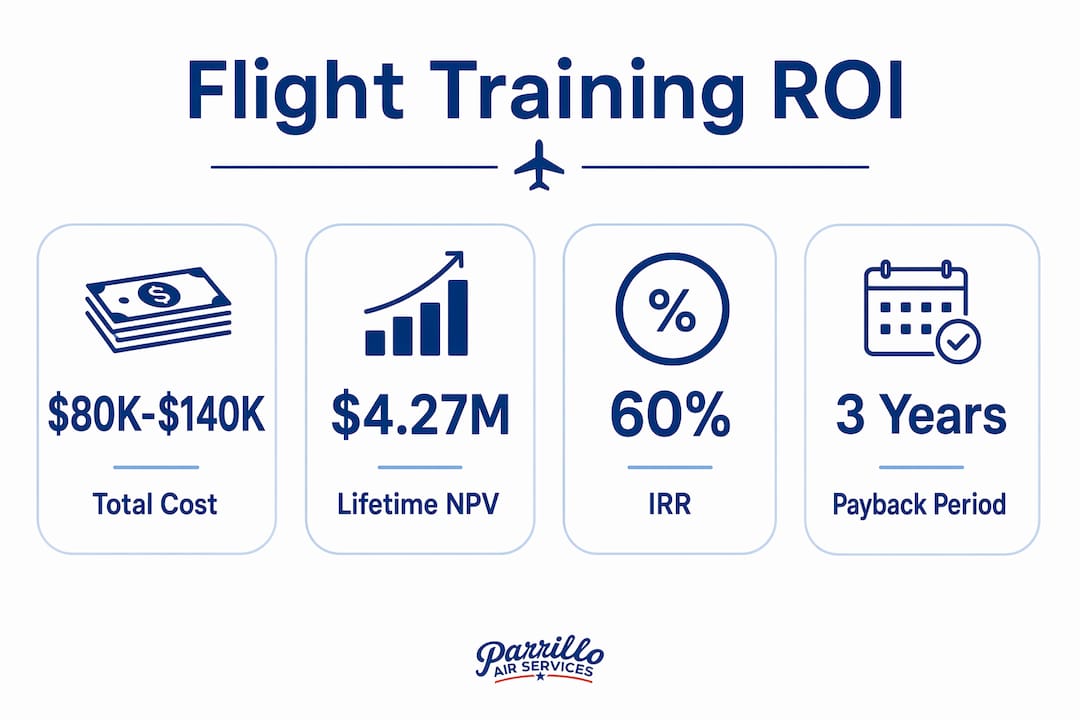
A 60% IRR is extraordinary. For comparison, a medical degree typically produces an IRR in the range of 15 to 20 percent after accounting for student debt and the years spent in residency. Law school IRR sits in a similar range. Pilot training reaches 60% because the upfront cost is moderate relative to how quickly earnings accelerate.
The salary progression follows a clear trajectory:
Flight instructor years (Year 1 to 2): $40,000 to $60,000 annually, building hours toward the 1,500-hour ATP minimum.
Regional airline (Year 2 to 4): Flight instructors and regional pilots earn $70,000 to $100,000 by year three. This stage is where the investment begins paying back.
Major airline (Year 4 and beyond): Major airline pilots reach $100,000 to $120,000 by year four. Captains at carriers like Delta Air Lines, United Airlines, and American Airlines earn $300,000 or more annually.
The financial picture extends beyond base salary. Pensions, 401(k) matching programs, profit-sharing, and free or heavily discounted travel benefits add tens of thousands of dollars in annual value that never appear in a salary figure. When you factor those in alongside the major airline salary ranges available in 2026, the lifetime value of a pilot career becomes one of the strongest arguments for this investment in any professional field.
The structure of your training program determines how efficiently you convert dollars into flight hours and certifications. Part 141 programs follow FAA-approved syllabi with defined stage checks, which means fewer total hours are required to meet certification minimums. Part 61 programs like those offered at Parrillo Air Services provide more flexibility, which suits students with variable schedules while still delivering rigorous, FAA-compliant instruction.
Budget flight schools present a specific risk that most cost comparisons miss. A lower hourly rate means nothing if the school lacks structured feedback systems. Budget programs often lack feedback mechanisms that catch skill gaps early, leading to costly re-training cycles that erase any tuition savings. A student who pays $10 less per flight hour but needs 30 extra hours to pass a checkride has spent more, not less.
Timing is the factor most aspiring pilots underestimate. Delaying flight training by six months can cost upward of $500,000 in lifetime earnings due to seniority placement delays. Seniority at airlines is not just a number. It determines your pay grade, your schedule, your route preferences, and your quality of life for the entire length of your career. Entering the seniority list six months earlier compounds across 30 years of flying.
Self-funded pilots hold a specific advantage here. Pilots who complete certifications independently can bypass airline training backlogs and start their careers up to three months sooner than sponsored candidates waiting on program slots. That three-month head start translates directly into seniority and lifetime earnings. The aviation career dedication required to self-fund is real, but so is the payoff.
Pro Tip: When evaluating flight schools, ask for their checkride first-attempt pass rate and average hours to certification. Schools that cannot answer those questions clearly do not track outcomes, which is a signal about their feedback culture.
Flight training funding options have expanded significantly, and the right combination can reduce the loan burden without extending your timeline.
The most practical options available in 2026 include:
Merit-based aviation loans: Lenders like Stratus Financial and AOPA Finance evaluate pilot logbooks, academic records, and career trajectory rather than just credit scores. This structure rewards students who demonstrate commitment and progress.
Airline-sponsored tuition reimbursement: Carriers including SkyWest Airlines, Republic Airways, and Envoy Air operate cadet programs that reimburse training costs in exchange for a service commitment after hiring. These programs effectively reduce net training costs by $20,000 to $40,000.
VA and GI Bill® benefits: Eligible veterans can apply military education benefits toward FAA-approved flight training programs, covering a substantial portion of ground school and flight hours at qualifying schools.
529 education savings plans: Funds in a 529 account can be applied to flight training at accredited institutions, offering tax-advantaged growth on money set aside for this purpose.
Hybrid training models: Virtual and in-person hybrid programs reduce costs by over $1,000 on travel and lodging alone, particularly for students completing ATP-CTP or advanced ratings at facilities outside their home region.
Flight school financial planning also means budgeting for costs that do not appear in tuition quotes. Medical certificate fees, FAA written exam fees, headset and equipment purchases, and checkride examiner fees commonly add $2,000 to $4,000 to a program's real cost. Students who account for these from the start avoid the mid-training cash shortfalls that cause training gaps, which in turn cause re-learning costs.
Flight training investment is a high-return capital commitment that pays back within three years and generates lifetime earnings exceeding $4 million when pursued with quality instruction, consistent training, and strategic timing.
| Point | Details |
|---|---|
| Total cost range | Zero-to-airline programs cost $80,000 to $140,000, with some exceeding $200,000. |
| ROI timeline | Pilots typically break even within three years and reach $100,000+ annually by year four. |
| Timing matters most | A six-month delay can cost $500,000 in lifetime earnings due to seniority loss. |
| Quality over price | Structured programs with feedback systems reduce total hours and prevent costly re-training. |
| Funding options exist | Merit-based loans, airline cadet programs, VA benefits, and 529 plans all reduce net cost. |
Most people researching flight training costs focus on the wrong number. They compare hourly rates between schools, debate Part 61 versus Part 141, and agonize over whether to buy a headset now or later. None of that matters as much as one thing: how fast you get your name on an airline's seniority list.
I have watched pilots delay their start date by a year because they wanted to save money on a cheaper program. In almost every case, the savings were real but the cost was not visible yet. It shows up a decade later when a colleague hired six months earlier is already a captain while they are still in the right seat. The $500,000 lifetime earnings gap from a six-month delay is not a hypothetical. It is the math of how airline pay scales work.
The other mistake I see consistently is treating flight training as something to do when the timing is perfect. The timing will never be perfect. The question is whether you start now or start later, and later always costs more in ways that do not show up on a training invoice. Self-funding, flying consistently, and choosing a school with real accountability systems are the three decisions that separate pilots who build wealth from pilots who just build hours.
Flight training expenses are real and significant. But framing them as an investment rather than a cost changes every decision that follows, from which school you choose to how often you fly each week. The flight instructor career pathway is not a detour. It is the first chapter of a career with a 60% IRR. Start it as soon as you can.
— Gm
Parrillo Air Services offers FAA Part 61 pilot instruction in Lynchburg, VA, with structured programs covering every certification from Private Pilot through Flight Instructor ratings. Training plans are built around your schedule, with personalized instruction that tracks your progress and catches skill gaps before they become expensive re-training cycles.

Whether you are funding your training independently, using VA benefits, or exploring airline cadet programs, Parrillo Air Services can help you map a path that minimizes cost and maximizes your timeline to the seniority list. Explore the flight training programs available or visit Parrillo Air Services to connect with an instructor and get a realistic cost and timeline estimate for your specific goals.
Flight training investment refers to the total financial and time commitment required to earn FAA pilot certifications, treated as a capital investment that generates career earnings over time rather than a simple educational expense.
A zero-to-airline training program costs between $80,000 and $140,000, with accelerated academy programs sometimes exceeding $200,000 depending on structure and speed.
Flight training produces a lifetime NPV of $4.27 million and an IRR of approximately 60%, making it one of the strongest financial returns available in any professional career.
Merit-based aviation loans, airline-sponsored cadet programs, VA and GI Bill® benefits, and 529 education savings plans all provide viable paths to funding flight training in 2026 without carrying the full cost out of pocket.
Flying two to three times weekly prevents skill regression and reduces total billable hours, directly lowering overall training costs compared to students who train infrequently.
The Role of a Flight Instructor: Career Impact Explained
Parrillo Air Services
Flight Training Programs | Part 61 & 141 Guide | Parrillo Air Services
Parrillo Air Services
Flight Instructor Career Pathway: Your Step-by-Step Guide
Parrillo Air Services
How Airline Pilot Pay Scales Work in 2026
Parrillo Air Services