
Most people assume airline pilots earn a fixed annual salary the way a teacher or accountant does. They don't. Understanding how airline pilot pay scales work requires a completely different mental model, one built around hourly rates, credited flight hours, seniority, and union contracts. Whether you're weighing a career in aviation or just trying to make sense of what pilots actually take home each month, this guide breaks down the airline pilot salary structure with the specificity and honesty that most career resources skip.
Pay is hourly, not salaried. Pilots earn based on negotiated hourly rates applied to credited flight hours each month.
Seniority drives everything. Your position on the seniority list determines your pay rate, aircraft type, and schedule control.
Union contracts set the scale. ALPA and other unions negotiate multi-year agreements that create scheduled pay increases over time.
Career earnings grow dramatically. Pay ranges from roughly $40,000 as a flight instructor to $400,000 or more as a senior major airline captain.
Actual pay varies monthly. Bonuses, per diem, profit sharing, and flight assignments make real earnings fluctuate beyond the base scale.
The single most important thing to understand about the airline pilot compensation scale is that it is not a salary. It is an hourly pay rate applied to credited flight hours, and the total changes month to month.
Here is how the calculation actually works:
To see what this looks like in practice, consider a straightforward example. Pilot pay at 75 block hours at $300 per hour produces $22,500 in a single month, or $270,000 annualized. That is a senior pilot scenario. A first-year regional first officer at $65 per hour flying 80 hours earns around $5,200 that month.
The gap between those two numbers explains why understanding pay scale progression matters so much before you commit to a career timeline.
Pro Tip: When researching airlines, look up the actual pilot agreement (most are publicly posted by ALPA) rather than relying on third-party salary averages. The contract gives you the exact hourly rates by year of service and aircraft type, which is the only number that really matters.
Not every pilot at the same airline earns the same hourly rate. Several variables determine your exact position on the scale.
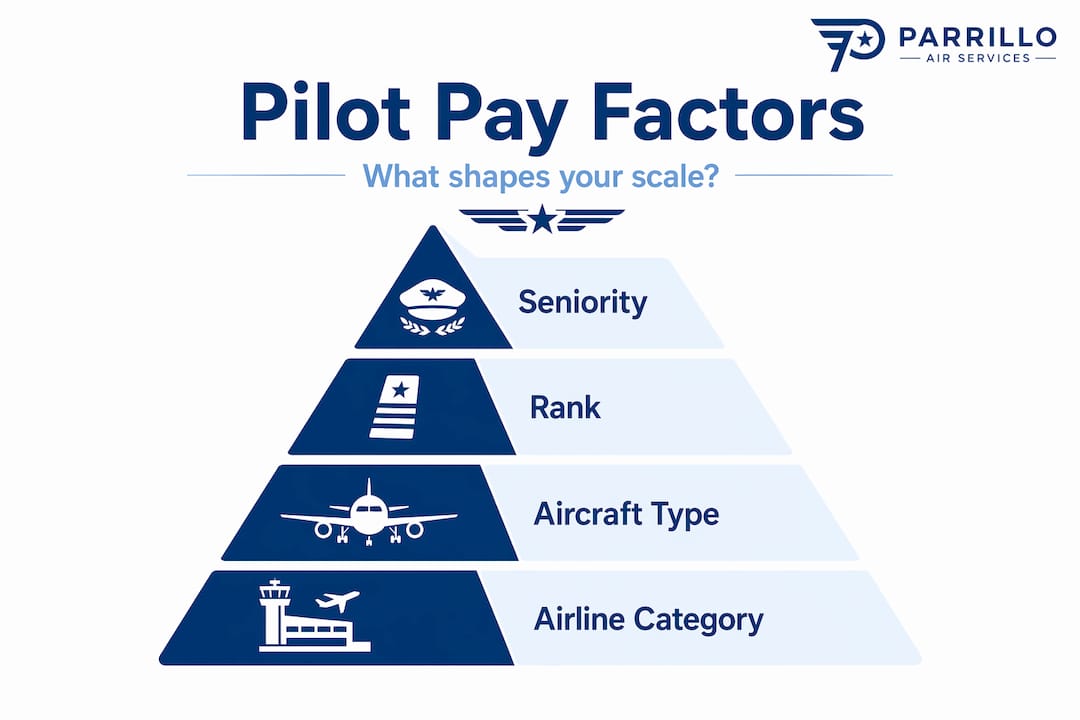
Seniority is the backbone of every pay scale in commercial aviation. The day you are hired, you receive a seniority number. Every pilot hired after you sits below you. That number governs not just your pay rate, but also your ability to hold a specific aircraft, base, and schedule. A senior pilot with 15 years at an airline can hold a widebody captain seat. A junior pilot with two years might be stuck on a regional narrowbody as a first officer, flying less desirable routes.
The pay gap between first officers and captains is significant. At major U.S. carriers, senior captains on widebodies can earn $400 or more per hour. First officers at the same airline earn considerably less, even with years of experience. The upgrade to captain (called a "seat upgrade") is entirely seniority-driven, so the timeline depends on how fast the airline grows and how quickly senior captains retire.
The aircraft you fly directly affects your pay. Widebody jets like the Boeing 777 or 787 pay more than narrowbody jets like the 737 or A320. This is by design. Pilots must hold type ratings for specific aircraft, and airlines reward pilots who operate their most complex, high-revenue equipment with higher hourly rates.
Here is a simplified comparison of how pay can differ at the same airline:
| Position | Aircraft type | Approximate hourly rate |
|---|---|---|
| First year first officer | Narrowbody (B737) | $65 to $90/hr |
| Senior first officer | Narrowbody (B737) | $150 to $200/hr |
| New captain | Narrowbody (B737) | $200 to $260/hr |
| Senior captain | Widebody (B777/B787) | $350 to $465/hr |
Delta captains on widebodies earn up to $465.13 per hour, with senior first officers earning around $317.73 per hour. Those numbers represent the top of the industry.
Pro Tip: If you are choosing between regional airlines early in your career, pay attention to their ATP certification pathways and upgrade times, not just their starting pay. A faster upgrade to captain at a regional airline accelerates your entire career timeline.
Airline pilot pay scales do not exist in a vacuum. They are created, negotiated, and updated through collective bargaining agreements between airlines and pilot unions, most prominently the Air Line Pilots Association (ALPA).
Here is what union contracts actually control:
The impact on pilot compensation from union negotiations extends well beyond base pay. Contracts shape career stability, schedule quality, and long-term financial security in ways that raw hourly rates don't capture.
Recent contract cycles have been particularly significant. New contracts have raised pilot pay by roughly 30 to 40 percent industry-wide, driven largely by the ongoing pilot shortage and union leverage.
New agreements are typically renegotiated every four to six years, and pay scale increases are scheduled across those contract years. This means pilot pay can jump sharply at renegotiation rather than increasing gradually each year.
Understanding this rhythm matters for career planning. A pilot hired the year before a major contract kicks in can see their hourly rate jump significantly without gaining a single year of seniority.
Here is a realistic look at what pilots actually earn at major career milestones, based on current industry data:
| Career stage | Typical annual pay |
|---|---|
| Flight instructor | $30,000 to $60,000 |
| Regional first officer (Year 1) | $55,000 to $65,000 |
| Regional first officer (Year 3 to 5) | $80,000 to $100,000 |
| Major airline first officer | $120,000 to $200,000 |
| Major airline captain (mid-seniority) | $200,000 to $300,000 |
| Major airline captain (senior, widebody) | $300,000 to $400,000+ |
Career pay progression spans from roughly $30,000 for new flight instructors to $400,000 or more for senior major airline captains.
A few additional income sources accelerate early career earnings:
The aviation careers dedication required to move through these stages is real, but the financial trajectory makes the early years worthwhile for pilots who plan strategically.

The pay scale gives you your hourly rate. Your actual monthly paycheck depends on what happens inside that month.
Here is what causes real-world pay to diverge from projections:
Managing this variability starts with understanding that separating base pay from credited hours is critical for monthly budgeting, especially in the early years when hourly rates are lower and the guarantee floor matters more.
Pro Tip: Learn the bidding system at your airline early. Senior pilots who understand how to bid premium international routes or high-hour months can substantially outperform what their seniority number alone would suggest. Reviewing your pilot interview preparation resources is a good starting point for understanding airline-specific systems before you even get hired.
I've watched a lot of aspiring pilots make the same mistake. They see the headline number, $400,000 for a major airline captain, and mentally plan their financial life around it from day one. What they miss is that the career timeline to that number spans 15 to 20 years, and the first five years look nothing like the last five.
What I've learned is that seniority is not just a compensation variable. It is the architecture of the entire career. Every financial decision a pilot makes, which airline to join, whether to upgrade early, whether to furlough and move on, feeds back into the seniority number and changes the earning trajectory for decades.
The recent wave of contract improvements is genuinely significant. A pilot entering the industry now has a better financial foundation than any cohort in the past 30 years. Regional starting pay has more than doubled compared to a decade ago, and major carrier contracts are delivering increases that were unthinkable five years ago. That context matters when you're weighing training costs against future income.
My real advice: treat the pay scale like a map, not a promise. Know exactly where you will be at year one, year five, and year ten based on the contracts in effect today. The career is absolutely worth it financially, but only if you go in with accurate expectations about how the timeline actually works.
— Gm

At Parrilloair, we believe the most motivated students are the ones who truly understand where the career leads, including what the pay looks like at every stage. Our FAA Part 61 flight training programs in Lynchburg, VA cover everything from your first discovery flight through commercial and flight instructor ratings. We teach you the technical skills to earn your certificates and give you the career context to make smart decisions about your path to the airlines. If you are ready to take the first step toward a cockpit career with a real financial future, explore our training programs and find out what getting started looks like.
Airline pilots are paid an hourly rate applied to credited block flight hours each month, not a fixed annual salary. Most contracts include a monthly hour guarantee to set a minimum earnings floor.
Seniority, rank (first officer vs. captain), aircraft type, and the airline category (regional vs. major) are the biggest factors affecting pilot wages. Union contract terms also determine the exact hourly rates at each career step.
Senior captains at major U.S. airlines typically earn between $200,000 and $400,000 or more per year, with top widebody captains at carriers like Delta earning up to $465 per hour.
Union contracts negotiated by ALPA and other pilot unions establish the official hourly pay rates, scheduled increases, and monthly guarantees that make up the airline pilot pay scale. Recent agreements have raised pay by roughly 30 to 40 percent across the industry.
Pay increases meaningfully with each year of seniority, with the largest jumps occurring at seat upgrades (first officer to captain) and when moving from a regional to a major airline, typically after five to ten years of experience.