Age doesn't disqualify adults from becoming pilots. The Federal Aviation Administration sets no maximum age to earn or hold a pilot certificate, at any level, full stop. The one real ceiling in U.S. aviation is 14 CFR Part 121, which bars pilots from serving as pilot-in-command or second-in-command for scheduled airline carriers after age 65. That rule governs employment at Part 121 carriers, not your right to train, test, and fly.
Adults starting at 25, 35, or 55 face the same certification rules as a 19-year-old, with one exception: the airline hiring window narrows the later you begin. A flight school like Parrillo Air Services in Lynchburg, Virginia, works with adult students every week who assumed age had already closed the door. It hadn't.
Here's what actually gates your progress, in order:
None of those numbers move upward. There is no "too old to start" line written anywhere in 14 CFR.
Age does not block adults from earning any pilot certificate; the only hard age-related limit is the Part 121 rule ending airline employment eligibility at 65.
| Point | Details |
|---|---|
| No maximum certification age | The FAA sets no upper age limit for earning or holding any pilot certificate. |
| Know the minimum ages | Student solo at 16, private at 17, commercial at 18, standard ATP at 23. |
| Age 65 applies to employment only | Part 121 scheduled airlines cannot employ pilots as PIC or SIC past 65; other flying careers have no such limit. |
| Medical exams get more frequent, not harder | First Class renewals shift from annual to every 6 months at age 40, but special issuances keep most conditions manageable. |
| Start with a discovery flight | Parrillo Air Services offers flexible, part-time-friendly training in Lynchburg, Virginia, for adults at any starting age. |
The regulatory framework splits cleanly into two categories: age to earn a certificate, and age to work under specific employment rules. Confusing the two causes most of the anxiety adults feel before they ever call a flight school.
On the certificate side, the FAA has confirmed directly that it imposes no ceiling. Its own guidance states plainly that there is no maximum age to hold a pilot certificate; a 70-year-old and a 25-year-old go through the identical eligibility process. On the employment side, Part 121 air carriers, meaning the scheduled passenger airlines you'd recognize by name, cannot let a pilot act as PIC or SIC once that pilot turns 65. That's an employer restriction tied to a specific business type, not a blanket rule about flying.
Here's how the minimum-age structure breaks down by certificate:
| Certificate | Minimum age | Governing regulation |
|---|---|---|
| Student pilot (solo flight) | 16 | 14 CFR §61.83 |
| Private pilot | 17 | 14 CFR Part 61, Subpart E |
| Commercial pilot | 18 | 14 CFR §61.123 |
| Flight instructor (CFI) | 18 | 14 CFR Part 61, Subpart H |
| ATP, restricted pathway | 21 | 14 CFR Subpart G |
| ATP, standard | 23 | 14 CFR §61.153 |
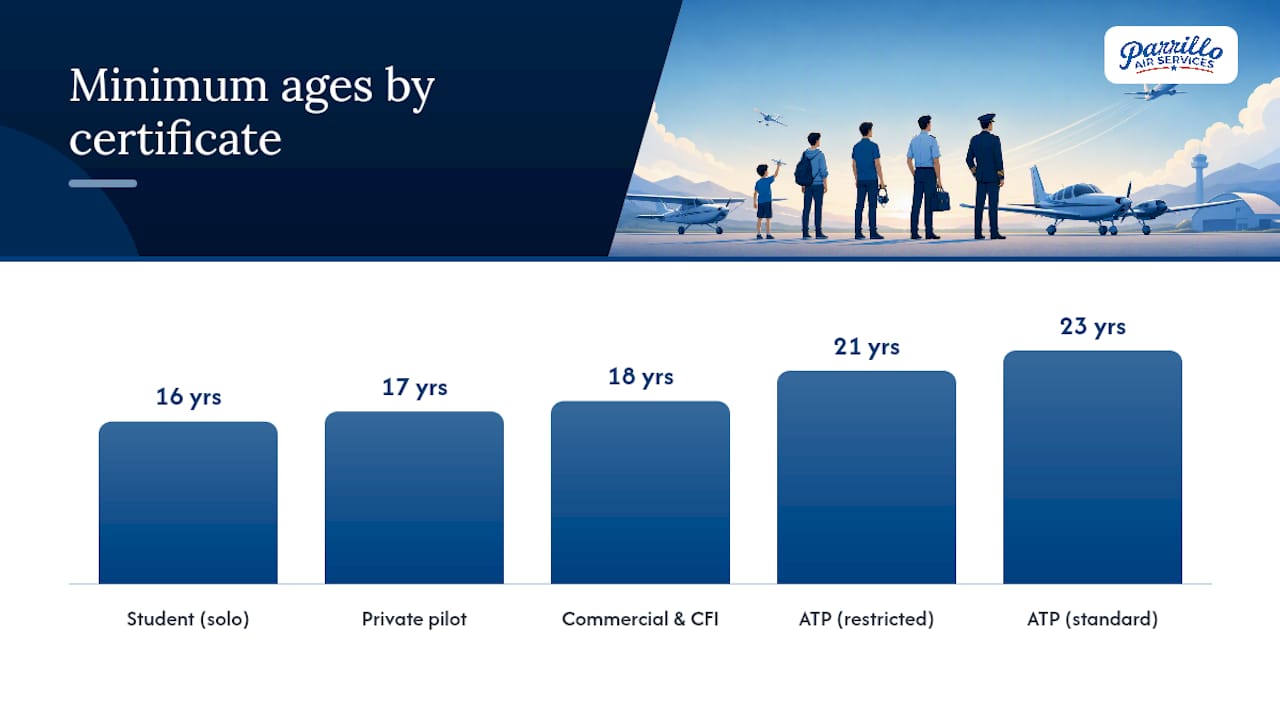
Section 61.153 and its neighboring sections in Subpart G lay out ATP eligibility in detail, including the aeronautical experience thresholds tied to each pathway. The restricted ATP at 21 exists specifically to let students who complete structured collegiate or military programs enter regional airline cockpits earlier than the standard track allows. Adults who transfer credit through a university aviation program, including Liberty University's credit transfer arrangement with training providers, sometimes qualify for this faster route.
Nothing in any of these sections references an upper bound. The age-65 language lives entirely in Part 121's operating requirements for domestic, flag, and supplemental carriers, a separate part of the regulatory code from the certification rules in Part 61.
Every pilot certificate above student level requires a valid medical certificate, and the class you need depends on what you want to fly professionally. A First Class medical is required for airline transport pilots, a Second Class covers commercial operations, and a Third Class suffices for private flying and most flight instruction. Age doesn't change which class you need, but it does change how often you'll sit through an exam and what an Aviation Medical Examiner (AME) is likely to flag.
Pilots under 40 renew First Class medicals every 12 months; pilots 40 and older renew every 6 months for First Class privileges. Third Class certificates last longer regardless of age, up to 5 years for pilots under 40 and 2 years for those 40 and older. That's the practical cost of starting later: more frequent trips to the AME, not a harder standard to meet.
Common issues an AME watches for as pilots age include:
None of these automatically end a career. The FAA's special-issuance process exists precisely because conditions like controlled hypertension, treated sleep apnea, or corrected vision rarely disqualify a pilot outright, they just require documentation from a treating physician and sometimes a follow-up protocol. Adults in their 40s and 50s make up a meaningful share of special-issuance holders who continue flying commercially for decades.
Pro Tip: Schedule your AME exam before you invest heavily in ground school. If a medical issue needs a special issuance, you want that clock running in parallel with your training, not blocking your checkride after you've already paid for it.
Realistic timelines depend far more on how often you fly than on your age. A part-time adult student flying twice a week reaches milestones on a different calendar than someone training full-time, but the certificates themselves take roughly the same flight hours either way.
A full professional track from zero experience to CFI typically runs somewhere between $70,000 and $100,000 total, spread across roughly 18 to 30 months for a dedicated part-time student. Aircraft rental and instructor time make up the bulk of that figure; ground school, exam fees, and headset or supply purchases add a smaller but real slice.
Pace changes the math more than most people expect. Intensive block training, where a student flies daily for weeks at a stretch, compresses the calendar but doesn't necessarily lower the total cost, since you're still paying for the same flight hours either way. What it does save is skill retention time: flying twice a week means relearning small things each session, while daily flying builds muscle memory faster. Financing options and career timeline planning resources can help adults map out a schedule that fits around a full-time job.
Your starting age shapes which doors stay wide open and which ones narrow, but it rarely closes a path entirely. Here's a practical breakdown by decade.
Starting in your 20s. You have the longest runway to a major airline career. Standard timelines to ATP eligibility, roughly 1,500 hours for an unrestricted certificate, put you at a regional airline in your mid to late 20s and potentially a major carrier within a decade after that, well before the age-65 cutoff even enters the conversation.
Starting in your 30s. Airline hiring remains fully realistic. You'll likely spend 3 to 5 years building hours through instructing or charter work before hitting airline minimums, putting you in a regional cockpit in your mid-30s with 25 to 30 years of runway before mandatory retirement.
Starting in your 40s. Regional and eventually major airline careers are still achievable, though the math gets tighter. A pilot starting certification at 42 and reaching ATP minimums by 46 or 47 still has roughly 18 years of airline career ahead, a full working career by most standards, just not a 35-year one.
Starting in your 50s and beyond. Airline hiring becomes a narrower window, though not an impossible one; some carriers have hired new-hire pilots in their late 50s. More adults in this bracket build rewarding careers as flight instructors, charter pilots, or corporate pilots, roles with no equivalent to the Part 121 retirement rule. Flight instruction in particular offers strong income potential without any age ceiling at all.
Across every bracket, corporate aviation, charter operations, cargo carriers, and instruction remain fully open regardless of age, since the age-65 rule applies specifically to Part 121 scheduled carriers. A pilot who ages out of major-airline eligibility can still fly professionally, and profitably, for another 15 or 20 years in these alternative aviation careers. Realistic ROI for a later starter usually hinges less on age and more on how quickly they build hours and whether they're willing to instruct or fly charter during the buildup years, since instructor pay and charter rates both climb steadily with experience.
Momentum beats perfection here. Adults who stall out usually do it by overthinking the decision rather than testing it. Here's the sequence that gets you from curious to enrolled.
Balancing training with a full-time job comes down to consistency more than raw hours. Adults who fly twice weekly, even for just an hour each session, tend to progress faster than those who fly sporadically for longer blocks, because aviation skills degrade quickly between lessons.
A typical Part 61 program built for working adults starts with a discovery flight, then moves into private pilot ground school and flight lessons scheduled around evenings and weekends. From there, students often layer in instrument training concurrently with the later stages of their private certificate, which shortens the overall timeline compared to treating each rating as a separate, sequential block.
Adults training for a commercial or CFI track benefit most from schools that build in simulator time between flight lessons, since simulator practice reinforces procedures and instrument scans without the cost or scheduling pressure of aircraft rental.
Parrillo Air Services structures its programs around exactly this kind of flexibility, offering discovery flights, private pilot instruction, instrument ratings, commercial certification, and flight instructor training under one roof in Lynchburg, Virginia. Students working full-time jobs schedule lessons around their availability rather than forcing their lives around a rigid class schedule, and simulator apps supplement in-air training so ground-based practice isn't wasted time.
What adults can generally expect from a well-run adult-focused program:
The school's Liberty University credit-transfer arrangement also gives adults a path to pair flight training with academic credit, useful for anyone pursuing an aviation degree alongside certification.
I've noticed that most adults who hesitate to start flight training aren't actually worried about the regulations, they're worried about looking out of place next to 19-year-old classmates or feeling behind before they've even begun. That worry doesn't match reality. Flight schools built around working adults see career-changers in their 30s, 40s, and 50s constantly, and instructors who work with that demographic regularly tend to teach differently: more efficient debriefs, less hand-holding, more respect for the fact that you're also managing a job and a family.
The honest tradeoff isn't age, it's runway. Someone starting at 45 has a narrower window for a major-airline career than someone starting at 23, and pretending otherwise does nobody favors. But a narrower airline window isn't the same as no career at all. Flight instruction, charter work, and corporate flying all offer real income and real satisfaction without a Part 121 clock running in the background. If your goal was always to fly, not specifically to fly for a major carrier, age changes almost nothing about your path.
Book the discovery flight. It costs less than a nice dinner out and tells you more about your fit for this than any amount of research will. Everything after that is just execution.
Unlike generic ground-school apps or self-study courses that leave adults guessing whether they're actually progressing, Parrillo Air Services pairs every adult student with an instructor who builds a schedule around your actual life, not a fixed classroom calendar. Working full-time doesn't disqualify you from flying twice a week; it just means your flight school needs to treat evening and weekend slots as first-class scheduling, not an afterthought.

Parrillo Air Services offers discovery flights as the lowest-friction way to test whether flight training fits your goals, followed by a clear path through private pilot, instrument, commercial, and flight instructor certificates, all under Part 61 flexibility. The school also helps students navigate AME referrals for medical questions and offers simulator practice to reinforce lessons between flights, so training time in the air counts for more. If you're ready to find out what a realistic timeline looks like for your situation, schedule a discovery flight with Parrillo Air Services and get a straight answer instead of another article to read.
Can you become a pilot at 40 or older?
Yes. The FAA imposes no age ceiling on any pilot certificate. Adults
starting in their 40s regularly complete private, instrument, and
commercial certificates, and many go on to fly professionally as
instructors, charter pilots, or corporate pilots.
Is there an age limit to start flying lessons?
No upper limit exists. The only age-related requirement is reaching 16
before you can solo an aircraft, though you can begin lessons and ground
school before that.
Can you be a pilot at 20?
Yes, and you can hold a private or commercial certificate well before
20, since the minimum age for commercial certification is 18. A standard
ATP certificate requires age 23, though a restricted ATP is available at
21 under specific experience pathways.
Does the age-65 rule mean I can't fly commercially after 65?
No. Age 65 only ends eligibility to serve as a pilot for Part 121
scheduled airlines. Flight instruction, charter flying, corporate
aviation, and cargo operations outside Part 121 carry no such age
restriction.
What medical certificate do adult students need?
It depends on your goal. A Third Class medical covers private flying and
most instruction, Second Class covers commercial operations, and First
Class is required for airline transport pilots. Renewal frequency
increases at age 40 for First Class certificates.
How long does it realistically take an adult to get a private pilot
certificate?
Most part-time adult students complete their private pilot certificate
in 6 to 12 months, flying roughly 40 to 65 hours total, depending on
weather, aircraft availability, and how consistently they schedule
lessons.