
Flight training duration for adults ranges from as little as 40 hours of flight time to well over 1,500 hours, depending on your license goal and training path. The FAA sets a minimum of 40 flight hours for a Private Pilot License (PPL) under Part 61, but the national average runs 60–70 hours before most adults reach checkride readiness. For adults eyeing a career in aviation, the full timeline from zero experience to Airline Transport Pilot (ATP) certification spans 1.5 to 4 years. Understanding how long flight training takes adults means knowing which stage you are targeting and which training framework fits your life.
The honest answer depends on three things: your end goal, your training framework, and how often you fly. Adults pursuing just a PPL face a very different timeline than those building toward a regional airline seat.
Part 61 training is flexible and suits working adults better, while Part 141 is faster but more rigid and aimed at full-time students. Part 61 lets you schedule lessons around your job and family. Part 141 follows a structured syllabus with fixed stage checks, which compresses the timeline but demands consistent availability.
Lesson frequency drives the timeline more than almost any other factor. Flying 2–3 times per week produces PPL completion in roughly 4–6 months. Weekly lessons stretch that to 9–12 months or longer. Full-time accelerated programs can finish private pilot training in 1–2 months, but those programs require you to treat flying as a full-time job.
Two early milestones affect your timeline before you ever leave the ground. The FAA requires a third-class medical certificate before your first solo flight. You also need to pass the FAA Private Pilot knowledge exam with at least 70% on 60 multiple-choice questions. Adults who delay these steps often stall their training by weeks.
Pro Tip: Schedule your FAA medical exam and start your knowledge test prep during your first month of ground school. Completing both early removes two major bottlenecks before they slow you down.
Private pilot training follows a predictable progression regardless of which framework you choose. Each stage has a realistic duration you can plan around.
Ground school covers aerodynamics, weather, navigation, regulations, and aircraft systems. Most adults complete this phase in 3–8 weeks, depending on whether they use an in-person course, a self-paced online program, or a combination. Passing the knowledge exam before your solo flight keeps your momentum intact.
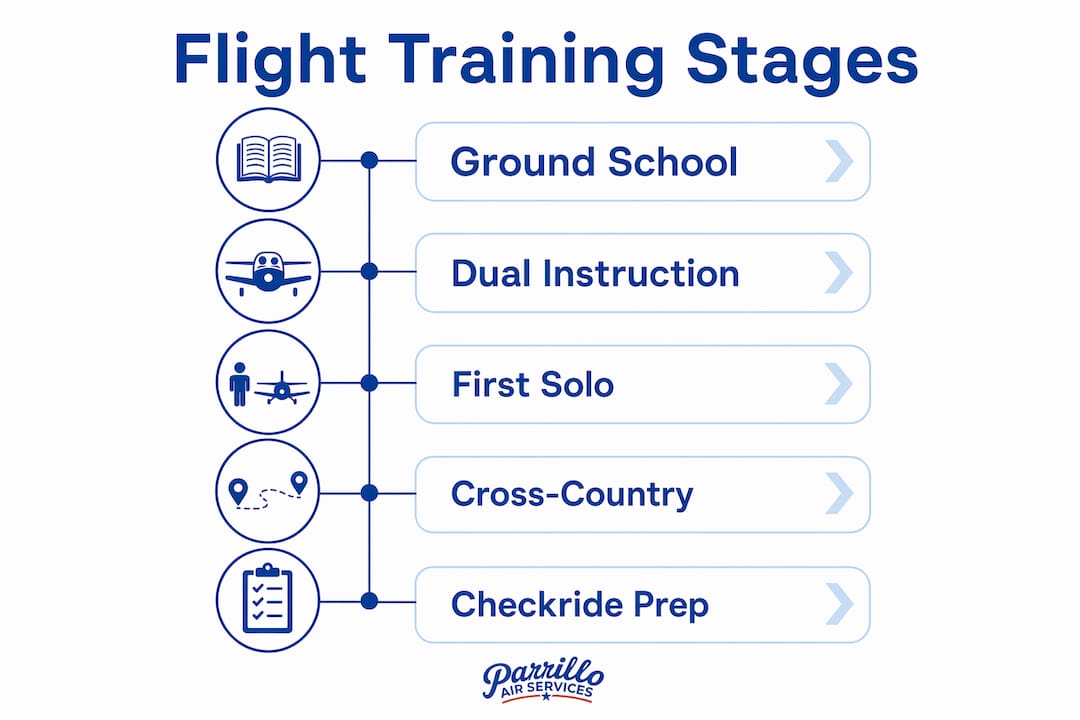
Your first flights are dual instruction, meaning your instructor is in the aircraft with you. Most students solo between 15 and 25 hours of flight time. The solo milestone is a significant confidence builder and marks the transition to more independent flying.
After solo, you build cross-country experience, practice emergency procedures, and refine maneuvers like stalls and steep turns. This phase typically accounts for 20–30 additional hours. Weather delays and aircraft availability can extend this stage, particularly for adults training at busy airports.
The practical exam, called the checkride, consists of an oral examination and a flight test with an FAA Designated Pilot Examiner. Most students spend 5–10 hours specifically preparing for the checkride after meeting the minimum requirements.
| Training path | Estimated PPL completion time |
|---|---|
| Full-time accelerated (Part 141 or Part 61) | 1–2 months |
| Part-time, 2–3 flights per week (Part 61) | 4–6 months |
| Part-time, once per week (Part 61) | 9–12 months or more |
| Infrequent, less than once per week | 18+ months |
The PPL is the foundation, not the finish line, for adults pursuing a career in aviation. The path to a professional pilot seat involves several additional certifications and a substantial hour-building phase.
The certification progression looks like this:
The hour-building phase from roughly 250 hours (commercial certificate) to 1,500 hours is the most underestimated part of the entire career path. This phase typically takes 12–24 months and is where many aspiring airline pilots stall or drop out. Working as a CFI is the standard solution because it pays you to accumulate hours while sharpening your skills.
Pro Tip: Treat the hour-building phase as a graduate school for your flying skills, not a waiting room. Every flight as a CFI makes you a sharper, more employable pilot.
| Training path | Estimated time to ATP readiness |
|---|---|
| Accelerated Part 141 academy | 27–42 months |
| Part 61 full-time | 34–51 months |
| Part 61 part-time | 51–76 months |
Total costs for the full career path range from $70,000 to $135,000 depending on school type and training speed. The PPL alone typically costs $10,000–$15,000. Adults who plan their training finances early avoid the funding gaps that cause the longest delays.
Adult learners face a specific challenge: real life competes with training. Jobs, families, and finances all create friction. The adults who finish fastest treat their training schedule like a non-negotiable work commitment.
A realistic weekly plan for a working adult looks like this: two flight lessons per week (roughly 1.5 hours each), plus 3–4 hours of ground study. That schedule produces PPL completion in approximately 4–6 months without requiring you to quit your job.
Adult flight training timelines depend on training path, lesson frequency, and career goals. The most direct route to a Private Pilot License takes 4–6 months with consistent twice-weekly lessons under FAA Part 61.
| Point | Details |
|---|---|
| FAA minimum hours | Part 61 requires 40 flight hours minimum; national average is 60–70 hours before checkride readiness. |
| Lesson frequency matters most | Flying twice per week produces PPL completion in 4–6 months; once per week stretches it to 9–12 months. |
| Career path adds years | Full ATP readiness takes 27–76 months depending on training path and schedule intensity. |
| Hour-building is the hidden hurdle | The phase from 250 to 1,500 hours takes 12–24 months and is where most career pilots stall. |
| Plan finances before starting | PPL costs $10,000–$15,000; full career path runs $70,000–$135,000 depending on school type and speed. |
Adults consistently underestimate two things: how much the gap between lessons costs them, and how long the hour-building phase actually takes. I have watched motivated, capable adults add six months to their PPL timeline simply because they flew once a week instead of twice. The math is unforgiving. Skills fade faster than most people expect, and every lesson spent re-learning last week's material is money and time spent twice.
The career path timeline surprises people even more. Most adults who walk into a flight school imagining themselves in an airline uniform within two years are not wrong to be ambitious. But they are often unaware that the stretch from commercial certificate to ATP minimums is a job in itself. Working as a CFI is the standard path through that phase, and it is genuinely one of the best jobs in aviation. You fly constantly, you teach what you know, and you get paid to do it.
My honest advice: choose your training framework based on your actual schedule, not your ideal schedule. Part 61 at Parrillo Air Services works well for adults who need flexibility because it adapts to your life rather than demanding you adapt to it. Set a realistic lesson frequency, protect it like a standing appointment, and treat every ground study session as part of your training, not optional homework. The adults who finish are not always the most talented. They are the most consistent.
— Gm
Adult learners need a training program that works around a real life, not one that demands you put your life on hold.

Parrillo Air Services offers flexible flight training programs under FAA Part 61 in Lynchburg, VA, designed specifically for adults balancing careers and family. From your first discovery flight through private pilot, instrument, commercial, and CFI certifications, the instruction is personalized to your pace and schedule. You can learn more about how flight training programs work and what to expect at each stage before you commit. Reach out to Parrillo Air Services to get a clear picture of your timeline and what it takes to get started.