The FAA and ICAO set a hard age-65 limit for Part 121 airline careers, which means every training decision you make today either buys you more seniority time or costs you years at the top of the pay scale.
Pro Tip: Target your ATP checkride no later than your late 30s. Every year of seniority you build before 50 compounds directly into higher pay, better schedules, and a stronger pension.

The FAA prohibits pilots from serving as a required crew member on Part 121 commercial airline flights once they turn 65. ICAO enforces the same standard internationally, meaning no multicrew commercial airline flight anywhere in the world after that birthday. That covers every major U.S. carrier and every international route.
What the rule does not cover is equally important. Part 135 charter operations, Part 91 corporate and private flights, and flight instruction all fall outside the Part 121 mandate. A pilot forced out of Part 121 at 65 can legally fly passengers under Part 135 the very next day. The rule is about the operating certificate, not the airspace.
| Operation type | Age-65 rule applies? | Notes |
|---|---|---|
| Part 121 (airline) | Yes | Mandatory retirement at 65 |
| Part 135 (charter) | No | No federal age cutoff |
| Part 91 (corporate/private) | No | No federal age cutoff |
| Flight instruction (CFI) | No | No federal age cutoff |
ALPA and ICAO both support keeping the 65 standard to preserve international consistency. A unilateral U.S. increase to 67 would still leave those pilots grounded on every international route under ICAO rules, producing a two-tier workforce with serious operational consequences.
"When it comes to pilot retirement age, the FAA has made clear that research must come first. That has not happened."
— Sen. Maria Cantwell, as cited in FAA guidance to Congress
Pro Tip: Before accepting a regional or major airline offer, read the collective bargaining agreement carefully. Some CBA provisions affect upgrade timelines and retirement benefit calculations in ways that interact directly with the age cap.
The age-65 cutoff creates a de facto deadline that works backward through every FAA milestone. Miss the window and you may reach captain upgrade with only a few years left before mandatory retirement, which guts the financial return on your training investment.
A typical Part 61 training progression runs like this:
| Starting age | Target ATP completion | Regional hire by | Captain upgrade (est.) | Years as captain before 65 |
|---|---|---|---|---|
| 18–20 | — | 24–27 | 30–38 | 27–35 years |
| — | 30 | — | 38–40 | 20–27 years |
| 30 | 35–38 | 36–40 | — | — |
| 35–40 | 40 | — | — | 10–17 years |
The 2026 pilot career timeline from Parrillo Air Services maps these milestones against current regional hiring conditions, which is worth reviewing before you commit to a start date.

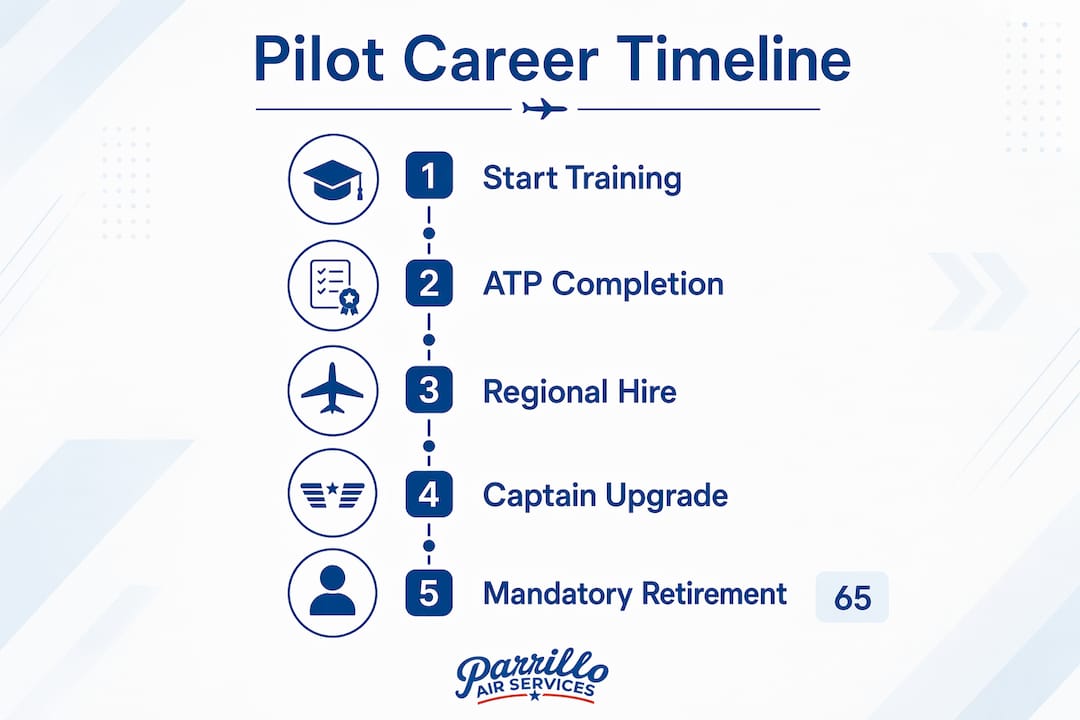
Mandatory retirement from Part 121 is not the end of a flying career. Several paths stay open, though the compensation and schedule shift considerably from a senior captain role.
Pro Tip: Keep your instrument currency and type ratings current through your final airline years. A lapsed currency or expired type rating can delay a Part 135 hire by months while you complete recurrent training.
The retirement age creates predictable churn. When senior captains exit at 65, every pilot below them on the seniority list moves up, accelerating upgrades and opening first officer seats for new hires. The peak retirement wave between 2026 and 2028 is pushing roughly 4,000 pilots out of Part 121 annually, which is the single best hiring environment for new ATP holders in decades.
Roughly 4,000 pilots are exiting Part 121 annually during the 2026–2028 peak retirement window — the largest sustained hiring opportunity for new ATP holders in a generation.
The cascading effects are real and worth planning around:
Proposals to raise the U.S. retirement age to 67 would complicate this picture. Under ICAO's international standard of 65, any pilot aged 66–67 would be grounded on every international route, creating a domestic-only tier of senior captains who displace less-senior pilots from domestic routes. ALPA and a Politico policy analysis both flag this as a source of operational disruption, not a solution to staffing gaps.
Medical certification and competency checks are the day-to-day gatekeepers of your flying career. The FAA medical certificate requirement applies at every age, and a First Class medical must be renewed annually after age 40. The age-65 rule is a separate legal limit that sits on top of medical fitness, not a substitute for it.
Peer-reviewed research on cognitive and biomarker profiles in older pilots shows that some senior pilots demonstrate brain aging consistent with much younger individuals. Researchers argue that chronological age is an imperfect proxy for fitness and advocate for individualized, competency-based assessments instead of a blanket cutoff.
| Assessment type | What it measures | Who requires it |
|---|---|---|
| FAA First Class Medical | Physical and cognitive fitness | FAA (required for ATP) |
| Airline proficiency check | Procedural and decision-making skills | FAA / airline ops specs |
| Competency-based assessment (proposed) | Individualized cognitive and biomarker profile | Research proposal only |
"Some senior pilots demonstrate cognitive and biomarker profiles indicating variability in brain aging, suggesting chronological age alone may not fully indicate flight fitness."
— Peer-reviewed research, PMC
ALPA and ICAO favor keeping the age-65 standard precisely because competency-based assessments are not yet standardized or validated for operational use. Until they are, the bright-line age rule provides consistent, enforceable safety margins across international operations.
Pro Tip: Schedule your First Class medical well before any certificate checkride. A medical surprise discovered the week of your ATP practical test can delay your hire date by months.
Follow this sequence and you maximize the chance of making captain with years of seniority still ahead of you.
| Starting age | ATP-eligible by | Regional hire target | Captain upgrade target | Years to 65 as captain |
|---|---|---|---|---|
| 20 | — | — | 33–39 | — |
| — | 33–34 | 34 | — | 17–24 |
| 35 | 40 | — | — | 10–17 |
Track FAA medical renewal dates, monitor airline hiring freezes through ALPA bulletins, and budget for recurrent training costs throughout your career. Parrillo Air Services offers flexible scheduling and personalized Part 61 programs designed to keep students on the fastest realistic path to ATP eligibility.
Starting training with the age-65 Part 121 retirement limit in mind is the single most important career-planning move an aspiring pilot can make, because seniority time lost early never comes back.
| Point | Details |
|---|---|
| Age 65 is a hard Part 121 limit | FAA and ICAO both enforce mandatory retirement at 65 for multicrew airline operations. |
| Plan milestones 5–7 years ahead | Reaching ATP eligibility takes roughly 5–7 years from zero hours under typical Part 61 trajectories. |
| Post-65 options exist | Part 135 charter, Part 91 corporate, and CFI roles remain open with no federal age cutoff. |
| 2026–2028 is a peak hiring window | Roughly 4,000 annual retirements are opening more seats than any period in recent decades. |
| Parrillo Air Services | Offers Part 61 training from discovery flight through ATP prep with scheduling built around your career timeline. |
The conventional wisdom says "start training when you're ready." That advice ignores the math. A pilot who earns an ATP at 27 and upgrades to captain at 35 has 30 years of captain pay and pension accrual ahead. A pilot who starts the same journey at 38 may reach captain at 48 and have 17 years. The financial difference over a career is not marginal.
What most career guides miss is that the retirement age does not just set an end date. It sets the value of every year of seniority you accumulate. The seniority system means your 10th year at an airline is worth far more than your first, in schedule quality, pay, and route choice. Cutting that curve short by starting late or taking gaps in training is where most aspiring pilots quietly lose the most money.
The debate over raising the cap to 67 is worth watching, but planning around a potential rule change is a gamble. ICAO has no intention of moving its international standard, and the FAA has explicitly told Congress that research must precede any change. Build your timeline around 65. If the rule changes in your favor, treat the extra years as a bonus.
If the checklist above made one thing clear, it is that timing matters more than almost any other variable in a pilot career. Parrillo Air Services gives aspiring pilots in Lynchburg, VA a direct path from zero hours to ATP-eligible through personalized Part 61 instruction, with scheduling built around real life, not a rigid classroom calendar.

Every program at Parrillo Air Services maps directly to the milestones that determine how much seniority time you bank before 65:
The school also supports Liberty University credit transfer, which can reduce total training costs for students already enrolled there. Maintenance tracking for the training fleet is supported through tools like SquawkFree, keeping aircraft available and your training schedule on track.
Ready to map your training to a real airline career timeline? Request program details and book a discovery flight at Parrillo Air Services today.
The claims in this article draw on FAA regulatory guidance, ALPA position statements, ICAO standards, peer-reviewed cognitive research, and industry reporting. Key sources are listed below.
| Source | Publisher | Notes |
|---|---|---|
| Pilot Retirement Age position | Air Line Pilots Association (ALPA) | Union position on age-65 standard and opposition to unilateral increases |
| FAA warns Congress against raising retirement age | Reuters | FAA administrator letter to Senate, February 2024 |
| Five Unintended Consequences of Raising the Pilot Retirement Age | Politico (sponsored analysis) | Operational and labor consequences of a unilateral U.S. change |
| Why a U.S. retirement age of 67 would ground senior captains internationally | Simple Flying | ICAO constraints and two-tier workforce analysis |
| Pilot shortage and mandatory retirement peak | Aeronautics Magazine | 2026–2028 retirement wave and annual exit estimates |
| Part 121 vs Part 135 retirement age paradox | View from the Wing | Practical difference between Part 121 and Part 135 age rules |
| Cognitive and biomarker profiles in older pilots | PubMed Central (peer-reviewed) | Research on competency-based vs. age-based fitness assessment |
| Aviation career timeline: 2026 pilot guide | Parrillo Air Services | In-house career timeline and hiring window guidance |
Aviation Career Salary Expectations: 2026 Complete Guide
Parrillo Air Services
Aviation Career Timeline Planning: Your 2026 Pilot Guide
Parrillo Air Services
Major Airline Pilot Salary Ranges: 2026 Guide
Parrillo Air Services
Adult Flight Training Benefits: Your 2026 Career Guide
Parrillo Air Services