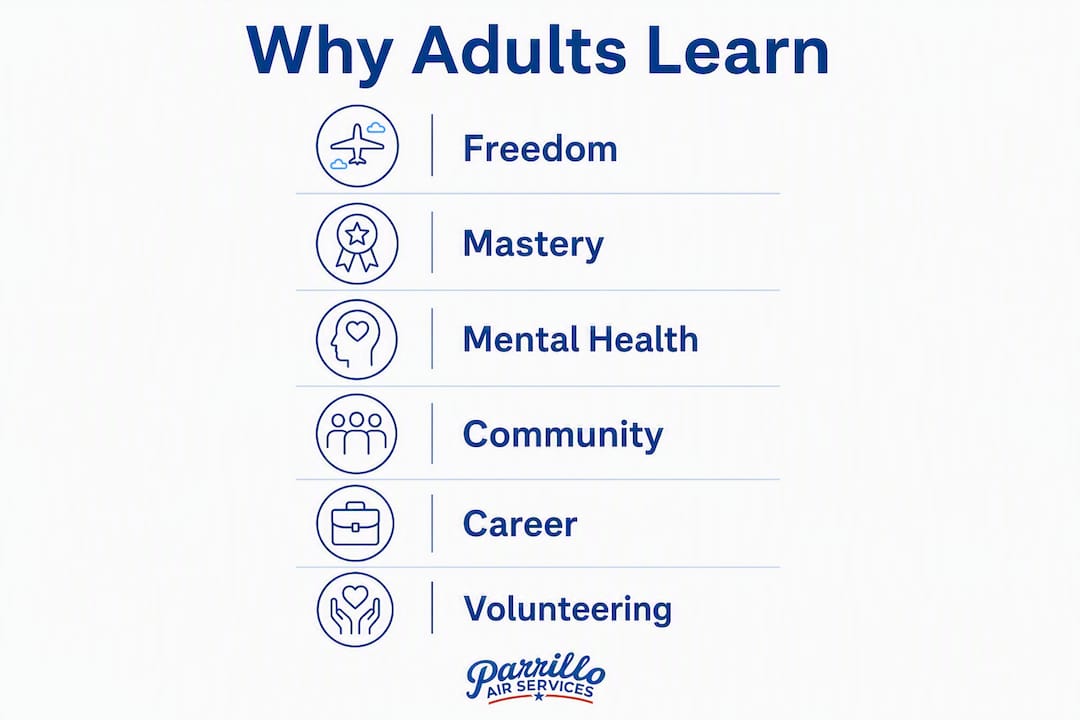
Adults learn to fly because the cockpit delivers something genuinely rare: a skill that demands your full attention, rewards discipline, and opens doors that no other hobby or second career quite matches. The top motivations are freedom to travel on your own terms, the mental challenge of mastering a complex skill, the tight-knit aviation community, and for some, a complete career reinvention.
Here is what drives most adult learners:
Two things worth knowing before you read further: the FAA's Aeronautical Decision Making (ADM) framework is the backbone of how pilots are trained to think, and Parrillo Air Services in Lynchburg, VA operates under FAA Part 61, which means flexible scheduling built around your life, not a rigid school calendar.
The motivations vary, but they cluster into a handful of themes that show up again and again among adult students.
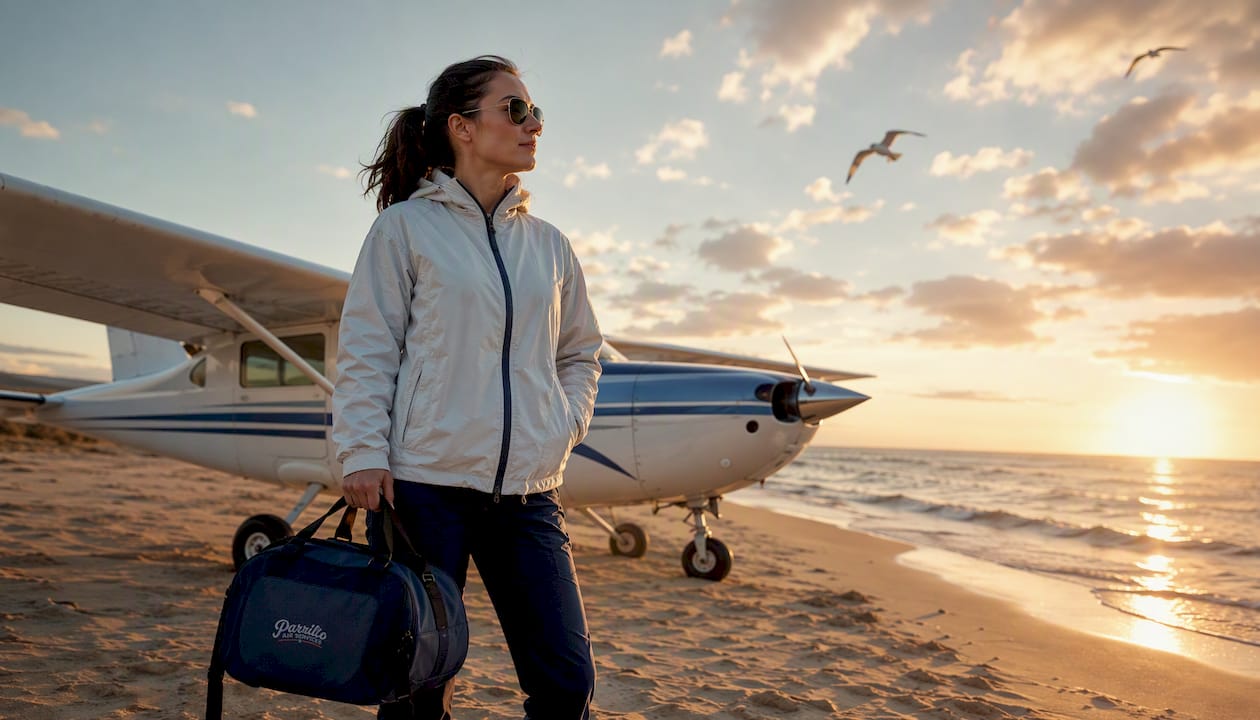
Flying gives you access to many more public-use airports across the United States than commercial service airports. That gap is the point. A private pilot can fly direct from a small regional strip to a mountain town with no TSA line, no connection, and no checked-bag fee. For adults who travel frequently for work or family, that kind of flexibility is worth real money and time.
Most adults who start flight training are not running from something. They are chasing a specific kind of challenge: one where the feedback is immediate, the stakes are real, and the skill ceiling is high enough to keep you learning for years. Weather interpretation, systems management, navigation, and communication all have to work together. That complexity is exactly what makes it satisfying.
Research and pilot reports consistently link flight training to reduced anxiety and stronger decision-making habits. The FAA's ADM framework trains pilots to recognize cognitive traps, evaluate options under pressure, and commit to a course of action. Those habits do not stay in the cockpit.
Aviation has a culture that is hard to find elsewhere. Fly-ins, hangar talk, flying clubs, and organizations like the Experimental Aircraft Association create a social layer that keeps pilots engaged long after the certificate is earned. For adults who feel isolated in routine professional life, this community is often a surprise benefit.
The regional airline pilot shortage has made professional aviation a realistic second career for adults in their 30s and 40s. The pathway is long and requires serious commitment, but the advantages of adult flying courses for career changers are real: adults often bring financial stability, discipline, and decision-making experience that younger students lack.
Not every adult wants a career or even frequent travel. Organizations like Angel Flight and similar medical-mission networks rely on private pilots to transport patients who cannot access commercial aviation. Flying becomes a direct form of service.
Pro Tip: Tell your instructor your actual goal in the first lesson. A retiree flying for weekend trips needs different training emphasis than someone targeting a commercial certificate. Instructors recommend that adult learners declare their mission early so instruction can be tailored to mission-critical skills, cutting wasted hours.
Flight training does not just teach you to operate an aircraft. It installs a decision-making framework that most people never develop elsewhere.
The FAA's ADM system is the formal structure behind this. It teaches pilots to identify hazardous attitudes (like impulsivity or invulnerability), apply risk-management checklists, and evaluate options before committing. The process is deliberate and repeatable, which is exactly what makes it transferable.
Adults who go through this training report a stronger internal locus of control: the sense that outcomes depend on their own preparation and judgment rather than luck or external forces. That shift shows up in how they handle high-stakes decisions at work, in relationships, and in health management.
The cognitive load of flight training is also worth naming directly. Instructors consistently say the biggest challenge for adult students is the mental workload, balancing systems, weather, and regulations simultaneously, not physical ability. That challenge is also the benefit. Keeping multiple variables in mind under mild stress is one of the better cognitive workouts available to adults.
Pro Tip: Between lessons, spend 15 minutes reviewing the "why" behind one maneuver or regulation rather than re-reading checklists. Oral exams test conceptual depth, not memorization, and building that understanding early makes checkride prep far less stressful.
There is no general FAA upper age limit for earning or holding a private pilot certificate. FAA guidance is clear on this: medical fitness and personal goals drive eligibility, not birthdate. The one exception is airline careers under Part 121, which cap at age 65. For recreational and private flying, age is not the barrier most people assume.
You will need at least a Third-Class FAA Medical Certificate for private pilot privileges. The process involves a visit to an FAA-designated Aviation Medical Examiner (AME). Common conditions like controlled hypertension or corrected vision are frequently manageable. The smart move is to schedule your medical exam early in the process, before investing heavily in training hours.
| Training Stage | Typical Hours | Estimated Cost Range |
|---|---|---|
| Private Pilot Certificate | typically requires 60–80 flight hours | with an estimated cost range of $14,000–$22,000 depending on region, aircraft, and lesson frequency |
| Instrument Rating (add-on) | requires substantial additional flight hours | with associated costs varying widely |
| Commercial Certificate (add-on) | requires extensive flight experience | with costs and requirements depending on individual circumstances |
Training reality: Students typically require 60–80 flight hours to meet private pilot standards, with training costs most often ranging from $14,000 to $22,000 depending on region, aircraft, and lesson frequency.
For a detailed breakdown of how long the process takes at different paces, the adult flight training timeline guide at Parrillo Air Services walks through realistic scenarios.
Part 141 schools follow a rigid, FAA-approved syllabus with minimum hour requirements and structured stage checks. Part 61 allows a more flexible sequence, which means you can pause for a work trip, adjust your lesson pace, and focus on the skills most relevant to your goals. Part 61's flexible structure frequently allows working adults to progress at a sustainable pace, reducing dropout risk compared with intensive programs. For most adults balancing jobs and family, Part 61 is the practical choice.
The path from "I want to learn to fly" to "I have a license" has a clear sequence. Here is what to do, in order.
Questions to ask a school or CFI before enrolling:
Red flags to watch for:
| Myth | Reality |
|---|---|
| "I'm too old to start" | No FAA upper age limit for private flying; adults over 60 complete training regularly |
| "Flying requires exceptional physical fitness" | Standard health with a Third-Class medical is sufficient; physical demands are modest |
| "It's too expensive for most people" | Costs are real but comparable to other major hobbies; Part 61 lets you pace spending |
| "Adults learn slower than younger students" | Adults bring discipline, focus, and motivation that often offset any pace difference |
| "You need perfect eyesight" | Corrected vision meets Third-Class medical standards |
| "Training takes years" | Most adults complete the private certificate at a part-time pace |
Treating training as a ring-fenced project is the single most effective habit: set a budget, pick a weekly cadence, and schedule your next lesson before you leave each session. Adults who treat training as something they will "get to when life calms down" rarely finish.
Simulator practice between lessons keeps the material fresh without burning flight hours. Even a desktop simulator running X-Plane or Microsoft Flight Simulator reinforces instrument scan habits and procedure memory. Pair that with Part 61's flexibility and you have a training structure that actually fits around a full adult life.
The private pilot certificate is a starting point, not a destination. Here is where it leads:
For adults considering the professional track, aviation careers require genuine dedication and a multi-year plan. The rewards are real, but the commitment is not casual.
Adults who start flight training with clear goals, a realistic budget, and consistent scheduling have the highest completion rates and the most satisfying outcomes.
| Point | Details |
|---|---|
| No upper age limit | The FAA sets no maximum age for a private pilot certificate; medical fitness matters more than birthdate. |
| Real cost range | Private pilot training typically runs 60–80 hours and $14,000–$22,000 depending on region and pace. |
| Part 61 fits adult life | Flexible scheduling under Part 61 lets working adults progress without rigid program deadlines. |
| Consistency over intensity | Two shorter sessions per week outperform one long lesson every two weeks for adult retention. |
| Parrillo Air Services | Offers FAA Part 61 training in Lynchburg, VA, from discovery flights through commercial and CFI ratings. |
Most articles about adult flight training spend a lot of time reassuring you that it is not as hard as you think. That framing misses something.
It is hard. The mental workload is real. You will have lessons where nothing clicks, where the radio sounds like noise, where you wonder why you are doing this. Those sessions are not failures. They are the mechanism. The reason flight training builds the decision-making habits and mental resilience it does is precisely because it demands them from you, repeatedly, in real time.
What I have seen consistently in adult learners is that the ones who finish are not the ones who found it easy. They are the ones who treated the hard lessons as data rather than discouragement. They scheduled the next lesson before they left the airport. They asked their instructor "why" instead of just "what." They built a habit, not a hope.
The other thing worth saying plainly: safety is not a constraint on your training. It is the training. The discipline that makes you a safe pilot is the same discipline that makes you better at everything else. Start there, stay consistent, and the certificate follows.
Parrillo Air Services offers discovery flights as the first step into aviation, and it is genuinely the right place to start. You get hands-on time in the cockpit, a CFI who explains what is happening as it happens, and a clear sense of whether full training fits your goals, all before committing to a full program.

Under FAA Part 61, Parrillo Air Services builds your training schedule around your life, not the other way around. Working adults, career changers, and retirees all train here on timelines that fit their actual availability. There is no rigid cohort start date, no pressure to accelerate past your comfort level.
What to expect on a discovery flight: roughly 60 minutes total, including a pre-flight briefing, 30–45 minutes in the air with you at the controls for part of it, and a debrief afterward. Wear comfortable clothes, bring a valid ID, and come with questions.
To get started or learn more about the full range of programs from private pilot through commercial and CFI ratings, visit the Parrillo Air Services flight training page.