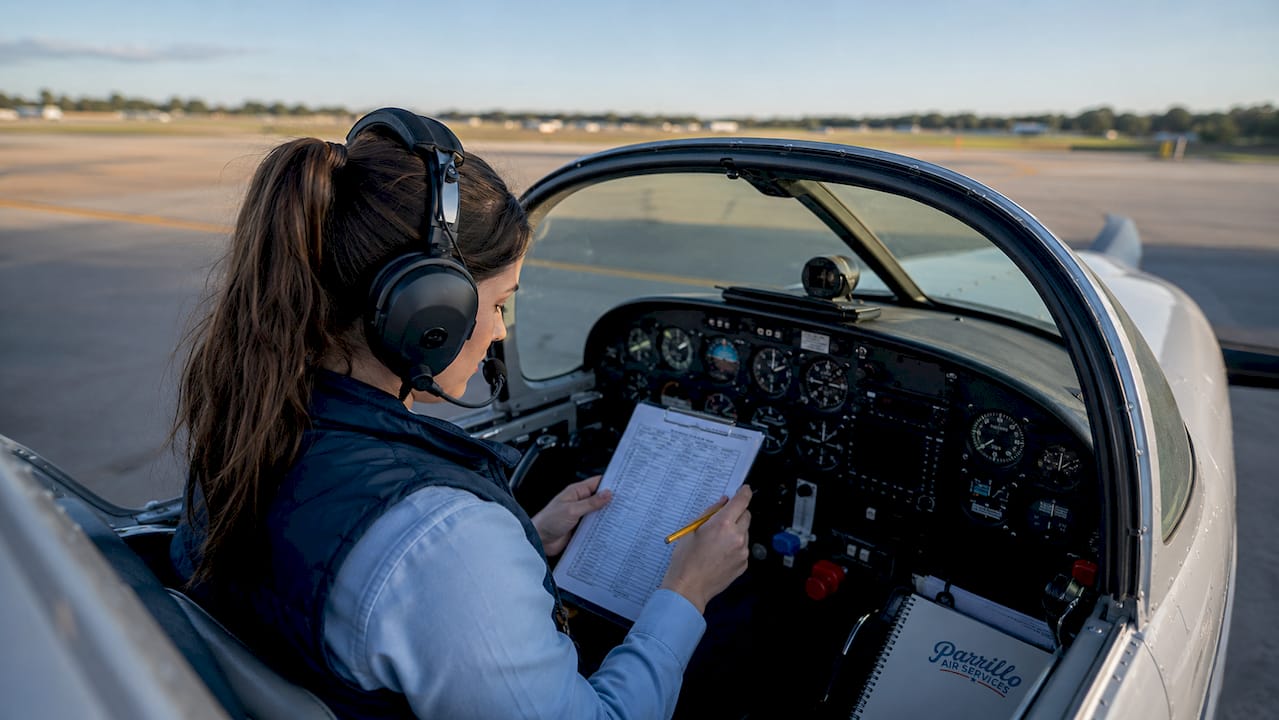
The FAA minimum flight hours for a private pilot certificate is 40 total hours under 14 CFR Part 61, split between dual instruction with a Certified Flight Instructor and solo flight time. This number is the legal floor set by the FAA, not a proficiency guarantee. Most students will fly well beyond it before they are genuinely ready to pass the checkride. Understanding what those 40 hours actually contain, and why the real-world number is higher, is the most useful thing you can know before you start training.
The 40-hour minimum breaks into two legally distinct categories: at least 20 hours of dual flight instruction with an authorized instructor, and at least 10 hours of solo flight time. The remaining 10 hours are flexible, but the FAA specifies exactly how the dual and solo blocks must be structured. Simply logging seat time is not enough. Each category must be documented separately in your logbook.
Within your 20 dual hours, the FAA requires specific training blocks that must each be logged and endorsed:
3 hours of cross-country flight training with your instructor, covering navigation, weather decision-making, and route planning
3 hours of night flight training, including at least one cross-country flight over 100 nautical miles and 10 takeoffs and landings at an airport with an operating control tower
3 hours of simulated instrument training, flown under the hood to develop basic attitude flying skills
3 hours of practical test preparation completed within two calendar months before your checkride date
The checkride prep timing requirement is one of the most commonly missed details. Hours logged six months before your test do not count toward this block. You must fly those three hours within the two months immediately before your instructor signs your endorsement.
Solo hours carry their own requirements. The solo cross-country requirements include at least 5 hours of solo cross-country flying, one solo cross-country flight of at least 150 nautical miles total distance with full-stop landings at three points, and at least one leg of 50 nautical miles between takeoff and landing points. You also need three solo takeoffs and landings to a full stop at a controlled airport.
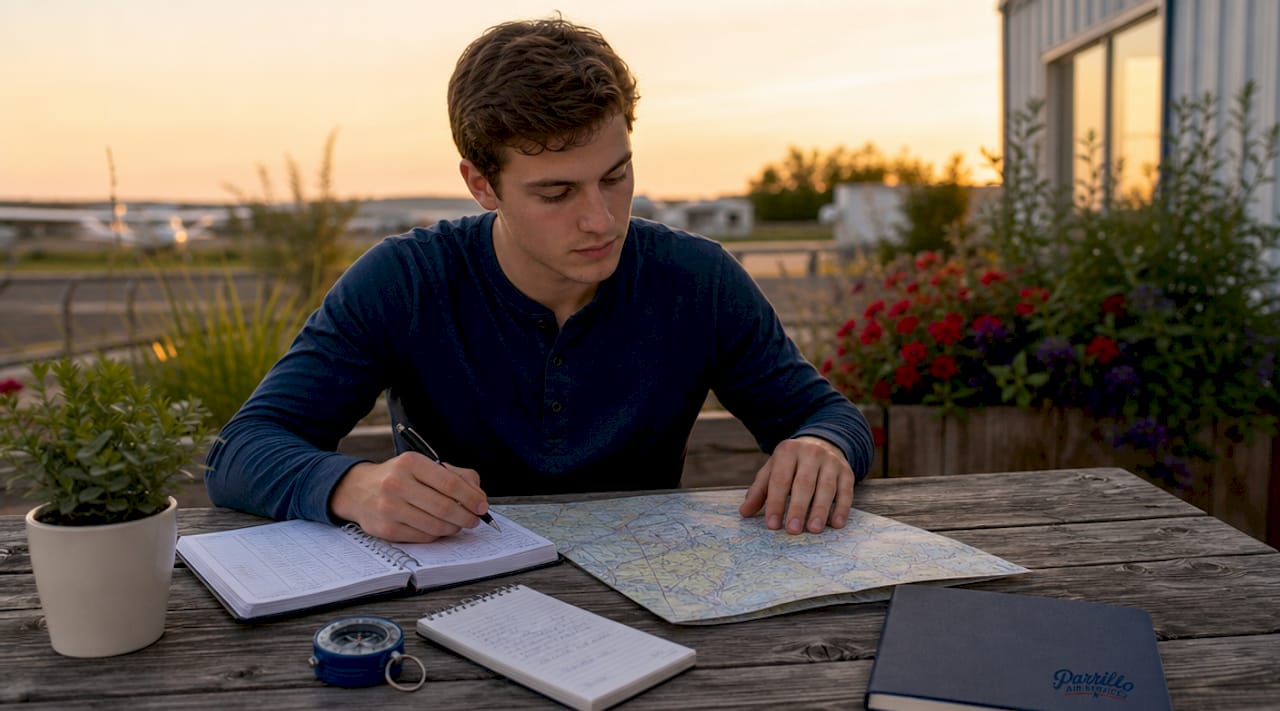
Pro Tip: Plan your solo cross-country route before you start accumulating solo hours. A poorly planned route can force you to fly extra legs just to satisfy the distance and landing requirements, adding cost and time to your training.
The training path you choose determines the minimum hours you are legally required to fly. Under Part 141 programs, the FAA reduces the total minimum to 35 hours because the school operates under an FAA-approved syllabus with structured oversight. Part 61 schools like Parrillo Air Services offer more scheduling flexibility, which suits many students better even though the regulatory minimum is slightly higher.
| Requirement | Part 61 | Part 141 |
|---|---|---|
| Total minimum hours | 40 hours | 35 hours |
| Dual instruction minimum | 20 hours | 20 hours |
| Solo flight minimum | 10 hours | 5 hours |
| Curriculum structure | Flexible, instructor-led | FAA-approved syllabus required |
| FAA oversight level | Standard | Elevated, with stage checks |
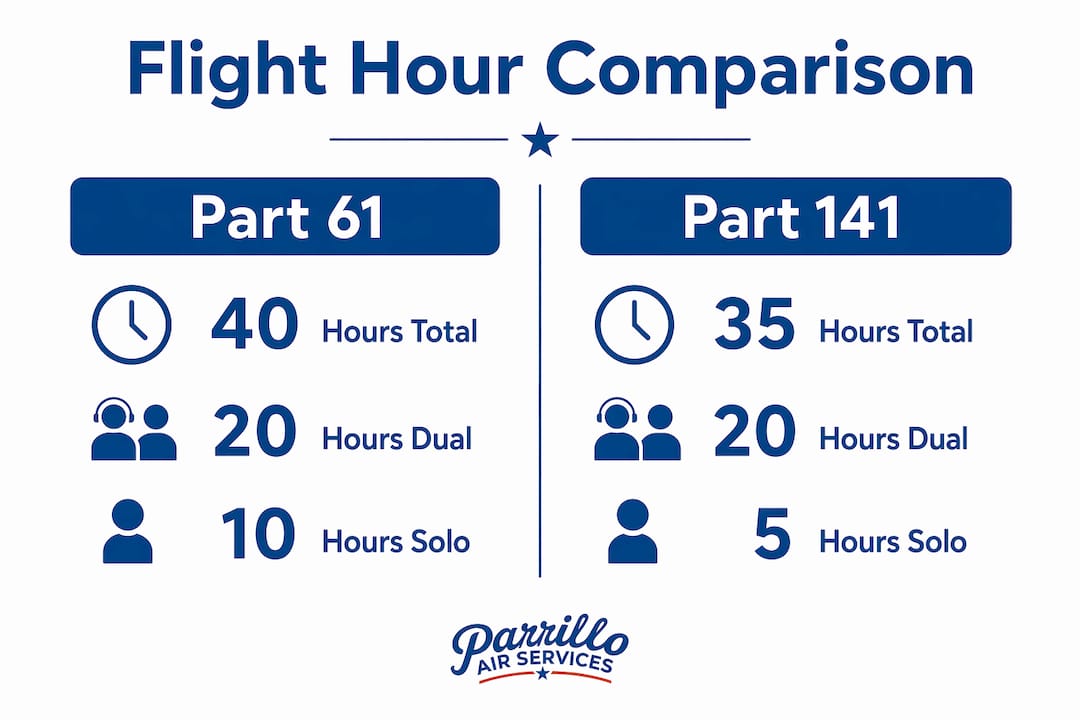
The five-hour difference in total minimums comes almost entirely from the solo requirement. Part 141 oversight gives the FAA confidence that students are progressing through a controlled curriculum, so less solo time is required to demonstrate readiness. That said, the dual instruction minimum stays identical at 20 hours under both paths.
Pro Tip: If you value scheduling flexibility and a personalized pace, a Part 61 school is often the better fit. If you want a rigid, week-by-week structure with formal stage checks, Part 141 may suit you. Either way, most students exceed the minimums regardless of which path they choose.
For a deeper look at how Part 61 training is structured, the Part 61 training overview at Parrillo Air Services walks through what the regulation actually means for your day-to-day training.
The average student needs 60 to 70 hours of total flight time before reaching checkride proficiency, despite the 40-hour regulatory minimum. This gap is not a failure. It reflects the reality of learning a complex skill in an environment shaped by weather, scheduling, and individual learning curves.
Several factors consistently push students past the minimum:
Weather cancellations. A student flying in the mid-Atlantic or Southeast will lose training days to low ceilings, thunderstorms, and wind. Each gap in training requires review before progressing.
Scheduling gaps. Flying once every two weeks instead of two or three times per week forces your instructor to spend time rebuilding skills rather than building new ones. Consistency matters more than total calendar time.
Skill plateaus. Crosswind landings, steep turns, and emergency procedures often require more repetition than the minimum hours allow. Your instructor will not endorse you until you demonstrate genuine proficiency, not just logged hours.
Logbook gaps. Students who do not track their regulatory blocks carefully sometimes discover late in training that they are short on cross-country or night hours, requiring additional flights.
AOPA data and training providers consistently report that students who train two to three times per week reach the checkride faster and with fewer total hours than those who train sporadically. The 40-hour minimum is achievable in theory, but planning your budget and schedule around 60 to 70 hours is the realistic approach.
Meeting the private pilot certification hours efficiently comes down to three things: detailed logbook management, consistent scheduling, and proactive communication with your Certified Flight Instructor. Here is a practical framework for staying on track.
Log every flight with category detail. Your logbook must distinguish between dual, solo, cross-country, night, and simulated instrument time. A single flight can count toward multiple categories, but only if you log it correctly. Use a digital logbook like ForeFlight or Foreflight's logbook module to flag regulatory blocks automatically.
Build a training checklist from 14 CFR § 61.109. Print the regulation and track each required block as you complete it. Cross-country dual: 3 hours. Night dual: 3 hours. Instrument dual: 3 hours. Checkride prep: 3 hours within two months. Solo cross-country: 5 hours. Knowing exactly where you stand prevents surprises.
Schedule your checkride prep flights deliberately. Because checkride prep hours must fall within two calendar months of your practical test, do not fly them too early. Coordinate with your instructor to schedule these flights as part of your final training phase.
Confirm your solo cross-country route satisfies all FAA specifications. The cross-country routing requirements include total distance, number of full-stop landings, and minimum leg lengths. Plan the route with your instructor before you fly it solo, not after.
Debrief every flight. A 15-minute debrief with your instructor after each flight is worth more than an extra hour in the air without feedback. Identify what needs work and address it in the next session before the skill degrades.
Pro Tip: Ask your instructor to review your logbook for regulatory compliance at the halfway point of your training, around 20 hours. Catching a gap at 20 hours costs you one or two extra flights. Catching it at 38 hours can delay your checkride by weeks.
For guidance on getting your training started on the right foot, the student pilot certificate process at Parrillo Air Services covers what you need before your first solo flight.
The FAA minimum of 40 flight hours under Part 61 is the legal starting point, but most private pilot students need 60 to 70 hours to reach genuine checkride readiness.
| Point | Details |
|---|---|
| FAA minimum under Part 61 | 40 total hours: 20 dual instruction and 10 solo flight time required. |
| Part 141 reduces the minimum | Part 141 programs require only 35 hours due to FAA-approved structured curriculum. |
| Real-world hours are higher | Most students fly 60 to 70 hours before passing the practical test. |
| Checkride prep has a timing rule | 3 hours of prep must be logged within two calendar months before the checkride. |
| Logbook accuracy prevents delays | Incomplete or miscategorized entries can delay endorsements and add unnecessary flight time. |
The 40-hour minimum is a legal threshold, not a training target. I have seen students arrive at their checkride with 42 hours and perform beautifully, and I have seen others at 75 hours who were not ready. The hours are a proxy for skill, and skill is what the examiner is actually measuring.
What concerns me about how minimum hours get discussed online is that students sometimes treat them as a finish line. They count down to 40 hours like a countdown clock, then feel frustrated when their instructor says they need more time. The regulation exists to set a floor for safety, not to define what a competent pilot looks like.
The students who progress most efficiently are the ones who focus on mastering each maneuver before moving to the next, fly consistently rather than sporadically, and treat every debrief as seriously as the flight itself. They also plan their logbook from day one, so they are never scrambling to satisfy a regulatory block in the final weeks of training.
If you are starting your training, budget for 65 hours and plan your schedule around two to three flights per week. You may finish in fewer hours. You will almost certainly not finish in exactly 40. And that is completely normal.
— Gm

Parrillo Air Services offers FAA Part 61 flight training in Lynchburg, VA, with personalized instruction designed around your schedule and learning pace. Every student trains with an experienced Certified Flight Instructor who tracks your regulatory hour blocks from day one, so you never arrive at the checkride with a logbook gap. From your first discovery flight through your private pilot practical test, the program is built to get you to proficiency efficiently. Visit the flight training programs page to learn more about enrollment, scheduling, and what to expect during your first few hours of training.
The FAA requires a minimum of 40 total flight hours under Part 61, including at least 20 hours of dual instruction and 10 hours of solo flight time. These are legal minimums, not proficiency guarantees.
Most students need 60 to 70 total flight hours before they are ready for the practical test, according to AOPA and aviation training providers. Factors like weather, scheduling gaps, and skill progression consistently push totals above the 40-hour minimum.
Part 61 requires 40 total hours with 10 hours of solo time, while Part 141 reduces the total to 35 hours with only 5 hours of solo time due to its FAA-approved structured curriculum. The dual instruction minimum of 20 hours stays the same under both paths.
The 3 hours of practical test preparation must be completed within two calendar months immediately before your checkride endorsement. Hours flown outside that window do not satisfy this specific regulatory requirement.
Incomplete or incorrectly logged entries can delay your instructor endorsement and push back your checkride date. Tracking each regulatory block, including cross-country, night, instrument, and solo time, throughout your training prevents this problem.
Private Pilot License: Privileges, Pathways & Next Steps | Parrillo Air Services
Parrillo Air Services
Private pilot license: Privileges, pathways, and next steps
Parrillo Air Services
What Does FAA Part 61 Mean for Aspiring Pilots?
Parrillo Air Services
Commercial Pilot Certificate Requirements | Parrillo Air Services - Lynchburg, VA
Parrillo Air Services