Getting your commercial pilot certificate is one of the most defined processes in professional aviation, yet most aspiring pilots underestimate just how many moving parts are involved. The commercial pilot certificate requirements set by the FAA are not just a checklist — they represent a legal threshold between flying as a hobby and flying for pay. Miss one element and your checkride gets denied, your medical lapses, or your career stalls before it starts. This guide walks you through every requirement, from eligibility and flight hours to medical certification and the practical test, so you can move forward with clarity and confidence.
| Point | Details |
|---|---|
| Eligibility basics | Be at least 18, have a Private Pilot Certificate, and hold the required medical and instrument ratings. |
| Flight hour minimums | FAA requires 250 flight hours under Part 61 including specific PIC, cross-country, and instrument time. |
| Knowledge test pass mark | You must score at least 70% on the 100-question FAA commercial pilot knowledge exam. |
| Medical certification | A valid Second-Class medical certificate is required for commercial flying and is valid for 12 months. |
| Practical test standards | The ACS requires demonstrating knowledge, risk management, and flying skill to FAA standards for certification. |
The FAA commercial pilot certificate requirements begin with eligibility, and the rules are specific. You must be at least 18 years old, hold a valid private pilot license, and demonstrate English proficiency. You also need at least a Second-Class medical certificate, which we'll cover in depth shortly.
The Instrument Rating is technically optional at this stage, but skipping it costs you. Without it, your commercial certificate carries a VFR-only limitation, meaning you cannot fly commercially in instrument meteorological conditions. For any serious aviation career, that restriction is a dealbreaker. Most instructors recommend earning your instrument rating before beginning commercial training, and most serious students follow that advice.
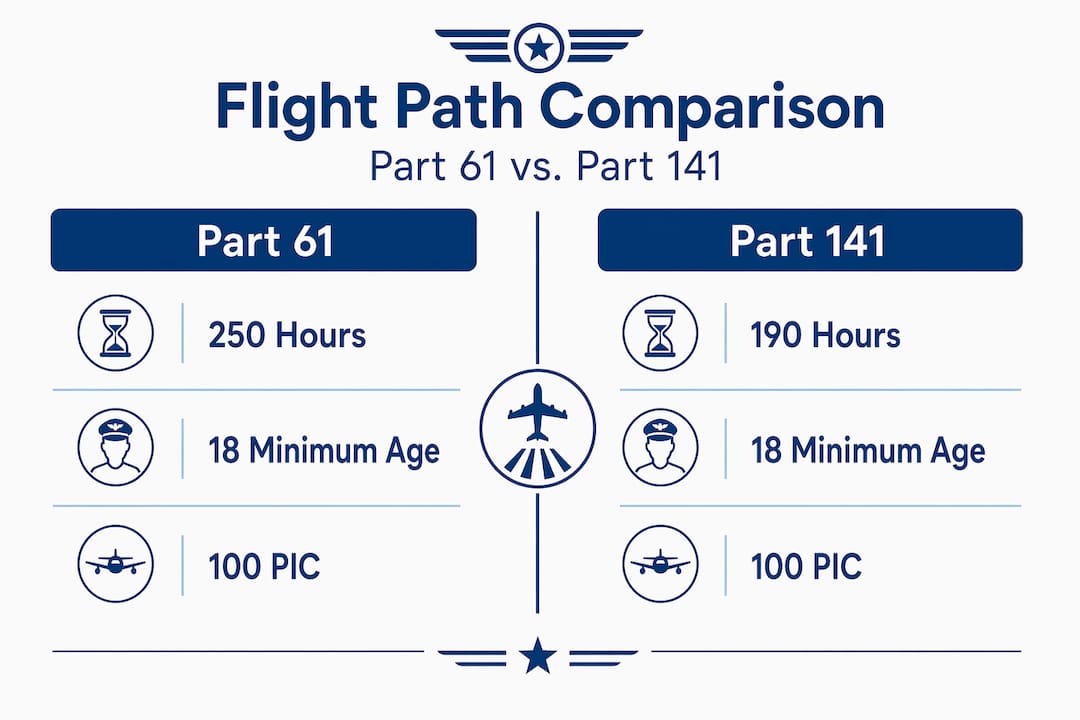
When it comes to flight hours, the FAA commercial pilot requirements vary by training path. Under Part 61, you must log a minimum of 250 total flight hours, including 100 hours as pilot-in-command (PIC), 50 hours of cross-country flight, and 10 hours of instrument training. Part 141 schools with an approved curriculum can reduce that minimum to 190 total hours, though the structured syllabus and stricter oversight are tradeoffs worth considering.
| Requirement | Part 61 | Part 141 |
|---|---|---|
| Total flight hours | 250 | 190 |
| Minimum age | 18 | 18 |
| PIC hours required | 100 | Varies by curriculum |
| Cross-country hours | 50 | Per approved syllabus |
| Instrument hours | 10 | Per approved syllabus |
Key eligibility requirements at a glance:
The knowledge test is not a formality. The Commercial Pilot Knowledge Test contains 100 multiple-choice questions with a minimum passing score of 70%, and you have 3 hours to complete it. Every question carries equal weight, which means a bad stretch through weather or FARs can drag your score quickly.

Here is why the 70% minimum is a trap more than a goal. Examiners review your test results before your oral exam. A low score signals weak areas, and examiners are trained to probe exactly those subjects during the oral portion of the practical test. Scoring 85% or above gives you credibility before you even say a word.
Pro Tip: Use a structured question bank tool and track your performance by category. Identify your three weakest topic areas early in your study and devote focused sessions to each. Students who study broadly without tracking category scores frequently miss the same question types repeatedly without realizing it.
Effective preparation covers six primary topic areas:
Your test report is valid for 24 months. If your checkride does not happen within that window, you retake the written test. Review pilot interview exam tips to build the broader knowledge confidence that pays off on both oral and written evaluations.
The Second-Class medical certificate is the most underestimated requirement on the commercial pilot certificate requirements list. Many students complete hundreds of flight hours only to discover a disqualifying condition weeks before their checkride. Do not let that be your story.
The Second-Class medical certificate is mandatory to exercise commercial pilot privileges and is valid for 12 months regardless of the pilot's age, with exam costs typically ranging from $100 to $200. After 12 months, the certificate automatically downgrades to Third-Class privileges, which means you can still fly privately but cannot legally accept compensation.
The exam itself covers:
"Any lapse in medical currency immediately results in the loss of ability to be compensated for flying." This is not a technicality — it is a hard stop with real financial consequences.
Certain conditions, like prior DUI convictions, mental health diagnoses, or specific medications, require the FAA to issue a Special Issuance authorization before you can hold a medical certificate. That process can take months.
Pro Tip: Schedule your medical exam before you begin logging serious flight hours. If a condition requires special issuance, you want months of runway to resolve it, not weeks.
The commercial pilot practical test is where everything converges. The Airman Certification Standards (ACS) integrate knowledge, risk management, and skill proficiencies into every task, requiring pilots to perform maneuvers *and* manage associated risks simultaneously.
Every task in the ACS is evaluated across three dimensions:
Key maneuvers and ACS tolerance standards:
| Maneuver | Altitude Tolerance | Bank Angle | Airspeed |
|---|---|---|---|
| Chandelle | N/A | ±5° at rollout | +5/0 knots |
| Lazy eight | ±100 ft at 180° | ±10° | ±10 knots |
| Steep spiral | ±100 ft | Constant bank | ±10 knots |
| Power-off 180 | Within 200 ft | N/A | N/A |
The oral exam portion often surprises students more than the flight. Examiners use scenario-based questioning to assess your decision-making under pressure.
Pro Tip: Review your ACS evaluation tasks and practice narrating your risk management thought process out loud during flight training. Examiners consistently report that students who struggle in oral sections can perform maneuvers well but cannot articulate their thinking.
Here is the honest version of the commercial pilot certification process that most guides avoid.
Meeting the FAA minimums does not mean you are ready. It means you are legally eligible to attempt the checkride. Those are not the same thing. Many students find that achieving checkride-level proficiency requires closer to 270 to 300 hours rather than the minimum 250, depending on how consistently they trained and in what conditions.
The medical certificate conversation is one we have repeatedly with students who treat it as an afterthought. They complete 200 hours, feel great physically, and then discover during their exam that a prescription or a past medical issue triggers an FAA review. The FAA medical certificate is more than paperwork. For commercial operations, it is the switch that turns your certificate on or off. Get the exam early.
The knowledge test score also shapes your experience far beyond a single number. We have watched students celebrate a 71% pass only to face a grueling two-hour oral exam while a fellow student who scored 90% was out in 45 minutes. The written score is a signal. Examiners use it. Aim high.
The students who reach certification fastest are almost never the ones with the most natural talent. They are the ones who flew consistently, at least twice a week, reviewed every lesson with their instructor, and treated ground study as seriously as flight time. Talent helps at the margins. Consistency is what gets you there.

You now understand what commercial pilot certificate requirements involve from eligibility through the checkride. The question is who is going to get you there.
At Parrillo Air Services in Lynchburg, VA, we guide aspiring commercial pilots through every stage of the certification process under FAA Part 61. Our instructors provide personalized ground and flight training calibrated to your pace, your schedule, and your career goals. From your first cross-country to your final checkride prep, we make sure you are not just meeting minimums but flying with the confidence and command that airlines want to see.