
If you've started researching how to become a pilot, you've probably seen "FAA Part 61" everywhere, and assumed it's just a category of flight school. That's one of the most common misconceptions in aviation training. What does FAA Part 61 mean, exactly? It's the federal regulatory framework that defines who can earn a pilot certificate, what training they must complete, and what privileges they're granted. Every certificate from student pilot to Airline Transport Pilot (ATP) flows through this rulebook. Understanding it isn't optional. It's the foundation everything else is built on.
| Point | Details |
|---|---|
| Part 61 is a regulatory framework | It governs pilot and instructor certification, not just a type of flight school. |
| Multiple certificates fall under Part 61 | Student, recreational, private, commercial, ATP, and flight instructor certificates are all issued here. |
| Minimums are floors, not targets | Private pilot requires 40 hours minimum, but most students need significantly more time to pass. |
| Flight reviews keep you current | Every pilot must complete a flight review every 24 calendar months to exercise certificate privileges. |
| Part 61 vs. Part 141 is about flexibility | Part 61 allows customized training pace; Part 141 follows a strict FAA-approved syllabus. |
The scope of Part 61 is broader than most people expect. Title 14 of the Code of Federal Regulations (14 CFR) Part 61 prescribes the requirements for issuing pilot, flight instructor, and ground instructor certificates, including the privileges and limitations attached to each. It's not a training school designation. It's the law that governs pilot qualification in the United States.
Think of Part 61 as the master rulebook. It tells you what certificates exist, who qualifies for them, what training counts, and what you're legally allowed to do once you hold one.
Here's what Part 61 specifically governs:
The FAA Part 61 explanation that matters most to you as an aspiring pilot is this: Part 61 is the standard by which your eligibility for every certificate and rating is measured. If your training doesn't meet its requirements, you can't get your certificate, regardless of how skilled you are in the cockpit.
The private pilot certificate is where most pilots start, and it's the best lens for understanding how FAA Part 61 requirements work in practice. The regulation sets specific minimums you must meet before you can take your checkride.
Under 14 CFR § 61.109, a private pilot applicant must log at least:
Those sub-requirements inside the 40 hours matter. You can't just accumulate 40 hours of casual flying and show up for a checkride. The hours must be distributed correctly, with specific endorsements and logged accurately.
Here's the reality most schools don't advertise: the national average for private pilot completion is around 60 to 70 hours, not 40. The minimums exist in regulation, but proficiency is what determines when you're actually ready. A student who rushes to 40 hours and fails the checkride still has to pay for more training. Patience and consistency pay off more than speed.
Logbook documentation is where many applicants run into unexpected trouble. Recording flight time in an FAA-acceptable format is mandated by 14 CFR § 61.51. Missing required data fields, like the type of experience or instructor endorsement, can invalidate entries even if the training genuinely happened. This is not a technicality the FAA overlooks.
Pro Tip: Log every flight the same day it happens. Memory fades, and reconstructing logbook entries weeks later is a compliance risk that can delay or derail your checkride application.
Earning your certificate is only step one. FAA Part 61 regulations require every pilot to stay current by completing recurrent training, and the primary mechanism for that is the flight review.
A flight review under 14 CFR § 61.56 must include at minimum:
The review is required every 24 calendar months. If you let it lapse, you cannot act as pilot-in-command until you complete a new one. There's no grace period.
One thing that surprises many pilots: the flight review is not a pass/fail checkride. There's no specific maneuver standard you must hit perfectly to "pass." What it requires is an instructor's logbook endorsement confirming the review was completed. If the instructor isn't satisfied with your performance, they simply don't endorse you and you keep training. That's very different from a practical test with a designated examiner.
There are a few scenarios where you can skip the standard flight review interval:
The instructor's endorsement validity is legally critical here. Endorsements from instructors who are not currently certified hold no standing under Part 61. Before you schedule a flight review, confirm your CFI's certificate is current.
Pro Tip: Don't treat the flight review as a box to check every two years. Use it as an honest self-assessment. The pilots who get the most out of reviews treat them like a mini-recurrency program, not a formality.
When people debate Part 61 vs. Part 141 training, they're comparing two FAA-approved pathways to the same certificates. Part 141 is not "better" and Part 61 is not "easier." They're structured differently, and that structure matters depending on your goals.
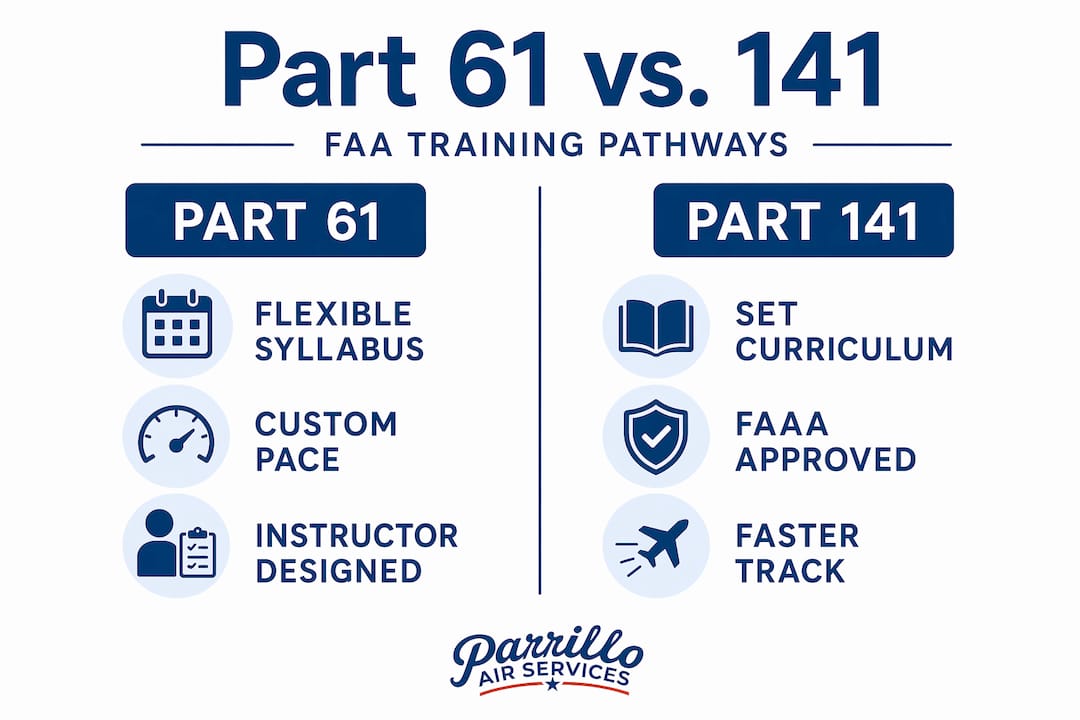
| Feature | Part 61 | Part 141 |
|---|---|---|
| Syllabus | Flexible, instructor-designed | FAA-approved, fixed curriculum |
| Minimum hours (private) | 40 hours | 35 hours |
| Schedule flexibility | High | Lower |
| Oversight | Individual CFI | FAA-audited school |
| Best for | Adult learners, part-time students | Full-time students, GI Bill users |
Part 141 schools operate under an FAA-approved training course outline. Every lesson is prescribed in advance, and the school is audited regularly. That structure allows the FAA to reduce the minimum hour requirement slightly, which is why Part 141 private pilot training can be completed in 35 hours instead of 40.
Part 61 training allows CFIs and students to tailor the training pace and syllabus to individual needs. If you learn faster in certain areas or need more repetition elsewhere, a Part 61 instructor can adjust without needing formal curriculum approval. That flexibility is a genuine advantage for adult learners with jobs, families, or irregular schedules.
The tradeoff is that Part 61 requires more self-discipline from the student. Without a fixed syllabus pushing you forward, it's easy to stall on lessons that feel uncomfortable. Students who thrive under Part 61 tend to be self-motivated and communicative with their instructor about their progress.
If you're considering options and want a deeper breakdown, the guide on choosing an FAA Part 61 school covers the practical career considerations side of this decision in detail.
I've seen a lot of aspiring pilots treat Part 61 as background noise, something their instructor handles while they focus on flying. That thinking creates problems that are entirely avoidable.
The most common failure I observe isn't in the cockpit. It's in the logbook. Pilots log their hours inconsistently, skip required data fields, or accept endorsements from instructors who are no longer current. When those issues surface at the checkride or during a certificate application, the frustration is real. The training happened. The hours are genuine. But missing logbook elements can invalidate entries, and the FAA doesn't make exceptions based on good intentions.
The second thing I'd push back on is the 40-hour myth. I've watched students fixate on hitting the minimum and treating it like a finish line. Minimum hours are a legal threshold, not a readiness indicator. The DPE sitting across from you during your checkride doesn't care that you have exactly 40.1 hours. They care whether you can fly the airplane safely and answer their questions confidently.
Part 61 gives you flexibility, and that's genuinely valuable. But flexibility without structure is just drift. The students who perform best are the ones who use the freedom Part 61 offers to dig deeper into areas where they need work, rather than treating it as permission to move faster.
— Gm
If you're ready to move from understanding the regulation to actually training under it, Parrillo Air Services in Lynchburg, VA offers FAA certified flight training built around the flexibility that makes Part 61 work for real people with real schedules.

At Parrillo Air Services, every student works directly with experienced CFIs who tailor instruction to your pace, learning style, and career goals. Whether you're working toward a private pilot certificate or pursuing a professional pathway to the airlines, the training here is grounded in genuine mentorship, not a one-size syllabus. Schedules are built around your life, not the other way around. If you're serious about earning your wings, reach out to Parrillo Air to take the first step.
Get in Touch Today