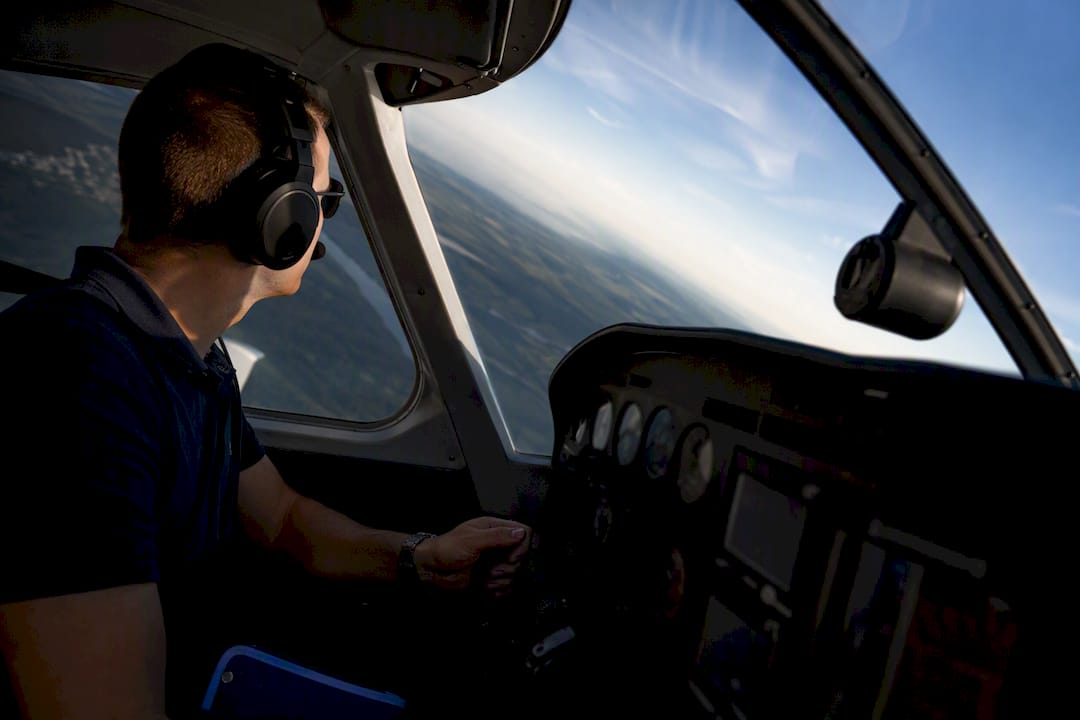
Commercial pilot maneuvers are the FAA-tested performance and ground-reference tasks, steep turns, chandelles, lazy eights, steep spirals, eights on pylons, and slow flight and stalls, graded against Commercial Airplane ACS tolerances. Passing them comes down to three things: a disciplined clearing and entry routine, constant energy management, and enough repetition that your control inputs stop feeling like separate steps. Get those three right and the checkride becomes a formality.
TL;DR:
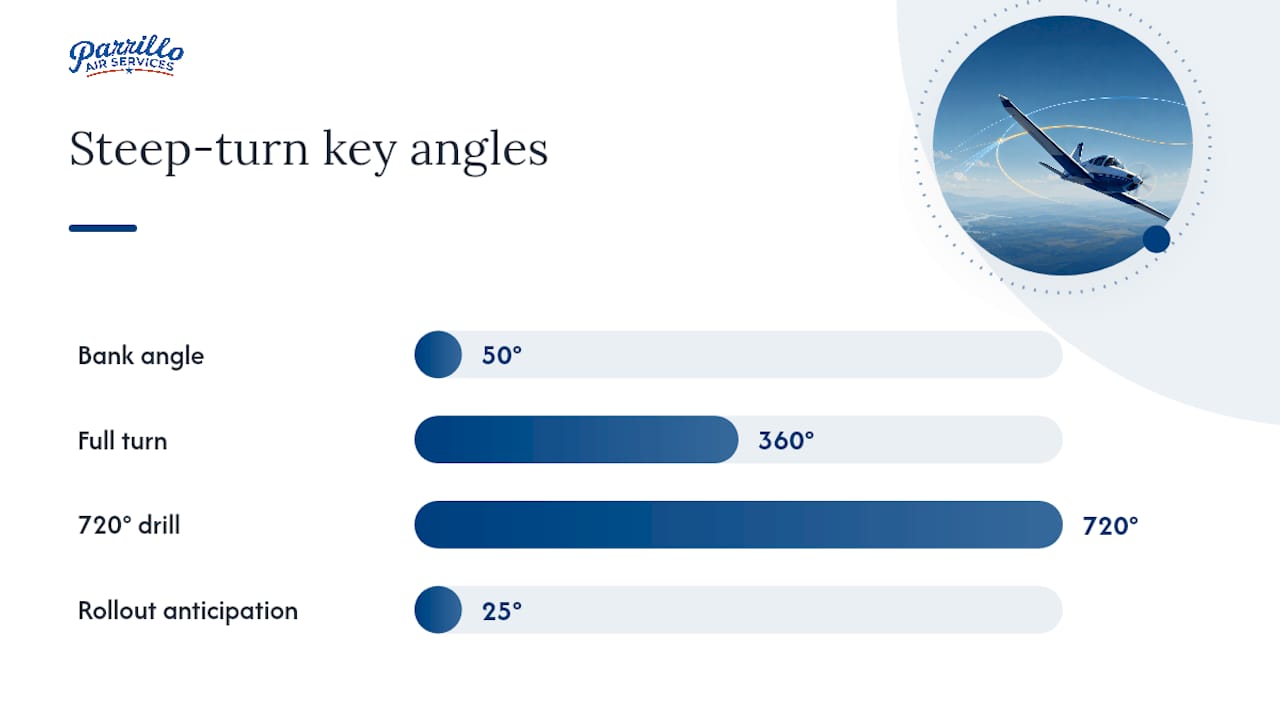
Before you climb into the practice area, you need every entry number in your head, not on a kneeboard you'll forget to glance at mid turn. Here's the compact version, pulled from Airplane Flying Handbook Chapter 10 procedures and Commercial ACS tasks, that you can run through in the runup area or tape to your kneeboard.
Every one of these starts the same way: clear the area, confirm altitude and airspeed, and brief yourself on the abort trigger before you touch the controls. Skipping that step is the single fastest way to bust a tolerance before you've even rolled in.
Steep turns exist to test your ability to hold coordinated flight and constant altitude while your bank angle, and therefore your load factor, changes everything about how the airplane behaves. The Airplane Flying Handbook frames this as a division-of-attention exercise more than a stick-and-rudder trick, and examiners treat it that way too. If you can't hold a steep turn, you probably can't hold anything else on the ride either.
The Commercial ACS calls for 50° of bank, a full 360° turn in each direction, entered at a specified airspeed appropriate to the airplane. Roll in smoothly, add back pressure as the bank increases to counter the loss of vertical lift, and add power if your airplane needs it to hold airspeed through the increased drag. Your eyes should be doing three things at once: outside for a visual pitch reference, a glance at the altimeter, and a check on bank angle, cycling every few seconds rather than fixating on any one instrument.
The most common fault is altitude bleed during rollout, because pilots relax back pressure too early as the bank decreases. The fix is a drill: hold the steep turn for a full 720°, both directions, without looking at the altimeter more than once every ten seconds. If you can do that, the checkride version feels slow by comparison.
Pro Tip: Practice steep turns at a higher altitude than you'll fly them on the checkride, then work your way down. You'll build the muscle memory for pitch and power without the added stress of proximity to minimum altitudes.
A chandelle asks you to gain the maximum possible altitude in a 180° climbing turn without stalling, which sounds simple until you realize the airplane is losing energy the entire time and your job is to spend that energy at exactly the right rate. The Commercial ACS grades this on smoothness and precision, not aggression. A chandelle flown too aggressively just stalls early; one flown too timidly wastes the climb performance the maneuver is designed to showcase.
Entry speed matters more here than in almost any other maneuver. Roll in at the recommended entry airspeed for your airplane, typically maneuvering speed or a manufacturer-specified figure, then begin a coordinated 30° bank turn while simultaneously starting a smooth pitch increase.
The apex, that moment at the 90° point where pitch stops increasing, is where most students lose the sight picture. Practice by picking a cloud or a distinct feature 90° off your entry heading and using it as a target for where your nose should stop climbing. Miss that visual cue consistently, and the whole second half of the maneuver falls apart because you're chasing a pitch attitude instead of holding one.
Every other commercial maneuver has a moment where you can hold something constant, a bank angle, an altitude, a heading. Lazy eights never let you. The Pilot Institute's breakdown of commercial maneuvers points out that this constant, changing control pressure is exactly what the maneuver is built to test, and it's why examiners can spot a poorly practiced lazy eight almost instantly. There's nowhere to hide.
The maneuver traces a figure eight across the horizon using two 180° turns in opposite directions, with bank and pitch both changing continuously throughout. You need a reference point straight ahead and two more at 45° left and right for your wingtip references at the steepest bank points.
Most instructors teach this in stages: start with half-figures where you fly just one 180° segment and reset, then add shallow peaks, then work up to full peak bank angles. Rushing straight to full-scale lazy eights before you've internalized the 90° checkpoint almost always produces a lopsided figure that an examiner will flag immediately.
Pro Tip: Fly the maneuver with your instructor calling out "45, 90, 135, 180" as you pass each checkpoint. Your ear picks up timing errors faster than your eyes catch attitude errors.
A steep spiral is a power-off descending turn through three full 360° circles around a fixed point on the ground, and the entire maneuver is governed by one non-negotiable rule from the Airplane Flying Handbook: you must enter high enough to complete all three turns and roll out no lower than 1,500 feet AGL. Get the entry altitude wrong and you either have to bail out of the maneuver early or you finish it dangerously low. There's no partial credit for guessing right.
Before entry, pick a ground reference point you can hold visually through a full descending spiral, reduce power to idle or the glide setting for your airplane, and establish best glide speed. Bank should not exceed 60° at any point, and most pilots fly it closer to 40° to keep the workload manageable.
Wind correction is the real skill being tested here, since maintaining a constant ground radius means constantly varying your bank as the wind pushes you around the circle. If you notice your altitude dropping faster than planned or your radius drifting wildly, abort the maneuver, add power, and climb back to a safe altitude before trying again. That's not a failure of the maneuver. That's the maneuver working as designed.
These two maneuvers get confused constantly because they both involve circling a ground reference, but they're testing different skills. Turns around a point asks you to hold a constant radius from a single point using bank corrections for wind. Eights on pylons asks you to keep a reference line, usually your wingtip or a fixed sighting device, aligned with two pylons on the ground while your altitude, not your bank, does the correcting.
The pivotal altitude for eights on pylons depends entirely on your groundspeed, which means wind speed and direction change your target altitude constantly during the maneuver. Most training airplanes fly this somewhere between 500 and 800 feet AGL, and pilots adjust altitude up or down in small increments to keep the sight line locked on the pylon.
Examiners watch for the same failure mode in both maneuvers: a pilot who fixates on the ground reference and lets airspeed or coordination slide. A useful drill is flying turns around a point at three different bank angles in a single session so you build a feel for how much correction different wind speeds actually require, rather than memorizing one number that only works in calm air.
Slow flight and the three stall tasks, power-off, power-on, and accelerated, test whether you recognize a degraded flight condition early and recover with minimum altitude loss. The Commercial ACS is specific about this: you're not being graded on how gracefully you stall the airplane, you're being graded on how promptly and correctly you recognize and recover from the first indication of impending loss of control.
For slow flight, configure the airplane per the task requirements, typically landing configuration, and decelerate smoothly to a speed at which any further decrease produces an immediate stall warning. Hold that speed, altitude, and heading while performing turns, climbs, or descents as directed. For power-off stalls, configure for landing and reduce power to idle while maintaining altitude until the stall break; for power-on stalls, configure for takeoff or departure and apply climb power while raising the nose to induce the stall.
The most frequent examiner fault is a delayed recovery, where the pilot recognizes the stall but hesitates before applying corrective input. Build in a safety buffer during practice: brief your instructor beforehand on the exact altitude at which you'll bail out of the maneuver if the recovery isn't progressing, and never practice accelerated stalls below the altitude your instructor specifies for intervention.
Pro Tip: Practice recognizing the onset of a stall with your eyes closed, relying only on the aural warning and control feel. Checkride examiners often disguise the visual cues by having you look outside for traffic right as the stall develops.
The Commercial Airplane ACS spells out numeric tolerances for most performance maneuvers, and knowing these numbers cold changes how you practice. Vague goals like "fly it smoothly" don't help you self-correct in the airplane. Specific numbers do.
Brief these numbers to yourself before every practice flight, not just before the checkride. Write your target altitude, airspeed, and heading on a kneeboard card and glance at it during the setup phase of each maneuver, not mid-turn when you're already task-saturated.
It's worth separating graded tolerances from advisory numbers. A manufacturer's recommended maneuvering speed or a suggested entry altitude is guidance, not a hard tolerance you'll be scored against. The ACS tolerances, on the other hand, are the actual pass or fail line. Confusing the two leads students to obsess over precision on numbers that don't matter and get sloppy on the ones that do.
Cramming every maneuver into a single lesson block produces shaky, memorized performances that fall apart under checkride pressure. A staged progression builds the same skills into muscle memory instead.
Checkpoint flying drills help across every stage. Fly a chandelle or lazy eight and have your instructor call out the 90° and 180° points without warning, forcing you to check your energy state, altitude, airspeed, pitch, at that exact moment rather than relying on a rehearsed timeline. Combined-maneuver sequences matter just as much, since the checkride never gives you a maneuver in isolation; you fly one, clear the area, then flow directly into the next.
Pro Tip: Log a short debrief after every maneuver-focused lesson, noting which specific checkpoint (45°, 90°, 180°) you missed and by how much. Patterns show up after three or four lessons that are invisible after just one.
The commercial certificate program is built around the same staged logic outlined above, moving students from fundamentals to full mock checkride sequences under FAA Part 61 instruction. Flexible scheduling allows lessons to focus where a student struggles rather than following a fixed syllabus that ignores individual weak points.
A typical progression through the program looks like this:
Students who transfer credit through Liberty University can fold this same maneuver progression into their existing coursework, and the personalized instruction model means a student who needs six extra hours on lazy eights gets them, instead of being pushed forward on a fixed timeline.
Every commercial maneuver is flown primarily by outside visual reference, but your instruments are running a constant background check the whole time. Altitude and airspeed tolerances are graded numbers, and your eyes alone aren't precise enough to hold them without a periodic instrument cross-check.
The scan pattern that works best splits attention roughly 80/20 between outside references and the panel. During a steep turn, your visual pitch reference tells you roughly where the nose belongs, but a glance at the altimeter every few seconds catches the slow altitude creep that a purely visual scan misses. The same logic applies to chandelles, where airspeed decays throughout the maneuver and a late glance at the airspeed indicator can catch an approaching stall before it becomes a problem.
Attitude indicator cross-checks matter most during steep spirals and lazy eights, where bank angle changes continuously and a visual-only assessment tends to drift without you noticing. A quick scan confirming actual bank against your target, 50° in a steep turn, 30° at a lazy eight peak, catches the gradual over-banking that happens when a pilot gets absorbed in the outside picture.
Build the habit of a three-second instrument scan at every checkpoint in a maneuver, the 90° point in a chandelle, the peak in a lazy eight, the rollout in a steep turn. That single habit fixes more tolerance violations than any control-input correction ever will, because most tolerance busts start as an unnoticed drift, not a sudden mistake.
Uncoordinated flight is the fastest way to turn a technically correct maneuver into a failed one, because adverse yaw and slip or skid tendencies show up the moment bank angle changes, which is exactly what every performance maneuver asks the airplane to do continuously.
Steep turns demand rudder input matched to aileron throughout the roll in and roll out, not just during the initial bank change. Many students apply rudder correctly entering the turn, then forget it during rollout, producing a skidding turn right as the examiner is watching for a clean heading rollout. Chandelles and lazy eights are worse offenders, since bank is constantly changing and rudder pressure has to track that change smoothly rather than in discrete steps.
The ball in the turn coordinator is your ground truth here. If it's not centered, you're either slipping or skidding, and both waste energy that a performance maneuver depends on. Practice holding coordinated flight through a full lazy eight with your instructor covering the ball, forcing you to fly by feel and outside cues, then uncovering it periodically to check yourself. Pilots who develop that feel rarely need to think about rudder consciously during a checkride. It happens automatically, the same way it does in a coordinated turn during pattern work.
Slow flight and stalls carry their own coordination trap: as airspeed decreases, the rudder becomes progressively more effective relative to the ailerons, and pilots who don't adjust their inputs end up skidding into a stall, which can produce an unexpected wing drop right at the break.
Every maneuver in this guide has a built-in abort point, and knowing it before you start matters more than any technique refinement. Clearing turns exist for a reason beyond checkride grading: performance maneuvers put the airplane in unusual attitudes and reduced-energy states, and a missed traffic conflict during a chandelle or steep spiral is a far bigger problem than a missed tolerance.
Set a hard altitude floor before every maneuver that involves a descent or a stall, and brief it out loud with your instructor before you start. For steep spirals, that floor is the 1,500 feet AGL rollout altitude specified in the Airplane Flying Handbook; for stall practice, most instructors set a personal minimum well above that, especially for accelerated stalls where the recovery can require more altitude than a standard power-off stall.
Weather and turbulence change the calculus on every maneuver here. Steep turns and lazy eights in bumpy air produce inconsistent bank and pitch that no amount of technique can fully compensate for, and practicing eights on pylons in gusty crosswinds can push your pivotal altitude calculations well outside what you rehearsed in calm conditions. If conditions deteriorate mid lesson, the right move is stopping the maneuver, not pushing through it to finish the sequence.
A flight simulator session before a maneuver-heavy flight lesson lets you rehearse entries, timing, and checkpoint recognition without any of the altitude or fuel constraints of the airplane, which is especially useful for chandelle apex timing and lazy eight checkpoint calls before you burn flight hours refining them in the air.
The conventional advice on commercial maneuvers treats them as separate skills to memorize one at a time, steep turns this week, chandelles the next. That approach produces students who can fly each maneuver in isolation but fall apart the moment a checkride examiner strings three of them together with an oral question in between. The ACS doesn't test maneuvers. It tests judgment under a changing workload, and that only shows up when you practice transitions, not just tasks.
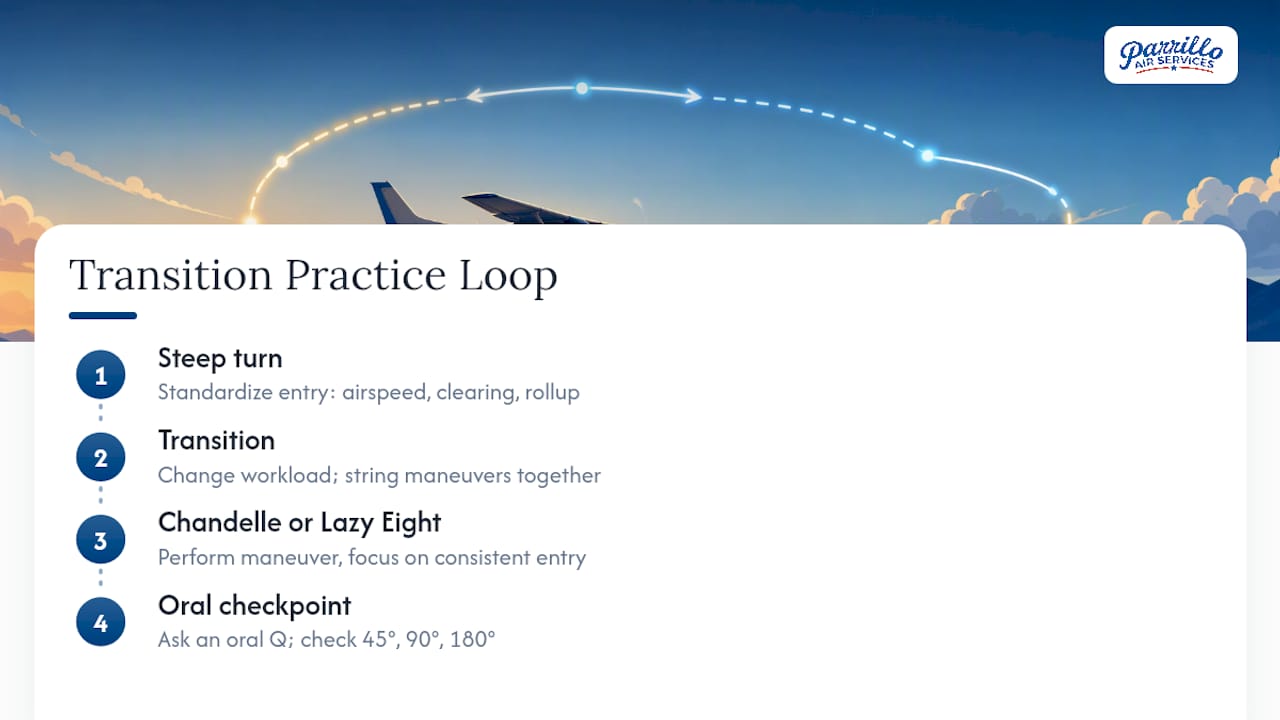
The most overrated piece of advice out there is chasing perfect numbers before the entry is standardized. A pilot who nails the tolerance on a steep turn but enters it inconsistently, wrong airspeed, no clearing turns, sloppy rollup, hasn't actually learned the maneuver. They've memorized a lucky outcome. Fix the entry first, every time, and the tolerances tend to follow.
If there's one thing worth prioritizing above everything else in this guide, it's the checkpoint habit: knowing what your airplane should be doing at the 45°, 90°, and 180° points of any maneuver, and checking it every single time. That single discipline, more than any control technique, is what separates a checkride pass from a repeat.
— Gm
Reading through checkpoints and tolerances gets you only so far. The gap between knowing what a chandelle should look like and actually flying one within ACS standards closes fastest with an instructor watching your entries, catching your rudder lag, and calling out your checkpoints in real time.

Commercial training is offered under FAA Part 61 with flexible scheduling so lessons can focus on whichever maneuver is actually giving you trouble instead of following a rigid week-by-week template. This approach is especially useful for maneuvers like lazy eights and steep spirals, where targeted practice on a weak checkpoint can be more effective than general practice. Students transferring credit through Liberty University can integrate a similar maneuver progression into their coursework. If you're ready to move from reading about ACS tolerances to actually meeting them in the airplane, get more information about our flight training programs and set up a lesson block built around where you need it most.
Master Ground Reference Maneuvers With 2–3 Circuits Per Lesson for Student Pilots
Parrillo Air Services
Commercial pilot certificate requirements: Your complete guide
Parrillo Air Services
Before Engine Start: Aeronautical Decision Making Pilots Must Run
Parrillo Air Services
Student Pilots: Short Field Takeoffs, POH Steps and 50% Margin
Parrillo Air Services