Aeronautical decision-making is the systematic, teachable process pilots use to spot hazards, weigh risk, and choose the safest course of action, continuously, from preflight planning to the moment the aircraft is tied down. It relies on structured tools like PAVE, 3P, and the 5 Ps rather than gut instinct. The single most useful habit you can build starting on your next flight: run a PAVE or 5P check before engine start, then hold yourself to a written personal minimum before you decide to go.
TL;DR:
- Using structured tools like PAVE and 5P helps pilots identify hazards and assess risks more effectively than relying on gut instinct or intuition.
- The four decision-making models — 3P, PAVE, 5P, and DECIDE — are designed for different moments in flight, from preflight to emergencies, and are most effective when their use is routine.
- Formal risk assessment tools like FRAT should be reserved for complex or unfamiliar flights, while quick frameworks like 5P support real-time decision checks.
- Recognizing and countering hazardous attitudes and cognitive biases, such as get-there-itis and confirmation bias, is critical to making safe, rational choices in flight.
- Consistent practice, scenario-based training, and thorough debriefs focused on decision processes are essential for internalizing ADM skills and improving flight safety.
Table of Contents
- What Is Aeronautical Decision Making, and Why Does the FAA Teach It?
- What Are the Main ADM Models Pilots Actually Use?
- How Do You Assess Risk and Set Go/No-Go Rules?
- How Do You Apply ADM at Each Phase of Flight?
- What Are the Five Hazardous Attitudes, and How Do You Beat Them?
- How Do You Practice and Train ADM Effectively?
- How Does Parrillo Air Services Build ADM Into Flight Training?
- What Cognitive Biases Trip Up Pilots Beyond the Five Attitudes?
- How Does Crew Resource Management Connect to ADM?
- Why ADM Training Needs to Feel Uncomfortable to Actually Work
- Ready to Practice ADM With an Instructor Who Actually Debriefs the Decisions?
- Where Can You Read More on ADM Fundamentals?
- Sources
What Is Aeronautical Decision Making, and Why Does the FAA Teach It?
The FAA defines aeronautical decision making, or ADM, as a systematic approach pilots use to consistently determine the best course of action in response to whatever circumstances a flight throws at them. That word "consistently" matters. ADM isn't a one-time judgment call you make when the weather looks sketchy. It's a loop that runs from the moment you start your preflight planning to the moment you shut down and walk away from the airplane, and it's built directly into the Pilot's Handbook of Aeronautical Knowledge.
Here's what a lot of student pilots get wrong when they first hear about ADM: they assume good judgment just accumulates with flight hours, the way muscle memory does with landings. The FAA's own guidance pushes back on that assumption directly. Judgment is a skill, not a byproduct of logbook time, and it responds to deliberate practice the same way stick-and-rudder skills do. A 5,000-hour pilot with no structured decision training can make worse calls than a 200-hour pilot who has drilled scenario-based ADM with an instructor.
Why does this matter enough for the FAA to build entire training chapters around it? Because the data behind general aviation accidents keeps pointing at the same root cause. The General Aviation Joint Steering Committee has repeatedly identified inadequate ADM and poor resource management as leading contributors to accidents that had nothing to do with mechanical failure or a lack of flying skill. The airplane worked fine. The pilot's decision process didn't.
That finding reshaped how the FAA structures pilot certification. ADM concepts now show up across every certificate level:
- Private pilot training introduces PAVE and basic risk assessment during the earliest cross-country lessons.
- Instrument training layers in scenario-based decisions around weather minimums and diversion planning.
- Commercial and flight instructor certifications expect you to teach ADM, not just apply it, which forces a deeper understanding of why each model works.
- Knowledge tests and checkrides both probe ADM reasoning directly, not just rote memorization of checklist acronyms, a point covered in detail in guidance on FAA knowledge test content.
The practical takeaway is simple: ADM isn't a soft skill bolted onto "real" flying. It's tested, it's trained, and it's the difference between pilots who handle a deteriorating situation calmly and pilots who get surprised by one.
What Are the Main ADM Models Pilots Actually Use?
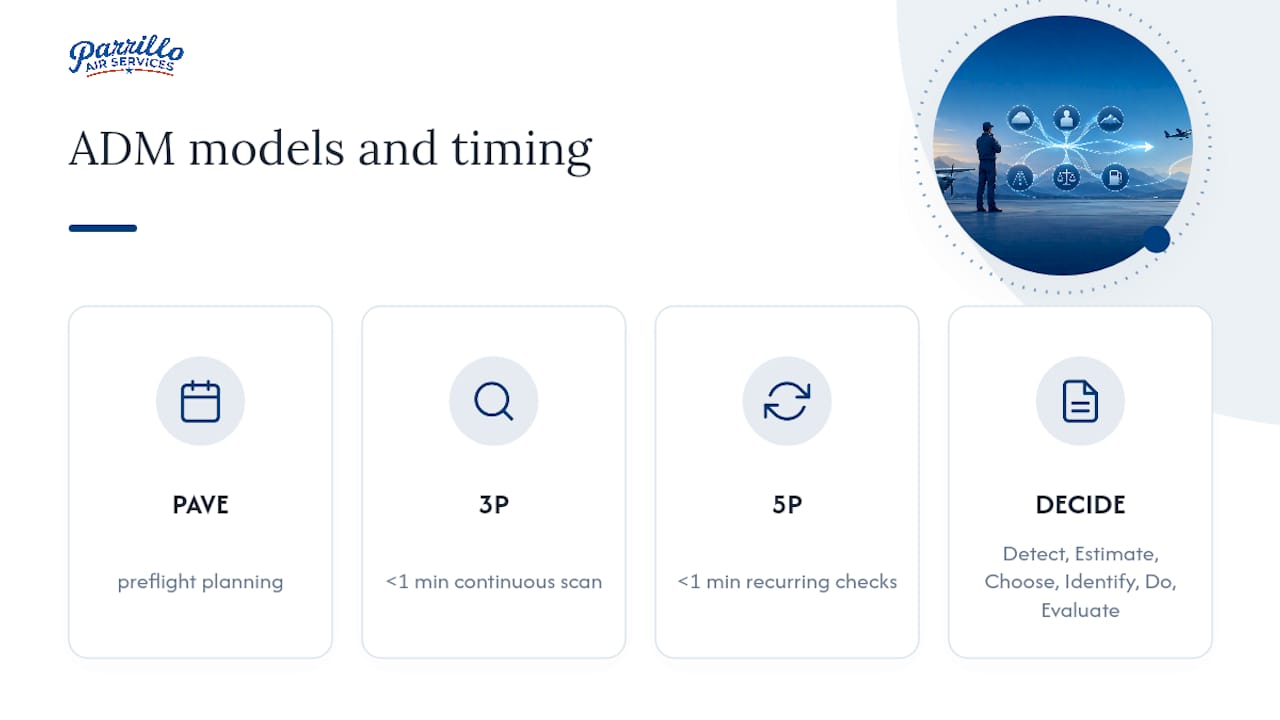
Four frameworks cover almost every decision-making situation you'll face in the cockpit, and each one is built for a slightly different moment in the flight.
3P: Perceive, Process, Perform
The FAA's preferred continuous-loop model is 3P, and it's designed to run in the background for the entire flight, not just at specific checkpoints. You perceive a hazard, process what it means for your flight, and perform an action, then the loop starts again. The FAA's ADM guidance pairs 3P with PAVE, CARE, and TEAM as the supporting checklists that fill in each step.
Here's a quick example. You're cruising at 6,500 feet and notice the outside air temperature has dropped and a haze layer is thickening ahead (perceive). You process that using PAVE: environment risk is climbing, your personal minimum for visibility is 5 miles, and you're currently looking at maybe 6 and dropping (process). You perform the action: request a lower altitude from ATC to stay clear of the haze layer, or turn back toward better conditions before visibility drops further (perform). The loop never stops running.
PAVE: the preflight hazard scan
PAVE breaks hazard identification into four buckets: Pilot (your own fitness and currency), Aircraft (mechanical status and performance limits), enVironment (weather, terrain, airspace, time of day), and External pressures (schedules, passengers, get-there-itis). It's taught in the Pilot's Handbook of Aeronautical Knowledge as the starting point for hazard perception, and it's tested directly on the private pilot knowledge exam and oral checkride portions, a topic covered in more depth in a checkride preparation checklist.
PAVE works best as a preflight tool because it's comprehensive but slow. Running through all four categories with real depth takes a few minutes, which is fine on the ramp and impractical at 3,000 feet with a rapidly forming thunderstorm fifteen miles out.
5P: the fast, recurring check
That's where the 5 Ps come in. Plan, Plane, Pilot, Passengers, and Programming cover similar ground to PAVE but are built for speed, meant to be run at specific decision points throughout the flight rather than once before departure. Formal risk sheets are useful teaching tools, but pilots tend to replace them in practice with faster frameworks like the 5 Ps precisely because a full FRAT worksheet doesn't fit into the ninety seconds you have before crossing the runway hold-short line.
Good checkpoints for a 5P run: before engine start, before takeoff, at the top of climb, roughly hourly during cruise, and before beginning a descent.
DECIDE: for problems that need structure, not speed
DECIDE is the six-step model for situations that don't resolve in seconds: Detect, Estimate, Choose, Identify, Do, Evaluate. It's less useful for the split-second go-around decision and more useful for something like a partial electrical failure at night, where you have a few minutes to work the problem methodically instead of reacting on instinct.
The four models aren't competing systems. PAVE catches what you should have thought about before you ever started the engine. 3P and 5P keep you scanning for new hazards once you're airborne. DECIDE gives you a structured fallback when something genuinely complicated shows up mid-flight. Most experienced pilots run all four without consciously labeling which one they're using at any given moment.
How Do You Assess Risk and Set Go/No-Go Rules?
Turning ADM models into an actual go or no-go decision requires a way to score risk, not just identify it. A Flight Risk Assessment Tool, or FRAT, does exactly that by asking structured questions across the same pilot, aircraft, environment, and external-pressure categories PAVE uses, then assigning point values that sum into a risk score.
The FAA's own guidance is candid about FRAT's limits: formal sheets are excellent for training and for planning unusual flights, but they're often too cumbersome for routine day-to-day operations. Nobody fills out a ten-question worksheet before a familiar pattern flight on a clear afternoon. Use a FRAT deliberately for cross-countries, unfamiliar airports, or marginal weather calls, and rely on the faster 5P check the rest of the time.
Once you've identified a hazard, three smaller frameworks help you actually process and respond to it:
- CARE works through the hazard itself: what are the Consequences if it goes wrong, what Alternatives exist, what's the Reality of the situation stripped of wishful thinking, and are there External factors changing the picture.
- TEAM covers your response options: Transfer the risk (bring an instructor or more experienced pilot), Eliminate it (cancel or reroute), Accept it (proceed knowing the risk), or Mitigate it (add fuel, delay departure, choose a different runway).
- IMSAFE checks whether you're personally fit to fly at all, covering Illness, Medication, Stress, Alcohol, Fatigue, and Emotion, and it's worth pairing with a look at why medical fitness standards exist in the first place.
None of this means much without numbers attached to it. Personal minimums turn abstract risk categories into concrete thresholds you check against before every flight:
| Category | Example personal minimum |
|---|---|
| Fuel reserve | Land with at least 1 hour remaining, not the FAA legal minimum |
| Visibility (day VFR) | adequate distance for safe visual flight, with higher caution advised in unfamiliar terrain |
| Crosswind component | 15 knots until 25 hours post-checkride, then reassess |
| Currency | recent flight experience required before solo cross-country flights |
| Ceiling | a cautious minimum altitude above ground level for pattern work in unfamiliar areas |
A pattern worth knowing: the GAJSC has flagged inadequate ADM and resource management as a recurring thread across general aviation accidents. It's rarely one bad decision. It's usually a chain of small, individually defensible ones that stacked up because nobody stopped to run the numbers against a written threshold.
Write your minimums down before you need them. Deciding in the moment, with a passenger in the seat next to you and a schedule to keep, is exactly when hazardous attitudes creep in.
How Do You Apply ADM at Each Phase of Flight?
ADM only works if it's built into a routine you run the same way every time, not something you remember to do occasionally when the weather looks bad. Here's a checkpoint structure that covers a typical flight from planning to landing:
- Preflight: Full PAVE scan plus a FRAT if the flight involves anything unfamiliar, night conditions, or marginal weather.
- Pretakeoff: A 5P check on the runway or hold-short line, focused specifically on anything that's changed since preflight.
- Top of climb / hourly in cruise: Repeat the 5P check, paying particular attention to fuel burn against your planned reserve and any weather trend.
- Pre-descent: Reassess Plan and Programming specifically, since this is where approach planning and airport weather become relevant again.
- Final approach: A last gut check limited to Plane and Pilot, since this is not the time for a full five-category review.
Three short scenarios show how the loop actually runs under pressure.
Weather deteriorating en route. You perceive a cloud layer lowering faster than forecast. You process it against your personal ceiling minimum and realize you'll be below it in fifteen minutes if the trend holds. You perform the action: request a diversion to an airport with better reported conditions, well before the ceiling actually closes in on you.
Unexpected maintenance discrepancy. You perceive a slightly rough-running engine on runup. You process the risk using CARE: the consequence of ignoring it could be an in-flight failure, and the reality is you have no way to diagnose it further on the ramp. You perform the TEAM response: eliminate the risk entirely by canceling and calling maintenance, even though it costs you the flight.

Passenger and time pressure. You perceive that your passenger has a tight schedule and keeps checking the clock while you're still finishing the weather briefing. You process this as an external-pressure hazard from PAVE, recognizing that the pressure is coming from someone else's timeline, not the actual flight conditions. You perform the fix directly: briefing your passenger up front that weather and fuel decide the schedule, not the calendar, defuses most of that pressure before it becomes a factor in your decision-making.
Diversion and cancellation phrasing works best when it's plain and non-negotiable: "We're diverting to [airport] because ceiling and visibility have dropped below my personal minimums," or "I'm canceling this flight due to a maintenance discrepancy I can't verify is safe." Neither sentence invites debate, and that's the point.
What Are the Five Hazardous Attitudes, and How Do You Beat Them?
Every pilot carries some risk of falling into one of five well-documented attitude traps, and recognizing them fast is often the entire fix.
- Anti-authority ("Rules are for other pilots") — antidote: "Follow the rules; they're usually right." Rehearse it by reading a regulation you disagree with and stating the antidote phrase out loud before dismissing it.
- Impulsivity ("I have to act now") — antidote: "Not so fast, think first." Practice by deliberately pausing five seconds before any in-flight decision during training flights, even obvious ones.
- Invulnerability ("It won't happen to me") — antidote: "It could happen to me." Review one accident report a month where the pilot's experience level matches your own.
- Macho ("I can do it") — antidote: "Taking chances is foolish." Practice by verbally acknowledging a limit out loud to your instructor or passenger instead of silently pushing through it.
- Resignation ("What's the use?") — antidote: "I'm not helpless. I can make a difference." Counter it by always identifying at least one action you can still take, even in a degraded situation.
Instructors can evaluate attitude recognition directly during training flights by deliberately introducing a minor pressure scenario, a slightly late departure, a borderline weather call, and watching whether the student names the attitude they're feeling before acting on it. A student who says "I'm feeling some get-there-itis right now" out loud has already done the hardest part of the fix.
How Do You Practice and Train ADM Effectively?
ADM improves the same way any other pilot skill improves: through repetition against realistic scenarios, not through reading about it once. A few structured drills make that practice concrete.
- Run a 5P check out loud at every lesson checkpoint, even on pattern flights, until it becomes automatic rather than something you have to consciously remember.
- Build scenario templates that start simple and add complexity over time. Begin with a single variable, low fuel on a otherwise normal flight, then progress to stacked scenarios combining weather, a minor mechanical discrepancy, and passenger time pressure simultaneously.
- Use flight simulators or even tabletop walk-throughs to rehearse decision points without the cost or risk of airborne training time. Simulators are particularly useful for scenarios you'd never want to practice for real, like an actual engine failure at low altitude.
- Draft written SOPs for recurring decisions rather than deciding fresh each time. A written rule like "cancel any flight if reported ceiling is below 2,000 feet AGL at the destination" removes emotion from the moment you're actually facing that ceiling.
Debriefs matter more than the flight itself. After a training scenario, the most useful question isn't "how was your landing?" It's "walk me through what you perceived, how you processed it, and why you chose that action." Shifting the debrief toward the decision process rather than raw flying performance is what actually builds judgment over time, and it's a habit worth carrying into every stage of training, including the persistence required to reach career-level certifications.
Measurable progress looks like fewer hesitations before stating a decision out loud, consistent use of the same model at the same checkpoints without prompting, and a written personal minimums sheet that gets updated as experience grows rather than staying static from the first solo flight.
How Does Parrillo Air Services Build ADM Into Flight Training?
Parrillo Air Services structures FAA Part 61 instruction around scenario-based lessons specifically because ADM has to be practiced with real hazards, not just discussed on a whiteboard. Flexible scheduling means lessons can be timed around actual weather changes rather than always flying in ideal conditions, which is exactly when ADM skills get tested for real.
A few resources worth reviewing before your next lesson:
- Go/no-go decision guide for building a personal minimums checklist.
- Weather and training schedules for understanding environmental risk factors.
If you're ready to practice these frameworks in the air with an instructor watching your decision process rather than just your stick-and-rudder skills, a discovery flight is a low-pressure place to start.
What Cognitive Biases Trip Up Pilots Beyond the Five Attitudes?
Hazardous attitudes get most of the attention in ADM training, but several cognitive biases operate quietly underneath them and don't fit neatly into any of the five categories.
Confirmation bias shows up when a pilot has already decided to go and starts unconsciously favoring weather sources that support that decision while discounting ones that don't. Checking three METARs and believing the one that says VFR conditions, while dismissing the two that suggest otherwise, is confirmation bias in action.
Anchoring happens when an early piece of information, like a favorable forecast checked the night before, keeps influencing a decision even after updated information contradicts it. The forecast from twelve hours ago shouldn't carry the same weight as the current METAR, but it often does psychologically.
Plan continuation bias, sometimes called "get-there-itis" in less formal terms, is the tendency to keep pursuing an original plan even as evidence mounts that conditions have changed. It's distinct from the macho or resignation attitudes because it's not about ego or giving up. It's simply momentum: the plan was made, and stopping it feels like more effort than continuing.
Recency bias leads pilots to overweight their most recent flight experience when assessing current risk. A pilot who flew successfully through marginal weather last week may underestimate similar risk this week, purely because the last outcome was fine.
None of these biases announce themselves. The fix is the same one that works for hazardous attitudes: name the bias out loud when you notice it operating, and treat that recognition as a cue to run your model again rather than trust your gut.
How Does Crew Resource Management Connect to ADM?
Crew resource management, or CRM, extends ADM beyond a single pilot's head and into every resource available during a flight, other crew members, passengers, air traffic control, and onboard technology. Even in a single-pilot general aviation cockpit, CRM principles apply in a scaled-down form sometimes called single-pilot resource management, or SRM.
The core idea is that good decisions rarely come from one person's judgment in isolation. A pilot flying solo still has resources: ATC can offer weather deviations or traffic advisories that change the risk picture, a passenger with local knowledge might flag something the pilot missed, and onboard avionics can confirm or contradict a gut read on conditions. SRM asks pilots to actively pull in that outside information rather than defaulting to whatever they perceived first.
In multi-crew environments, CRM formalizes this further through structured communication, one crew member cross-checking another's read of an instrument, both agreeing before executing a critical decision, and a culture where a junior crew member is expected to voice a safety concern even to a more experienced captain. That culture shift, treating disagreement as valuable rather than insubordinate, came directly out of accident investigations where poor communication, not poor flying skill, caused the crash.
For a student pilot, the practical takeaway is smaller in scale but identical in principle: your instructor, your passengers, and ATC are all resources your ADM process should actively use, not just background noise you tune out while running your own internal checklist.
Why ADM Training Needs to Feel Uncomfortable to Actually Work
Teaching decision-making to student pilots exposes a pattern fast: the students who improve the most are the ones who get put in scenarios where the "right" answer isn't obvious, not the ones who memorize PAVE and 5P as vocabulary words for a written test.
Here's what surprises a lot of new instructors: a student who nails every landing but freezes when asked to explain their weather diversion reasoning is a bigger safety concern than a student with slightly rough landings who can walk through CARE and TEAM confidently. Stick skills get corrected fast. Decision habits, once set wrong, take much longer to unlearn.
Three things worth doing immediately if you're serious about improving your own ADM. First, write your personal minimums down this week, not after your next scary flight. Second, practice saying hazardous attitudes and cognitive biases out loud when you notice them, even flying solo. Third, ask your instructor to debrief your decision process specifically, not just your flying, after every lesson.
— Gm
Ready to Practice ADM With an Instructor Who Actually Debriefs the Decisions?
Reading about PAVE and 5P checks builds the vocabulary. Flying scenarios where an instructor watches how you actually process a hazard, and asks why you chose that action instead of another, builds the judgment. That gap between knowing the models and using them under real pressure is exactly where Parrillo Air Services focuses its Part 61 instruction, with scenario-based lessons designed to put you in front of realistic decision points rather than just logging hours.

Personalized instruction and flexible scheduling mean lessons can be built around the exact conditions that test decision-making, not just clear-sky days that make everything look easy. Whether you're starting with a discovery flight or working toward a private pilot certificate, instrument rating, or commercial certification, every stage of training folds ADM practice into the actual flying rather than treating it as a separate lecture topic. Get the full breakdown of programs, timelines, and how to schedule your first lesson on the flight training programs page.
Where Can You Read More on ADM Fundamentals?
For readers who want the source material behind these frameworks: the FAA's Pilot's Handbook of Aeronautical Knowledge covers ADM foundations and testing scope. The FAA's dedicated ADM guidance document details 3P, CARE, and TEAM. GAJSC accident findings appear in the FAA Safety Briefing on ADM, and PAVE-specific detail is in FAA-H-8083-25C. For a business aviation angle on weather-driven go/no-go calls, see this guide on executive flight weather decisions.