The fastest, cheapest way to build flight hours is to get paid to fly. That means prioritizing a Certified Flight Instructor certificate first, layering in near-free options like safety-pilot swaps and flying clubs, and logging everything under 14 CFR §61.159 so nothing gets tossed out at a checkride. Here's what to do this week:
Building flight hours efficiently means getting paid to fly through CFI work while stacking low-cost options and airtight logbook discipline.
| Point | Details |
|---|---|
| CFI is the fastest paid route | Instructing converts rental hours into paid hours, often reaching 50 to 100 hours a month at busy schools. |
| Stack low-cost options early | Safety-pilot swaps, flying clubs, Civil Air Patrol, and Angel Flight add cheap legal hours while you train. |
| Track category hours separately | PIC, night, cross-country, instrument, and multi-engine minimums each matter for ATP and R-ATP eligibility. |
| Log every flight precisely | Note PIC status, conditions, and instructor certificate numbers to avoid losing credit at a checkride. |
| Parrillo Air Services sequences training to cut downtime | Its CFI pathway and flexible scheduling help students move through ratings without wasted Hobbs time. |
Becoming a CFI flips the entire cost equation. Instead of paying $150 to $250 an hour to sit in the right seat, you get paid to occupy it. Every hour of dual given counts toward your total time, and a busy instructor can log real cross-country, night, and instrument time on top of routine pattern work.
Instructors at active flight schools commonly fly 50 to 100 hours a month once their student load fills in, though the first two or three months after certification are usually slower while you build a reputation and a client base.
Getting there requires sequencing: private, instrument, commercial, then CFI, often followed by a CFII and MEI to widen your student pool and daily availability. Checkride prep eats calendar time more than flight time, so book your designated pilot examiner slot the moment your training provider clears you, rather than waiting for a "perfect" week.
Pro Tip: Ask a prospective employer how many hours their average first-year CFI logs. A school that can't answer that question probably can't keep you busy.
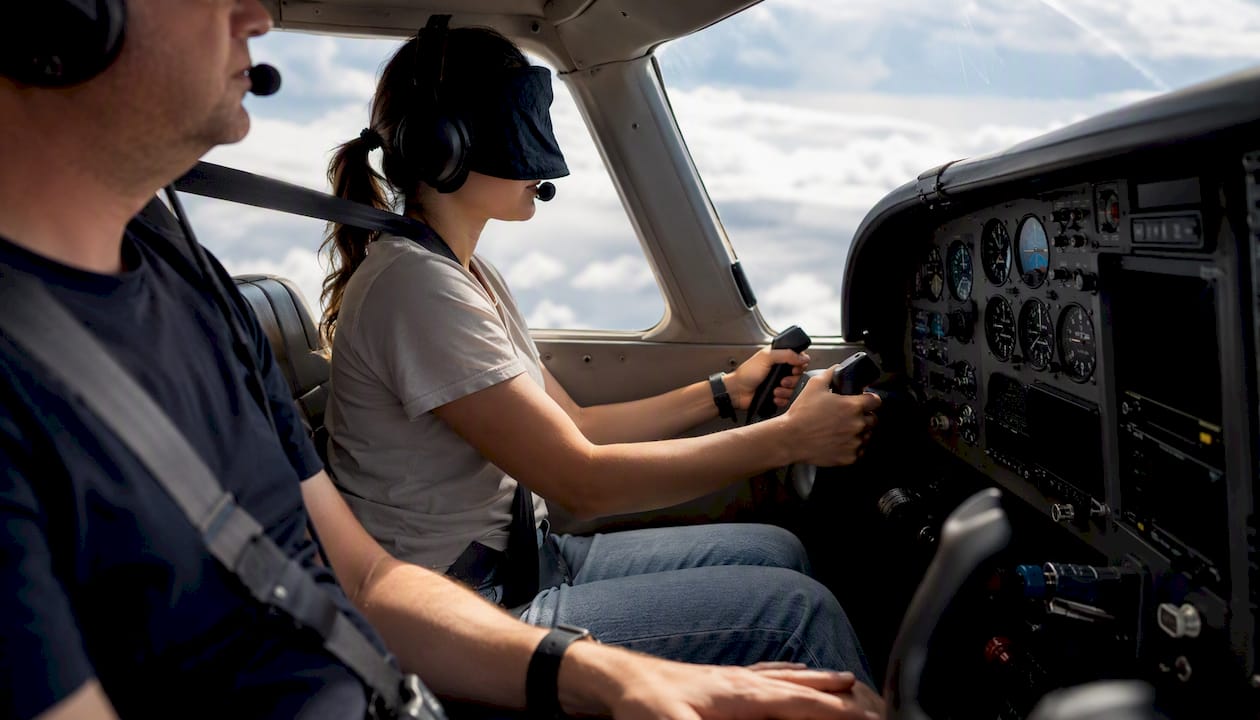
Not every hour needs a school's hourly rate attached to it. Safety-pilot arrangements let you log time as sole manipulator under a view-limiting device while a rated pilot serves as your required safety pilot; you split the Hobbs cost, and both pilots can log time depending on who's flying and who's acting as PIC per 14 CFR §61.51. Get the roles straight before you ever leave the ground.
Flying clubs and equity aircraft partnerships typically run well below school wet rates because you're paying closer to fuel and maintenance cost, not a profit margin layered on top of instruction. The tradeoff is scheduling: club aircraft get booked out, and you're competing with other members for prime slots.
Civil Air Patrol and Angel Flight both offer mission flying once you clear their qualification process, which usually takes a background check and a few orientation flights. CAP missions build legitimate cross-country and PIC time; Angel Flight compassion missions do the same while covering fuel costs for the flight.
Pro Tip: Bring your logbook to the first club meeting you attend. Members are far more likely to fly with a pilot who already looks organized and serious.
Banner towing, aerial survey, pipeline patrol, and skydive operations are the classic entry-level commercial gigs, and each has a distinct rhythm. Banner towing runs seasonal, heavy on weekends near beaches and stadiums, and pays modestly but logs tailwheel and low-altitude maneuvering skill fast. Aerial survey and pipeline patrol run longer contract blocks, often multi-week, and build steady cross-country PIC hours in a fixed geographic pattern. Skydive operations are high-cycle, short-hop flying that racks up landings and multi-engine or complex time depending on the aircraft.
The smart stacking strategy pairs a stable primary role, CFI work, with a seasonal supplement. Fly students on weekdays, tow banners on summer weekends, and take pipeline contracts during instructing lulls. Stacking paid roles with instructing creates more predictable monthly hours than betting everything on one seasonal job that dries up in the off-season.
The unrestricted ATP under 14 CFR §61.159 requires 1,500 total hours, but 14 CFR §61.160 carves out Restricted ATP paths that drop that threshold to 750, 1,000, or 1,250 hours depending on whether you came up through a military program, a bachelor's or associate's degree with an approved aviation curriculum, or a similar structured pathway.
Airlines and the ATP written both care about specific categories, not just total time: pilot-in-command, cross-country, night, instrument, and multi-engine hours each have their own minimums buried in the regulation. Track them separately in your logbook software or a spreadsheet, because "1,500 hours total" means nothing if you're short on night PIC.
Schedule the ATP-CTP course and written exam near the end of your hour-building runway, not the beginning. The course typically runs $3,950 to $4,800, and the knowledge fades if you sit on it for a year before applying to airlines.
A logbook entry needs the date, aircraft type and identification, route or purpose, and total flight time, with clear notation of who acted as PIC per 14 CFR §61.51. Safety-pilot entries should specify simulated instrument conditions and who held the controls. Dual instruction entries need the instructor's certificate number if you're logging toward a rating. Cross-country entries need the straight-line distance noted when it applies toward a certificate requirement.
The single fastest way to lose hours you thought you had is vague logging. A DPE or airline records auditor who can't tell whether you were PIC or safety pilot on a given leg will throw that time out, and you can't retroactively fix intent.
Chair-fly your sortie before you ever start the engine. Sit in a chair, run through checklist flow, radio calls, and maneuver sequence out loud, so the airborne time is execution, not discovery. A scripted 60 to 90 minute solo session might look like: three touch-and-goes with progressively shorter patterns, one simulated engine-out to a landing spot, then 20 minutes of slow flight and stall series in the practice area.
Use a simulator to knock out instrument procedure repetition and emergency drills, which preserves your actual Hobbs minutes for maneuvers and cross-country legs that need real airplane feel. Route your cross-country legs to hit multiple towered airports in one flight, which builds radio proficiency and satisfies mileage requirements simultaneously; a broader directory of U.S. airports helps when plotting routes that thread several qualifying stops into one trip.
Mission-based flying, where every sortie has a written objective before takeoff, consistently reduces wasted Hobbs minutes compared to open-ended "let's go fly around" sessions.
Pro Tip: Debrief every flight within an hour of landing while the details are fresh. A five-minute voice memo on what worked beats a vague memory a week later.
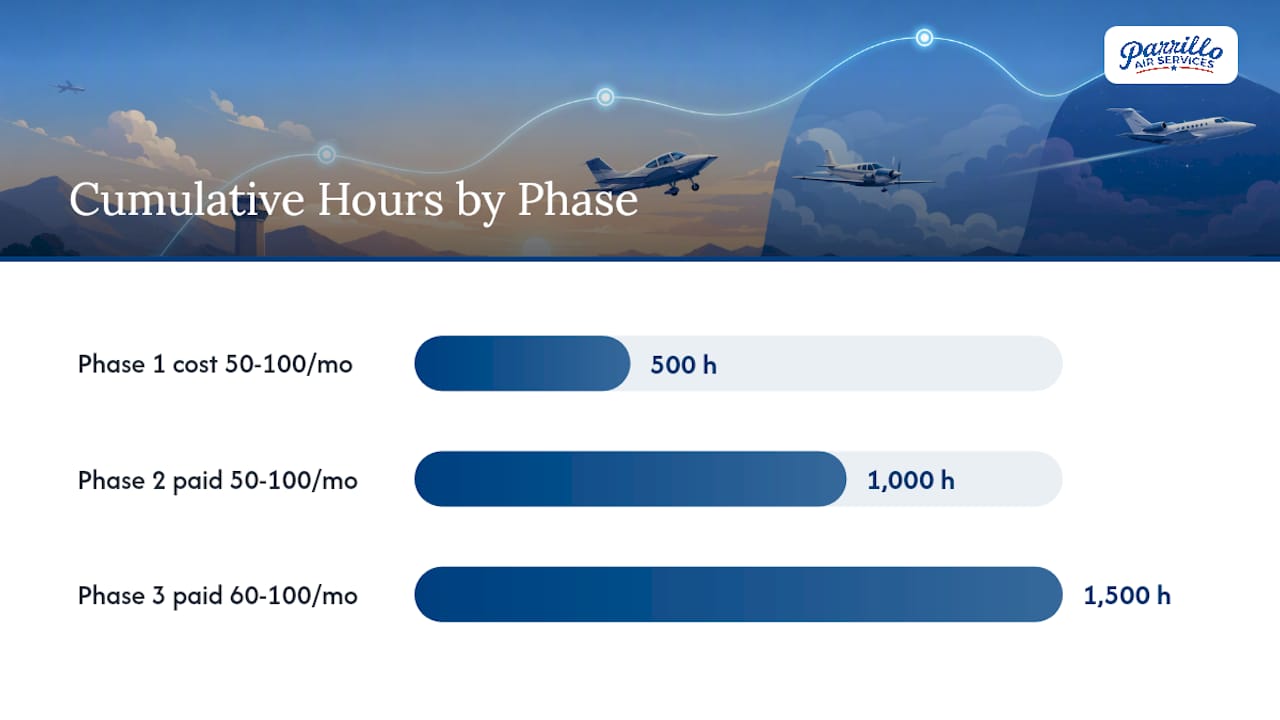
Most pilots move through three phases on the way to ATP minimums, and each phase leans on a different mix of paid and low-cost flying.
From zero to 500 hours, lean on flying clubs, safety-pilot swaps, and finishing your CFI training. Expect to still be spending money in this phase, though club rates and shared costs keep it well below retail school pricing. From 500 to 1,000 hours, CFI work becomes your primary engine, supplemented by seasonal banner towing or survey contracts when student demand dips. From 1,000 to 1,500, sustained instructing plus contract or Part 135 support flying rounds out category time you might still be missing, particularly multi-engine and night.
| Phase | Hours/Month | Cost or Pay | Cumulative Hours |
|---|---|---|---|
| Phase 1: club & CFI training | 50 to 100 | Net cost (rental/club rates) | 500 |
| Phase 2: CFI + seasonal work | 50 to 100 | Net paid | 500–1,000 |
| Phase 3: sustained CFI + contract | 60–100 | Net paid | 1,000–1,500 |
Your actual pace depends heavily on regional demand and weather windows, which the career progression guide breaks down in more depth.
We sequence Parrillo Air Services students so ratings build on each other without downtime, using our own scheduling and completion data to cut wasted Hobbs minutes between certificates.
Parrillo Air Services runs its CFI pathway with flexible scheduling built around the reality that most new instructors are juggling a second job while they build a student roster. Our instructor pathway sequences CFI, CFII, and MEI training so you're never sitting idle waiting on the next rating, and Liberty University students can transfer credit directly into the program instead of repeating coursework.

If you're closing in on your commercial certificate and wondering what comes next, a planning call maps your specific route to 1,500 hours, including when to schedule your ATP-CTP course so it lands near the finish line instead of a year before you need it.
Check these sources directly before making major training or logging decisions, since regulations and program details can shift year to year.
This article is general information, not a substitute for advice from a qualified lawyer. Consult a qualified legal professional about your own circumstances before acting on anything here.