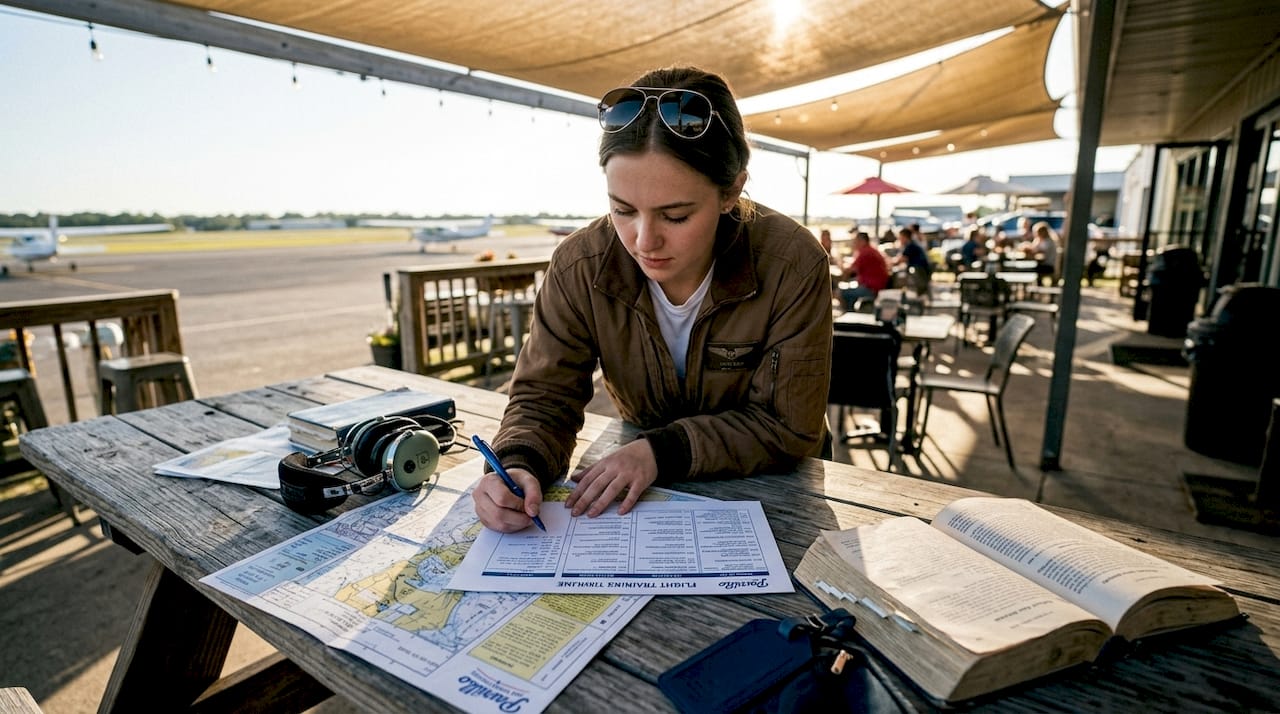
Flight training time commitment breakdown refers to the detailed allocation of hours and durations required at each pilot certification stage, from Private Pilot License through Airline Transport Pilot readiness. Most aspiring pilots underestimate the total investment. The full path from zero experience to airline-ready status takes 2–5 years depending on training pace, program type, and how consistently you fly. This guide covers every stage, compares Part 61 and Part 141 programs, and gives you a realistic pilot certification timeline to plan your career with confidence.
The Private Pilot License requires a minimum of 40 flight hours under Part 61, but most students average 60–75 hours before they are checkride-ready. That gap exists because the FAA minimum assumes ideal conditions. Weather delays, scheduling gaps, and the natural learning curve push most students well past 40 hours.
Full-time students typically finish their PPL in 3–6 months. Part-time students who fly once or twice a week often take 6–12 months. The difference is not just calendar time. Infrequent flying forces you to re-learn skills between lessons, which adds hours and cost.
Pro Tip: Start your ground school before your first flight lesson. Students who complete ground school early spend less time reviewing concepts in the cockpit and finish their PPL faster.

Part 61 programs are more flexible but generally require more flight hours and longer timelines than FAA-approved Part 141 programs. Part 141 students can complete their PPL in as few as 35 hours versus the 40-hour minimum under Part 61. That difference compounds across every subsequent rating.
Part 141 programs follow a structured, FAA-approved syllabus. Progress is tracked stage by stage, which keeps students on pace and reduces backtracking. Part 61 programs, like those offered at Parrillo Air Services, give instructors more flexibility to tailor lessons to each student's pace and learning style. That flexibility suits working adults and career changers who cannot commit to a rigid schedule.
The right choice depends on your lifestyle. If you can train full-time and want the fastest possible timeline, a Part 141 program delivers. If you need flexibility and personalized instruction, Part 61 is the stronger fit.
Typical durations for advanced ratings after PPL break down as follows. Each rating builds on the last, and skipping ahead is not an option. The FAA requires each certificate before you can pursue the next.
Pro Tip: Pursue your Instrument Rating immediately after your PPL while the skills are fresh. Students who wait more than a few months often need refresher hours, which adds time and cost.
Cumulatively, these four ratings add roughly 12–18 months to your training timeline after the PPL. Full-time accelerated programs compress this to the lower end. Part-time training stretches it toward 18 months or beyond. The airline pilot career pathway runs through every one of these ratings without exception.
Hour building is the most time-consuming phase of the entire pilot training schedule. The standard ATP certification requires 1,500 total flight hours. Most pilots exit their CFI training with 250–300 hours. That leaves 1,200 or more hours to accumulate before an airline will hire you.
Graduates of FAA-approved Part 141 bachelor's degree programs qualify for a Restricted ATP at 1,000 flight hours. Associate degree graduates qualify at 1,250 hours. That reduction shortens the hour-building phase by 6–12 months, which is a significant career advantage. If you are weighing whether a college degree matters for your aviation career, the R-ATP hour reduction is one of the strongest financial and time arguments for earning one.
| ATP Path | Hours Required | Estimated Time to Build Hours |
|---|---|---|
| Standard ATP | 1,500 hours | 18–24 months as a CFI |
| R-ATP (Associate degree) | 1,250 hours | 14–20 months as a CFI |
| R-ATP (Bachelor's degree, Part 141) | 1,000 hours | 12–16 months as a CFI |
Most pilots build hours by working as a CFI, flying charter, or doing banner towing. The CFI route is the most common because it pays while you fly. Accelerated full-time programs total 2–3 years from zero experience to ATP readiness when hour building is included. Part-time paths stretch to 4–5 years.
Flying frequently is the single most controllable factor in your training timeline. Students who fly 3 times per week averaged 55 total hours to reach checkride readiness, while students flying once weekly averaged 73 hours. That 18-hour difference translates directly into cost savings and months off your timeline.
Skill retention drops sharply when you go more than 5–7 days between flights. Your instructor ends up spending the first 20 minutes of each lesson reviewing what you forgot. Flying at least twice a week keeps skills sharp and lessons productive.
Realistic weekly schedule options:
| Training Frequency | Avg. PPL Hours | Estimated PPL Timeline |
|---|---|---|
| 3+ flights per week | ~55 hours | 3–5 months |
| 2 flights per week | ~65 hours | 5–8 months |
| 1 flight per week | ~73 hours | 8–12 months |
Weather and scheduling conflicts are unavoidable, especially at smaller airports. Build buffer time into your plan. If you expect to fly 3 days a week, plan your budget and schedule as if you will actually fly 2. That mindset prevents frustration and keeps your finances intact. The total flight training investment from zero to ATP-ready ranges from $80,000 to $150,000, and lesson frequency is one of the biggest levers you control.
The most direct path from zero experience to airline-ready pilot takes 2–3 years full-time, or 4–5 years part-time, with total flight training costs ranging from $80,000 to $150,000.
| Point | Details |
|---|---|
| PPL baseline hours | Most students need 60–75 hours, not the 40-hour FAA minimum, to reach checkride readiness. |
| Advanced ratings add 12–18 months | Instrument, commercial, multi-engine, and CFI ratings each require dedicated time after the PPL. |
| ATP hour reduction matters | A Part 141 bachelor's degree cuts the ATP requirement from 1,500 to 1,000 hours, saving 6–12 months. |
| Fly at least 3 times per week | Students flying 3 times weekly average 18 fewer hours than those flying once a week. |
| Part 61 offers flexibility | Part 61 programs suit working adults but typically require more total hours than Part 141 programs. |
Most aspiring pilots walk in expecting a clean, linear path. The reality is messier, and that is fine as long as you plan for it.
The biggest mistake I see is treating the FAA minimums as a budget. Forty hours for a PPL is a floor, not a target. Planning around 65–70 hours from the start means you will not be financially blindsided when you hit hour 50 and still need more practice on crosswind landings.
Consistency beats intensity over the long run. A student who flies twice a week for a year will almost always outperform one who flies every day for a month and then disappears for two months. Aviation skills are perishable. Treat your training schedule like a gym membership you actually use.
If your circumstances allow it, an accelerated program is worth serious consideration. Compressing the PPL through CFI phase into 7–8 months of focused training builds a stronger pilot than spreading the same content over 3 years of casual flying. The skills compound when you are immersed.
Ground school is where most students underinvest. The FAA Knowledge Test is not just a checkbox. Understanding the material deeply makes you a safer and faster learner in the cockpit. Start studying before your first lesson and never stop.
— Gm
Parrillo Air Services offers structured pilot training in Lynchburg, VA, covering every stage from the first discovery flight through Private Pilot, Instrument Rating, Commercial Pilot, and Certified Flight Instructor certifications.

The school operates under FAA Part 61, which means flexible scheduling built around your life, not a rigid classroom calendar. Experienced instructors work with each student individually to build skills efficiently and safely. Whether you are planning a full-time push toward an airline career or fitting training around an existing job, Parrillo Air Services has a path for you. Visit the flight training programs page to get detailed information on requirements, timelines, and next steps.