
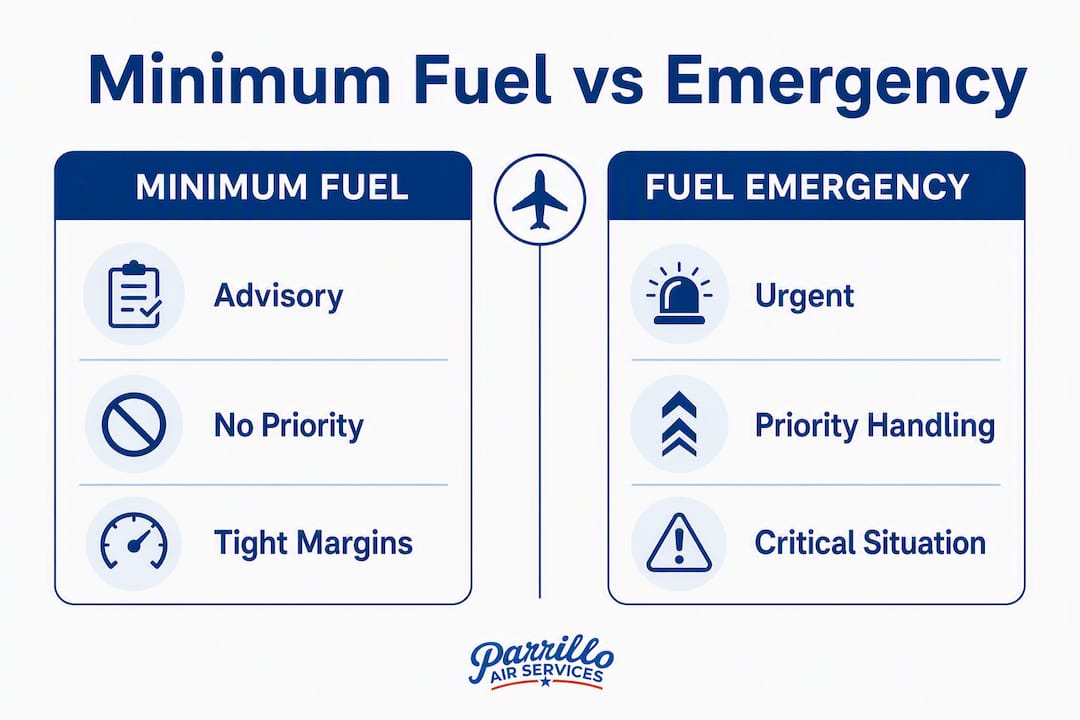
"Minimum fuel" means your aircraft can reach its destination, but you cannot accept any further delay without risking the ability to land safely. Per AIM § 5-5-15, it is an advisory, not an emergency declaration, and it does not automatically grant you priority handling from ATC.
TL;DR: "Minimum fuel" tells ATC your margins are tight. It does not trigger emergency procedures. If you actually need traffic priority to land safely, you must declare an emergency separately.
The FAA's InFO 08004 defines minimum fuel as a state where the aircraft can reach its destination but can accept little or no delay. The phrase "cannot accept any undue delay" is doing real work here. It does not mean you are out of fuel. It means your margin has shrunk to the point where any additional holding, vectoring, or sequencing could push you into a genuinely dangerous situation.
SKYbrary reinforces this with the PANS-ATM Doc 4444 definition: the flight is committed to land at a specific aerodrome, and no additional delay can be accepted. Both sources agree on the core point: this is an informational advisory, not a distress call.
One thing students consistently get wrong is assuming there is a specific fuel quantity that triggers the call. There is not. FAA legal guidance makes clear that no single numeric regulatory threshold defines minimum fuel. The declaration is based on pilot judgment, informed by the operator's Standard Operating Procedures.
Key fuel-state terms to know:
Controllers treat a minimum fuel advisory as exactly that: information. When you declare minimum fuel, FAA Order 7110.65R requires controllers to relay that advisory to any facility accepting control jurisdiction and to remain alert for any occurrence that might delay the aircraft. That handoff note matters more than most student pilots realize.
When a pilot states "minimum fuel," the controller logs it and passes it forward. The next sector already knows before you check in. That continuity is the system working as designed.
What controllers do not do is automatically bump you to the front of the sequence — even when you're enrolled in the best mileage programs for U.S. travelers that support efficient routing and prioritization. Minimum fuel does not confer priority handling. A controller who has five aircraft in a holding stack will acknowledge your advisory and watch for delays, but they will not necessarily pull you out of sequence unless you escalate.
What the controller does operationally:
The practical difference between an advisory and an emergency from the controller's side is significant. An emergency triggers coordination with crash/fire/rescue, clears the runway, and reshuffles the sequence. A minimum fuel advisory does none of that. It simply keeps everyone downstream informed.
Example scenario: You are inbound to Charlotte Douglas on a 45-minute leg and have just enough fuel to land with your required reserves. You check in with Approach: "Charlotte Approach, Cessna 172 November 4521 Bravo, minimum fuel." The controller acknowledges, notes it, and passes it to the tower on handoff. You get sequenced normally. If the controller then tells you to expect a 20-minute delay for traffic, that is your cue to reassess and potentially escalate.

This is where the confusion runs deepest, and where the stakes are highest. The two states are operationally distinct in almost every way.
Core differences at a glance:
Sample radio calls:
Minimum fuel advisory (initial contact):
Fuel emergency (Mayday declaration):
The Mayday call includes the distress signal three times, states the nature of the emergency, and gives fuel remaining in minutes. That last detail is not optional during an emergency. It tells the controller exactly how much time exists to solve the problem.
Decision flow: when to escalate from minimum fuel to Mayday
A lot of the confusion around this term comes from how it sounds. "Minimum fuel" feels urgent, almost alarming. That feeling leads to two opposite errors: pilots who over-declare it for minor tightness, and pilots who under-declare it because they do not want to "cause a fuss."
Myth-busters:
Scenario 1: The commuter flight facing a traffic delay
A regional turboprop is inbound to a busy hub with fuel calculated for destination plus required reserves. The pilot checks in with Approach and states minimum fuel. ATC acknowledges and sequences the flight normally. Twenty minutes later, the controller calls with a revised sequence that adds 15 minutes. The pilot immediately reassesses: landing with less than required reserves is now a real possibility. The pilot declares a fuel emergency, reports fuel remaining in minutes, and requests direct routing. ATC clears the sequence. The aircraft lands with reserves intact.
Scenario 2: The diversion that escalates
A student pilot on a cross-country leg encounters unexpected headwinds. Fuel burn is higher than planned. The pilot declares minimum fuel with the destination in sight but recognizes that a go-around would push fuel below final reserve. The instructor on the radio advises the student to commit to the landing and brief for a no-go-around scenario. The student lands on the first approach. No emergency was needed, but the minimum fuel call kept ATC informed and ready.
Sample radio phrases for correct use:
Fuel awareness and radio discipline are not advanced topics. They show up in training from the first cross-country flight, and how a student handles them under pressure is one of the clearest indicators of pilot judgment.
At Parrillo Air Services, instructors build minimum fuel scenarios into cross-country and instrument training sessions deliberately. The goal is not to scare students but to make the decision feel familiar before it ever happens in real life. A student who has practiced the radio call, run through the escalation decision, and talked through the SOP with an instructor will not freeze when fuel margins tighten on an actual flight.
Good fuel management is not about having a perfect plan. It is about recognizing when the plan has changed and communicating that change before it becomes a crisis.
Instrument rating training is where fuel management and radio procedures converge most directly. IFR operations involve holding patterns, alternate requirements, and ATC sequencing that can all affect fuel state. Students who understand minimum fuel before they start instrument training arrive with a significant advantage.
Instructors also use these scenarios to teach the harder lesson: that declaring an emergency is not a failure. SKYbrary and FAA guidance both caution against hesitation. The pilot who waits too long to escalate because they do not want to "bother" ATC is the pilot who ends up in the accident report. Parrillo Air Services trains students to see the Mayday call as a professional tool, not a last resort.
Run through this sequence the moment you recognize your fuel state is tight:
"Minimum fuel" is an advisory, not an emergency: it tells ATC your margins are tight, requires no priority handling, and must be escalated to a Mayday the moment you need traffic priority to land safely.
| Point | Details |
|---|---|
| Minimum fuel is advisory only | It informs ATC of tight margins but does not trigger priority handling or emergency services. |
| No fixed numeric threshold exists | The FAA sets no single quantity; pilot judgment and operator SOPs define when to declare. |
| ATC relays the advisory forward | Controllers pass the minimum fuel status to the next facility during handoff and monitor for delays. |
| Escalate to Mayday without hesitation | If you need priority to land safely, declare an emergency and report fuel remaining in minutes. |
| Parrillo Air Services trains this from the start | Scenario-based fuel management and radio procedure practice are built into cross-country and instrument training. |
Most of the accidents and incidents tied to fuel exhaustion share one feature: the pilot knew the situation was deteriorating and waited. They waited because declaring minimum fuel felt like admitting a mistake. They waited because escalating to a Mayday felt like overreacting. They waited because the destination was close and surely the sequence would work out.
It usually does not work out on its own. The system is designed to help pilots who communicate early and clearly. A minimum fuel advisory is not an admission of poor planning. It is a professional, proactive communication that keeps everyone in the loop. The controller who knows your margins are tight can make better decisions. The next sector that receives the handoff note is already prepared.
What actually concerns safety experts is not the pilot who declares minimum fuel too early. It is the pilot who waits until the gauges are critical before saying anything. By that point, the options have narrowed considerably.
The switch from minimum fuel to Mayday should be fast when conditions change. SKYbrary puts it plainly: pilots must prioritize safety and request traffic priority when fuel remaining requires it. That is not a suggestion. It is the standard.
Parrillo Air Services gives aspiring pilots in Lynchburg, VA, something most online guides cannot: real scenario training where fuel management decisions get practiced before they matter. The difference between reading about minimum fuel and actually calling it on the radio, with an instructor listening and ready to debrief, is the difference between knowing the term and owning the skill.

From your first cross-country flight through instrument rating training, Parrillo Air Services builds radio discipline and fuel awareness into every stage of the curriculum under FAA Part 61. Simulator sessions and scenario-based lessons put you in the cockpit for exactly the situations this article describes, with an instructor who can walk you through the escalation decision in real time.
Ready to train with instructors who treat fuel management as a core skill, not an afterthought? Schedule a discovery flight with Parrillo Air Services and see how practical, scenario-driven instruction prepares you for the real decisions ahead.
Schedule a discovery flight with Parrillo Air Services and see how practical, scenario-driven instruction prepares you for the real decisions ahead.
Schedule a Discovery Flight