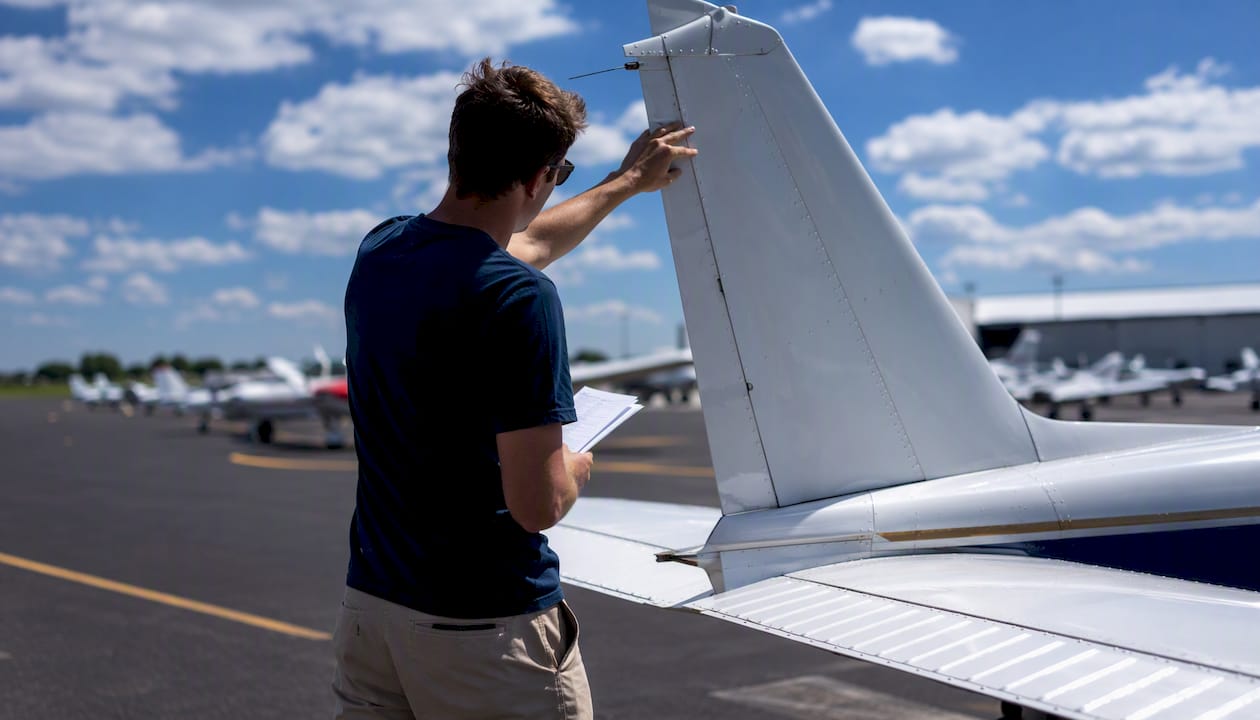
Solo flight hours matter because they develop the independent pilot-in-command (PIC) judgment, radio discipline, and decision-making under pressure that no amount of dual instruction can fully replicate. The FAA, AOPA, and the Society of Aviation and Flight Educators (SAFE) all treat solo time as a distinct training category, not just a checkbox. Parrillo Air Services structures its FAA Part 61 training around the same principle: solo hours are where student pilots stop performing for an instructor and start flying for real.
Three things solo time builds that dual instruction cannot:
The regulatory floor is specific. Under 14 CFR § 61.109, a Private Pilot applicant must log a minimum amount of total flight hours including a set number of solo flight hours. Those solo hours carry their own sub-requirements: a portion of solo cross-country flight, one solo cross-country over a specified distance with full-stop landings at multiple points, and a few solo takeoffs and landings at a towered airport.
FAR 61.87 governs the endorsement process. Before a student can fly solo, an authorized instructor must endorse the student's logbook twice: once for the specific make and model of aircraft, and once for the specific airport or practice area. The endorsement is not permanent. It expires 90 days after the date of issue, which means students who fall behind in training may need a re-endorsement before flying again. Read the regulation text yourself at eCFR — the plain language is accessible and worth knowing cold.
For logging purposes, FAR 61.51 allows a student pilot to log PIC time for any solo flight, provided they hold the required endorsement and are the sole occupant of the aircraft. That logged time counts toward certificate requirements.
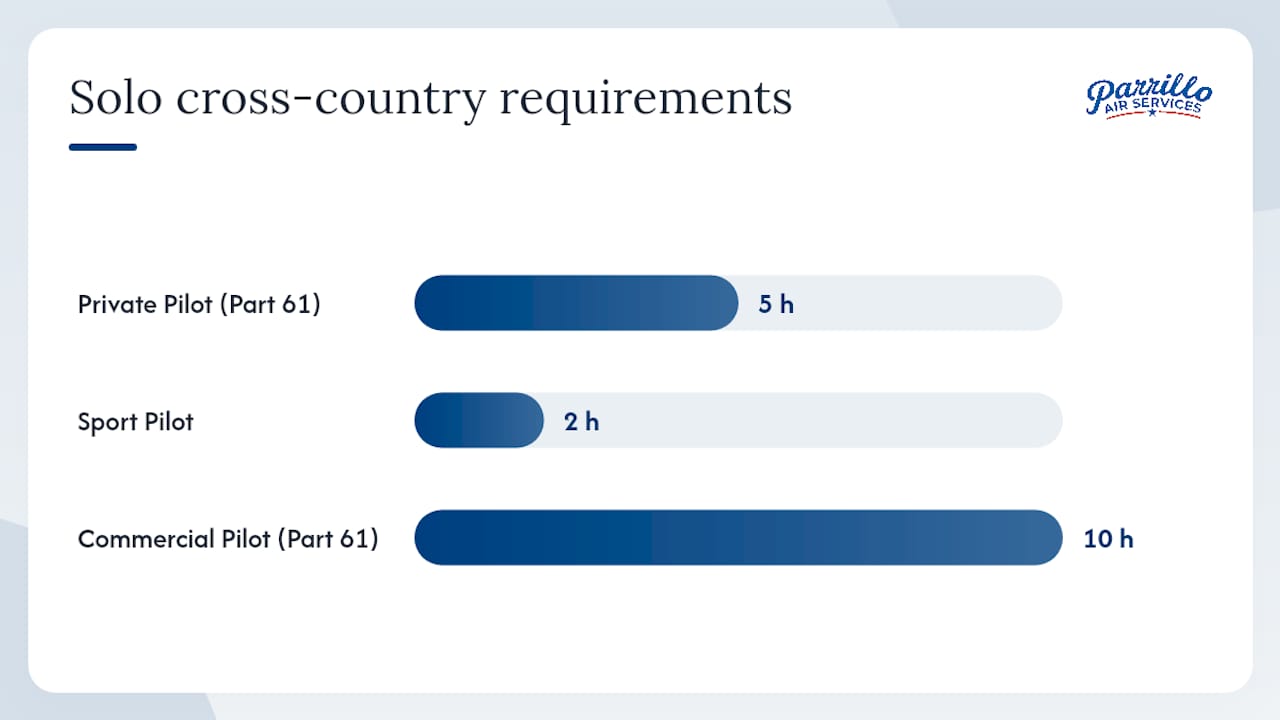
| Certificate | Total Hours (min) | Solo Hours (min) | Solo Cross-Country | Notes |
|---|---|---|---|---|
| Private Pilot (Part 61) | — | 10 | 5 hrs | Includes 3 T/O & landings at towered airport |
| Sport Pilot | — | 5 | 2 hrs | Lighter requirements, limited privileges |
| Commercial Pilot (Part 61) | 250 | — | 10 hrs | PDPIC may substitute for some solo time |
Pro Tip: Check your logbook endorsement dates before every solo flight. A lapsed 90-day endorsement grounds you just as effectively as a mechanical issue — and it's an easy thing to miss after a training gap.
The private-to-commercial progression is where solo time starts to matter financially. Commercial applicants under Part 61 need 250 total hours, including 10 hours of solo cross-country and specific night and instrument time. The regulation permits Performing the Duties of Pilot in Command (PDPIC) as a partial substitute, meaning a student can log certain flight time toward commercial requirements with an instructor on board, without it counting as true solo PIC time.
That substitution is legal. Whether it's wise is a separate question.
Key downstream effects of limited solo time:
Accumulating solo hours without a plan produces logbook entries, not pilots. AOPA and experienced CFIs recommend a progressive complexity model: traffic patterns first, then short local solos, then solo cross-countries with increasing route complexity.
Practical tactics:
For logging, FAR 61.51 is the governing rule. A proper solo logbook entry includes: date, aircraft make/model and registration, departure and arrival airports, total flight time, solo time in the appropriate column, and a brief remarks entry noting the nature of the flight (pattern work, cross-country, etc.). Keep your endorsement pages current and never log solo time without the corresponding endorsement on file. For step-by-step logbook templates, the practical guide to logging pilot flight hours covers the exact entry format.
Pro Tip: Build a solo training plan with your CFI before your first solo, not after. Map out the specific flights, routes, and skills you'll target across your 10 required solo hours. Students who plan their solo progression finish faster and log more useful time.
The industry consensus is clear, even if the regulatory minimum is modest.
SAFE's published critique of PDPIC argues that legal substitution creates a measurable experience gap. When a student never flies truly alone, they never fully internalize the weight of command. The pressure of being the only person in the aircraft, responsible for every decision, is not something dual instruction or PDPIC replicates.
AOPA's position is that the first solo is both a milestone and an ongoing training tool. Pattern solos and cross-country solos incrementally build PIC judgment beyond what dual instruction provides, and that development continues well past the private pilot checkride.
Recommended reading for students who want to go deeper:
Solo flight hours are the single training category where student pilots develop genuine PIC judgment, and no regulatory substitute fully replaces the skills built by flying alone.
| Point | Details |
|---|---|
| FAA minimums are a floor, not a goal | Part 61 requires 10 solo hours for a private certificate, but meaningful solo skill takes deliberate practice beyond that minimum. |
| Solo builds skills dual instruction cannot | Independent decision-making, radio management, and emergency handling develop differently when no instructor is present. |
| Log solo time correctly under FAR 61.51 | Record date, aircraft, airports, total time, solo column, and endorsement reference — every entry must match your logbook endorsement. |
| PDPIC is legal but carries tradeoffs | Commercial applicants may substitute PDPIC for some solo time, but SAFE and experienced CFIs warn it leaves a gap in independent command experience. |
| Parrillo Air Services | Structured solo progression and logbook guidance are built into Parrillo Air Services's Part 61 curriculum from day one. |
The decision to send a student solo is the most consequential call a flight instructor makes. What I'm watching for isn't a specific hour count. It's the moment a student stops looking at me for confirmation and starts trusting their own read of the situation. Consistent landings matter, but the behavioral signal that carries the most weight is self-correction: a student who catches a high approach, calls the go-around, and explains why without prompting has demonstrated something no maneuver grade captures.
Early solos surface one common mistake above all others: students rush. The pattern gets compressed, the checklist gets abbreviated, and the radio call comes half a beat late. The fix is deliberate slowing down, not more practice at speed. Fly the pattern wider than you think you need to. Give yourself more time on final. The aircraft is not in a hurry, and neither should you be.
Pro Tip: On your first solo, fly the pattern exactly as you practiced it with your instructor. This is not the flight to try anything new. Consistency is the entire point.
Student pilots who train under a structured solo progression program arrive at their private checkride with more than the minimum hours. They arrive with logged, credible PIC time and the judgment to back it up.

Parrillo Air Services offers FAA Part 61 flight training in Lynchburg, VA, with a curriculum designed to move students from discovery flight to solo to certification on a clear, instructor-guided timeline. Solo progression is built into the program from the start, not treated as an afterthought once the dual hours are done. Every student gets logbook guidance, a structured solo plan, and an instructor who tracks readiness against the same behavioral markers the research supports. If you're ready to start building real PIC time, schedule a discovery flight and see how the program works in practice.
Before your first solo, read the actual regulations. They're shorter and clearer than most guides suggest.