Most pilots-in-training assume avionics knowledge means memorizing where buttons live in the cockpit. That assumption creates real gaps. The role of avionics in training is far deeper than interface familiarity. It shapes how you build mental workflows, manage automation under pressure, and make decisions when conditions deteriorate fast. From your first ground school session to your first solo cross-country flight, avionics systems are actively forming your procedural habits and safety instincts. This guide breaks down exactly how that works, and what you can do to get the most from it.
| Point | Details |
|---|---|
| Avionics training builds mental models | Learning avionics shapes cognitive workflows and automation habits, not just button familiarity. |
| Structured progression matters | Effective training moves from ground school through procedure trainers to full flight simulators in deliberate steps. |
| TAA aircraft sharpen situational awareness | Training in FAA-defined Technically Advanced Aircraft builds skills directly transferable to airline cockpits. |
| Fidelity mismatches create risk | Using a low-fidelity training device for high-fidelity tasks produces gaps that carry into real flight. |
| Early preparation pays long-term dividends | Pilots who engage with avionics workflows before simulator sessions reach proficiency faster and retain it longer. |
Before you can appreciate how avionics shapes your training, you need to know what you are actually working with. Modern training aircraft are not the analog-gauge machines your grandparents flew. Today's training fleet is increasingly built around glass cockpit technology and integrated navigation systems.
Here are the key avionics systems you will interact with as a student pilot:
Primary Flight Display (PFD): Replaces traditional analog gauges with a single integrated screen showing attitude, airspeed, altitude, heading, and vertical speed in real time.
Multifunction Display (MFD): Presents moving map navigation, traffic, weather, and engine data on a second screen, giving you situational awareness well beyond what older cockpits allowed.
GPS Navigation Units: Systems like the Garmin GNS 430W provide integrated GPS moving map navigation, approach capability, and flight plan management.
Autopilot Systems: Units like the Garmin GFC 500 allow you to manage aircraft pitch, roll, altitude holds, and coupled approaches, which builds your automation management skills from early on.
Flight Management System (FMS): At more advanced training levels, the FMS coordinates navigation, performance data, and route management into one programmable unit.
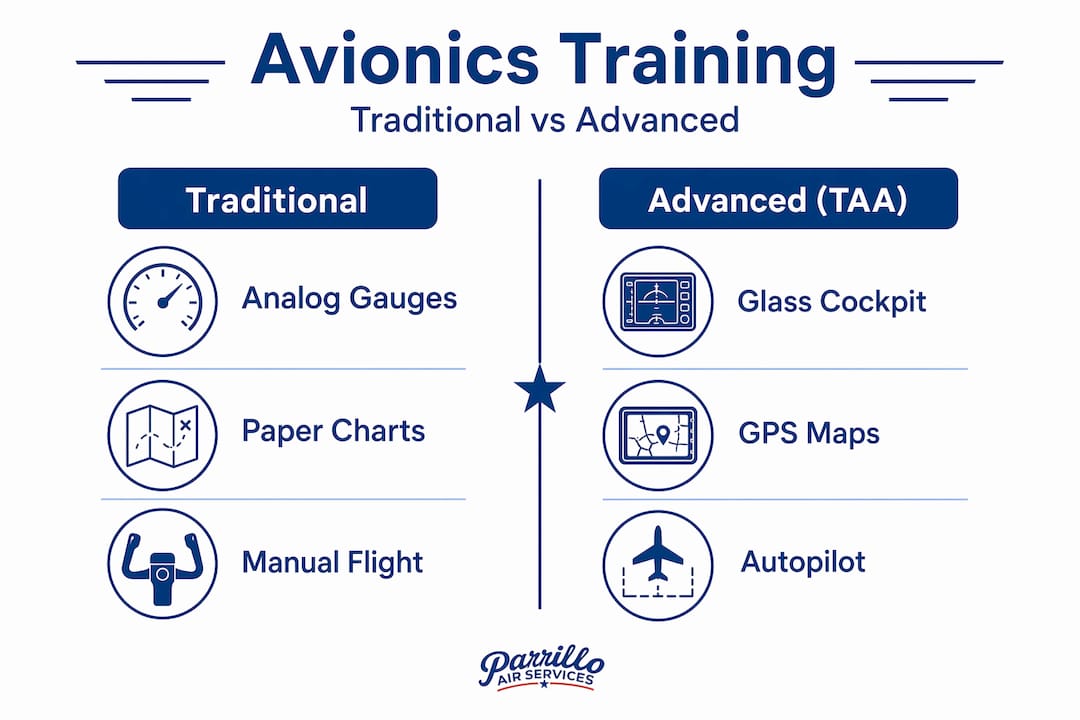
The FAA defines a Technically Advanced Aircraft (TAA) as one equipped with an electronic PFD, a GPS moving map with navigational capability, and at least a two-axis autopilot. This definition matters because TAA time counts toward your commercial pilot certificate requirements. Training in TAA-equipped aircraft is not a luxury. It is a deliberate step toward airline-ready skills.
| Feature | Traditional aircraft | TAA-equipped aircraft |
|---|---|---|
| Attitude reference | Analog gyro instruments | Electronic PFD with AHRS |
| Navigation display | VOR/ADF needle deflection | GPS moving map with MFD |
| Autopilot | None or single-axis wing leveler | Two-axis or full coupled autopilot |
| Situational awareness | Pilot-constructed mental picture | Integrated traffic, terrain, and weather data |
Pro Tip
When you start flying a glass cockpit aircraft, spend time on the ground running through the MFD pages and autopilot modes before each flight. Familiarity built on the ramp translates directly to confidence in the air.
Understanding a Garmin G1000 in theory is one thing. Using it correctly under workload is another. That gap is exactly why avionics training is structured as a layered progression rather than a single event.
Your first encounter with avionics is academic. You learn what each system does, how data flows between units, and what normal versus abnormal indications look like. This is where you build the foundational mental model that every future procedure depends on.
Tools like the Airbus Virtual Procedure Trainer digitally replicate cockpit procedures without requiring a full simulator. You practice sequences, mode selections, and checklists in a low-stakes environment. This builds procedural muscle memory before expensive simulator time begins.
High-fidelity simulators combine avionics interaction with realistic handling. You practice emergency procedures, instrument approaches, and systems failures. The simulator is where your ground school knowledge gets stress-tested.
Real flight time integrates everything. You apply avionics skills within actual aerodynamic and environmental variables, where the cost of error is real.
One reason this structure matters: training tools that lack evidence of measurable competence outcomes do not earn regulatory credit under FAA or EASA standards. That is why your training provider needs to match each device to its appropriate training role. A procedure trainer is excellent for building cockpit familiarity. It is not a substitute for full-motion simulation when you are training for upset recovery.
Pro Tip
Before every simulator session, brief yourself on the avionics workflows you expect to use. Walking through autopilot mode sequences or FMS programming in your head before you strap in cuts your warm-up time and keeps the session focused on skill, not fumbling.
Here is where most students underestimate what avionics training actually does for them. It is not about knowing which button arms the approach mode. It is about building the procedural mental models that keep you from task-shedding under pressure.
Task-shedding is what happens when workload spikes and your brain starts dropping lower-priority tasks to cope. Poorly trained pilots shed critical tasks because those tasks were never automated through repetition. Effective avionics training moves cockpit workflows from conscious effort into reliable cognitive habit.
Several concrete benefits follow from this:
Mode awareness. You know what the autopilot is doing, why it is doing it, and what it will do next. This is not trivial. A huge proportion of airline incidents involve pilots who were surprised by automation behavior.
Reduced error under pressure. When checklist sequences are internalized, you execute them correctly even when the situation is abnormal or stressful.
Crew Resource Management integration. APS-MCC training, which operates under EASA standards, combines theory and simulator sessions to build multi-crew cockpit workflow skills directly tied to avionics competency.
Threat and Error Management (TEM). Recognizing threats before they become errors depends on maintaining situational awareness. That awareness is substantially built through avionics data interpretation.
"The goal of avionics training is not to produce pilots who can operate the system. It is to produce pilots who think ahead of the system." This distinction separates reactive operators from genuinely safe aviators.
The impact of avionics on aviation training outcomes is measurable at the organizational level too. When pilots arrive at type rating courses with strong avionics mental models already in place, type-specific training is faster and retention is higher. That benefits both the individual pilot and the airline investing in their training.
The importance of avionics in training becomes clearest when you look at what goes wrong without it. One of the most common problems is a mismatch between the fidelity of training devices and the actual cockpit.
| Challenge | Risk | Best practice |
|---|---|---|
| Low-fidelity procedure trainer used for high-workload scenarios | Pilots develop incorrect habits for actual flight conditions | Match device fidelity to specific task requirements |
| Training treated as downstream from system design | Long adoption delays and costly retrofits | Integrate training requirements at Critical Design Review stage |
| Generic simulator without aircraft-specific avionics | Negative transfer of learned behaviors | Use type-specific or aircraft-similar avionics in simulation |
| No measurable competency outcomes from training tools | No regulatory credit earned for training hours | Select validated tools that produce documented competency evidence |
Military programs provide some of the clearest data here. Naval aviation programs that integrated training requirements early in avionics system design reduced time-to-proficiency by up to 40%. The U.S. Navy's training system for jet pilot preparation includes avionics-focused simulators covering heads-up displays, helmet-mounted systems, and precision landing modes. Civilian programs are adopting these same principles, particularly as TAA aircraft become the default in professional flight training.
A systems-training mindset offers a practical framework here. The principle: use the lowest-cost platform capable of delivering the required training outcome. Do not put procedural memorization tasks in a full-motion simulator if a desktop procedure trainer achieves the same result at a fraction of the cost. Reserve high-fidelity simulation for scenarios that genuinely require it.
Pro Tip
When evaluating a flight school, ask specifically what avionics are installed in their training fleet and whether their simulators match those systems. Consistency between the sim and the actual aircraft accelerates learning far more than flying hours alone.
Understanding the role of technology in flight training is only useful if you act on it. Here is how to engage with avionics training in a way that actually builds the skills professional aviation demands.
Prioritize training in TAA-equipped aircraft from the start. Your commercial pilot certificate requirements can be met with TAA time, and the skills transfer directly to airline equipment.
Desktop or tablet-based procedure trainers let you rehearse FMS programming, autopilot mode sequences, and approach procedures without burning simulator budget. Repetition here is free. Use it generously.
Read the pilot operating handbook sections on automated systems. Understand the logic behind mode sequencing, not just the steps. Pilots who understand the why adapt faster when something behaves unexpectedly.
Simulators build procedural proficiency. Actual flight builds sensory integration and judgment. Neither replaces the other. Schedule them in sequence so each session reinforces the last.
Programs like APS-MCC include scenario-based multi-crew training that directly targets avionics competency. If your path leads toward airline flying, structured multi-crew avionics training is not optional.
The avionics training benefits you build now carry forward through every rating, every type course, and every line check you will face in a professional career.
I have watched a lot of students approach avionics training like it is an inconvenient technical requirement, something to get through so they can focus on "real" flying. That framing is a mistake, and it tends to show up later in the most unforgiving moments.
In my experience, the pilots who struggle most in simulator evaluations are not the ones who lack stick-and-rudder skill. They are the ones who never built confident automation mental models. When the workload spikes and the autopilot does something unexpected, their situational awareness collapses because they never truly understood what the system was managing for them.
What I think gets overlooked too often is how early this foundation needs to be built. Waiting until your instrument rating to seriously engage with avionics workflows puts you behind. The student pilot phase is the right time to start understanding how glass cockpit data flows and what automation is actually telling you.
The research on early integration is compelling. Programs that treat avionics training as a design-first priority, not an afterthought, produce measurably faster and more confident pilots. That principle applies at the individual level too. The student who proactively studies cockpit workflows between sessions, rehearses FMS programming on a procedure trainer, and asks good questions about mode logic is the student who progresses fastest and retains the most.
My advice: treat avionics as the cognitive infrastructure your flying depends on. Build it deliberately, from day one.
— Gm

At Parrillo Air Services, based in Lynchburg, VA, FAA Part 61 flight training programs are built around the kind of modern avionics exposure that prepares you for professional aviation. Students train in aircraft equipped with contemporary glass cockpit systems, building the procedural mental models and automation management skills airlines expect before you ever reach a type rating course. From your private pilot certificate through instrument, commercial, and flight instructor ratings, every stage of training at Parrillo Air Services emphasizes avionics competency alongside real-world airmanship. Explore the full program details or reach out to schedule a discovery flight and see the training environment for yourself.
Avionics training builds the procedural mental models and automation management skills pilots need for safe, professional flight operations. It goes beyond interface familiarity to develop cognitive workflows that hold up under real workload.
The FAA defines TAA as aircraft with an electronic PFD, GPS moving map, and at least a two-axis autopilot. Training in TAA counts toward commercial pilot certificate requirements and builds directly transferable airline cockpit skills.
By internalizing cockpit workflows through structured repetition, pilots avoid task-shedding under pressure, maintain mode awareness, and execute critical procedures correctly even in high-stress or abnormal situations.
Both serve distinct purposes. Simulators build procedural proficiency and allow safe practice of abnormal scenarios. Actual flight integrates avionics skills with real sensory and aerodynamic inputs. Using them in sequence produces the best outcomes.
From the start. Students who engage with glass cockpit workflows during their private pilot training build stronger foundations that accelerate every subsequent rating and reduce time-to-proficiency in professional training environments.