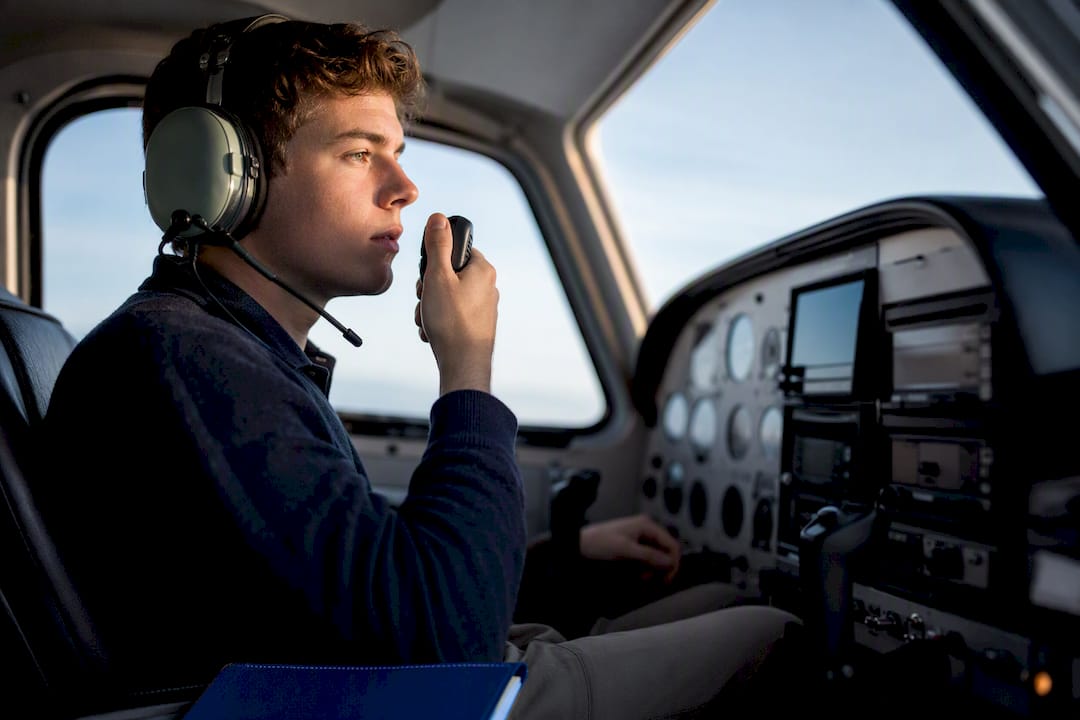
Every routine radio call breaks down into four parts: who you're calling, who you are, where you are, and what you want. On your first contact at a new field, tack "student pilot" onto your callsign if you need the controller to slow down or repeat something. Beyond that, one rule matters more than sounding polished: fly the airplane first, key the mic second.
TL;DR:
- Student pilots should always use the full four-part callup structure, especially when first establishing contact on new frequencies or at unfamiliar airports.
- Repeating critical instructions, such as runway or altitude assignments, verbatim and ending with your callsign ensures clear communication and reduces runway incursion risks.
- Practicing radio calls through written drills, listening to live traffic, and supervised exercises significantly improves fluency and confidence over time.
- When radio fails, squawk 7600 and follow standard procedures like visual signals or remaining on the last assigned route and altitude until safe to land.
- Using the phonetic alphabet for callsigns and numbers, especially "niner" for nine, minimizes confusion caused by static or accents during transmissions.
Table of Contents
- What Is the Four-Part Callup Every Student Pilot Should Know?
- Sample Radio Calls for Common Student Pilot Scenarios
- Which Frequency Do You Use, and What Does Each One Expect?
- What Do You Have to Read Back, and Why Does It Matter?
- How Should You Practice Radio Calls Before You're Comfortable?
- What Mistakes Do Student Pilots Make on the Radio?
- Why Do Pilots Use the Phonetic Alphabet and Special Numbers?
- What Do You Do If Your Radio Fails in Flight?
- How Do Transponder Codes Work With Radio Calls?
- What Separates Professional Radio Etiquette From Amateur Chatter?
- How Parrillo Air Services Builds Radio Skills Into Every Lesson
- Ready to Practice Radio Calls With an Instructor Beside You?
- Sources
- FAQ
Every routine radio call breaks down into four parts: who you're calling, who you are, where you are, and what you want. On your first contact at a new field, tack "student pilot" onto your callsign if you need the controller to slow down or repeat something. Beyond that, one rule matters more than sounding polished: fly the airplane first, key the mic second.
What Is the Four-Part Callup Every Student Pilot Should Know?
The four-part structure covers nearly every routine transmission you'll make as a student pilot, from a taxi request to a position report in the pattern. The AIM lays out this template because it forces you to organize your thoughts before you press the button, not while you're talking.
Here's what each slot means, with an example for each:
- Who you're calling: the facility you need. "Lynchburg Ground."
- Who you are: your aircraft type and full callsign on first contact. "Cessna one two three four five."
- Where you are: your position on the field or in the air. "At the main ramp."
- What you want: your specific request. "Ready to taxi for departure with information Bravo."
Put together: "Lynchburg Ground, Cessna one two three four five, at the main ramp, ready to taxi with information Bravo."
Busy frequencies call for a different rhythm. When ground or tower is stacked with traffic, use a two-step call: key up, state only who you're calling and who you are, then wait for them to respond before dumping your full request. This keeps the frequency from getting clogged with a long transmission nobody was ready to copy. A breakdown of the callup formula notes this two-step pattern exists specifically to protect controller workload on congested channels. On a quiet frequency with no one else talking, skip the two-step and just give the full call. It's faster for everyone.
One more thing that trips up new students: after your first exchange, the controller will often abbreviate your callsign, say to "three four five" or just "four five." Match that abbreviation on every subsequent call during that session. Reverting to your full callsign after they've shortened it isn't wrong, but it's unnecessary chatter, and controllers notice.
Sample Radio Calls for Common Student Pilot Scenarios
Rehearsing exact phrasing before you ever key the mic is one of the most useful things you can do between lessons. AOPA's sample radio calls cover the situations you'll hit constantly during early training, and adapting them to your airplane and airport takes just a few minutes.
- Taxi request (ground): "Lynchburg Ground, Cessna one two three four five, student pilot, at the main ramp, ready to taxi with information Bravo."
- Ready for departure (tower): "Lynchburg Tower, Cessna three four five, ready for departure runway two five."
- Departing the pattern: "Lynchburg Tower, three four five, request straight out departure."
- Entering downwind (towered field): "Lynchburg Tower, three four five, midfield downwind runway two five."
- Turning base: "Three four five, turning base runway two five."
- CTAF self-announce, inbound: "Smith Field traffic, Cessna one two three four five, ten miles northwest, inbound for landing, Smith Field."
- CTAF self-announce, entering downwind: "Smith Field traffic, Cessna three four five, entering left downwind runway one eight, Smith Field."
- CTAF self-announce, on final: "Smith Field traffic, Cessna three four five, final runway one eight, Smith Field."
- Requesting a frequency change: "Lynchburg Ground, three four five, request frequency change to Unicom."
- Practice area position report: "Lynchburg Approach, Cessna three four five, request flight following to the practice area, ten thousand feet."
Notice the pattern across these: your first call at any new frequency gets the full treatment, including your complete callsign and, where it helps, the words "student pilot." Every follow-up call on that same frequency gets shorter. Once tower has said "three four five, cleared to land," you don't need to reintroduce yourself or restate the runway. You're already in the conversation.
Add "student pilot" specifically when you're new to a facility, working an unfamiliar procedure, or genuinely unsure what to say next. AOPA's guide for new pilots points out that controllers tend to slow down and simplify their instructions once they know a student is on frequency. You don't need it on every single transmission, just when it buys you something.
Which Frequency Do You Use, and What Does Each One Expect?
Every flight touches several different frequencies, and each one has its own rhythm and expectations.
- ATIS: a recorded loop of weather, runway in use, and field conditions, updated regularly and identified by a phonetic letter (Alpha, Bravo, Charlie). Listen to it before your first call and reference the letter so the controller knows you have current information.
- Ground control: handles taxi instructions and ramp movement at towered airports. Short, transactional exchanges.
- Tower: manages runway operations, takeoff and landing clearances, and pattern traffic.
- Approach/Departure: handles aircraft transitioning to and from the airport, often assigning headings, altitudes, and traffic advisories.
- CTAF/Unicom: used at non towered airports where pilots self-announce position and intentions since there's no controller.
- Emergency (121.5): the universal distress frequency, monitored by many facilities and satellites, reserved for real emergencies or when you've lost communication elsewhere.
Listen before you transmit. That's true on every frequency, but it matters most on ATIS and CTAF, where stepping on someone else's call or asking for information already broadcast wastes everyone's time.
At non towered fields, timing your self-announces matters as much as the wording. A rough guide many instructors teach: call around 10 miles out when inbound, then again entering the pattern, turning base, and on final. That spacing gives other traffic enough warning to sequence around you without cluttering the frequency with constant chatter.
What Do You Have to Read Back, and Why Does It Matter?
Not every ATC instruction requires a verbatim readback, but several specific ones do, and skipping them is one of the fastest ways to create a dangerous misunderstanding. The AIM lists the items that must be read back exactly:
- Runway assignment: "Cleared for takeoff runway two five, three four five."
- Hold-short instructions: "Hold short runway two five, three four five."
- Assigned altitude: "Climb and maintain three thousand, three four five."
- Assigned heading: "Fly heading two seven zero, three four five."
- Frequency changes: "Contact ground point six, three four five."
Readbacks exist because a misheard runway or a missed hold-short instruction has caused real runway incursions. NTSB analyses of these incidents repeatedly identify readback failures as a causal factor, which is exactly why the AIM treats this as non-negotiable rather than optional courtesy.
Note the distinction: "roger" just means you heard the transmission. "Wilco" means you heard it and will comply. Neither one satisfies a required readback. If the instruction involves a runway, altitude, heading, or frequency, you repeat the specific numbers back, not a vague acknowledgment.
How Should You Practice Radio Calls Before You're Comfortable?
Radio fluency builds the same way any other flying skill does: in small, repeatable steps, not by hoping it clicks on your first solo. Many flight instructors follow a version of this five-step progression, moving from ground-based drills into supervised and then independent transmissions, based on how CFIs commonly sequence radio training.
- Reframe the fear. Talking on the radio feels high stakes because everyone on frequency can hear you mess up. Recognize that every pilot on that frequency was a student once.
- Paper drill. Write out the four-part callup for five different scenarios using your home airport's actual runways and frequencies.
- LiveATC listen-along. Spend 30 minutes streaming real traffic on Liveatc and try predicting what the pilot will say before they say it.
- Listen-only flight. Sit in the airplane or a simulator app and just listen to the pattern of calls without keying the mic yourself.
- Supervised calls, then solo. Your instructor makes the first few calls, then hands you specific ones, then steps back entirely.
Between formal lessons, chair-flying is the highest-value drill you're not doing enough of. Sit somewhere quiet, run through an entire flight out loud, taxi call, takeoff call, pattern calls, and shutdown, using your actual airport's layout. Recording yourself and playing it back exposes filler words and hesitations you don't notice in the moment.
For structured practice tools, look at three categories: live audio streams like LiveATC, simulator apps that let you rehearse calls tied to a visual scenario, and roleplay sessions with your instructor where they play the controller. Instructor resources like those from Simulator Center Training round out this practice with structured scenario work you can't get from audio alone.
What Mistakes Do Student Pilots Make on the Radio?
A few errors show up constantly during early training, and all of them are fixable in the moment.
- Talking over someone else. If you key the mic and hear another transmission already in progress, release and wait. Don't try to talk louder or faster.
- Truncating your callsign incorrectly. Dropping to "four five" before the controller has abbreviated it first can create confusion with another aircraft on frequency.
- Paraphrasing a readback instead of repeating it. "Got it, taking off" is not a readback. "Cleared for takeoff runway two five, three four five" is.
When you catch yourself mid-mistake, correct it cleanly rather than fumbling through it. Say "Correction, Cessna one two three four five is holding short runway two five" and move on. Controllers hear corrections constantly, and a clean fix reads as competence, not failure.
If flying the airplane and talking on the radio start competing for your attention, the radio loses every time. Say "stand by" and finish flying. A late radio call is a minor inconvenience. A mishandled airplane is not.
Why Do Pilots Use the Phonetic Alphabet and Special Numbers?
Clear enunciation on the radio isn't a stylistic choice. Static, accents, and weak signals distort speech, and single letters especially get lost easily. Q sounds like U, M sounds like N, B sounds like D. The phonetic alphabet, Alpha, Bravo, Charlie through Zulu, exists specifically to eliminate that confusion.
Your tail number gets spoken phonetically every time: N12345 becomes "November one two three four five," though in normal domestic operations you'll typically drop the November and controllers will address you by your aircraft type and the numbers, like "Cessna one two three four five."
Numbers get their own treatment too. Each digit is spoken individually rather than as a whole number, so 3,500 feet is "three thousand five hundred," and a squawk code like 4602 is "four six zero two," not "forty six oh two." The exception that trips up nearly every new student: the number nine is pronounced "niner." That's deliberate. Spoken quickly over a radio, "nine" and "five" can sound nearly identical, especially with background noise or an accent. "Niner" avoids that ambiguity entirely, and it's the only number in the entire system that gets a modified pronunciation.
Practice saying your callsign and common numbers out loud until the phonetics come automatically. Hesitating over how to say your own tail number is a fixable problem, and it's one of the easiest wins in your entire radio training.
What Do You Do If Your Radio Fails in Flight?
Lost communication is one of those emergencies that sounds terrifying until you actually walk through the procedure, at which point it becomes almost mechanical.
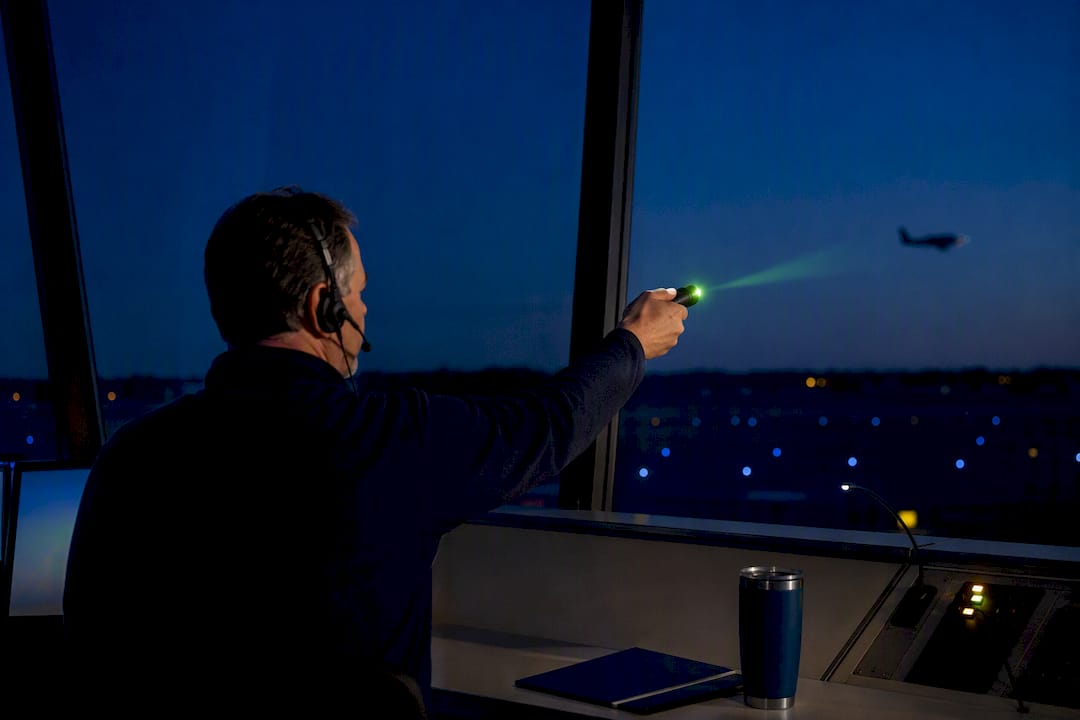
If you're in the pattern at a towered airport and lose your radio, watch the tower for light gun signals. A steady green means cleared to land or take off, depending on whether you're airborne or on the ground. Flashing red means the airport is unsafe, don't land. Steady red means give way and continue circling.
If you lose communication while in the air on an IFR flight plan or receiving flight following, the general guidance is to squawk 7600 on your transponder, which signals radio failure to controllers without you saying a word. Continue on your last assigned route and altitude, or your filed flight plan if no specific assignment was given, and land as planned. Controllers will clear traffic out of your path once they see that code.
For a student pilot flying VFR near a towered field, the simplest fix is often the best one: if you can still receive but not transmit, try acknowledging instructions by rocking your wings or, at night, turning your landing light on and off. If you can do neither, proceed to the pattern, watch for light signals, and land using standard traffic pattern procedures while staying alert for other aircraft.
How Do Transponder Codes Work With Radio Calls?
Your transponder and your radio work as a team, not as separate systems. When a controller assigns you a discrete code, like "squawk zero two five three," you read it back exactly as instructed, the same way you'd read back a runway or altitude assignment. Dial in the code, and the controller can then identify your specific aircraft on their radar display among dozens of other targets.
A handful of codes exist outside normal assigned traffic and carry universal meaning regardless of what frequency you're on. Squawk 7700 signals a general emergency. Squawk 7600 signals radio failure, covered in the lost communication procedures above. Squawk 7500 signals unlawful interference, essentially a hijack code you'd hope to never need. None of these require you to say anything on frequency, which matters if your radio has failed or you're too busy managing an emergency to talk.
Outside of an assigned code, most VFR flights squawk 1200 by default when not receiving air traffic services, though this varies somewhat by country and airspace. Once you check in with approach or departure and receive a discrete code, that number becomes part of how the controller tracks and refers to you, even though they'll still call you by your aircraft type and callsign over the radio.
What Separates Professional Radio Etiquette From Amateur Chatter?
Brevity is the entire game. The AIM's own guidance on communications phraseology makes clear that controllers value being brief, organized, and predictable over sounding polished or formal. A student pilot who says exactly what's needed, in the right order, sounds more professional than one straining for confident-sounding filler.
A few habits separate smooth radio work from awkward radio work. Think through your call before you key the mic, especially on a busy frequency where dead air costs everyone time. Never use "please" or "thank you" mid-transmission. It wastes airtime, and while it's not technically wrong, controllers notice the seconds it adds up over a busy shift. Keep your tone level and unhurried even when you're nervous. Speed doesn't equal competence, and a controller would rather hear a clear, slightly slower call than a fast, garbled one.
If you don't understand an instruction, say "say again" rather than guessing or reading back something you're not sure about. That single phrase has probably prevented more incidents than any other tool in your vocabulary. Professionalism on the radio isn't about sounding like an airline captain. It's about being predictable enough that the controller never has to wonder what you're going to do next.
How Parrillo Air Services Builds Radio Skills Into Every Lesson
Radio training at Parrillo Air Services follows the same staged approach outlined above: your CFI makes the early calls while you watch and listen, then hands you specific transmissions once you're ready, then steps back as you take over full radio duty before solo. That progression is baked into how flight training programs are structured, not treated as a side skill. If radio work is the piece holding back your confidence, a focused practice session or a discovery flight is a direct way to work on it with real feedback in real time.
— Gm
