You are ready for your checkride when you can walk in with every required document in hand, an airworthy aircraft with complete paperwork, and the ability to demonstrate every Private Pilot ACS task to tolerance. If any item below is missing, fix it before you schedule the date.
Quick pass/fail check — run this in five minutes:
If any answer is no, call your CFI today. IACRA submissions and logbook corrections cannot be rushed on checkride morning.
A complete private pilot checkride preparation checklist covers documents, aircraft paperwork, ACS-aligned maneuver practice, and a structured mock-checkride plan run with your CFI in the final 7–14 days.
| Point | Details |
|---|---|
| Documents are non-negotiable | Bring photo ID, medical/BasicMed, AKTR, IACRA confirmation, and all FAR 61.39 logbook endorsements — missing one ends the checkride. |
| Aircraft paperwork must be current | Verify ARROW documents, annual inspection, ADs, ELT battery, and transponder test (24-month) before checkride morning. |
| Aim for center of ACS tolerance | Target ±50 ft and ±5 kts rather than the published ±100 ft and ±10 kts limits so a momentary deviation stays inside the standard. |
| Mock orals beat flashcards | Run timed, CFI-graded oral sessions with your actual document packet and POH; scenario-based answers outperform rote recitation every time. |
| Parrillo Air Services prep sessions | Parrillo offers mock orals, mock checkride flights, and paperwork review in Lynchburg, VA, graded to ACS standards with one-on-one instruction. |
The DPE checks your paperwork before the oral begins. Missing a single item ends the checkride before it starts. Bring everything in a dedicated folder or three-ring binder with photocopies in a separate sleeve.
Regulatory callouts that matter: FAR 61.39 lists the eligibility requirements the DPE verifies before the oral. FAR 61.109 specifies the aeronautical experience minimums. Your CFI's endorsement must explicitly state that you have received training on the areas of deficiency identified on your knowledge test and that you are prepared for the practical test — a generic signature is not enough.
Pro Tip: At least seven days before your checkride, sit down with your CFI and physically open your logbook together. Verify every endorsement is present, legible, and dated correctly. Catching a missing endorsement on day seven gives you time to fix it; catching it on day zero does not.
The DPE's preflight document review covers the aircraft as thoroughly as it covers you. The memory aid most pilots learn is ARROW: Airworthiness certificate, Registration, Radio station license (international flights), Operating handbook/POH, and Weight and balance data. That is the floor, not the ceiling.
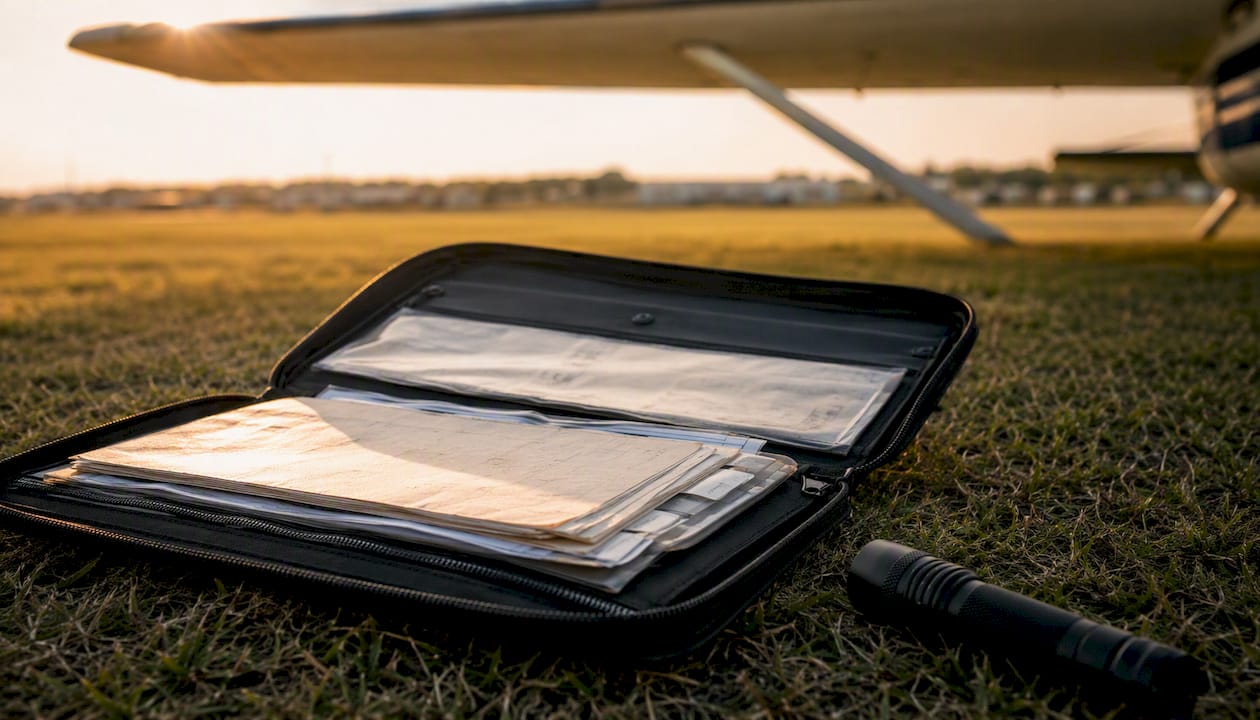
Aircraft documents the DPE will check:
| Document | Where to find it | What the DPE looks for |
|---|---|---|
| Airworthiness certificate | Displayed in the aircraft (usually on the instrument panel) | Original, not a copy; no expiration date but must reflect current aircraft configuration |
| Registration certificate | Aircraft document pouch | Current and matches the N-number on the aircraft |
| POH / AFM | Cockpit, specific to the aircraft serial number | Correct edition for that tail number; operating limitations section intact |
| Weight and balance data | POH supplement or separate document | Current data reflecting installed equipment; signed by an A&P if equipment was added |
| Maintenance logbooks | With the aircraft or FBO | Annual inspection current; all ADs complied with and signed off |
| ELT inspection record | Maintenance logbook | Battery replacement and inspection current |
| Transponder test record | Maintenance logbook | VFR Mode C transponder tested within 24 calendar months |
The Gleim ACS Companion Guide reproduces the practical-test checklist DPEs actually use during this review — download it and compare your aircraft's paperwork against it before the checkride.
Required VFR instruments and equipment: The FAR 91.205 list covers the basics (TOMATO FLAMES for day VFR, FLAPS for night additions). When a piece of equipment is inoperative, work through the FAR 91.213 decision flow: Is it on the MEL? Is it on the POH's inoperative equipment list? Is it required by FAR 91.205 or an AD? If the answer to the last question is yes and no approved deferral exists, the aircraft is not airworthy.
Pro Tip: The morning of the checkride, open the aircraft document pouch before you start the exterior preflight. Verify every item is physically present. Aircraft documents occasionally get pulled for maintenance paperwork and not returned. Five minutes of document check saves an embarrassing conversation with the DPE.
The oral is a conversation, not a quiz. DPEs use scenario-based follow-ups to test whether you can apply knowledge to a real problem, not just recite a list. AOPA's checkride guidance makes this explicit: acronyms like TOMATO FLAMES and AVIATES are a starting point, but an examiner who asks "your alternator fails 30 miles from the airport at night — walk me through it" wants a mitigation plan, not a list of letters.
Core oral topics drawn from the Private Pilot ACS:
How to structure your answers: State the regulatory or POH reference first, then apply it to the scenario. A model answer sounds like this: "FAR 91.205 requires a functioning altimeter for VFR day flight. In this scenario, with the altimeter inoperative, I would reference FAR 91.213 to determine if the aircraft can be legally flown. Since it is required equipment and there is no MEL deferral, the aircraft is not airworthy and I would not depart."
The Private Pilot ACS organizes every testable task by Area of Operation and assigns a task code (e.g., I.C.K1 for preflight knowledge). Print the ACS, tab the major areas, and bring it to the oral. DPEs expect you to reference it. Knowing where to find the answer is as important as knowing the answer.
Pro study flow: Spend 20 minutes each day running through one ACS Area of Operation as a verbal briefing to yourself or a study partner. Treat it like a debrief, not a flashcard session. When you can explain why a regulation exists, not just what it says, you are ready.
Every maneuver on the checkride has a published standard. The FAA ACS lists numeric tolerances for each task — and the DPE grades to those numbers, not to a general impression of "pretty good."
Maneuvers typically evaluated:
ACS tolerances you need to own:
The most common tolerances across maneuvers are ±100 ft for altitude, ±10 kts for airspeed, and ±10° for heading and bank angle. Touchdown zone accuracy for short-field landings is within 200 ft beyond the designated point. These figures come directly from the FAA ACS.
Statistic callout: The ACS sets specific altitude and airspeed tolerances for most maneuvers. Aim for better control within these bounds to avoid pushing outside the standard during the checkride.
Pro Tip: Before every maneuver, verbalize your clearing turns and your entry parameters. After recovery, verbalize what you noticed and what you corrected. DPEs are listening for that self-assessment — it shows PIC judgment, not just stick-and-rudder skill.
Per-maneuver notes:
AOPA's checkride guidance notes that examiners sometimes introduce off-nominal scenarios — a stall from an unusual configuration, a landing to a different touchdown point — specifically to test whether you can adapt rather than execute a rehearsed sequence.
Arriving calm and organized is half the battle. Here is a workable two-part timeline.
Pro Tip: Apply IMSAFE the morning of the checkride, not just before a solo flight. Stress and fatigue are the two items most student pilots underestimate on test day. If you slept poorly, eat a real breakfast and give yourself extra time at the airport before the oral begins.
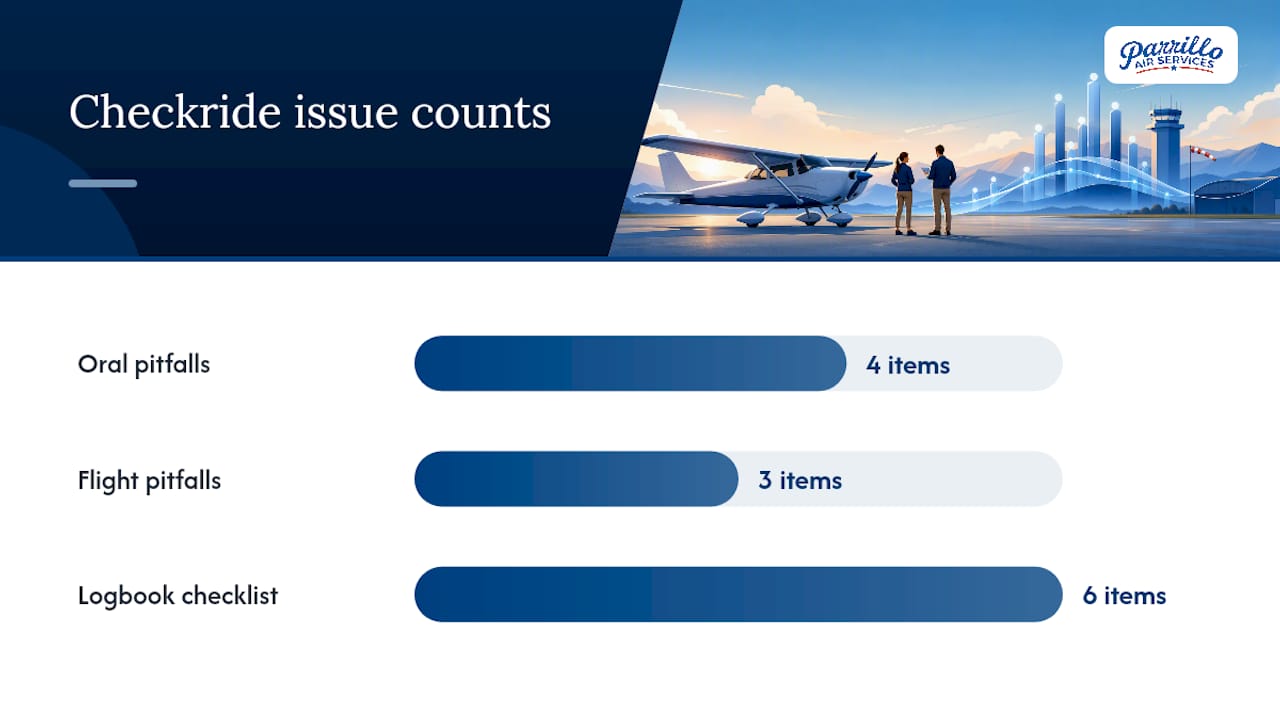
Most discontinuances trace back to a small set of repeatable mistakes. Knowing them in advance is the cheapest insurance available.
Common oral pitfalls:
Common flight pitfalls:
If something goes wrong in flight: Acknowledge the deviation out loud ("I went high on that turn — correcting now"), correct it, and stabilize. DPEs are watching how you manage errors, not just whether they occur. A student who self-corrects cleanly often passes; one who ignores the deviation and hopes the examiner missed it rarely does.
Quick logbook audit checklist before the checkride:
A structured 7–14 day final prep plan beats an unfocused accumulation of extra hours. Here is how to build it.
Instructor endorsement reminder: Your CFI's practical-test-ready endorsement must state that you have received training within the preceding 2 calendar months and are prepared for the practical test. The endorsement must also confirm training on knowledge-test deficiency areas. A vague "ready for checkride" note does not satisfy FAR 61.39.
Pro Tip: Ask your CFI to give you at least one mock oral where they do not tell you the topic in advance. Walking in cold — just like the real checkride — is the only way to know whether your preparation is genuine or just pattern recognition.
Most checkride failures are not skill failures. They are preparation failures: a missing endorsement, an answer that trails off into uncertainty, a maneuver practiced only in ideal conditions. The student who shows up with a complete document packet, a tabbed ACS, and 10 hours of deliberate mock-checkride practice is not just more likely to pass — they are more likely to pass cleanly, without a single uncomfortable pause.
Parrillo Air Services builds its Part 61 training programs around exactly this kind of structured, ACS-aligned preparation. Mock orals are not an optional add-on; they are part of the standard curriculum. Instructors grade to ACS tolerances from the first solo maneuver, so the standards are familiar long before the DPE sits in the right seat. That consistency is what turns a nervous student into a confident applicant.
The checklist in this article is the same framework Parrillo instructors use with students in the final two weeks before a checkride. Use it as written, and the day-of surprises shrink to near zero.
Parrillo Air Services gives student pilots in Lynchburg, VA, a concrete path from "almost ready" to "ready to pass" — without the guesswork of self-directed cramming.

The checkride prep services include mock oral sessions (typically 90 minutes, covering your weakest ACS areas with a CFI playing DPE), mock checkride flights graded to ACS tolerances, and a full paperwork review to catch endorsement gaps before the DPE does. Bring your logbook, document packet, POH, and FAR/AIM to the first session. Plan for at least two weeks of lead time before your scheduled checkride date.
Parrillo's Part 61 structure means scheduling is flexible around your availability, and every session is one-on-one with an instructor who knows the local DPE's tendencies. For students pursuing the full private pilot certificate through Parrillo, checkride prep is woven into the final training phase rather than bolted on at the end.
Ready to schedule your mock checkride or get a paperwork review? Contact Parrillo Air Services to book a prep session and confirm your readiness before the real thing.
Every source below is free to download and directly relevant to the practical test.
Practical tip: Download the ACS PDF and use sticky tabs or bookmarks for Areas of Operation I (Preflight), II (Preflight Procedures), and VII (Emergency Operations). Those three areas generate the most scenario-based oral questions and are the fastest to reference mid-conversation with the DPE.