
Mentorship in aviation careers is the intentional guidance from experienced professionals that accelerates learning, builds confidence, and supports career advancement for aspiring and current pilots. The role of mentorship in aviation careers extends far beyond the cockpit. It shapes Aeronautical Decision Making (ADM), reduces early dropout rates, and connects aspiring pilots to the networks and knowledge they cannot get from a textbook. Captain Robert McRath, a vocal advocate for pilot mentorship, argues that seeing real pilots as accessible human beings makes aviation feel achievable, which directly encourages more diverse participation and closes workforce gaps. The evidence backs this up: structured mentorship programs produce measurable improvements in both skill development and operational safety.
Mentorship is a strategic instrument for human resource development in aviation, not a casual add-on to formal training. A systematic review of 34 peer-reviewed articles confirms that mentorship and coaching improve non-technical skills in pilots and ground crew by approximately 35% and positively affect operational safety outcomes by roughly 26%. Those numbers represent fewer incidents, better crew communication, and sharper situational awareness across the board.
The distinction between mentorship and formal instruction matters here. A certified flight instructor (CFI) teaches procedures and checks boxes toward FAA certification. A mentor does something different: they share judgment. Mentors develop ADM by walking mentees through real scenarios involving weather decisions, fuel planning, and risk tolerance that go well beyond what any written exam covers. Mentorship builds ADM by enabling pilots to think through risk and critical decisions in ways that textbook knowledge alone cannot replicate.

Non-technical skills, sometimes called "soft skills" in other industries, are anything but soft in aviation. Crew resource management, threat and error management, and situational awareness are all non-technical competencies that mentors actively model and reinforce. When a mentor debrefs a flight with a student pilot, pointing out a moment where communication broke down or a checklist was rushed, that conversation does more for long-term safety than hours of solo study.
Pro Tip: Seek mentors who have worked in the aviation sector within the last five to seven years. Hiring standards, training pathways, and pay structures have shifted significantly, and advice from someone whose experience predates recent changes can send you down the wrong path.
The path from zero flight hours to an airline seat is long, expensive, and filled with decision points where the wrong turn costs months and thousands of dollars. Mentorship helps pilots bridge the 2.5 to 4 year training-to-airline placement gap by providing guidance through cost management, certification sequencing, and timeline expectations. Without that guidance, many trainees simply quit.
The barriers are real and specific:
Financial pressure. Flight training costs can exceed $100,000 for a full professional pilot pathway. Mentors who have navigated financing, scholarships, and part-time flying jobs provide a roadmap that no admissions brochure offers.
Certification sequencing. Private pilot, instrument rating, commercial certificate, multi-engine rating, and Certified Flight Instructor credentials each have prerequisites and strategic timing considerations. A mentor helps you sequence them efficiently.
Training plateaus. Most student pilots hit periods where progress feels stagnant. Mentorship validates these plateaus as a normal part of development, which significantly reduces dropout rates.
Industry networking. Aviation is a relationship-driven industry. Mentors open doors to chief pilots, airline recruiters, and professional organizations that a student pilot would otherwise never access.
Confidence under pressure. Check rides, simulator evaluations, and airline interviews all require composure. Mentors who have sat in those seats provide both preparation and perspective.
Formal employer-student mentorship partnerships accelerate workforce readiness by giving students hands-on insight into industry standards before they ever apply for a job. Flight schools that build these partnerships into their programs give students a measurable competitive advantage.
Pro Tip: When you start flight training, ask your CFI directly whether they are willing to serve as a career mentor, not just a flight instructor. Many instructors welcome the expanded relationship but wait for the student to initiate it.
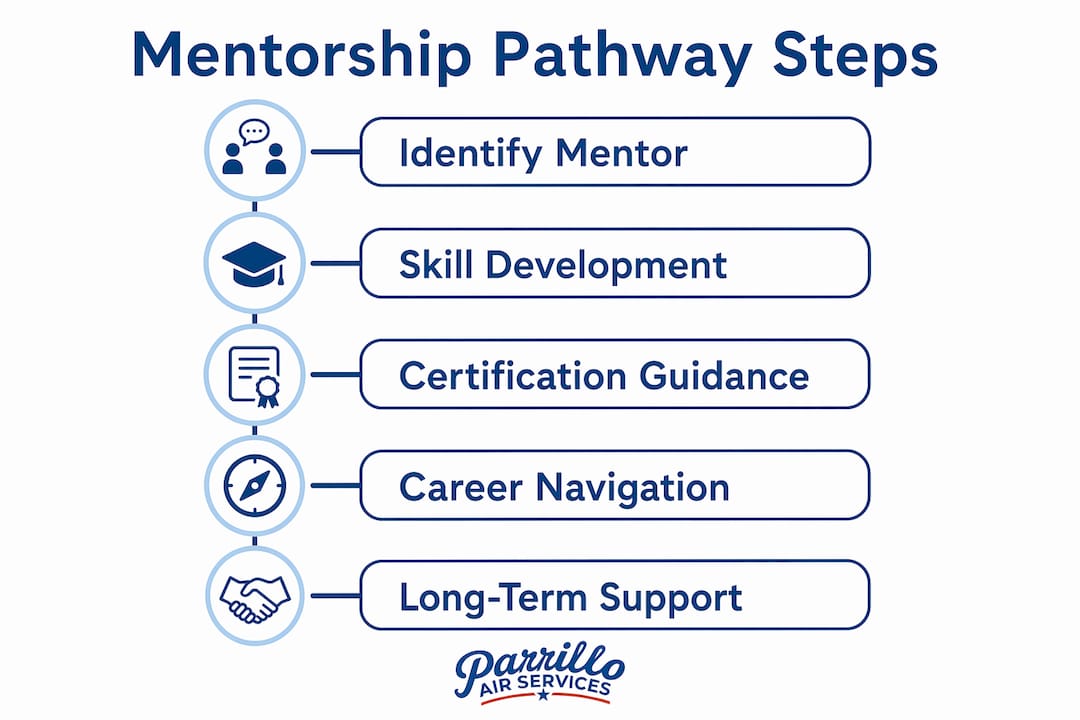
Aviation mentorship is not one-size-fits-all. Effective mentorship often comes from a diverse "board of advisors" that includes flight instructors, career mentors, and safety mentors with recent industry experience. Understanding the different roles helps you build the right network intentionally.
Here are the four primary mentorship types every serious aviation career benefits from:
Flight instructor as mentor. The CFI relationship is the most natural starting point. High-impact mentoring often begins informally when a flight instructor evolves into a career guide, sharing insights about the industry beyond the lesson plan.
Career mentor. This is typically an active airline or corporate pilot who can speak to current hiring practices, type rating strategies, and the realities of seniority-based career progression. Their value is currency: they know what the industry looks like right now.
Safety mentor. A safety mentor focuses specifically on ADM, crew resource management, and risk culture. This role is especially valuable during the transition from single-pilot general aviation flying to multi-crew airline operations.
Peer mentor. A fellow pilot who is one or two steps ahead in training or career progression. Peer mentors normalize the experience, share recent test prep strategies, and provide emotional support without the authority dynamic of a senior mentor.
The table below compares formal and informal mentorship models to help you decide which approach fits your current career stage.
| Mentorship type | Structure | Best for | Key limitation |
|---|---|---|---|
| Informal | Organic, relationship-driven | Early training, building trust | No accountability framework |
| Formal program | Structured, employer or school-led | Career transitions, diversity pipelines | Can feel transactional |
| Peer mentorship | Collaborative, experience-sharing | Training plateaus, interview prep | Limited senior perspective |
| Board of advisors | Multiple mentors, different roles | Full career development | Requires active management |
Relying on a single mentor creates a blind spot. One person's career path reflects one set of circumstances. Building a board of advisors, even informally, gives you multiple perspectives and reduces the risk of following advice that no longer applies to current industry conditions.
Aviation careers demand more than technical skill. The lifestyle is genuinely demanding: irregular schedules, time away from family, physical fatigue, and years of building seniority before reaching the routes and aircraft you actually want to fly. Mentors help pilots maintain discipline, mental stamina, and realistic career expectations during long training periods that often involve low or negative income.
The long-term benefits of mentorship extend well beyond the training phase:
Professional identity. Mentors model what it looks like to carry yourself as a professional pilot, from how you communicate in a crew briefing to how you handle a difficult passenger situation.
Communication skills. Aviation communication is precise and structured. Mentors who debrief flights and discuss scenarios actively train the communication habits that define career-long performance.
Resilience through setbacks. Failed check rides, deferred type ratings, and furloughs are part of many aviation careers. Mentors who have experienced these setbacks provide perspective that prevents them from becoming career-ending events.
Diversity and retention. Captain McRath emphasizes that mentorship makes aviation feel accessible to people who do not see themselves represented in the cockpit. This is not just a social good. It directly addresses the industry's documented pilot shortage by widening the talent pipeline.
Faster career advancement. Individuals with mentors develop stronger professional networks and greater clarity in career decisions, which translates to faster career advancement and higher job satisfaction over time.
Mentorship also addresses something rarely discussed in aviation training materials: the psychological weight of a career that demands perfection. Pilots operate in an environment where errors carry consequences that most professions never face. A mentor who normalizes the anxiety of early career flying, while reinforcing the habits that manage it, provides a form of support that no syllabus can replicate.
Mentorship is the single most effective non-technical investment an aspiring pilot can make, directly improving safety outcomes, career speed, and long-term resilience.
| Point | Details |
|---|---|
| Safety and skill gains | Mentorship improves non-technical skills by ~35% and safety outcomes by ~26%, per a 34-article systematic review. |
| Career navigation | Mentors reduce dropout rates by guiding pilots through the 2.5 to 4 year training-to-airline placement gap. |
| Build a board of advisors | Combine a CFI, career mentor, safety mentor, and peer mentor for full-spectrum career guidance. |
| Currency matters | Seek mentors with experience from the last five to seven years to get advice relevant to today's hiring environment. |
| Mentorship drives diversity | Accessible mentorship widens the pilot pipeline and directly addresses the aviation industry's workforce shortage. |
I have watched talented student pilots quit not because they lacked skill, but because nobody told them the plateau they were experiencing was normal. That is a mentorship failure, not a training failure. The aviation industry spends enormous energy on syllabus design, simulator technology, and regulatory compliance. It spends far less energy on the human infrastructure that keeps aspiring pilots in the game long enough to use all of that.
The most underrated mentorship move I have seen is the informal debrief. Not the formal post-flight review with a grade sheet, but the conversation over coffee where a senior pilot says, "Here is what I would have done differently, and here is why it took me three years to figure that out." That kind of knowledge transfer does not show up in any FAA curriculum. It is irreplaceable.
My honest advice: do not wait for a mentorship program to find you. Reach out to pilots whose careers you respect. Ask specific questions. Offer something in return, whether that is research, scheduling help, or simply genuine engagement. Most experienced pilots want to give back. They just need someone to ask. And if you are already an experienced pilot reading this, consider that the best thing you can do for aviation right now is make yourself available to someone who is where you once were.
The aviation careers dedication required to succeed in this industry is real, and mentorship is what makes that dedication sustainable.
— Gm
Parrillo Air Services, based in Lynchburg, VA, builds mentorship into the fabric of its FAA Part 61 flight training programs. From your first discovery flight through your commercial certificate and flight instructor rating, you work with instructors who treat your career trajectory as seriously as your logbook hours.

The airline pilot interview is one of the most mentorship-dependent milestones in any pilot's career, and Parrillo Air Services prepares students for exactly that moment. If you are ready to train with people who are invested in where you end up, not just whether you pass your next check ride, explore Parrillo Air's flight training programs and take the first step toward a career built on real guidance.
Mentorship in aviation careers provides aspiring pilots with guidance on skill development, certification sequencing, industry networking, and career decision-making. It supplements formal flight training by building judgment, confidence, and professional identity that textbooks cannot teach.
A systematic review of 34 peer-reviewed studies found that mentorship and coaching improve non-technical skills by approximately 35% and positively affect operational safety outcomes by roughly 26%. Mentors develop ADM and crew resource management skills that directly reduce in-flight errors.
Pilots benefit most from a board of advisors that includes a flight instructor, a career mentor with current airline experience, a safety-focused mentor, and a peer mentor at a similar career stage. Each role addresses a different dimension of professional development.
Start with your current flight instructor and ask directly whether they are willing to mentor your career, not just your training. Aviation organizations such as the Aircraft Owners and Pilots Association (AOPA) and Women in Aviation International (WAI) also offer formal mentorship opportunities for aviators at every stage.
Mentors who have navigated the full training pathway provide practical guidance on financing options, scholarship sources, and strategic timing of ratings to minimize cost. This kind of career guidance for pilots is one of the most concrete and immediate benefits a mentor delivers.
Why Aviation Careers Require Dedication: Your Complete Guide | Parrillo Air Services
Parrillo Air Services
Why aviation careers require dedication: your complete guide
Parrillo Air Services
The Role of a Flight Instructor: Career Impact Explained
Parrillo Air Services
Ace Your Airline Pilot Interview: Complete Prep Guide | Parrillo Air Services
Parrillo Air Services