
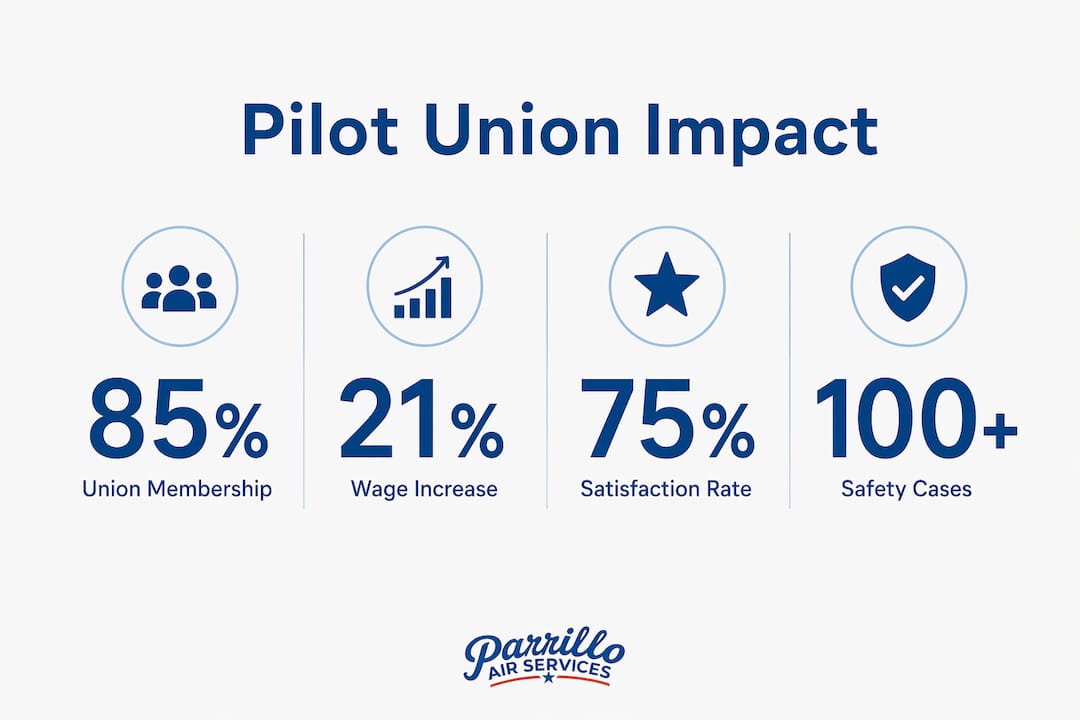
Aviation unions are defined as collective labor organizations that represent pilots and airline employees in negotiations with management over pay, benefits, safety, and working conditions. The role of aviation unions for pilots extends far beyond wage talks. Unions like ALPA (Air Line Pilots Association) and IFALPA (International Federation of Air Line Pilots' Associations) serve as the professional backbone of the pilot workforce, giving individual pilots a collective voice that no single contract could provide. Between 80–85% of employees at major U.S. carriers like American, Southwest, and United belong to unions. That figure dwarfs the 11% national workforce average, which tells you exactly how central union membership is to the airline industry.
Pilot union representation operates through a legal framework called collective bargaining. The formal output of that process is a Collective Labor Agreement, or CLA. A CLA is the binding contract between a union and an airline that governs nearly every aspect of a pilot's professional life.
The scope of a CLA goes well beyond a base salary number. Negotiations cover scheduling rules, rest requirements, fatigue management protocols, pension contributions, health coverage, and career progression pathways. Each of these items directly affects how safe and sustainable a pilot's career is over the long term.
The complexity of aviation labor agreements is significant. Major carriers operate across multiple subsidiaries and jurisdictions, which means a single union may need to coordinate bargaining strategies across dozens of pilot groups. ALPA, for example, represents pilots at more than 35 U.S. and Canadian airlines. That scale requires disciplined solidarity and coordinated negotiating positions across very different work environments.
A concrete example of what collective bargaining delivers: negotiations at Air Canada secured a 21% compounded wage increase over four years, plus expanded benefits including dental, vision, and mental health coverage. That outcome was only possible because pilots bargained as a unified group rather than as individuals.
| Standard CLA component | Pilot-specific provision |
|---|---|
| Base salary and pay scales | Hourly flight pay rates by aircraft type |
| Health and dental benefits | Mental health coverage and fatigue-related medical support |
| Pension and retirement | Defined benefit plans tied to years of service |
| Scheduling and hours | Duty time limits, rest requirements, and trip rig rules |
| Grievance procedures | Specific protections for license-related disciplinary actions |
Pro Tip: Before signing any employment contract, request a copy of the current CLA from your union. The CLA is the authoritative document on your actual rights, not the offer letter from HR.
The legal and safety functions of pilot unions are where membership value becomes most visible in a crisis. Union legal support activates immediately when a pilot faces detention or arrest abroad, coordinating legal counsel, embassy liaison, and direct support for the pilot's family. For pilots flying international routes, this protection is not theoretical. It is a practical safety net that no individual pilot could replicate on their own.

IFALPA's position is clear: pilot unions balance power between pilots and management, with safety as the overriding principle above cost or convenience. That framing matters because airlines face constant financial pressure to reduce costs, and fatigue management or maintenance standards are frequent targets. Unions hold the line on those standards through contract language and direct advocacy.
Union safety influence also shapes aircraft design and regulatory standards. Pilot associations have historically provided technical expertise to the FAA and international aviation bodies, pushing for cockpit design improvements, crew rest regulations, and accident investigation protocols that protect pilots and passengers alike.
Key areas where unions provide support beyond the contract:
Pro Tip: Many pilots underestimate the legal protection benefit until they need it. Review your union's legal assistance program before you fly your first international trip, not after an incident occurs.
Union political advocacy is a formal, organized function. ALPA operates a Political Action Committee, known as ALPA-PAC, which advances pilot-aligned agendas by influencing elected officials and aviation policy decisions at the federal level. This is not informal lobbying. It is a structured effort to shape the regulatory environment that governs every pilot's daily work.
The tactics unions use in regulatory settings are deliberate. ALPA pioneered the practice of filling hearing rooms with uniformed pilots during FAA proceedings. The visual presence of credentialed aviation professionals signals expertise and collective resolve to regulators and lawmakers. It is a tactic that has influenced outcomes on crew rest rules, aircraft certification standards, and airline staffing requirements.
Union political influence extends the impact of aviation workforce advocacy well beyond what direct employer negotiations can achieve. Regulatory changes on rest requirements or hiring minimums affect every pilot at every carrier, not just those at one airline. That industry-wide reach is only possible through coordinated political action.
The results of union-driven policy efforts include:
Member sentiment on aviation union membership is nuanced and worth understanding honestly. 75% of union members believe their union improves wages and working conditions. That is a strong majority, and it reflects real, measurable gains in pay and quality of life that collective bargaining delivers.
Approval of union representation in the workplace sits even higher. Over 85% of airline employees approve of how their union represents them on the job. That level of approval is rare in any industry and reflects genuine confidence in the union's core function.
The tension emerges when the conversation shifts to power and politics. Approximately 60% of airline employees feel that unions hold too much power. That concern reflects a real ideological divide within pilot communities about the appropriate scope of union authority.
The sharpest point of disagreement is political spending. Nearly 90% of members oppose the use of union funds for political endorsements. That near-unanimous disapproval signals a clear boundary that members draw between workplace representation and partisan political activity.
| Member perception | Data point |
|---|---|
| Unions improve wages and conditions | 75% agree |
| Approve of union workplace representation | Over 85% approve |
| Unions hold too much power | Approximately 60% agree |
| Oppose union political spending | Nearly 90% disagree with the practice |
Understanding how union negotiations shape pilot pay helps put these approval numbers in context. Pilots who see direct financial gains from collective bargaining tend to rate their unions more favorably on every dimension.
Aviation unions are the single most effective mechanism pilots have for securing fair pay, safe working conditions, and professional legal protection across their careers.
| Point | Details |
|---|---|
| Union coverage is dominant | Between 80–85% of major U.S. airline employees belong to unions, far above national averages. |
| Collective bargaining delivers real gains | Coordinated negotiation has secured multi-year wage increases and expanded health benefits at major carriers. |
| Legal protection is a core benefit | Unions provide immediate legal counsel and embassy coordination when pilots face crises abroad. |
| Political advocacy shapes regulations | ALPA-PAC and union lobbying have directly influenced FAA rules on fatigue, hiring minimums, and cockpit standards. |
| Member approval is high but nuanced | 85% approve of union representation; 90% oppose union political spending, showing a clear boundary members draw. |
Pilots entering the profession today often focus on ratings, hours, and interview prep. Union membership feels abstract until the moment it is not. I have seen pilots dismiss their union as bureaucratic overhead, then face a license investigation or an international detention and suddenly understand what collective representation actually means.
The historical tactics that ALPA's founders developed, putting uniformed pilots in front of regulators to project expertise and resolve, were not just symbolic. They changed the regulatory environment that every pilot now works in. Rest rules, cockpit standards, and hiring minimums exist in their current form partly because earlier generations of pilots showed up and fought for them as a group.
The tension between high approval of representation and deep skepticism about political spending is real and worth taking seriously. Unions that ignore member sentiment on political activity risk eroding the trust that makes collective action effective in the first place. The most effective unions listen to that feedback and stay focused on the core mission.
My advice to any pilot starting out: get involved early. Attend union meetings. Read the CLA. Understand what regional airline hiring standards look like and how union advocacy shaped them. The pilots who understand their union are the ones who benefit most from it.
— Gm
Understanding the labor environment you are entering is part of becoming a professional pilot. At Parrillo Air Services, flight training in Lynchburg, VA goes beyond stick-and-rudder skills. The programs prepare aspiring pilots for real airline careers, including the pay structures, union environments, and professional standards they will encounter at regional and major carriers.

Parrillo Air Services offers FAA Part 61 instruction from discovery flights through commercial and flight instructor ratings. Every program is built around personalized instruction, flexible scheduling, and a clear pathway to the flight deck. If you are ready to understand what a pilot career actually looks like from day one, explore the training programs and take the first step toward the cockpit.
Aviation unions represent pilots in collective bargaining with airlines, negotiating pay, benefits, scheduling, and safety standards. They also provide legal support, safety advocacy, and political representation that individual pilots cannot access alone.
Collective bargaining allows pilots to negotiate as a unified group, producing binding agreements that cover wages, rest rules, pensions, and health benefits. Coordinated negotiations have delivered outcomes like multi-year compounded wage increases and expanded mental health coverage at major carriers.
Between 80–85% of employees at major U.S. airlines are union members. That rate is far above the 11% national workforce average, making aviation one of the most heavily unionized industries in the United States.
Unions provide immediate legal assistance when pilots face detention or arrest abroad, coordinating legal counsel, embassy contact, and family support. This protection is especially critical for pilots operating international routes.
Over 85% of airline employees approve of their union's workplace representation. However, approximately 90% oppose the use of union funds for political endorsements, reflecting a clear divide between support for core union functions and skepticism about political activity.