
A commercial pilot job market guide defines the certifications, flight hour requirements, and employment conditions that determine whether an aspiring pilot lands a professional flying job or stalls before ever reaching the cockpit. The FAA recognizes two primary credentials for professional flying: the Commercial Pilot Certificate and the Airline Transport Pilot (ATP) certificate. Understanding which credential you need, when you need it, and how the current job market rewards each one is the foundation of every smart career plan. This guide covers FAA requirements, aviation employment trends, job types, and the preparation mistakes that cost candidates real time and money.
The FAA's commercial pilot certification requirements under 14 CFR Part 61 set a clear baseline every aspiring pilot must clear before earning the right to fly for compensation. You must be at least 18 years old, hold a Private Pilot Certificate, and carry a valid second-class medical certificate. The flight hour minimums are specific and non-negotiable.

Per 14 CFR § 61.129, the commercial certificate requires at least 250 total flight hours. Those hours must include 100 hours of pilot-in-command (PIC) time, 50 hours of cross-country flight, and 10 hours of instrument training. You also need an Instrument Rating before you can fly commercially for hire under most operations. Think of the Instrument Rating not as optional but as the prerequisite that makes your commercial certificate actually usable.
The commercial certificate gets you into charter, cargo, banner towing, and similar operations. Scheduled airline work requires something more. To fly for a Part 121 airline, the FAA mandates an ATP certificate, which demands 1,500 total flight hours with specific PIC, cross-country, night, and instrument sub-requirements under 14 CFR § 61.159.
The Restricted ATP (R-ATP) offers a faster on-ramp. Under 14 CFR § 61.160, qualifying pathways reduce the hour minimum to 750–1,250 hours depending on your training background. Military pilots, graduates of four-year aviation degree programs, and graduates of two-year aviation programs each qualify for different R-ATP minimums. The critical limitation: R-ATP holders can serve as first officers but cannot act as PIC in Part 121 operations. Upgrading to full ATP requires meeting the complete hour and age requirements and submitting a separate application.
| Certificate | Minimum Hours | PIC Eligibility | Primary Use |
|---|---|---|---|
| Commercial Pilot | 250 total | Yes, for commercial ops | Charter, cargo, CFI, survey |
| R-ATP | 750–1,250 total | First officer only | Regional airline first officer |
| Full ATP | 1,500 total | Yes, including captain | All Part 121 airline operations |
Pro Tip: Track your flight time in four separate buckets from day one: PIC, cross-country, night, and instrument. Failing to meet any single sub-minimum delays your ATP eligibility even if your total hours are high enough.
The commercial aviation job market is steady, not explosive. The BLS projects 4% employment growth for airline and commercial pilots from 2024 to 2034, with approximately 18,200 job openings per year. That number sounds large, but most of those openings come from replacement hiring, not net new positions. Retirements, medical disqualifications, and career exits drive the bulk of annual demand.
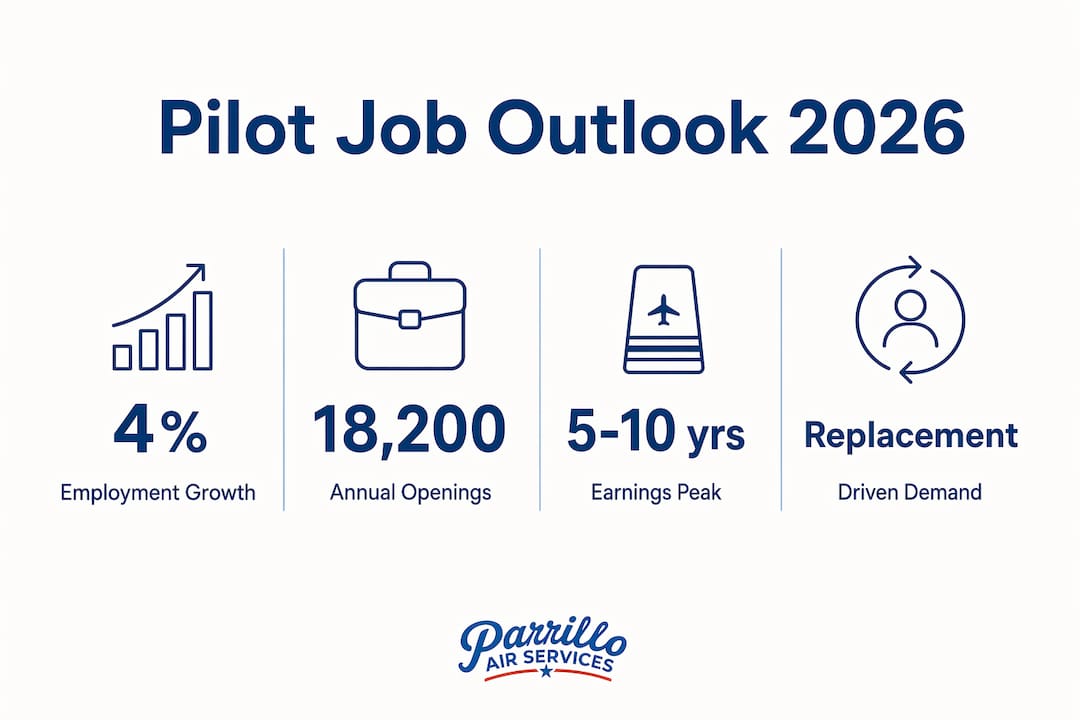
This distinction matters for your planning. A market driven by replacement hiring is more predictable than one driven by airline expansion. Demand stays consistent even when the broader economy slows, because airlines must replace departing captains regardless of growth cycles.
Three forces are sustaining pilot hiring right now. Leisure travel demand continues to recover and grow past pre-pandemic levels, filling regional and major airline seats. E-commerce growth is pushing freight carriers like FedEx and UPS to expand their fleets and hire more cargo pilots. Private and charter operations are also growing, particularly in markets where business travelers prefer flexibility over scheduled service.
Regional airlines remain the primary entry point for ATP-certified first officers fresh from flight training pipelines.
Cargo carriers offer competitive pay and schedules, often attracting pilots who prefer freight over passenger service.
Charter and on-demand operations hire at the commercial certificate level, making them accessible earlier in a pilot's career.
Competition is real. The 4% growth rate means you are competing against a large pool of qualified candidates. Your logbook, endorsements, and interview preparation determine who gets the call.
The misconception to avoid: the pilot shortage narrative overstates immediate opportunity. Openings exist, but they go to prepared candidates with clean records, complete documentation, and the right certificates.
Career planning for a commercial pilot starts at the private certificate stage, not after you earn your commercial. Every flight hour you log should serve a dual purpose: building total time and filling specific sub-minimum buckets that the FAA requires for ATP eligibility.
Here is the sequence that works:
Earn your Private Pilot Certificate and begin logging cross-country and night hours deliberately from the start.
Add your Instrument Rating before pursuing the commercial certificate. This is a prerequisite for most commercial flying jobs anyway.
Complete commercial certificate training under 14 CFR Part 61 with a focus on hitting all sub-minimums, not just total hours.
Earn your Certified Flight Instructor (CFI) certificate. Instructing is the most reliable way to build PIC time while earning income. Many pilots reach ATP minimums faster through instructing than through any other path.
Evaluate R-ATP vs. full ATP timing. If you attended an aviation degree program, the R-ATP pathway may get you into a regional airline cockpit 250–750 hours sooner than the standard ATP route.
Apply to regional airlines once you meet R-ATP or ATP minimums. Regional carriers like those operating under major airline brands provide structured upgrade paths to captain seats.
Pro Tip: Airlines value pilots who keep impeccable flight logs and complete endorsement records. Disorganized documentation slows hiring paperwork and signals poor attention to detail to recruiters.
After hiring, expect an intensive training period. Airlines provide ground and flight training specific to their aircraft and operations after you join. Your FAA certificate gets you hired. The employer's training program makes you line-ready. Showing up prepared to absorb that training quickly is a competitive advantage.
Commercial pilot career opportunities extend well beyond the airline cockpit. The commercial certificate opens doors to a wide range of flying jobs, each with different pay structures, schedules, and hour-building potential.
| Sector | Certificate Required | Typical Entry Role | Hour-Building Value |
|---|---|---|---|
| Regional Airlines | R-ATP or ATP | First Officer | Moderate, structured |
| Major Airlines | Full ATP | First Officer | High, fast upgrade track |
| Cargo/Freight | ATP | First Officer or Captain | High, consistent hours |
| Charter/On-Demand | Commercial + Instrument | Pilot | High, varied routes |
| Agricultural/Survey | Commercial | Pilot in Command | High, specialized PIC time |
| Banner Towing/Sightseeing | Commercial | Pilot | Moderate, good early PIC |
Regional airlines like those operating under American Eagle, SkyWest, or Envoy Air brands are the most common first airline job. They offer structured upgrade timelines and flow-through agreements to major carriers. Cargo operations at companies like FedEx Feeder or UPS contract carriers attract pilots who want consistent schedules and strong pay without the passenger service demands.
Charter and on-demand operations under Part 135 rules hire at the commercial certificate level, making them accessible before you reach ATP minimums. Agricultural flying, aerial survey, and banner towing all count toward your PIC time and can accelerate your path to ATP eligibility. These roles also build the kind of real-world decision-making experience that airline interviewers respect.
For a detailed breakdown of what regional airline hiring requires in 2026, the requirements differ meaningfully from major airline standards.
The most common and costly mistakes in the commercial pilot pipeline fall into a predictable pattern. Recognizing them early saves you months and thousands of dollars.
Skipping the Instrument Rating early. Some students delay the Instrument Rating to save money. This backfires because most commercial flying jobs require it, and building instrument hours later costs more than integrating it into your training sequence from the start.
Logging hours without tracking sub-minimums. Total hours are not enough. Pilots who reach 1,500 hours but lack sufficient night or cross-country time still cannot qualify for the ATP. Log every flight with all applicable time categories from day one.
Assuming the commercial certificate equals airline readiness. The commercial certificate alone does not qualify you for airline work. The ATP or R-ATP is the actual airline entry credential.
Misunderstanding R-ATP limitations. An R-ATP holder cannot serve as PIC in Part 121 operations. Pilots who plan to upgrade to captain must apply separately for the full ATP after meeting all requirements under 14 CFR § 61.160.
Underestimating total training costs. Flight training is expensive. Pilots who do not plan financially often pause training mid-stream, which disrupts skill continuity and extends the timeline to certification.
Preparation is not just about logging hours. It is about logging the right hours, in the right sequence, with complete documentation at every stage.
You can also find pilot job listings and workforce resources through transportation-focused employment platforms that specialize in aviation career support.
Aspiring commercial pilots who plan their certification sequence carefully, document every flight hour precisely, and understand the difference between the commercial certificate, R-ATP, and full ATP will enter the job market with a clear competitive edge.
| Point | Details |
|---|---|
| Certification sequence matters | Earn Private, then Instrument, then Commercial in order to stay eligible for the broadest range of jobs. |
| Sub-minimums determine ATP timing | Track PIC, cross-country, night, and instrument hours separately from day one to avoid eligibility delays. |
| R-ATP is a first officer credential | R-ATP holders cannot serve as PIC in Part 121 ops and must upgrade to full ATP for captain eligibility. |
| Job market is replacement-driven | Most of the 18,200 annual openings come from retirements and exits, making demand steady and predictable. |
| CFI is the best time-building path | Instructing builds PIC hours faster than most alternatives while generating income during the process. |
Most aspiring pilots I talk to focus almost entirely on total flight hours. That is the wrong priority. The pilots who move through the hiring process fastest are the ones who treat their logbook like a legal document from their very first solo. Every endorsement recorded, every category of time separated, every flight reviewed for accuracy. Airlines and regional carriers have seen every kind of logbook, and a messy or incomplete one raises questions that a clean one never does.
The R-ATP conversation also gets oversimplified. Students at aviation degree programs sometimes assume the R-ATP is a shortcut to a captain seat. It is not. It is a faster path to a first officer seat, which is still a valuable thing. But you need to plan for the full ATP upgrade from the moment you start your R-ATP pathway. Pilots who treat R-ATP as the finish line end up surprised when the upgrade process requires a separate application and additional documentation.
My honest read on the 2026 market: the demand is real, the competition is serious, and the pilots who prepare methodically will always outperform those who rush. Spend the extra time with a quality instructor. Build your hours in roles that develop real decision-making, not just seat time. And read the airline pilot career pathway requirements before you assume you know what the next step looks like.
— Gm
Parrillo Air Services trains aspiring pilots at its Lynchburg, VA facility under FAA Part 61, covering every certification from Private Pilot through Commercial and Flight Instructor ratings. The school's personalized instruction model means your training sequence is built around your schedule and your career goals, not a generic syllabus.

Whether you are working toward your first certificate or building hours toward ATP eligibility, Parrillo Air Services provides the hands-on guidance and structured programs that prepare you for real airline hiring standards. Get the details on flight training programs and find out how Parrillo Air Services can put you on the right path from your first flight.
The FAA requires 250 total flight hours for a commercial certificate, including 100 hours PIC, 50 hours cross-country, and 10 hours instrument training under 14 CFR § 61.129.
The BLS projects approximately 18,200 annual openings for airline and commercial pilots from 2024 to 2034, driven primarily by retirements and workforce exits rather than net new positions.
The R-ATP allows first officer roles at reduced hour minimums (750–1,250 hours), while the full ATP requires 1,500 hours and is required to serve as PIC in Part 121 airline operations.
Reaching $200,000 in annual pay typically takes 5–10 years of experience, advancement to captain positions, and seniority at a major airline.
Yes. Airlines provide type-specific training after hiring, including ground school and simulator work for the aircraft you will fly. Your FAA certificate qualifies you for the job. The employer's program qualifies you for the aircraft.
Regional Airline Hiring Requirements: 2026 Pilot Guide | Parrillo Air Services
Parrillo Air Services
Airline Pilot Career Pathway Steps: 2026 Guide
Parrillo Air Services
Major Airline Pilot Salary Ranges: 2026 Guide
Parrillo Air Services
Major Airline Pilot Requirements 2026: What You Need
Parrillo Air Services