
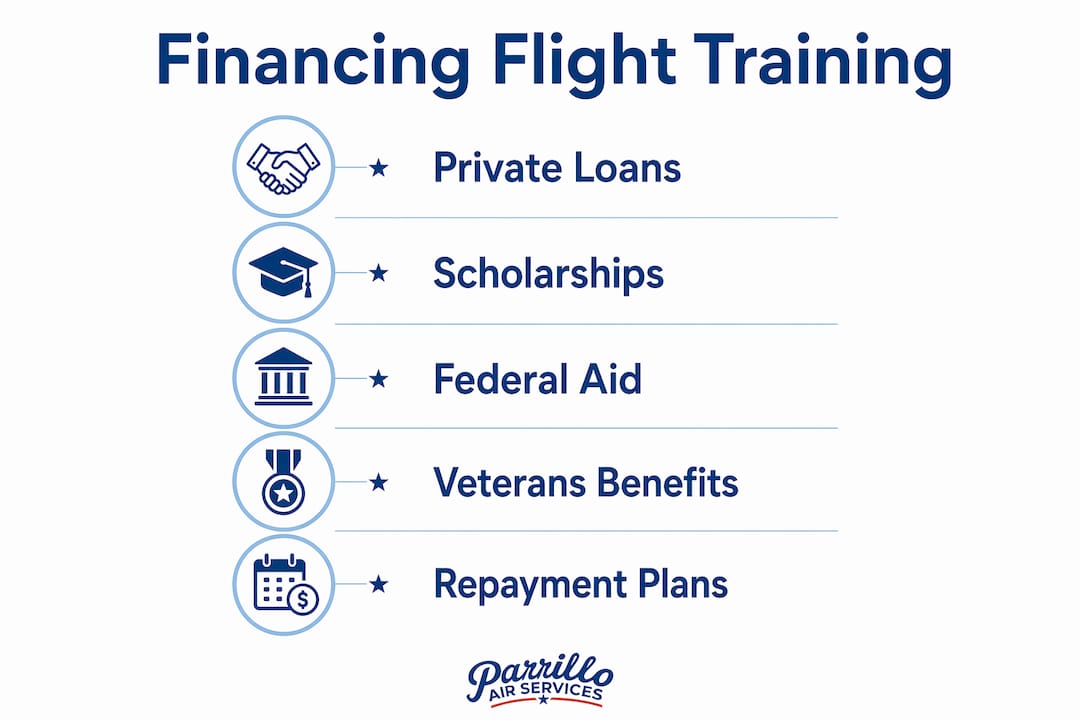
Adults can finance flight training through a combination of private loans, scholarships, and government benefits that together cover the full cost of earning a pilot certificate. The most common path to fund flight training as an adult requires stacking two or three funding sources, since full zero-to-airline programs run $80,000–$120,000 plus $15,000–$25,000 in living expenses. Federal aid through FAFSA applies only to Title IV accredited schools, which excludes many flight programs. Private lenders like Sallie Mae, scholarships from AOPA, and GI Bill benefits for veterans fill that gap. This guide breaks down every option, what each costs, and how to build a funding plan that matches your training timeline.
Adult pilot training costs vary significantly depending on which certificates you pursue. A Private Pilot License costs $8,000–$20,000 nationally, with a median around $16,000 for adults in 2026. That figure includes aircraft rental ($9,000–$13,000), instructor fees ($3,000–$5,000), knowledge test prep and exam fees, a medical exam, and study materials.
If your goal is an airline career, the budget grows considerably. Full zero-to-airline-ready training runs $80,000–$140,000 when you include every rating from Private Pilot through Certified Flight Instructor (CFI). Living expenses during full-time training add another $15,000–$25,000 on top of direct training costs. Planning for the total number, not just tuition, is the single most important budgeting step you can take.
| Certificate / Rating | Estimated Cost Range |
|---|---|
| Private Pilot License (PPL) | $8,000–$20,000 |
| Instrument Rating (IR) | $8,000–$15,000 |
| Commercial Pilot Certificate (CPL) | $20,000–$35,000 |
| Certified Flight Instructor (CFI) | $5,000–$10,000 |
| Full Zero-to-Airline Program | $80,000–$140,000 |
Pro Tip: Budget 20% above your school's published estimate. Aircraft maintenance delays, weather cancellations, and extra flight hours are common, and they add up fast.
The cost breakdown above shows why a single loan rarely covers everything. Most adults who successfully complete training combine a primary loan with at least one scholarship and either savings or family support.
Private loans are the dominant funding source for adult flight training. 62% of private flight school loans originate with Sallie Mae, which offers amounts from $1,000 up to 100% of certified training costs, no origination fees, and cosigner release options. That market share reflects how well Sallie Mae's Career Training Smart Option Loan fits aviation students: flexible repayment terms, competitive APR, and the ability to cover both tuition and living costs.
Federal aid through FAFSA and Pell Grants is available, but only at Title IV participating schools. Most Part 61 flight schools do not hold Title IV status, which means federal aid is off the table for many adult learners. Part 141 schools are more likely to qualify. Verifying your school's Title IV status before building a finance plan is not optional. It determines which funding doors are open to you.
Veterans have a separate and valuable path. The Post-9/11 GI Bill covers approximately $29,000 or more per academic year for private flight training at VA-approved schools. The Yellow Ribbon Program can cover gaps above that cap. Veterans commonly stack GI Bill benefits with a private loan to cover the full program cost.
Scholarships represent free money that most adult students underuse. The Aircraft Owners and Pilots Association (AOPA) distributes over $1.2 million annually in flight training scholarships ranging from $250 to $14,000. Treating scholarship applications as an ongoing pipeline, rather than a one-time attempt, is the approach that produces results.
| Financing Source | Amount Available | Key Condition |
|---|---|---|
| Sallie Mae Career Training Loan | Up to 100% of certified costs | No origination fee; cosigner release available |
| Federal Pell Grant / Direct Loans | Varies by school | Title IV school required |
| Post-9/11 GI Bill | ~$29,000+ per year | VA-approved program required |
| AOPA Scholarships | $250–$14,000 per award | Competitive application process |
| Personal Savings / Family Support | Unlimited | No repayment required |
Pro Tip: Apply to at least five to ten scholarships per cycle. AOPA alone offers dozens of individual awards. Applying broadly is the only way to build a steady funding pipeline rather than relying on a single award.
Deferment and interest-only repayment options during training can last 12 months or longer depending on the loan program. These features matter most during the CFI time-building phase, when you are earning less while accumulating flight hours.
A funding stack is the term aviation finance professionals use for combining multiple sources to cover total training costs. Most adults who complete full career training use a loan as the foundation, then layer in scholarships, GI Bill benefits if eligible, and personal savings to close the gap. Here is how to structure that stack effectively.
Calculate your total cost first. Add tuition, aircraft rental, exam fees, medical costs, supplies, and living expenses for the full duration of training. Use the table above as a starting point, then get a written cost estimate from your school.
Check your school's Title IV status. If the school participates in Title IV, file the FAFSA immediately. Federal Direct Loans carry lower interest rates than most private options and should be used before private loans when available.
Apply for scholarships before you start. AOPA and other aviation organizations open scholarship cycles annually. Submit applications early and reapply each cycle. Treating scholarships as a pipeline, not a lottery, changes your results.
Select a private loan with deferment options. Loans that allow deferment during training protect your cash flow during the months when you are flying full time and earning little. Confirm the deferment period length and any interest capitalization terms before signing.
Plan for the time-building phase. After earning your CFI certificate, most pilots spend 12–24 months building hours at instructor pay rates. Your loan repayment schedule needs to account for this lower-income period. Choose repayment terms that start manageable and scale up as your earnings grow.
Communicate with your lender proactively. Contact your lender before any payment difficulty arises. Many programs offer forbearance or income-driven adjustments that are not advertised prominently.
Pro Tip: Use interest-only payments during training rather than full deferment when your budget allows. Paying even a small amount monthly prevents interest from compounding on the full principal and reduces your total repayment cost.
The FAA certifies flight schools under two primary frameworks: Part 61 and Part 141. The regulatory category your school operates under directly affects which financial aid for flight school programs you can access.
Part 141 schools follow a structured, FAA-approved curriculum and are more likely to hold Title IV accreditation. That accreditation unlocks FAFSA, Pell Grants, and federal Direct Loans. Part 141 training also reduces the minimum flight hours required for a Private Pilot License from 40 to 35, which can lower your total cost modestly.
Part 61 schools operate with more flexibility, which suits working adults who need to train around a job or family schedule. However, most Part 61 schools do not participate in Title IV, which means federal aid is typically unavailable. Private loans and scholarships become the primary tools.
Key points to verify before enrolling:
Title IV status: Ask the school directly whether it participates in federal student aid programs.
VA approval: Veterans must confirm the specific program is approved for GI Bill benefits, not just the school in general.
Scholarship eligibility: Some aviation scholarships restrict awards to students at accredited institutions.
Loan lender acceptance: Confirm that your chosen lender will certify costs directly with the school.
Parrillo Air Services operates as an FAA Part 61 school, which gives adult students the scheduling flexibility that full-time workers need. Understanding the trade-offs between Part 61 and Part 141 before you choose a school prevents financing surprises later.
Training timelines determine how long you carry loan payments before your income grows. A Private Pilot License takes 6–12 months part-time for most adults. A full airline-track program runs 1–2 years full time. The faster you fly, the lower your total cost, because aircraft rental and instructor fees accumulate by the hour.
Here is how funding needs typically align with training milestones:
Private Pilot License: $8,000–$20,000. This is your first major funding draw and the foundation for every rating that follows.
Instrument Rating: $8,000–$15,000. Often financed as a second loan draw or from scholarship awards received during PPL training.
Commercial Pilot Certificate: $20,000–$35,000. The largest single cost milestone. Most adults use the bulk of their primary loan here.
CFI Certificate: $5,000–$10,000. Smaller cost, but this is where income begins. Many pilots use CFI earnings to start loan repayment.
Time-building phase: 1,000–1,500 hours required for airline hiring. CFI pay is modest, typically $30,000–$50,000 annually at regional schools. Loan repayment must fit within this income range.
Flying consistently shortens your timeline and reduces cost. Students who fly three or more times per week complete training faster and spend less on total hours than those who fly once a week and lose proficiency between sessions.
Pro Tip: Pass your FAA knowledge tests before starting flight training when possible. Arriving at your first lesson with the written exam complete removes a scheduling bottleneck and keeps your training momentum uninterrupted.
Adults who finance flight training successfully combine private loans, scholarships, and government benefits into a structured funding stack aligned with their training timeline and post-training income.
| Point | Details |
|---|---|
| Total cost exceeds tuition | Budget $80,000–$140,000 for full career training plus $15,000–$25,000 in living expenses. |
| Stack multiple funding sources | Combine a private loan, AOPA scholarships, and GI Bill benefits if eligible to cover total costs. |
| School type affects aid eligibility | Part 141 schools often qualify for FAFSA; most Part 61 schools require private loans instead. |
| Choose loans with deferment options | Deferment during training protects cash flow during the low-income CFI time-building phase. |
| Fly frequently to reduce total cost | Consistent training shortens timelines and lowers total aircraft rental and instructor fees. |
Most articles on adult flight training financing stop at "here are your loan options." The harder conversation is what happens after you earn your CFI certificate and start building hours at $35,000 a year while carrying $80,000 in debt.
I have seen adult students make two consistent mistakes. The first is assuming their school accepts FAFSA without verifying Title IV status. They plan their entire budget around federal aid, then discover at enrollment that private loans are their only option. The second mistake is underestimating living expenses. A student who budgets $1,200 a month for living costs during full-time training in a mid-size city is going to run short. Real numbers are closer to $1,800–$2,200 when you factor in transportation to the airport, food, and incidentals.
The adults who navigate this well do three things differently. They apply for scholarships before they need the money, not after. They choose loans with the longest available deferment period and confirm the terms in writing before signing. And they build a 12-month post-training budget that assumes CFI income, not airline income, because the gap between those two numbers is where most financing plans fall apart.
Deferment is not a safety net. It is a planning tool. Use it intentionally, not as a last resort.
— Gm
Adults who are ready to move from planning to flying need a school that understands both the training and the financial reality behind it. Parrillo Air Services offers FAA-certified flight training in Lynchburg, VA, with flexible scheduling designed for working adults. Programs run from introductory discovery flights through Private Pilot, Instrument, Commercial, and CFI ratings.

Parrillo Air Services provides detailed cost breakdowns and guidance on financing options so you can plan your funding stack before your first lesson. Whether you are exploring private loans, AOPA scholarships, or GI Bill eligibility, having the right school in your corner makes the process clearer. Visit the program information page to review training costs, program requirements, and next steps for adult learners ready to start.
A Private Pilot License costs $8,000–$20,000, while a full zero-to-airline program runs $80,000–$140,000 plus $15,000–$25,000 in living expenses.
Federal aid through FAFSA applies only to Title IV accredited schools. Most Part 61 flight schools do not hold Title IV status, so private loans and scholarships are the primary options for those students.
Sallie Mae's Career Training Smart Option Loan originates 62% of private flight school loans and offers amounts up to 100% of certified costs with no origination fees and flexible repayment terms.
Yes. The Post-9/11 GI Bill covers approximately $29,000 or more per academic year at VA-approved flight schools. Veterans should confirm program approval status and stack GI Bill benefits with a private loan to cover remaining costs.
AOPA distributes over $1.2 million annually in scholarships ranging from $250 to $14,000. Adults should apply to multiple awards each cycle and treat the process as an ongoing pipeline rather than a single application.