
If you're a student pilot, start with Pilots of America and AOPA's online resources. If you're building toward an airline career, add PPRuNe and Airline Pilot Central. Your immediate next step: register, read the rules, and post a brief introduction in the designated introductions subforum before asking a single question.
Here's where to start based on your stage:
Register on two or three of these today. Verify your email, read the pinned rules thread, and search for your question before posting it. That single habit will get you better answers faster than anything else in this guide.
The three benefits pilots consistently report are networking and job leads, technical and checkride help, and mentorship. Each one has a different time-to-value curve.
Networking and job leads show up fastest on verified professional boards. ProPilotWorld advertises paid full-access membership with curated job listings and direct recruiter access. PPRuNe's career threads surface airline hiring news within hours of announcements. If you're within six months of a regional airline application, a professional forum's job board is worth checking weekly.
Technical and checkride help is where general forums like Pilots of America earn their keep. Post a specific question about a maneuver, an instrument approach, or an aircraft system, and you'll typically see replies within a few hours during peak activity. The key word is specific. Vague questions get vague answers.
Mentorship takes longer, usually two to four weeks of consistent, quality participation before a senior member starts engaging with you personally. The forums that produce the best mentors tend to have regional chapters or verified-member structures, because those features create continuity. AOPA and EAA both run local chapter networks that turn online connections into in-person relationships. That's the step most pilots skip, and it's the one that actually moves careers.
A realistic timeline: expect helpful replies within hours, a sense of community within one to two weeks, and genuine mentorship connections within a month of active participation.
The right answer depends on your primary goal. Students building toward a private certificate belong on general GA forums. Pilots targeting airline careers need a professional board with a job section. Builders and restorers need EAA. Sim pilots need VATSIM or IVAO. The table below maps each community to the dimensions that matter most.
| Forum / Community | Best For | Access Model | Activity Level | Content Focus | Moderation & Verification | Key Features |
|---|---|---|---|---|---|---|
| Pilots of America | Student/GA community, peer mentorship | Free + signup | High, replies within hours | Checkride prep, social/networking | Moderated, code of conduct | Introductions subforum, Hangar Talk, topic diversity |
| PPRuNe | Airline career networking, industry news | Free + signup (guests limited) | Very high | Career/job discussion, industry news | Moderated, professional user base | Job threads, PMs, polls, uploads (registration required) |
| Airline Pilot Central | Airline career advice, peer technical discussion | Free + signup | High | Career/job board, technical | Moderated, anti-spam post-count rules | FAQ, posting rules, post-count access gates |
| JetCareers | Airline interview prep, career tracking | Free + signup | Moderate-high | Career/job board, interview prep | Moderated | Interview gouge threads, hiring timelines |
| ProPilotWorld | Verified professional networking, recruiter access | Paid subscription — | High | Career/job board, professional networking | Verified members, curated listings | Job listings, recruiter access, private messaging |
| JetForums | Jet owners, mechanics, FBO relationships | Free + signup | Moderate | Technical/maintenance, acquisitions | Moderated, clear registration rules | Detailed profile setup, maintenance threads |
| Airliners.net forum | Topic-specific deep dives, photography, trip reports | Free + signup | Very high | Civil aviation, technical/ops, photography | Moderated, topic-partitioned | Partitioned categories (Civil Aviation, Technical/Ops, Helicopter/VTOL, Trip Reports) |
| EAA community | Experimental/homebuilt builders and restorers | Free + signup (org membership available) | High | Technical/maintenance, experimental aircraft | Moderated, org-backed | Local chapters, events, authoritative homebuilt resources |
| VATSIM / IVAO | Flight simulation, virtual ATC practice | Free + signup | Very high | Flight simulation, procedural practice | Moderated, international | Real-time ATC simulation, large global user base |
| The Ninety-Nines | Women pilots, mentorship, local chapters | Membership-based | Moderate-high | Social/networking, mentorship | Org-backed, chapter structure | Regional chapters, events, mentorship programs |
| Reddit Aviation | Quick crowd feedback, casual discussion | Free (Reddit account) | Very high | General aviation, broad topics | Variable, community moderated | High reach, fast responses, low signal-to-noise ratio |
| AOPA community | Regulatory guidance, GA advocacy | Free + signup | High | Regulatory, safety, GA advocacy | Org-backed, authoritative | Primary authority resources, member tools |
| Pilot Career Centre | Career listings, international pilot jobs | Free + signup | Moderate | Career/job board | Moderated | Job listings, career resources |
| The Pilot's Place | General GA, social networking | Free + signup | Moderate | Social/networking, general GA | Moderated | Community forums, regional discussion |
| Professional Pilots Forum | Professional pilot discussion | Free + signup | Moderate | Career, technical, professional topics | Moderated | Professional peer discussion |
Quick notes on a few standouts:
One sentence: choose by your primary goal, then filter by activity level and moderation quality.
Audience match comes first. A student pilot asking checkride questions on a jet-owner forum will get polite but unhelpful responses. Spend two minutes reading recent threads before registering. If the active members are where you want to be in five years, you're in the right place.
Verification and moderation separate signal from noise. Forums with verified-member programs or post-count access gates tend to have higher-quality answers. The tradeoff is a slower onboarding experience.
Activity level is easy to check. Look at the timestamp on the most recent reply in the subforum you care about. If it's more than a week old, the community isn't active enough to be useful for time-sensitive questions.
Documented codes of conduct matter more than they sound. A forum with a published code of conduct has a mechanism for handling bad actors. One without it relies entirely on moderator discretion, which is inconsistent.
Job-board presence is a deciding factor for career-track pilots. Not every forum has one. PPRuNe, Airline Pilot Central, JetCareers, and ProPilotWorld all have active career sections. Pilots of America and Reddit Aviation do not, at least not in a structured way.
Regional vs. global focus affects mentorship quality. AOPA and EAA chapters give you local contacts. Global forums like PPRuNe give you breadth. For most pilots, one of each is the right combination.
Pro Tip: Before registering anywhere, search "[forum name] + review" or "[forum name] + worth it" on Reddit Aviation. Current and former members are usually candid about activity levels and moderation quality in ways the forum's own marketing isn't.
The first 48 hours on any forum determine whether you become a trusted member or a ghost account. Here's the exact sequence.
Keep it under 100 words. Mention your aircraft and home airport. Those two details generate more follow-up conversation than anything else in an intro post.
Airline Pilot Central and similar moderated boards commonly require around 10 posts before you can create new threads or use private messaging. The fastest way through is to add genuine value in replies to existing threads. Thoughtful, referenced answers get noticed by moderators and senior members who can promote accounts. Posting "great point!" ten times in a row will not work and may flag your account.
Pro Tip: On Discourse-based forums (AVweb uses this platform), your "trust level" upgrades automatically as you read threads, receive likes, and post consistently. The system is designed to reward genuine engagement, not just post count.
The single best rule: read first, search, then ask with specific details and note what you already tried. That one habit separates the members who get helpful replies from the ones who get ignored.
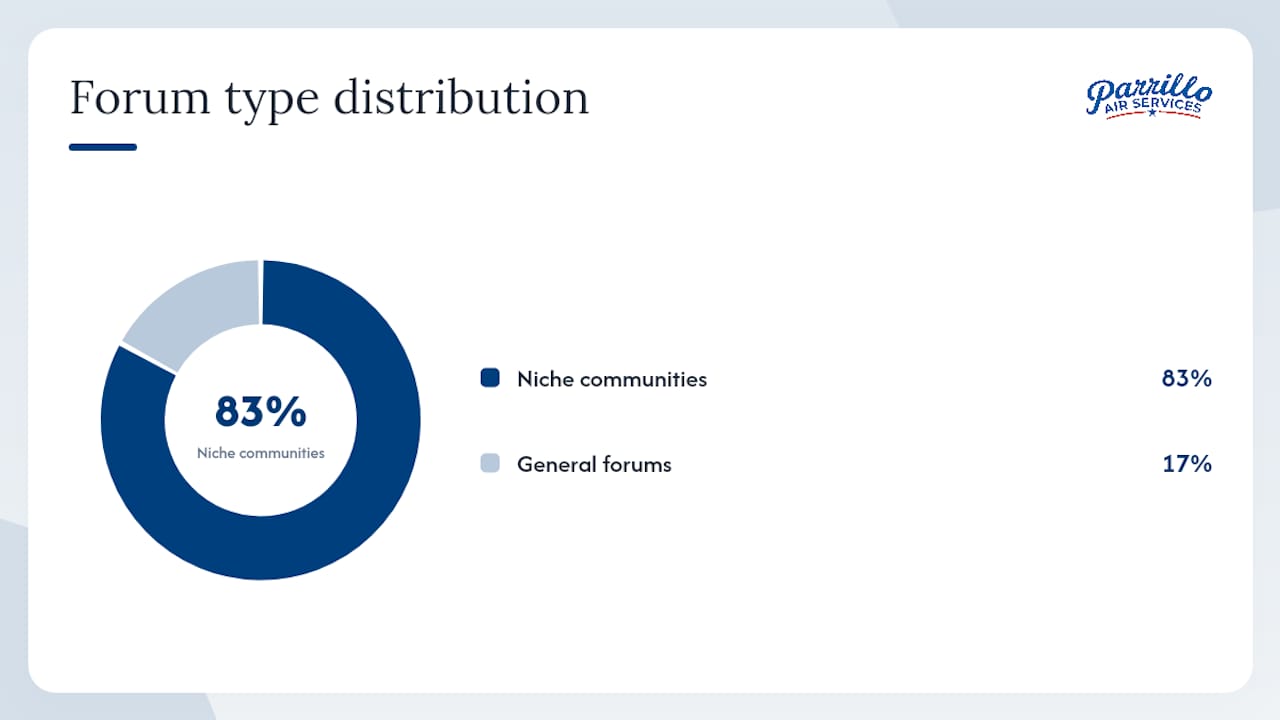
General forums cover a lot of ground, but some goals are better served by a focused community. Here's when to go niche.
If your primary interest is flight simulation, experimental building, women-in-aviation mentorship, or local flying club connections, a general forum will give you some of what you need but not all of it. Specialized networks have deeper expertise, more relevant events, and members who share your specific context.
VATSIM (Virtual Air Traffic Simulation Network) and IVAO (International Virtual Aviation Organization) are the two dominant platforms for pilots who want realistic ATC interaction in a simulation environment. Both are free to join and have large international user bases. VATSIM tends to have higher traffic density on North American routes; IVAO has a stronger presence in Europe and South America.
Neither is a forum in the traditional sense. They're real-time simulation networks with community forums attached. If you're using simulation to practice instrument procedures or build familiarity with ATC phraseology before your actual checkride, these are the right tools. If you just want to discuss aviation, a general forum serves that need better.
The Ninety-Nines is the oldest and largest organization for women pilots, with chapters across the United States. Membership gives access to mentorship programs, scholarships, and local chapter events that general forums simply don't replicate. If you're a woman pilot looking for mentors who understand the specific challenges of the field, The Ninety-Nines is the right starting point, not a general forum where that context is often absent.
The EAA community is the authoritative resource for experimental and homebuilt aircraft. Local EAA chapters hold regular build nights, fly-ins, and technical workshops. For builders, the combination of the online community and local chapter access is more valuable than any general forum. EAA is also the standard reference for regulatory questions specific to experimental aircraft, which the FAA's amateur-built rules make genuinely complex.
| Situation | Better Choice |
|---|---|
| Practicing ATC phraseology before a checkride | VATSIM or IVAO |
| Finding a local mentor or flying club | AOPA chapter finder, EAA local chapter, The Ninety-Nines |
| Building or restoring an experimental aircraft | EAA community |
| Women-specific mentorship and scholarships | The Ninety-Nines |
| Airline career research and job leads | PPRuNe, Airline Pilot Central, JetCareers |
| Quick technical question on a GA aircraft | Pilots of America, Reddit Aviation |
Forums are excellent for experience-sharing and interpretation. They are not primary authorities. For anything legal or regulatory, go to the source first.
The four primary authorities for U.S. pilots are:
When you see a regulatory claim on a forum, run it through this sequence:
Forum members often have genuine expertise, but they also have gaps, biases, and outdated information. The habit of verifying before acting takes two minutes and prevents real problems.
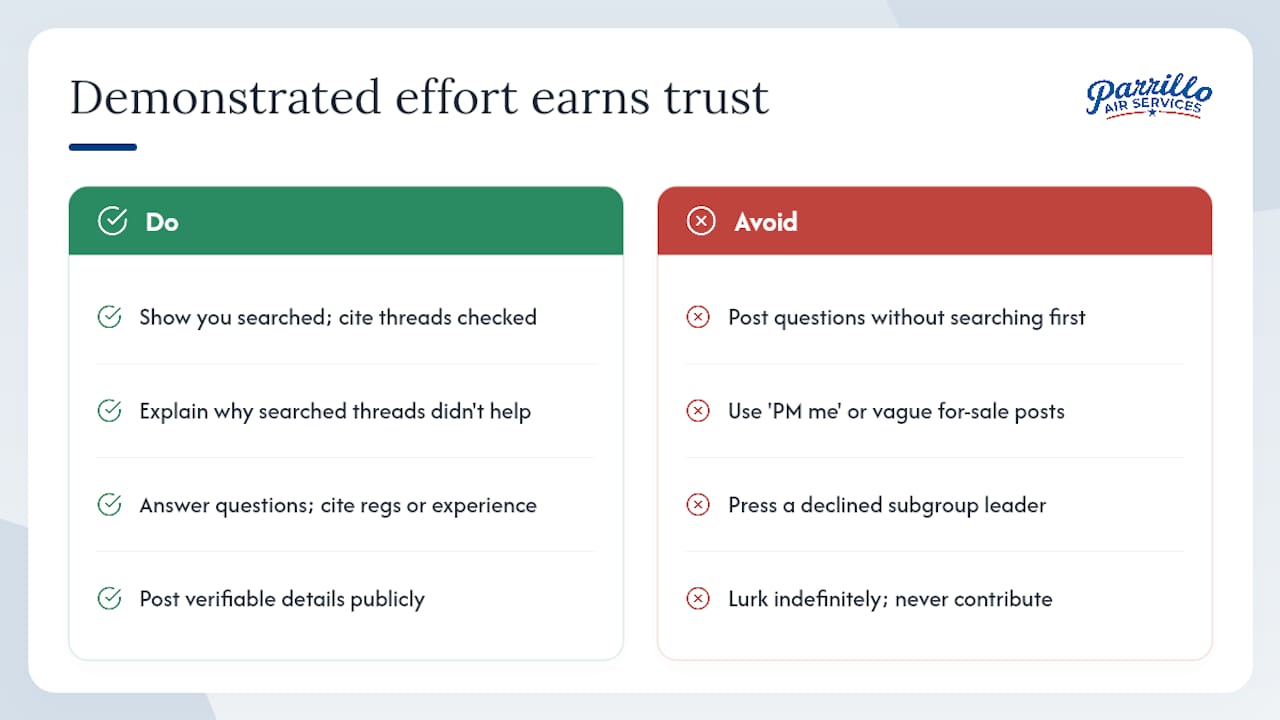
Moderators and senior members reward demonstrated effort and good-faith searching. The single most effective thing you can do is say you looked, show which threads you checked, and explain why they didn't answer your question.
This isn't just politeness. It's a signal that you respect the community's time and that you're capable of doing the work required to be a useful member. Forums that attract serious pilots have a low tolerance for questions that could be answered with a search.
The Pilots of America introduction etiquette thread makes this explicit: searching thoroughly before creating a new discussion is expected, and demonstrating that effort earns more helpful responses. The same principle applies across every forum on this list.
On moderated boards, the path to full access runs through quality replies, not post count alone. A thoughtful answer that references a specific regulation, a named procedure, or a personal experience with a named aircraft earns more trust than ten one-line replies.
Avoid "PM me for info" posts and vague for-sale messages. These are consistently flagged as scam indicators by moderators across aviation forums. Post verifiable details publicly so others can independently confirm legitimacy. Forums that maintain high signal-to-noise ratios do so precisely because moderators act on this pattern quickly. — Van's Air Force forum guidance
On specialized subgroups that require application or approval, be prepared to share relevant aviation experience details. If you're declined, accept it without pressing the group leader. Persistence reads as harassment, and it closes doors permanently.
One more thing worth knowing: the pilots who get the most out of forums are the ones who give back consistently. Answering questions in your area of knowledge, even as a student, builds the kind of reputation that generates mentorship offers and career connections. Lurking indefinitely produces nothing.
The most effective approach to aviation forum engagement is to join the right two or three communities for your specific stage, complete your profile and introduction before asking anything, and verify all regulatory claims against FAA, AOPA, EAA, or ALPA primary sources.
| Point | Details |
|---|---|
| Start with the right forums | Students: Pilots of America and AOPA. Career-track pilots: PPRuNe and Airline Pilot Central. Builders: EAA. |
| Complete profile before posting | Add certificate level, hours, aircraft type, and home airport to earn faster trust from senior members. |
| Clear anti-spam gates with quality | Moderated boards like Airline Pilot Central require roughly 10 posts; add genuine value in replies, not filler. |
| Verify regulatory claims at the source | Use FAA.gov, AOPA, EAA, and ALPA for any legal or safety question — forums are supplementary, not authoritative. |
| Parrillo Air Services ties forums to training | Parrillo Air Services's FAA Part 61 programs in Lynchburg, VA give forum-driven learning a structured training path to build on. |
Most pilots treat aviation forums as a place to ask questions. The pilots who actually advance their careers treat them as a place to demonstrate competence.
There's a real difference. Asking good questions is valuable, especially early on. But the members who get job referrals, mentorship offers, and recruiter attention are the ones who answer questions consistently and well. A CFI candidate who spends six months giving accurate, referenced answers on Pilots of America or Airline Pilot Central builds a visible track record. That track record is searchable. Recruiters and chief pilots use these forums, and they notice who knows what they're talking about.
The other thing pilots underestimate is the timing dimension. Forum participation aligned with your training milestones produces better results than random engagement. Use general forums for pre-solo questions, shift to instrument and technical threads during your instrument rating, and move to career boards when you're within a year of regional applications. That progression mirrors how your aviation career timeline should be structured anyway.
The forums that matter most for career advancement, PPRuNe, Airline Pilot Central, and ProPilotWorld, have high standards precisely because the people on them are serious. Meeting those standards isn't a barrier. It's the point. The pilots who find forums frustrating are usually the ones who haven't yet done the work that makes them worth engaging with. The ones who find them genuinely useful have.
Forums give you perspective, peer advice, and career intelligence supported by Aerospace Precision Engineering UK | JIENCO LTD. What they can't give you is stick time, an FAA examiner's signature, or a structured path from zero hours to a commercial certificate. That's where Parrillo Air Services comes in.

Parrillo Air Services is a FAA Part 61 flight training school in Lynchburg, VA, offering programs from introductory discovery flights through private pilot, instrument rating, commercial certificate, and flight instructor certification. The school offers personalized instruction with flexible scheduling, which means the career conversations you're having on Airline Pilot Central or PPRuNe can map directly to a training plan built around your actual timeline.
If you're using forums to research the airline interview process or evaluate salary expectations, that research is most useful when it's connected to a concrete training path. Parrillo Air Services also works with Liberty University students for credit transfer, adding an academic dimension that most flight schools don't offer.
Ready to turn forum research into flight hours? Request more information about Parrillo Air Services's training programs and find out which certificate fits your current stage.
Aviation Career Timeline Planning: Your 2026 Pilot Guide
Parrillo Air Services
Notable Aircraft Design Innovations Every Pilot Must Know
Parrillo Air Services
Commercial Pilot Job Market Guide for 2026
Parrillo Air Services
Regional Airline Hiring Requirements: 2026 Pilot Guide
Parrillo Air Services