
Yes, 2026 is the year most industry analyses point to as the peak of the pilot shortage, with a widely cited shortfall figure of roughly 24,000 pilots. For anyone weighing a career in the cockpit, that means hiring stays active, but getting hired depends less on the shortage headline and more on whether you show up "qualified and available" when the seat opens.
TL;DR:
- The 2026 pilot shortfall is projected at 24,000 but represents a peak-year snapshot, not the overall long-term demand for pilots.
- Active hiring figures are around 8,000 pilots in 2026, with roughly 18,200 annual job openings projected through 2034, indicating a steady rather than catastrophic market.
- The industry's pilot supply is constrained by fixed factors like mandatory retirements, the 1,500-hour rule, and training capacity limits, which create the pipeline squeeze.
- Post-2026 outcomes could include a normalization of hiring, sustained high demand, or accelerated growth depending on airline orders and retirement patterns.
- Success in this market relies more on consistent training and strategic career planning than timing the short-term shortage.
Table of Contents
- Pilot Shortage 2026: The Numbers Behind the Headlines
- Why 2026 Is the Peak: The Real Drivers
- What Happens After the Peak: Three Realistic Scenarios
- How the Shortage Shows Up in Hiring, Pay, and Career Mobility
- How to Prepare for a Pilot Career in 2026
- Where Parrillo Air Services Fits in the Pipeline
- A Straight Take on the 2026 Pilot Shortage
- Ready to Start Your Training Timeline?
- Sources
Pilot Shortage 2026: The Numbers Behind the Headlines
The 24,000 figure gets repeated everywhere, but it's worth knowing where it comes from and what it actually measures. It traces back to industry analyses summarized alongside Boeing's Pilot and Technician Outlook, which frames the near-term crunch inside a much bigger structural story: Boeing projects the industry will need 674,000 new pilots worldwide by 2045. The 24,000 number is a snapshot of a single tight year, not the whole picture.
Other sources tell a steadier, less dramatic story. The Bureau of Labor Statistics projects about 18,200 openings per year for airline and commercial pilots between 2024 and 2034, with employment growth of roughly 4% over the decade. That's a healthy job market. It just isn't a crisis by BLS's math. Major-carrier hiring tallies suggest a similar cooling: after the 2022–2023 hiring surge, analysts expect around 8,000 hires in 2026 across tracked major airlines, though the number moves depending on retirements and route expansion.
Here's the methodological catch nobody puts in the headline: the FAA's own aerospace forecast tracks growth in certificate holders, not a shortage count. It shows more people earning ATP and commercial certificates, but a bigger population of certificated pilots isn't the same as a bigger supply of pilots who are current, trained on the right aircraft, and ready to start next month.
| Source | What it measures | Key figure |
|---|---|---|
| Boeing / industry summaries | Peak shortfall estimate | ~24,000 in 2026 |
| BLS | Annual job openings, 2024–2034 | ~18,200 per year |
| AOPA / hiring trackers | Major-carrier hires in 2026 | ~8,000 |
| FAA | Certificate-holder population growth | Growth, not a shortage figure |
Three things drive the gap between these numbers:
- Boeing's figure is a peak-year snapshot; BLS measures a ten-year average.
- "Certificated" and "employable" aren't the same population.
- Hiring tallies count actual seats filled, which shifts with airline capacity plans year to year.
Why 2026 Is the Peak: The Real Drivers
The shortage didn't appear out of nowhere. It's the product of a few forces colliding at once, some fixed and some that could ease.
- Mandatory retirements: Federal rules force airline pilots out of the cockpit at 65, and a large cohort hired during the 1990s boom is aging out right on schedule.
- The 1,500-hour rule: FAA Part 61 requires 1,500 flight hours for an unrestricted ATP certificate, a threshold that keeps new commercial pilots out of the right seat for years longer than in most other countries.
- Training capacity: Flight schools, simulators, and check airmen are finite resources, and demand for slots has outpaced the industry's ability to add them quickly.
- The 2022–2023 hiring surge: Airlines rushed to rebuild staff after pandemic furloughs, hiring at a pace that pulled years of normal turnover into a short window. That surge is now the reason 2026 hiring looks calmer by comparison.
AOPA's reporting captures this dynamic well, describing current conditions as a pipeline squeeze: plenty of people hold student pilot certificates, but far fewer make it all the way through training to become qualified and available on an airline's timeline.
What Happens After the Peak: Three Realistic Scenarios
Nobody can tell you exactly what 2027 or 2028 looks like, but the range of plausible outcomes is narrow enough to plan around. Three scenarios cover most of it.
Scenario A: Normalization. Hiring eases from its 2026 peak as retirements settle into a predictable annual rhythm and the post-pandemic bulge fully works through the system. This is the "soft landing" case, and it's consistent with what BLS's steadier 18,200-per-year estimate implies.
Scenario B: Sustained elevated demand. Replacement-driven hiring stays high because retirement waves don't arrive all at once, they arrive in overlapping cohorts. Under this scenario, majors and regionals keep hiring at a brisk pace well past 2026, just without the frantic bonuses of the surge years.
Scenario C: Renewed expansion. If airlines accelerate fleet orders and route growth outpaces retirements, hiring could reaccelerate. This is the scenario Boeing's long-term structural forecast points toward, given its projection of 674,000 new pilots needed by 2045, a number that dwarfs any single-year peak.
Watch these signals to see which way the market is tilting:
- New aircraft orders and delivery schedules at major carriers
- The pace of mandatory retirements reported by the majors each year
- Flight school and simulator throughput, since certification bottlenecks limit how fast supply can respond
- Regional airline attrition rates, which tend to move first when majors ramp hiring
How the Shortage Shows Up in Hiring, Pay, and Career Mobility
The shortage doesn't hit every corner of the industry the same way. Majors, regionals, cargo carriers, and corporate operators each hire on a different clock, and understanding that difference matters more than watching the national headline.
Majors set the pace. When they hire aggressively, they pull captains and senior first officers up from regionals, which then forces regionals to backfill from flight instructor ranks and time-building pilots. Cargo carriers often move counter-cyclically, hiring hard when passenger airlines slow down. Corporate and charter operators tend to poach experienced pilots rather than train new ones, so their hiring rarely shows up in beginner-facing job boards at all.
- Signing bonuses at regionals became common during the 2022–2023 surge and have moderated but not disappeared.
- Tuition-reimbursement and cadet programs remain a meaningful lever regionals use to lock in future hires early.
- Time-to-captain has shortened at several regionals as senior pilots get pulled to majors faster than replacements arrive.
- Flight instructor demand has climbed as more students need CFIs to log hours toward the 1,500-hour threshold.
Roughly 18,200 pilot job openings are projected annually through 2034, a figure that includes growth plus the replacement of retiring pilots, according to BLS data. That number matters more for your planning than the 24,000 peak figure, because it reflects the sustained hiring rhythm you're actually training into, not a single dramatic year. For a closer look at how regional carriers structure their hiring right now, our regional airline hiring guide breaks down specific requirements by carrier tier.
How to Prepare for a Pilot Career in 2026
Timing the shortage is a losing game. Getting through the pipeline on a realistic, well-financed schedule is not. Here's the sequence that actually works.
- Start with a private pilot certificate, then stack instrument and commercial ratings on top. Each stage builds the hours and skills the next one requires, and skipping around rarely saves time.
- Plan for 3 to 5 years from zero experience to airline-ready, assuming full-time, consistent training. Part-time schedules stretch this considerably, sometimes past the point where earlier certificates need review or currency refreshers.
- Budget $75,000 to $120,000 for the full path, a range that holds up across most training-cost breakdowns for 2026, though your exact number shifts with aircraft rental rates, instructor availability, and how efficiently you fly.
- Build hours through flight instructing. Earning a CFI certificate is the most practical, and often the most affordable, route to the 1,500-hour ATP threshold, since you get paid while you accumulate time instead of just burning cash renting airplanes.
- Look hard at cadet and tuition-reimbursement programs. Several regionals structure these to reduce net cost and shorten time-to-hire, and they're worth researching before you pick a flight school, not after.
- Get your paperwork and interview skills in order early. Keep a clean logbook, know your numbers cold, and practice interview scenarios before you need them, not the week before an interview.
- Protect your currency. Long gaps in training, whether from cost, scheduling, or life circumstances, are the single most common reason motivated students stall out. A pause of a few months can mean re-flying maneuvers you'd already mastered.
Our aviation career timeline planning guide walks through stage-by-stage scheduling in more detail, and the ATP certification guide covers exactly what the 1,500-hour threshold requires in practice.
Where Parrillo Air Services Fits in the Pipeline
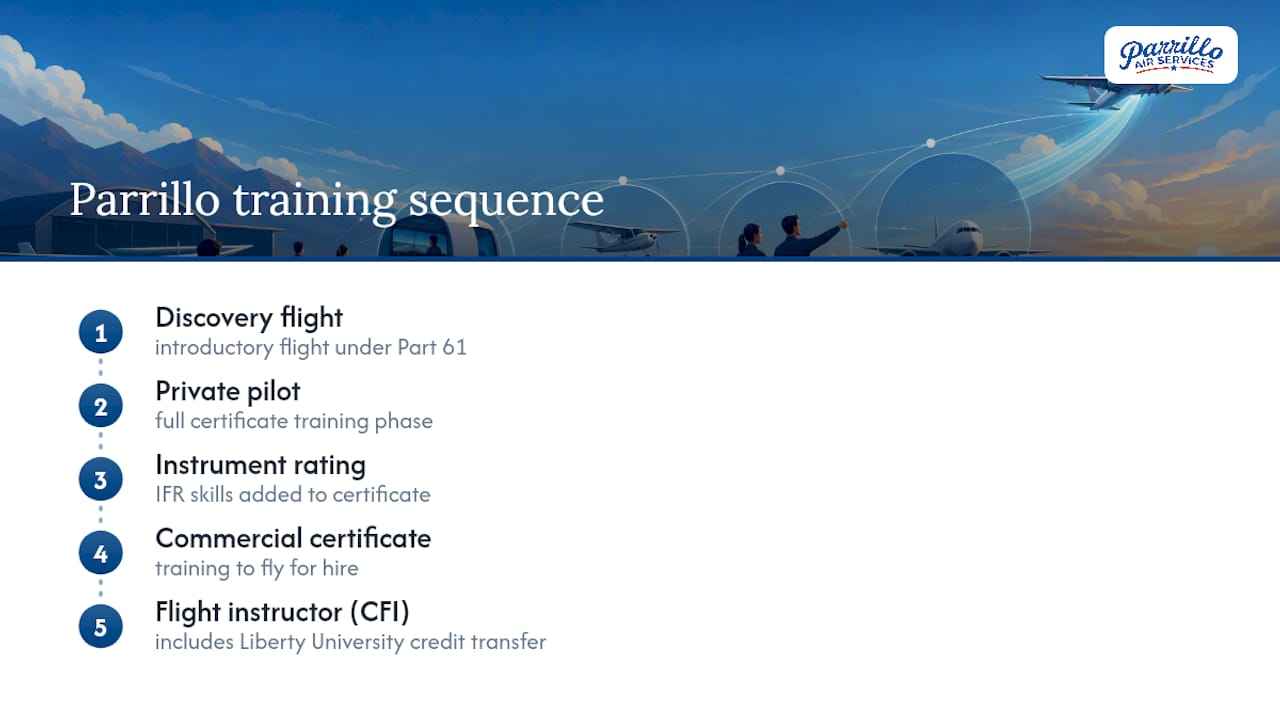
Parrillo Air Services runs FAA Part 61 training in Lynchburg, Virginia, covering the full sequence: discovery flights, private pilot certificate, instrument rating, commercial certificate, and flight instructor certification, including scheduling built around Liberty University credit transfer. The structure exists specifically to address the pipeline squeeze described above: personalized, flexible-schedule instruction cuts down the stalled-training gaps that keep otherwise capable students from becoming qualified and available. When you're comparing flight schools, ask directly about instructor-to-student ratios, aircraft availability, and how the school handles scheduling gaps before they turn into currency lapses.
A Straight Take on the 2026 Pilot Shortage
The 24,000 figure is real, but it's a single-year snapshot inside a much longer structural story that Boeing's own long-term forecast makes clear. Your three priorities: build a realistic financial plan before you start, train with consistency rather than trying to time the hiring cycle, and follow authoritative sources and local hiring notices instead of forum speculation.
— Gm
