
An instrument rating is an FAA add-on qualification that authorizes a certificated pilot to fly under Instrument Flight Rules (IFR), operating an aircraft solely by reference to cockpit instruments when outside visual references are unavailable. Governed by 14 CFR Part 61, specifically Section 61.65, this rating is the legal gateway to flying in clouds, fog, and low-visibility conditions that would ground any Visual Flight Rules (VFR) pilot. Without it, your certificate limits you to clear skies and visual contact with the ground. With it, you operate in a fundamentally different category of aviation, one that demands precision, discipline, and a complete shift in how you process flight information.
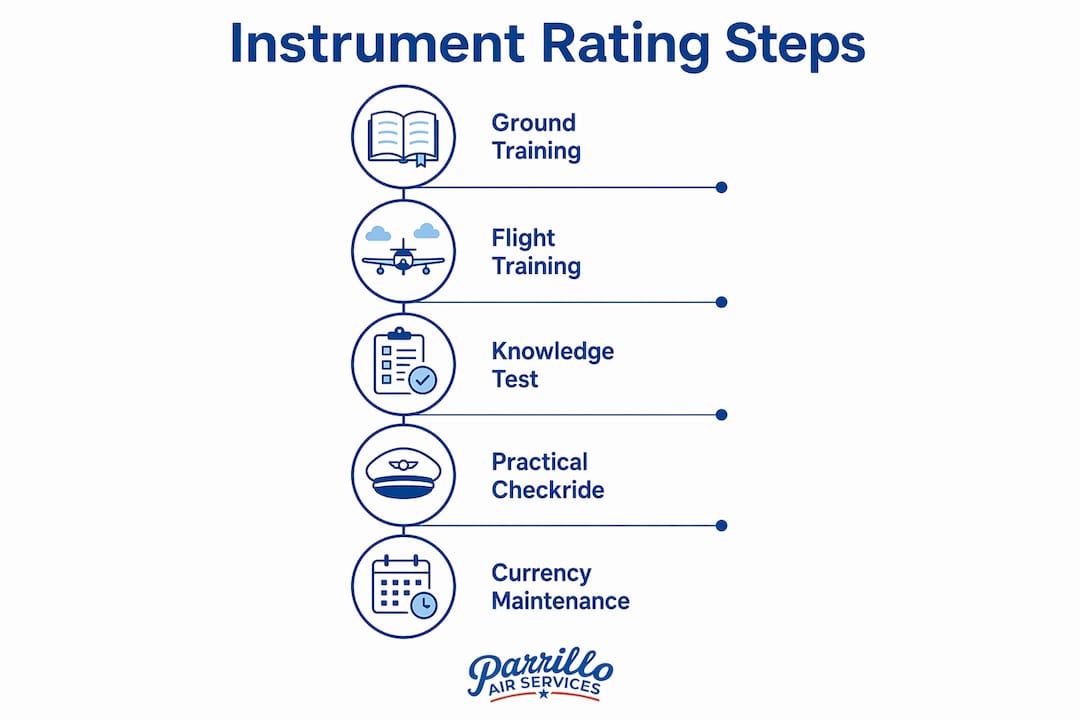
The FAA's § 61.65 lays out five distinct requirement categories every candidate must satisfy: ground training, flight training, a knowledge test, instructor endorsements, and a practical test known as the checkride. Each category has specific standards, and meeting all five in the correct sequence is what separates candidates who move efficiently through training from those who stall at administrative hurdles.
Ground training covers the aeronautical knowledge areas required for IFR operations. You can complete this through an authorized instructor or an approved home-study course. Topics include IFR regulations, instrument approach procedures, weather interpretation, navigation systems, and emergency operations. This is not a formality. The knowledge test draws directly from these areas, and the oral portion of your checkride will probe your understanding of every one of them.

Flight training requires a minimum number of hours in actual or simulated instrument conditions, logged under the supervision of a Certificated Flight Instructor Instrument (CFII). The FAA also permits credit for time logged in FAA-approved simulators and aviation training devices, though that credit is limited to 20 hours for most candidates under Part 61. That ceiling matters. Many students assume simulator time is an unlimited substitute for actual flight, and it is not.
Here is a summary of the core training requirements under § 61.65:
Hold at least a private pilot certificate (airplane, helicopter, or powered-lift, depending on rating sought)
Log a minimum of 50 hours of cross-country flight time as pilot in command
Complete 40 hours of actual or simulated instrument time
Receive a logbook endorsement from a CFII confirming readiness for the knowledge test
Pass the FAA Instrument Rating Aeronautical Knowledge Test with a score of 70% or higher
Receive a CFII endorsement confirming readiness for the practical test
Pass the instrument rating checkride with an FAA Designated Pilot Examiner (DPE)
Pro Tip: Log every instrument training flight with precise detail, including the specific instrument conditions encountered, the approaches practiced, and the equipment used. Vague logbook entries create problems during DPE review and can delay your checkride scheduling by weeks.
Proper logbook documentation is not optional paperwork. Missing or misaligned endorsements can delay FAA processing even when a pilot is fully skilled and ready to test. Build the habit of meticulous record-keeping from your first instrument lesson.
The practical benefits of holding an instrument rating extend well beyond the legal permission to fly in clouds. The rating restructures what flying means for you operationally, professionally, and from a safety standpoint.
Here are the four most significant ways the rating changes your capabilities:
Legal IFR flight in instrument meteorological conditions (IMC). The rating authorizes flight in clouds and low-visibility weather that is completely off-limits to VFR pilots. This is the core privilege. A VFR pilot who inadvertently enters IMC faces one of the most dangerous situations in aviation. An instrument-rated pilot is trained and authorized to handle it.
Access to the full national airspace system. IFR flight plans give you access to Class A airspace above 18,000 feet and priority handling from air traffic control in all airspace classes. VFR pilots are excluded from Class A entirely. For anyone pursuing airline or commercial aviation, operating in Class A is not optional.
Improved safety through disciplined procedure. Instrument training instills a scanning discipline and procedural rigor that makes you a better pilot in all conditions, not just IMC. The mindset shift from visual "see and avoid" flying to instrument scanning and checklist adherence reduces the cognitive errors that cause accidents even in clear weather.
Career advancement and marketability. Every professional pilot path, from regional airline first officer to corporate charter captain, requires an instrument rating. Earning it early in your training timeline signals to employers that you are serious and capable. At Parrillo Air Services, instrument training is positioned as the critical second step after the private pilot certificate for students targeting airline careers.
The operational flexibility the rating provides is not just theoretical. Consider a cross-country flight from Lynchburg, VA, to Charlotte, NC, in autumn. A VFR pilot checks the forecast, sees a broken ceiling at 1,500 feet, and cancels. An instrument-rated pilot files IFR, departs in the soup, climbs through the overcast, and arrives on schedule. That difference compounds over a career.
The FAA Instrument Rating knowledge test consists of 60 multiple-choice questions drawn from the FAA's published question bank. The passing score is 70%, meaning you can miss up to 18 questions and still pass. The test result is valid for 24 months, giving you a window to complete your flight training and schedule the checkride before it expires.
The subject areas tested include IFR regulations, meteorology, navigation, instrument approach procedures, aircraft systems, and aeronautical decision-making. Rote memorization of answers is a trap. The FAA updates its question bank, and DPEs probe the same knowledge areas during the oral exam. Understanding the why behind each answer is what carries you through both the written test and the checkride.
The practical test, or checkride, has two components: an oral examination and a flight evaluation. The oral exam is conducted by a DPE and covers your knowledge of IFR procedures, weather interpretation, aircraft systems, and regulatory requirements. The flight evaluation tests your ability to fly instrument approaches, holds, and en route procedures to the standards published in the FAA's Instrument Rating Airman Certification Standards (ACS).
Common checkride challenges include:
Maintaining precise altitude and heading during partial-panel exercises (flying without certain instruments)
Flying instrument approaches to ACS minimums under simulated IMC with a view-limiting device
Demonstrating correct missed approach procedures without hesitation
Answering oral questions about unfamiliar approach plates or weather scenarios
Pro Tip: Study the FAA knowledge test using the current ACS as your framework, not just a question bank app. The ACS tells you exactly what the DPE is authorized to test, which makes your oral preparation far more targeted and efficient.
Several persistent misunderstandings slow students down or create false confidence during training. Knowing them in advance puts you ahead.
| Misconception | Reality |
|---|---|
| More hours automatically means better preparation | § 61.65 requires mastery of specific areas, not just hour accumulation. Unfocused flying fails checkrides. |
| Simulator time replaces real flight training | FAA-approved device credit is capped at 20 hours under Part 61. Real instrument time is irreplaceable. |
| "VFR not recommended" means you cannot fly VFR | This briefing language is advisory, not a mandate. The pilot in command makes the final go/no-go call. |
| Passing the knowledge test means you are ready to fly IFR | The written test confirms knowledge. The checkride and ongoing currency requirements confirm proficiency. |
The "VFR not recommended" point deserves extra attention. Per AIM Chapter 7, flight service specialists use this language to flag deteriorating conditions, but the pilot in command retains full authority and responsibility for the go/no-go decision. For instrument-rated pilots, this briefing is a prompt to evaluate whether IFR is the appropriate option, not a prohibition on flight.
The instrument rating is not a license to fly in any weather. It is a license to make informed, legal decisions about weather that VFR pilots cannot legally make at all.
Currency is another area where pilots underestimate the ongoing commitment. To exercise instrument privileges, you must log six instrument approaches, holding procedures, and intercepting and tracking courses within the preceding six calendar months. Letting currency lapse means you need an Instrument Proficiency Check (IPC) from a CFII before flying IFR again. The training requirements do not end at the checkride.
The instrument rating is the single most impactful add-on qualification a private pilot can earn, unlocking IFR flight, Class A airspace, and every professional aviation career path.
| Point | Details |
|---|---|
| FAA regulatory basis | § 61.65 governs all instrument rating requirements, from ground training to the practical test. |
| Documentation matters | Missing logbook endorsements delay checkride scheduling regardless of pilot skill level. |
| Simulator credit is capped | FAA-approved device time counts for up to 20 hours under Part 61, not as a full substitute for flight. |
| Testing has two phases | A 60-question written test and a DPE-administered checkride both require preparation grounded in the ACS. |
| Currency is ongoing | Six approaches and holds every six months are required to maintain legal instrument privileges. |
Most student pilots treat the instrument rating as a box to check on the way to a commercial certificate. That framing undersells it badly. The instrument rating is where you learn to trust systems over instincts, and that shift is the foundation of every professional flying skill that follows.
The students I have seen struggle most with instrument training are the ones who were naturally gifted VFR pilots. Their instincts were sharp, their visual flying was smooth, and then they put on the foggles and fell apart. That is not a coincidence. Instrument flying exposes the gap between feel and fact. The airplane does not care how confident you are. It responds to inputs, not intentions.
What the rating actually teaches you is structured thinking under pressure. You learn to scan, prioritize, and execute procedures in a specific sequence even when your inner ear is telling you something completely different. That discipline carries into every flight you take afterward, IFR or not. Pilots who have earned the rating handle unexpected situations differently. They default to procedure rather than panic.
For anyone targeting a regional or major airline career, earning the instrument rating early and maintaining tight currency throughout training is the single best investment you can make. It is not just a requirement. It is the credential that tells every future employer you can be trusted in the system.
— Gm

Parrillo Air Services, located in Lynchburg, VA, offers FAA Part 61 instrument rating training with experienced CFIIs who build your skills from the ground up. Whether you are transitioning from your private pilot certificate or planning your path toward an airline career, the instrument program at Parrillo Air is structured to meet FAA § 61.65 requirements efficiently and thoroughly. Personalized scheduling, real aircraft time, and instructors who know the checkride process inside and out make the difference between a candidate who is ready and one who is not. Explore the flight training programs at Parrillo Air Services and take the next step toward IFR-capable flying.
An instrument rating authorizes a private pilot to fly under IFR in instrument meteorological conditions, including clouds and low visibility, using cockpit instruments instead of outside visual references. Without it, a private pilot is restricted to VFR flight in conditions that allow visual contact with the ground.
FAA § 61.65 requires a minimum of 40 hours of actual or simulated instrument time, plus 50 hours of cross-country pilot-in-command time. Most students complete the rating in 60 to 80 total training hours depending on frequency and conditions.
The test consists of 60 multiple-choice questions with a 70% passing threshold, meaning 42 correct answers are required. Candidates who study the FAA Instrument Rating ACS and understand the reasoning behind each topic, rather than memorizing answers, consistently pass on the first attempt.
Yes, but FAA regulations cap simulator and approved flight training device credit at 20 hours for Part 61 candidates. The device must hold FAA approval, and all time must be logged correctly to count toward the 40-hour instrument time requirement.
Every airline pilot position, from regional first officer to major carrier captain, requires an instrument rating as a prerequisite. It is also required before a pilot can pursue a commercial pilot certificate, making it a mandatory step on any professional aviation career path.
Instrument Rating Training Requirements: A Pilot's Guide
Parrillo Air Services
FAA Flight Instructor Rating Process Guide | Parrillo Air Services
Parrillo Air Services
Understand the FAA flight instructor rating process
Parrillo Air Services
The Role of a Flight Instructor: Career Impact Explained
Parrillo Air Services