U.S. airspace breaks into six classes: A, B, C, D, E, and G. Classes A through E are controlled, meaning air traffic control provides some level of separation or advisory service, while Class G is uncontrolled and runs on see-and-avoid. That single split determines whether you need a clearance, a radio call, specific equipment, or nothing more than good eyes and a sharp lookout.
TL;DR:
- Pilots must be aware that Class B and C airspace require explicit clearance or two-way radio contact, respectively, before entry.
- Class E airspace can start at various altitudes, such as 700 or 1,200 feet AGL, and is often misunderstood due to its shifting floors.
- When controlled airspace overlaps, the most restrictive class, typically A or B, governs, so pilots should default to stricter rules in uncertain zones.
- Night VFR minima in Class G are tighter, sometimes dropping visibility requirements to one mile, requiring additional vigilance.
- Learning to recognize chart patterns quickly is more crucial for safe cockpit navigation than memorizing altitude figures or numbers alone.
Table of Contents
- What Are the Six Airspace Classes at a Glance?
- Class A: IFR Only. Where It Starts and What That Means
- Class B: The Busy Hub 'Wedding Cake'
- Class C: Two-Way Comms and What to Expect from Approach
- Class D: Towered-Field Airspace and Reversion Behavior
- Class E: Variable Floors and Chart Cues
- Class G: Uncontrolled Airspace, Dimensions, and Safety Habits
- Special-Use Airspace and Other Charted Areas
- How to Read Sectional Charts Fast
- Operational Rules to Memorize Before Your Checkride
- What Happens When Airspace Designations Overlap?
- Instructor Perspective: Teaching Airspace at Parrillo Air Services
- Where to Go for Official Rules and Study Aids
- Why the Standard Airspace Chart Doesn't Teach You to Fly in It
- Sources
What Are the Six Airspace Classes at a Glance?
Every one of these numbers comes straight from FAA sources, and you'll want this table taped to your kneeboard or saved as a screenshot before your first solo cross-country.
| Class | Typical vertical limits | ATC role | Entry rule | Equipment expectations | VFR minima |
|---|---|---|---|---|---|
| A | 18,000 ft MSL to FL600 | Full separation, IFR only | ATC clearance and IFR flight plan | Transponder, ADS-B, IFR-certified aircraft | VFR not permitted |
| B | Surface to 10,000 ft MSL | Full separation | Explicit ATC clearance required | Mode C transponder, ADS-B in the veil | 3 SM visibility, clear of clouds |
| C | Surface to 4,000 ft above airport elevation | Separation for IFR, sequencing for VFR | Two-way radio contact established | Transponder with Mode C/ADS-B | 3 SM visibility, 500 below/1,000 above/2,000 horizontal |
| D | Surface to 2,500 ft AGL | Sequencing and traffic advisories | Two-way radio contact established | None specified beyond radio | Same as Class C |
| E | Surface, 700 AGL, 1,200 AGL, up to 14,500 MSL | Separation for IFR only | None for VFR | None specified for VFR | Same as C/D below 10,000 ft; higher above |
| G | Up to 1,200 ft AGL typically | None | None | None | Reduced, varies by day/night and altitude |
Keep this table handy for checkride prep, but treat it as a memory aid, not a substitute for the actual regulatory text in the AIM.
Class A: IFR Only. Where It Starts and What That Means
Class A begins at 18,000 feet MSL and runs to FL600, and it's the one class where the rules are refreshingly simple: no VFR, period. You won't find Class A boundaries drawn on a VFR sectional chart because visual flight isn't an option up there. Everyone operating in Class A is on an IFR flight plan, holding an ATC clearance, and flying under radar contact the entire time.
That has real planning consequences. If you're climbing out on an IFR flight plan toward your cruising altitude and that altitude sits above 18,000 feet, you're now flying under a completely different set of separation standards, and your altimeter setting shifts to a standard 29.92 rather than the local setting you'd use lower down. Key points to lock in:
- Vertical limits: 18,000 ft MSL to FL600, no exceptions by location.
- IFR flight plan and ATC clearance mandatory before entry.
- Altimeter set to 29.92 inches once above 18,000 feet.
- Not depicted on sectional charts since VFR traffic has no business there.
Class B: The Busy Hub 'Wedding Cake'
Class B airspace surrounds the nation's busiest airports and typically runs from the surface up to around 10,000 feet MSL, tailored into tiered rings that pilots nickname the wedding cake for its stacked-shelf shape. The critical detail students miss: you need an explicit clearance to enter, not just a radio call that gets acknowledged. If the controller says "standby" or reads back only your call sign, you are not cleared in.
- Solid blue lines on a sectional mark the boundary; each shelf shows its own floor and ceiling.
- Mode C transponder and ADS-B Out are required inside the Mode C veil, generally the 30 nautical mile ring around the primary Class B airport.
- Student pilots need specific endorsements to fly into certain Class B airspace, and some primary airports are off-limits to student solo flight entirely.
- Listen for the actual words "cleared into the Class B airspace." Anything less means keep clear.
Class C: Two-Way Comms and What to Expect from Approach
Class C airspace usually forms a 5 nautical mile core from the surface up to 4,000 feet above airport elevation, with a 10 nautical mile outer shelf starting around 1,200 feet. Medium-sized airports with a mix of airline and general aviation traffic tend to carry this designation. Unlike Class B, you don't need a clearance. You need to establish two-way radio communication, and you know you're legal the moment the controller uses your aircraft call sign back to you, even a simple "Cessna 12345, remain clear of the Class C, standby" counts as contact established, though not as permission to enter.
- Solid magenta rings on the sectional mark Class C boundaries.
- Transponder with Mode C or ADS-B Out is required to operate inside.
- Approach control typically provides sequencing and traffic advisories to VFR aircraft, not full separation.
- Expect a workload that's busier than Class D but far less rigid than Class B.
Class D: Towered-Field Airspace and Reversion Behavior
Class D typically extends from the surface to 2,500 feet above the airport elevation and covers smaller towered fields. Same rule as Class C on entry: establish two-way radio contact before you cross the boundary. There's no blanket transponder requirement here unless a specific notice says otherwise, which trips up students who assume every towered field demands Mode C.
- Dashed blue lines on the sectional identify Class D boundaries.
- Two-way radio contact required; no clearance phrase needed like Class B.
- When the tower closes for the night, the airspace typically reverts to Class E or Class G.
- Check the chart supplement and current NOTAMs before a night or early-morning arrival, since posted tower hours can shift.
Class E: Variable Floors and Chart Cues
Class E fills every gap the other controlled classes don't claim, and its floor is the single most confusing detail in the entire system. It can start at the surface, 700 feet AGL, 1,200 feet AGL, or as high as 14,500 feet MSL depending on location, then extends up to but not including 18,000 feet MSL. No clearance and no radio call are required to enter as a VFR pilot, but the airspace still supports IFR separation services.
- Shaded magenta vignette: floor drops to 700 feet AGL inside the shading.
- Shaded blue vignette: floor drops to 1,200 feet AGL.
- Dashed magenta line: Class E extends down to the surface, usually tied to an instrument approach.
- Above 10,000 feet MSL, VFR visibility and cloud clearance minima both increase, so double check your numbers before climbing through that layer.
Class E confuses more student pilots than any other class precisely because that floor keeps moving. Get comfortable spotting the vignette style before you ever look at a number.
Class G: Uncontrolled Airspace, Dimensions, and Safety Habits
Class G is airspace nobody controls. There's no ATC separation service, and it commonly extends up to 1,200 feet AGL, though remote areas of the western U.S. and Alaska push that ceiling much higher. VFR minima in Class G are the most relaxed in the system, especially at night, when visibility requirements can drop as low as one mile in some circumstances depending on altitude.
That relaxed standard doesn't mean relaxed vigilance. With no controller watching your tail, the entire burden of traffic separation falls on your eyes and the eyes of everyone else sharing that airspace.
- No ATC clearance, communication, or equipment requirement to operate.
- Day and night VFR minima differ, and night minima are noticeably tighter.
- Stay aware of nearby practice areas and non-towered airport traffic patterns, where uncontrolled airspace sees the heaviest general aviation density.
- Requesting VFR flight following from the nearest approach or center frequency adds a set of eyes even when you're not required to talk to anyone.
Special-Use Airspace and Other Charted Areas
Beyond the six main classes, sectional charts carry a second layer worth knowing: Military Operations Areas (MOAs), restricted areas, prohibited areas, warning areas, alert areas, and temporary flight restrictions (TFRs). Each carries different consequences if you blunder through without checking.
- Restricted and prohibited areas require specific coordination or permission and can carry real hazards like live ordnance; treat every restricted area as closed unless you've confirmed otherwise.
- MOAs are cautionary rather than forbidden. VFR traffic can transit them, but expect high-speed military traffic and reduced see-and-avoid margin.
- Warning and alert areas flag hazardous activity or high traffic density without legally barring entry.
- TFRs pop up with little notice around wildfires, VIP movement, and sporting events, so check current NOTAMs the same day you fly, not the week before.
Blue and magenta hatched boundaries on the sectional mark most special-use areas, with the specific type and altitude block printed nearby. Flight Service and the FAA's NOTAM search are your fastest way to confirm whether one is hot before you plan a route through it.
How to Read Sectional Charts Fast
Reading a sectional under time pressure gets easier with a repeatable sequence. Most new pilots try to read every number on the chart before they understand the visual pattern, and that's backward.
- Scan for line style and color first: solid blue, dashed blue, solid magenta, or magenta shading. That alone tells you which class you're looking at before you read a single number.
- Read the floor and ceiling figures printed near the boundary, then cross-check them against the chart supplement for that specific airport, since some fields carry nonstandard dimensions.
- Check current NOTAMs and TFRs along your route, and note which frequencies and equipment you'll need before you ever start the engine.
Operational Rules to Memorize Before Your Checkride
Boil the whole system down to three questions for every class: what do I need to enter, what equipment must I carry, and what weather minima apply.
- Class A: IFR clearance and flight plan, transponder and ADS-B, no VFR permitted.
- Class B: explicit ATC clearance, Mode C transponder inside the veil, 3 SM visibility and clear of clouds.
- Class C and D: two-way radio contact established, transponder required in Class C, standard 3 SM/500-1,000-2,000 minima.
- Class E: no clearance or radio call needed for VFR, minima match C/D below 10,000 feet MSL.
- Class G: no requirements, minima are the most relaxed and vary by day/night.
Above 10,000 feet MSL, VFR cloud clearance and visibility minima jump to 5 SM visibility and 1,000 feet below/above with 1 SM horizontal clearance from clouds, a change many students forget until they're staring at a wall of cumulus at altitude. Keep the AIM open on your second monitor while you study. It's the actual regulatory language behind every rule listed here.
What Happens When Airspace Designations Overlap?
When one piece of airspace overlaps another, the more restrictive designation governs. The hierarchy runs A, then B, then C, then D, then E, then G. A practical example: an instrument approach might extend Class E airspace down to the surface within an otherwise Class G area near a small airport, and that surface extension takes priority the moment it's active.
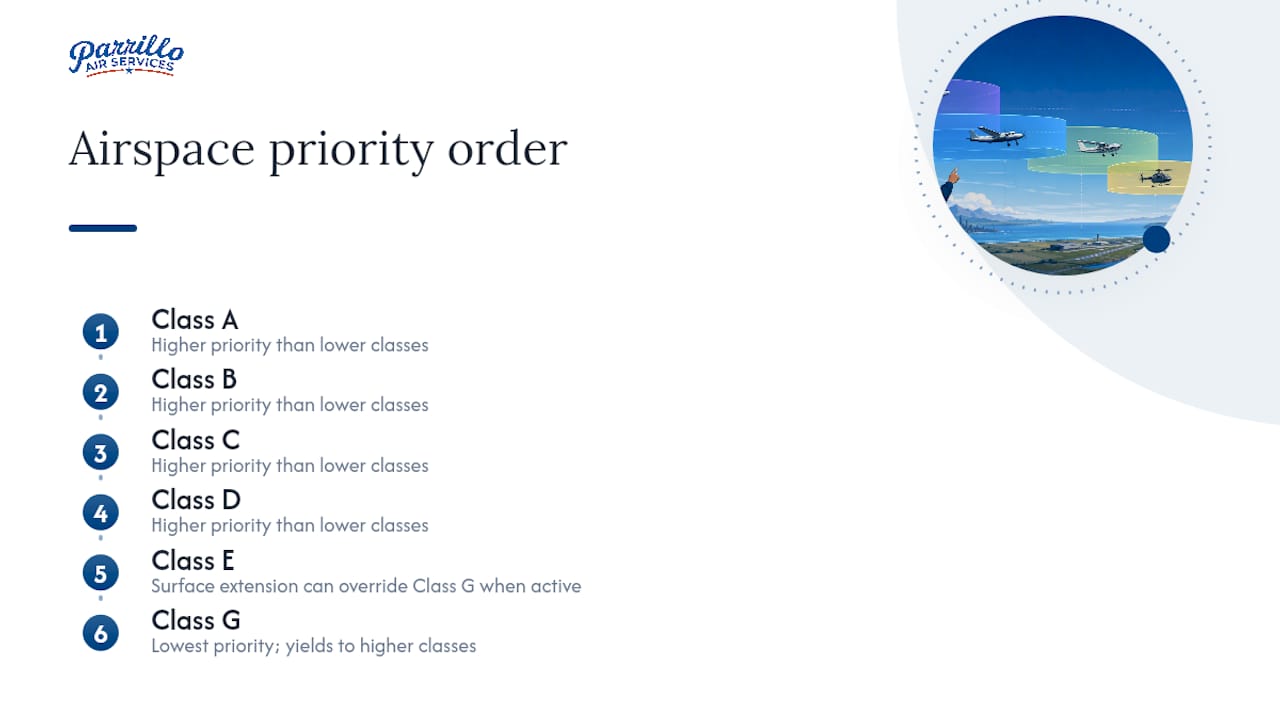
When you're not sure which rule applies in a spot where boundaries seem to touch, default to the stricter class and confirm with ATC or the chart supplement before you commit to a route through it.
Instructor Perspective: Teaching Airspace at Parrillo Air Services
Instructors at a flight training school often teach airspace in a fixed order: memorize the vertical limits table first, then spend a full ground session decoding chart symbols before ever touching numbers. That sequence mirrors how your brain actually processes a sectional at a glance.
Three mistakes show up constantly. First, students confuse dashed blue (Class D) with solid magenta (Class C) because both look similar at a glance. Second, students forget that towered fields revert to Class E or G after hours, then get surprised when no one answers the radio. Third, plenty of students assume every controlled airspace requires a transponder, when Class D typically carries no such mandate unless specifically noted.
Understanding air traffic control's actual role in each class clears up most of this confusion fast.
Where to Go for Official Rules and Study Aids
For the regulatory text itself, go straight to the FAA's Aeronautical Information Manual and the Airspace Classification pages of the Aeronautical Information Publication. AOPA's airspace flash cards make for quick review between lessons, and Parrillo Air Services' guide to FAA written exam topics ties airspace questions directly to what shows up on test day.
Why the Standard Airspace Chart Doesn't Teach You to Fly in It
The at-a-glance table gets a student through a written exam. It does almost nothing for the moment a controller says something unexpected on frequency and you have three seconds to figure out whether you're still legal to proceed. That gap between memorized facts and cockpit judgment is where most airspace mistakes actually happen, not in the classroom.
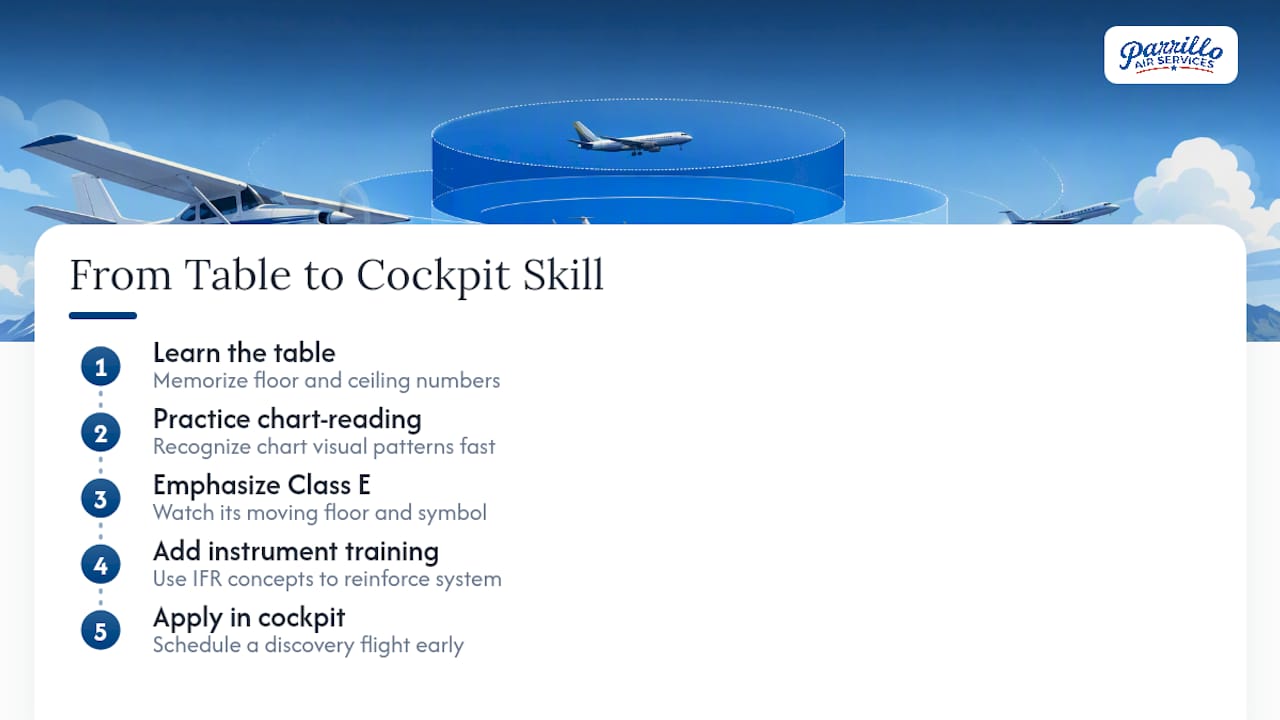
The conventional advice tells students to memorize the numbers and move on. That's backward. The floor and ceiling figures matter less than recognizing the visual pattern on a chart fast enough to act on it before you're five miles closer to a boundary you didn't see coming. Class E deserves more attention than most syllabi give it, precisely because its floor moves and its chart symbol is easy to misread under pressure.
If you're studying this material seriously, treat the table as day one and the chart-reading habit as the skill you actually practice for weeks. Pair that with real instrument training once you understand why Class A exists, since the two concepts reinforce each other. A solid grounding in instrument rating requirements makes the entire airspace system click into place in a way that flashcards alone never will. Consider scheduling a discovery flight with Parrillo Air Services to put this knowledge into an actual cockpit sooner rather than later.
— Gm
