
A training syllabus pilot program is a structured, written curriculum that organizes every phase of flight instruction into sequenced lessons with defined objectives, maneuvers, and completion standards aligned to FAA certification requirements. The term "training syllabus" is the recognized industry standard, and when pilots or instructors say "syllabus pilot," they mean a student progressing through that structured training curriculum with explicit lesson goals and documented progress. Under regulations like 14 CFR § 61.109 and 14 CFR § 91.1079, a proper flight syllabus covers ground training subjects, flight maneuvers, emergency procedures, and training device usage. Understanding what goes into a pilot course outline before you begin training is one of the most practical advantages you can give yourself.
A pilot training syllabus is more than a topic list. Under 14 CFR § 91.1079(b), it must describe principal ground training subjects, identify which training devices are used, and detail every maneuver per phase, distinguishing clearly between what is performed in actual flight versus in a simulator. That distinction matters because the FAA treats simulator credit and in-flight proficiency as separate categories, and a syllabus that blurs the two creates compliance problems at checkride time.
The core elements of a well-built pilot training syllabus include:
Ground training subjects: Weather theory, aerodynamics, airspace, regulations, navigation, and emergency procedures
Flight maneuvers: Normal operations such as takeoffs and landings, abnormal procedures like engine failures, and full emergency scenarios
Training device usage: Specific identification of which maneuvers can be completed in an approved simulator versus which require actual flight
Lesson sequencing: A defined order that builds skills progressively, from basic aircraft control to complex cross-country and night operations
Lesson objectives and completion standards: Each lesson must state what the student is expected to demonstrate before advancing
Documentation requirements: Instructor sign-offs, stage check records, and progress notes that create a verifiable training record
Pro Tip: Before enrolling in any flight training program, ask the school to show you the actual syllabus document. A school that cannot produce one is not organized for your success.
The documentation function of a syllabus is often underestimated. For FAA audits and checkride applications, a complete training record tied to a written syllabus is the difference between a smooth process and a delayed certificate.
The regulatory framework governing your flight training program determines how rigid or flexible your syllabus will be. Part 141 and Part 61 represent two distinct approaches, and the differences affect everything from lesson order to minimum flight hours.

| Feature | FAA Part 141 | FAA Part 61 |
|---|---|---|
| Syllabus approval | FAA-approved, locked course outline | Instructor-designed, flexible |
| Lesson sequence | Fixed, mandatory order | Adaptable to student needs |
| Stage checks | Required at defined intervals | Not required |
| Minimum flight hours (Private Pilot) | 35 hours | 40 hours |
| Progress documentation | Mandatory, standardized | Instructor discretion |
| FAA audit requirement | Yes, regular oversight | No formal audit |
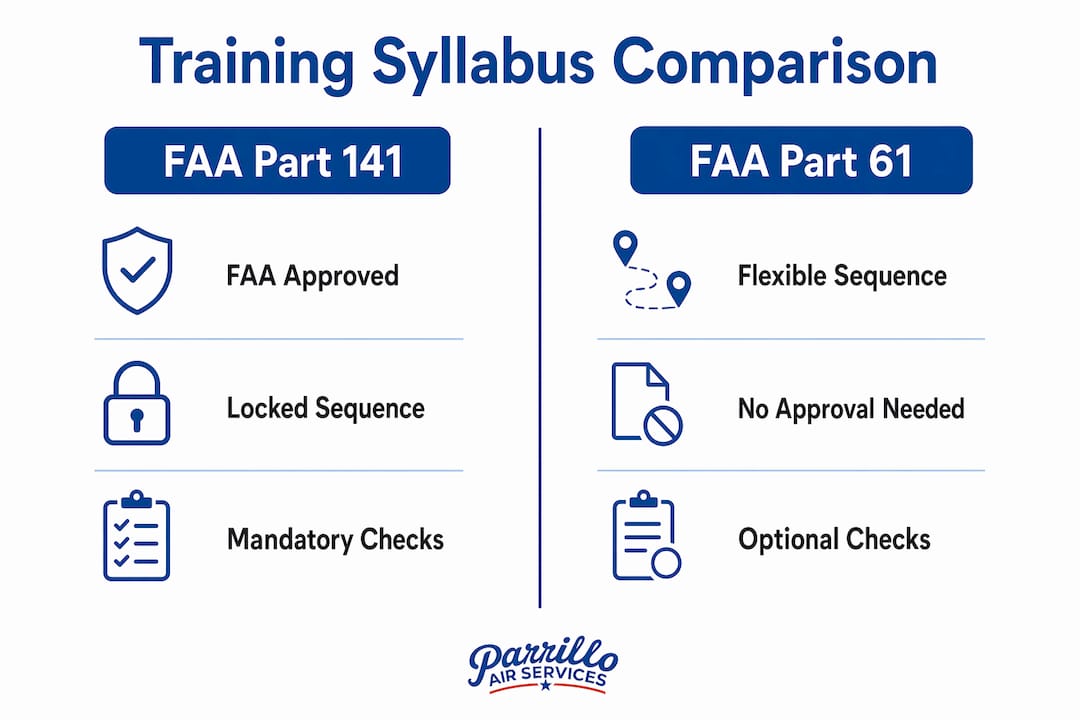
FAA Part 141 curricula operate with locked instructional sequences and mandatory progress documentation, which creates a consistent, standardized experience for every student at that school. The tradeoff is reduced flexibility. If you master a skill faster than the syllabus expects, you still follow the prescribed sequence. Part 61 instruction allows an experienced CFI to reorder lessons based on your learning pace, weather conditions, or aircraft availability.
Here is how the practical experience differs for students:
Part 141 students follow a defined stage structure. Completing Stage 1 requires a stage check with a designated examiner or check instructor before Stage 2 begins.
Part 61 students progress based on instructor judgment, which rewards students who communicate well with their CFI and stay organized about their own training records.
Hour requirements differ because Part 141 schools earn reduced minimums through FAA approval of their curriculum quality. Part 61 requires 40 flight hours for a Private Pilot certificate.
Transfer situations favor Part 141 records because the standardized documentation makes it easier for a new school to assess exactly where you left off.
Pro Tip: If you are training toward an airline career and want the fastest path to ATP minimums, ask your school specifically how their syllabus maps to regional airline requirements. The answer reveals how seriously they take long-term career planning.
A well-designed pilot training curriculum does not treat all lessons as equal. FAA regulations under 14 CFR § 91.1097 require training programs to include ground and flight curriculums for multiple training phases, each with associated study materials and defined objectives. Understanding these phases helps you see where you are in the larger picture at any point in your training.
The standard phases found in a structured flight syllabus are:
Initial training: Covers fundamental aircraft control, basic maneuvers, and introductory navigation. This is where most students complete their first solo flight.
Transition training: Applies to pilots moving from one aircraft type to another. The syllabus covers differences in systems, performance, and handling characteristics.
Upgrade training: Prepares a pilot for a higher certificate or rating, such as moving from Private Pilot to Instrument Rating or Commercial Pilot.
Differences training: A focused curriculum for pilots adding a new aircraft variant that shares a type certificate with one they already fly.
Recurrent training: Periodic proficiency training required to maintain currency, common in professional aviation and Part 135 operations.
Requalification training: Required when a pilot has been out of currency for a defined period and must re-demonstrate proficiency before returning to operations.
Within each phase, the syllabus maps specific maneuvers to either actual flight or approved training devices. Simulator credit is allowed for portions of flight training, but the syllabus must explicitly state which maneuvers qualify for device credit and which require in-flight execution. Students who assume simulator hours count the same as flight hours often discover the gap at checkride time, which is a preventable problem.
Ground school components run parallel to flight phases. A student in the initial phase completes ground lessons on weather, airspace, and regulations before flying the corresponding maneuvers. This parallel structure is not arbitrary. It ensures the cognitive framework exists before the physical skill is practiced.
A training syllabus that is built correctly functions as a direct map to the FAA Airman Certification Standards (ACS). The ACS defines exactly what a designated pilot examiner will test during a checkride, and every task in the ACS should correspond to at least one lesson in the syllabus. Mapping syllabus elements directly to FAA proficiency standards is what separates a well-prepared checkride candidate from one who has logged the hours but missed critical sub-elements.
| Syllabus element | ACS connection | Checkride impact |
|---|---|---|
| Emergency procedure lessons | ACS emergency operations tasks | Examiner tests declared emergencies |
| Night flight requirements | 14 CFR § 61.109 night minimums | Required for Private Pilot certificate |
| Cross-country planning lessons | ACS navigation tasks | Solo cross-country logged and verified |
| Instrument approach procedures | Instrument ACS tasks | Required for Instrument Rating checkride |
| Stall and spin awareness | ACS stall/spin tasks | Tested in every Private Pilot checkride |
Structured syllabus plans prevent gaps in training that total flight hours alone cannot reveal. A student can accumulate 45 hours and still be missing the required 3 hours of night flight or the 10 hours of solo time specified under 14 CFR § 61.109(a). The syllabus prevents that by tracking each sub-element independently, not just total time.
Stage checks in Part 141 programs serve a specific compliance function. A check instructor reviews the student's performance against the syllabus completion standards before the student advances. This creates a built-in quality control layer that Part 61 programs replicate informally through instructor judgment.
Pro Tip: Cross-reference your syllabus against the current FAA ACS for your certificate before your checkride. If any ACS task does not appear in your training record, address it with your instructor before the examiner does.
Documentation is the final piece. Every lesson completion, instructor endorsement, and stage check result creates the paper trail that supports your checkride application. A syllabus without documentation is just a plan. A syllabus with complete records is proof of training.
A pilot training syllabus is the foundational compliance and instructional document that connects every lesson, maneuver, and ground subject to FAA certification standards, and understanding it before you start training directly improves your outcomes.
| Point | Details |
|---|---|
| Syllabus definition | A written curriculum specifying ground subjects, maneuvers, devices, and objectives per lesson phase. |
| Part 141 vs. Part 61 | Part 141 uses locked, FAA-approved sequences; Part 61 allows instructor-designed flexibility. |
| Phase structure | Syllabi include initial, transition, upgrade, differences, recurrent, and requalification phases. |
| ACS alignment | Every syllabus task should map to a specific FAA Airman Certification Standards task for checkride readiness. |
| Documentation matters | Complete training records tied to the syllabus are required for checkride applications and FAA audits. |
Most students I have worked with treat the syllabus as background paperwork. They focus on flight hours and checkride dates, and they assume the instructor is handling the curriculum details. That assumption costs people time and money more often than any other single mistake in flight training.
The syllabus is your contract with the training program. It tells you exactly what you will learn, in what order, and to what standard. When you know the syllabus, you can prepare for each lesson before you arrive, which compresses your training timeline and reduces the number of repeated lessons. Students who read their syllabus and show up prepared consistently outperform those who treat each lesson as a surprise.
The Part 141 versus Part 61 question also gets oversimplified. I have seen students choose Part 61 because it sounds more flexible, without realizing that flexibility requires self-discipline and strong communication with your instructor. If you are not the type to track your own progress and ask hard questions, a Part 141 structure will serve you better. Neither framework is superior. The right one depends on how you learn.
One more thing worth saying directly: the airline pilot career pathway rewards pilots who trained with discipline and documentation. Regional airlines and majors look at training records. A clean, complete syllabus record from a structured program signals professionalism before you ever sit in an interview.
— Gm

Parrillo Air Services in Lynchburg, VA offers FAA Part 61 pilot instruction built around structured, clearly documented training programs. From your first discovery flight through Private Pilot, Instrument, Commercial, and Flight Instructor ratings, every program at Parrillo Air is designed with the syllabus rigor that prepares you for FAA checkrides and a professional aviation career. Flexible scheduling and personalized instruction mean your training moves at the right pace without sacrificing coverage or compliance. If you are ready to understand exactly what your training will look like from day one, explore Parrillo Air's programs or visit Parrillo Air Services to get started.
A training syllabus is a written curriculum that defines ground subjects, flight maneuvers, training device usage, and completion standards for each lesson phase. It serves as both an instructional guide and a compliance document aligned to FAA certification requirements.
Part 141 syllabi are FAA-approved with locked lesson sequences and mandatory stage checks, while Part 61 programs allow instructors to design flexible curricula. Part 141 reduces minimum flight hours for Private Pilot certification from 40 to 35 hours.
A pilot syllabus includes ground training subjects, normal and emergency flight maneuvers, training device specifications, lesson sequencing, individual lesson objectives, and documentation requirements for instructor sign-offs and progress records.
A properly built syllabus maps every lesson to a task in the FAA Airman Certification Standards, so completing the syllabus means covering everything the designated pilot examiner will test. Gaps in syllabus coverage directly translate to checkride risk.
Simulator credit is allowed for specific maneuvers identified in the syllabus, but FAA regulations require final proficiency verification in actual flight or an equivalent check. The syllabus must explicitly state which maneuvers qualify for training device credit.
More Info about Flight Training Programs - Parrillo Air Services
Parrillo Air Services
How flight training programs work: your path to FAA certification
Parrillo Air Services
Flight Training Programs | Part 61 & 141 Guide | Parrillo Air Services
Parrillo Air Services
The Role of Avionics in Training for Pilots
Parrillo Air Services