
Yes, you can complete meaningful pilot training part time. The most reliable route pairs an online ground school with regular Part 61 flight lessons scheduled for consistency, not convenience. Most working adults who fly twice a week and study between lessons finish their private pilot certificate in a timeframe generally ranging from several months to over a year. The variable that matters most isn't talent or money. It's whether you show up on a rhythm your calendar can actually sustain.
TL;DR:
Part-time flight training isn't one thing. It's a combination of formats you assemble around your job, and the mix matters more than any single choice.
Online ground school covers the academic side, aerodynamics, airspace, weather, regulations, without burning airport time on lectures. A good online program lets you knock out a module during a lunch break or after the kids go to bed, so every hour you spend at the airport goes toward stick-and-rudder skills instead of classroom talk. That's the single biggest time-saver available to a working student.
Part 61 scheduling is the other half of the equation. Unlike Part 141 programs, which follow a structured syllabus with set lesson sequencing often built around full-time student schedules, Part 61 training gives instructors latitude to build lessons around a student's actual availability. That flexibility is why independent CFIs and smaller Part 61 schools tend to offer the early-morning and weekday slots that larger academies with rigid timetables can't.
Beyond ground school and flight time, you have two more levers:
Most successful part-time students use all four, weighted differently depending on the week.
The number one killer of part-time training isn't cost. It's the gap between lessons. Wait three weeks between flights and you'll spend the first 20 minutes of every session relearning what you already knew.
Flying at least twice a week, paired with 30 to 45 minutes of daily study, produces measurably faster progress and fewer wasted lessons than sporadic scheduling. That frequency keeps muscle memory and situational awareness fresh enough that each lesson builds on the last instead of re-teaching it.
Morning lessons carry a practical edge too. Air is calmer before midday thermal activity kicks in, airport traffic is lighter, and you're mentally fresh rather than drained from a workday. Scheduling flights early and treating them as fixed, non-negotiable appointments reduces cancellations and keeps skills from eroding.
Three schedules cover most working students:
Weather will cancel flights. Build that into the plan instead of treating it as a disruption. Keep a standing backup activity, a ground-school module, written-exam practice questions, or chair flying a maneuver you haven't nailed yet, so a scrubbed flight still moves you forward.
Pro Tip: Book your weekly flight slot for the same day and time every week, even before you know if the weather will cooperate. A recurring appointment on your calendar is far more likely to survive a busy work month than one you schedule fresh each time.
Budget is where part-time students get surprised, usually because they don't account for how pacing affects total cost.
Aircraft rental plus instructor time typically runs in a wide range depending on aircraft type (a basic trainer versus a more complex model), your region, and whether your instructor is a full-time CFI or building hours toward an airline career. Rural flight schools often run cheaper than schools near major metro airports simply due to hangar and fuel costs.
Here's how the math shifts with frequency:
Training consistency beats intensity for preserving skill and reducing cost per retained flight hour. A student who flies sporadically doesn't just progress slower. They pay for the same lesson twice, once to learn it, once to relearn it after the gap.
For timelines: private pilot certification for a part-time student flying twice-weekly typically lands in the 6 to 12 month range. Instrument rating adds another few months on top, often 4 to 8 months at the same pace, since instrument work demands even tighter scheduling consistency to keep the scan sharp. Detailed hour-by-hour breakdowns can help you map your own pace against these bands.
One practitioner framework worth adopting: treat private pilot and instrument as Phase 1, sustainable at a part-time weekly pace, and treat commercial and CFI ratings as Phase 2, often better tackled in a dedicated full-time block later if you're heading toward a professional career, since those ratings reward high-volume time building.
Ground knowledge decays faster than flying skill for most part-time students, mostly because it's easier to skip a study session than a scheduled flight.
A daily 15 to 45 minute routine, done consistently, beats a marathon weekend cram session. Short, focused study tied directly to your next scheduled lesson makes review immediately relevant instead of abstract. If Tuesday's flight covers steep turns and slow flight, spend Monday's study block reviewing the aerodynamics behind both, not an unrelated chapter on airspace classes.
Practical routine breakdown:
Online ground school modules pair well here. Work through the syllabus in small chunks tied to your flying schedule rather than racing through it disconnected from actual lessons. The FAA's written exam topic outline is worth keeping open as a checklist so you know exactly which knowledge areas still need attention before test day.
Home simulator practice helps with procedures, checklists, radio calls, instrument scans, but it doesn't replace actual stick-and-rudder feel or the physical sensations of flight. Treat it as a procedural rehearsal tool, not a flying substitute.

Pro Tip: Keep a running "weak points" list on your phone after every lesson. Reviewing that list for five minutes before your next flight often does more for progress than an hour of unfocused study.
Turning all of this into action starts before you ever climb into a cockpit.
Before you start:
Sample 3-month rhythm:
Track readiness for solo by watching for consistent landings without instructor input and calm radio communication, not a calendar date.
When booking flexible lessons, ask instructors directly: How early can lessons start? What's the cancellation and weather policy? Can lesson length flex if progress runs ahead or behind schedule?
The FAA doesn't apply different eligibility rules to part-time students. The requirements are identical to full-time training, just spread across a longer calendar.
You need to be at least 16 years old to solo and 17 to earn a private pilot certificate. You'll need to read, speak, write, and understand English. A third-class medical certificate from an aviation medical examiner is required before solo flight, so schedule that exam early since processing can take a few weeks.
Beyond FAA minimums, part-time students face one prerequisite full-time students don't have to plan around as carefully: calendar discipline. You need a job or life schedule with genuine recurring availability, not just occasional free weekends. If your work schedule changes weekly with no predictability, that's worth solving before you start, because instructors build lesson plans around expected cadence.
Financially, you don't need the full certificate cost saved before you begin. Most students pay per lesson or per training block. Some pilot organizations, including The Ninety-Nines, offer scholarships that can offset costs for qualifying students, worth researching before you assume the full price tag is unavoidable.
There's no prerequisite flight experience required to start. Every private pilot candidate starts at zero flight hours. What matters going in is realistic time expectations and a training provider willing to work around your calendar rather than force you into theirs.
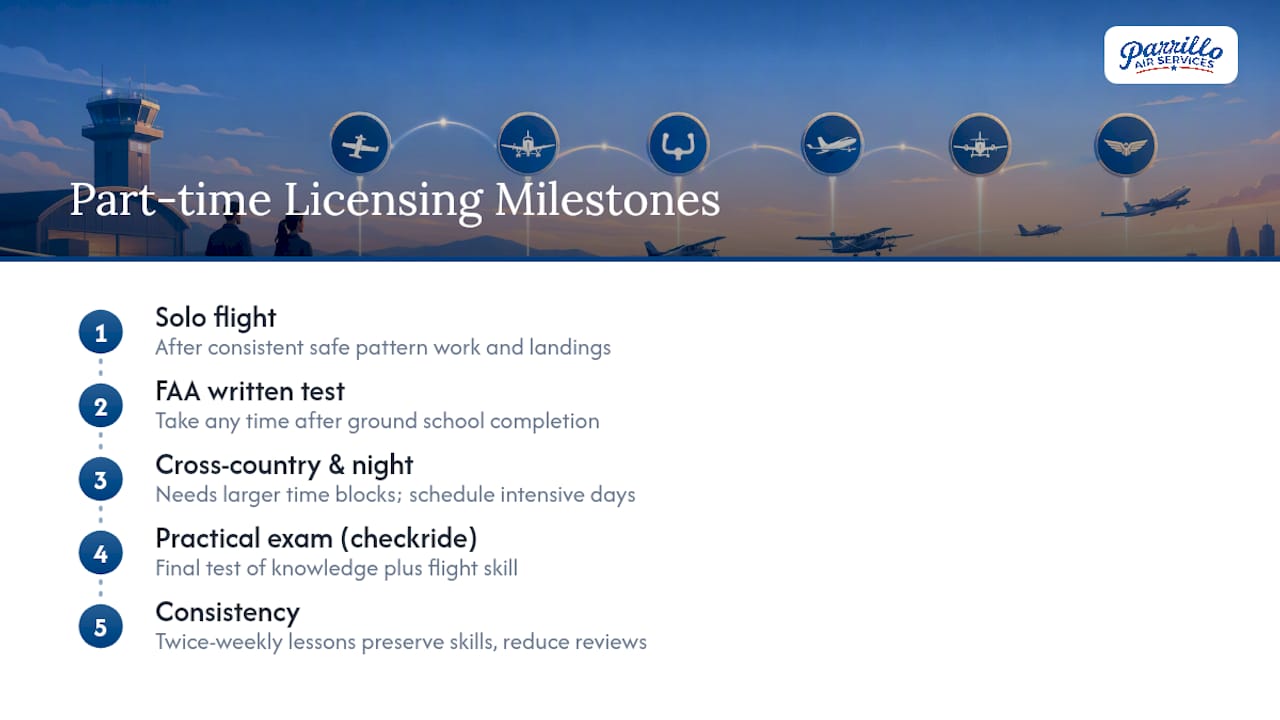
Part-time students hit the same FAA milestones as anyone else. The difference is spacing them out without letting gaps between milestones erode the skills you already built.
The first major checkpoint is solo flight, typically reached once your instructor confirms consistent, safe pattern work and landings. For part-time students, this often lands later in the calendar than for full-time students, simply due to total flight hours logged per month, but the skill bar itself doesn't change.
Next comes the FAA written knowledge test, which you can take any time before your practical exam once your ground school coursework is complete. Many part-time students take this earlier than expected, sometimes before solo, because ground study happens on its own schedule independent of flight availability. There's a real advantage here: knock out the written exam while flight lessons continue, rather than waiting and cramming both at once.
Cross-country training milestones (solo cross-country flights, night flying requirements) come next, often the trickiest to schedule for working students since they need larger blocks of daylight or specific evening windows. This is where short intensive blocks, a day off work, a long weekend, often outperform squeezing them into normal weekly lesson slots.
The final milestone is the practical exam, the checkride, which tests both the written knowledge and the flying skill built over the entire schedule. Part-time students who maintained twice-weekly consistency typically arrive at this stage with retention intact rather than needing extensive review flights beforehand.
Part-time training carries one safety risk full-time training mostly avoids: skill decay between lessons. A student who hasn't flown in three weeks isn't just slower to warm up. They're more likely to make the kind of small errors, a shallow flare, a late go-around decision, that compound during exactly the maneuvers where margin matters most.
Instructors watch for this closely with part-time students, often starting each lesson after a gap with a review of basic maneuvers before progressing to new material. That's not wasted time. It's a safety check disguised as a warm-up.
Fatigue is the other risk unique to this population. Flying after a full workday, or scheduling a lesson during an already exhausting week, puts a tired brain into a cockpit. Aeronautical decision-making research consistently flags fatigue as a factor in judgment errors, and a part-time student squeezing in a lesson after a 10 hour shift is not operating at full capacity. If a lesson falls on a day you're running on empty, it's worth rescheduling rather than flying distracted.
Weather decision-making also deserves extra attention for part-time students specifically because gaps between flights mean less recent practice reading changing conditions. Leaning on your instructor's judgment early, and asking direct questions about marginal weather calls, builds the pattern recognition that eventually becomes your own.
Part-time training fails most often not from lack of aptitude but from burnout, trying to fly, study, work, and maintain a personal life at full intensity simultaneously until something breaks.
The fix isn't fewer flights. It's realistic pacing built around your actual energy levels, not an idealized schedule. If your job runs demanding hours during certain weeks (quarter-end, tax season, school semesters), plan lighter training weeks around those periods in advance rather than white-knuckling through both at once.
Protecting one full rest day a week, with no flying and no ground study, matters more than it sounds. Training fatigue compounds quietly. You don't notice it until a lesson that should feel routine suddenly feels overwhelming, which is usually a sign you need a break, not more practice.
Communicate your work calendar to your instructor honestly and early. A flexible Part 61 school built around working students' schedules can shift lesson timing around your actual demanding weeks rather than penalizing you for a schedule you can't control. That flexibility only works, though, if you're upfront about it rather than trying to force a rigid pace onto an unpredictable job.
Family and personal relationships need the same honesty. Block out a training timeline with people close to you so they understand why weekend mornings are sometimes unavailable. Training in isolation, without buy-in from the people around you, is one of the more common reasons part-time students quit mid-program, not because flying got harder, but because home life friction built up unaddressed.
Flexible scheduling only helps if the instructor is genuinely willing to build lesson plans around a student's actual week, not just advertise flexibility while defaulting to a fixed timetable. Parrillo Air Services structures its Part 61 instruction around early-morning and weekday slots specifically because that's when working professionals have real availability, not because it's the easiest schedule to run.
What separates students who finish from students who stall isn't raw talent. It's whether they protect a consistent weekly rhythm even during busy stretches at work. Students who treat their twice-weekly flight slot as fixed, the way they'd treat a recurring work meeting, tend to move steadily toward private pilot, instrument rating, and beyond toward commercial and flight instructor paths. The ones who let scheduling slide "just this week" repeatedly are the ones who end up re-learning material they already paid to learn once.
— Gm
Parrillo Air Services runs FAA Part 61 instruction built specifically for people who can't drop everything to train full-time. That means early-morning and weekday lesson slots designed around a working schedule, not a fixed academy timetable you have to bend your job around.

Programs range from an introductory discovery flight through private pilot, instrument rating, commercial certification, and flight instructor training, with personalized instruction paced to how often you can realistically fly. If you're a Liberty University student, scheduling supports credit transfer as part of your training plan too.
Before reaching out, jot down your realistic weekly availability, mornings, weekday evenings, or weekends, so your first conversation focuses on building a schedule around your actual life. Ask about lesson frequency options, weather cancellation policy, and how instructors handle gaps in your calendar during busy work stretches.
The next step is simple: book a discovery flight or get more information about Parrillo's flight training programs and start mapping a part-time schedule that fits the job you already have.
Get in Touch TodayFor official rules, medical certificate requirements, and written-exam standards, the FAA's own publications remain the primary source. EAA offers mentorship programs and community events that pair well with part-time training. For a broader look at certification requirements and motivation, this overview of what it takes to become a pilot is worth a read. For deeper timeline planning, see how long flight training actually takes adults.