
Major airline pilot requirements in 2026 center on earning an unrestricted FAA ATP certificate with at least 1,500 total flight hours, a First-Class medical certificate, and meeting airline-specific hiring standards that go well beyond the FAA baseline. The FAA Airline Transport Pilot (ATP) certificate is the industry's recognized credential for Part 121 airline operations, and every major carrier treats it as the non-negotiable starting point. Airlines like United Airlines layer on preferred qualifications including turbine time, recent flight hours, and a bachelor's degree. This guide breaks down every requirement you need to meet, from FAA aeronautical experience rules to documentation you must have ready on day one.
The FAA sets the floor, and major airlines build on top of it. To qualify for an unrestricted ATP certificate with an airplane multiengine class rating, you must meet the aeronautical experience minimums defined in 14 CFR § 61.159. These are not suggestions. Every subcategory must be satisfied independently.
| Flight Hour Category | Minimum Required |
|---|---|
| Total flight time | 1,500 hours |
| Cross-country time | 500 hours |
| Night flight time | 100 hours |
| Instrument time (actual or simulated) | 75 hours |
| Pilot in command (PIC) total | 250 hours |
| PIC cross-country | 100 hours |
| PIC night | 25 hours |
| Multiengine time (in class sought) | 50 hours |

The subcategory breakdown is where most aspiring pilots underestimate the challenge. Reaching 1,500 total hours while simultaneously satisfying every subcategory requires deliberate planning from your first training flight. A pilot who logs 1,500 hours primarily in single-engine day VFR flying may find themselves short on instrument or multiengine time. The FAA does not allow you to substitute total hours for category deficiencies.
"Hours accounting" is the term flight training professionals use for tracking all subcategories in parallel. Proper hours composition management is as important as total hours. Pilots who ignore subcategory tracking often face certification delays of months while they scramble to fill specific gaps.
Pro Tip: Start a dedicated logbook spreadsheet from day one that tracks every subcategory separately. Review it monthly, not just when you approach 1,500 hours.
You must also be at least 23 years old and hold a valid First-Class FAA medical certificate. English language proficiency is required, and you must pass the ATP written knowledge test and practical exam administered by an FAA Designated Pilot Examiner.
The Restricted ATP (R-ATP) certificate, established under 14 CFR § 61.160, allows certain pilots to enter Part 121 airline operations before reaching the full 1,500-hour threshold. The hour reductions depend on your background.
Military pilots: 750 total flight hours required
Aviation university graduates (AABI-accredited four-year degree): 1,000 total flight hours required
Aviation associate degree or two-year program graduates: 1,250 total flight hours required
Age requirement: Minimum 21 years old (versus 23 for full ATP)
The R-ATP is a strategic entry tool, not a shortcut to the left seat. R-ATP holders are limited to Second-in-Command (SIC) roles in Part 121 multiengine turbine aircraft. You cannot serve as Pilot in Command on a commercial airline flight until you hold the full, unrestricted ATP certificate, which requires reaching 1,500 hours and age 23.
This distinction matters for career planning. A 21-year-old aviation degree graduate who enters a regional airline at 1,000 hours will spend time in the right seat building toward the full ATP upgrade. That time counts toward total hours and builds turbine experience simultaneously, which is exactly what major airlines prefer to see. The R-ATP is best understood as an accelerated entry mechanism that lets you start earning turbine time sooner, not a permanent credential.
Pro Tip: If you are pursuing an aviation degree, confirm your program holds AABI accreditation before enrolling. Non-accredited programs do not qualify for the 1,000-hour R-ATP reduction, which could cost you months of additional time building.
Understanding and planning for R-ATP restrictions is critical because early airline entry is balanced by a delayed PIC upgrade. Pilots who enter at 1,000 hours may reach the major airline interview stage with more turbine SIC time but less total PIC time than candidates who built hours through flight instruction. Major airline hiring panels evaluate the full picture.
The FAA sets minimum eligibility. Major airlines set competitive hiring standards. United Airlines' First Officer posting illustrates exactly what the gap looks like in 2026.
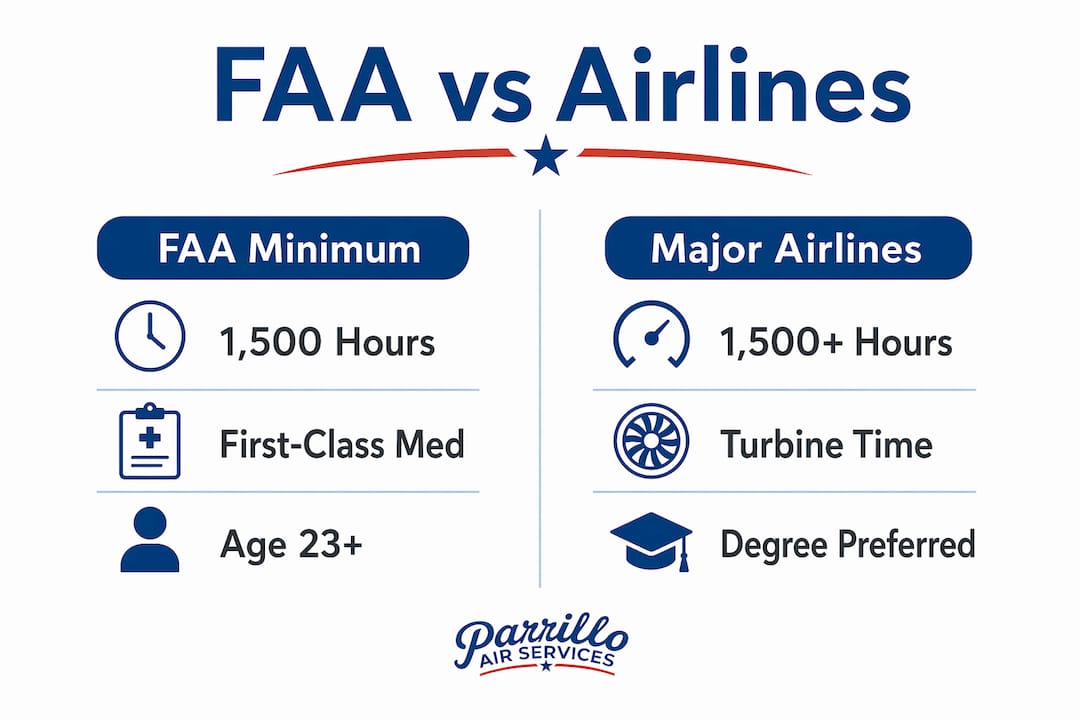
| Requirement | FAA Minimum | United Airlines Standard |
|---|---|---|
| Total flight hours | 1,500 | 1,500 (unrestricted ATP required) |
| Turbine fixed-wing hours | Not specified | 1,000 hours preferred |
| Recent flight time | Not specified | 100 hours in past 12 months preferred |
| Medical certificate | First-Class | First-Class required |
| FCC radio license | Not specified | Restricted Radiotelephone Operator Permit required |
| Education | Not specified | Bachelor's degree preferred |
| Starting pay | N/A | $125.52 per flight hour (ALPA agreement) |
The turbine time preference is the most significant gap between FAA eligibility and major airline competitiveness. A pilot with 1,500 hours in piston aircraft meets the FAA standard but will struggle to compete against candidates with 1,000 or more hours in turbine-powered aircraft. This is why the regional airline pathway remains the dominant route to major airline hiring. Regional carriers operate turbine equipment, and exceeding minimum flight hours strategically in turbine aircraft directly improves your standing.
The bachelor's degree preference at United Airlines is not a hard requirement, but it carries real weight in competitive hiring pools. When two candidates have similar flight hours and medical qualifications, the degree often becomes the differentiator. You can explore the nuanced debate around this in detail at Parrillo Air Services' breakdown of whether pilots need a degree.
The First-Class FAA medical certificate is a hard requirement for ATP operations. The examination tests vision, hearing, cardiovascular health, neurological function, and mental health. Pilots under 40 must renew their First-Class medical every 12 months. Pilots 40 and older renew every six months.
Common disqualifications include certain cardiac conditions, seizure history, and some psychiatric diagnoses. The FAA does offer Special Issuance waivers for specific conditions, but the process takes time and is not guaranteed. If you have any medical history that might raise a flag, consult an Aviation Medical Examiner (AME) early in your training, not after you have already invested thousands of hours and dollars.
Beyond the medical certificate, major airlines require a specific set of documentation that many aspiring pilots overlook until the hiring process begins. United Airlines requires the following on or before the first day of employment:
FCC Restricted Radiotelephone Operator Permit: Required for operating aircraft radio equipment in the United States. You apply through the FCC directly, and the process is straightforward but must be completed before hiring.
Valid U.S. passport: Must have at least six months of validity remaining beyond your expected start date.
International Certificate of Vaccination for Yellow Fever: Required for international operations and must be presented on day one.
Legal employment authorization: Documentation confirming your right to work in the United States.
Logbook verification and credential documentation can create hiring process bottlenecks. Military pilots in particular should initiate FAA military experience verification well before applying, as the process can take weeks. Treat your documentation as a parallel project to your flight hour building, not an afterthought.
The career path for airline pilots follows a well-defined progression. Each step builds on the previous one, and skipping steps is rarely possible.
Student Pilot Certificate: Obtain your FAA medical and student pilot certificate. Begin logging flight time immediately.
Private Pilot Certificate (PPL): The foundation of all further ratings. Requires 40 hours minimum under Part 61.
Instrument Rating: Adds 50 hours of cross-country PIC time and builds toward ATP instrument minimums.
Commercial Pilot Certificate (CPL): Requires 250 total hours. Review the full commercial certificate requirements before planning your training timeline.
Certified Flight Instructor (CFI) and CFII ratings: The most common and cost-effective way to build hours toward ATP minimums while earning income.
Multi-Engine Rating and MEI: Builds the 50 hours of multiengine time required for the ATP multiengine class rating.
Regional airline first officer role: Builds turbine SIC time, which is the preferred experience type for major airline applications.
ATP certificate and major airline application: With 1,500 hours, a clean medical record, and complete documentation, you are eligible to apply.
Flight instruction is the most reliable hour-building method for most pilots. A CFI working full-time can accumulate 500 to 800 flight hours per year, which means reaching ATP minimums in roughly two to three years after earning the commercial certificate. The hours also naturally include cross-country, night, and instrument time if the CFI actively manages their flight schedule.
Balancing subcategory requirements during the CFI phase requires attention. Night instruction hours count toward your night minimums, but only if you are logging them correctly. Review your logbook against the ATP subcategory requirements every 90 days.
Meeting major airline pilot requirements in 2026 demands an unrestricted FAA ATP certificate, 1,500 carefully composed flight hours across eight subcategories, a First-Class medical certificate, and airline-specific credentials including an FCC radio permit and valid passport.
| Point | Details |
|---|---|
| FAA ATP is the baseline | All major airlines require an unrestricted ATP with multiengine class rating and 1,500 total hours. |
| Subcategory hours matter | Track PIC, night, cross-country, instrument, and multiengine hours separately from day one. |
| R-ATP accelerates entry | Military and degree-program graduates can enter airlines at 750 to 1,250 hours but are limited to SIC roles. |
| Airlines prefer turbine time | United Airlines prefers 1,000 turbine fixed-wing hours, making the regional airline pathway critical. |
| Documentation is a parallel project | FCC permits, passports, and vaccination records must be ready before the hiring process concludes. |
Most aspiring pilots focus almost entirely on total flight hours and underestimate everything else. The medical certificate, the FCC permit, the logbook subcategory gaps, the turbine time preference. These are not minor details. They are the factors that separate candidates who get interviews from candidates who meet the minimum and nothing more.
The R-ATP question comes up constantly, and my honest view is this: if you qualify for the 1,000-hour pathway through an accredited aviation degree, take it. The turbine SIC time you build at a regional carrier during those extra 500 hours is exactly what major airlines want to see. You are not losing anything by entering earlier. You are gaining the right kind of experience faster.
What I see derail otherwise qualified pilots most often is documentation. Someone reaches 1,500 hours, passes their ATP checkride, and then discovers their FCC permit application is pending or their passport expired six months ago. These are fixable problems, but they delay hiring by weeks or months. Start the paperwork during your CFI phase, not after you submit your first major airline application.
Research each airline's posted job requirements directly and revisit them every six months. Preferences shift. What United Airlines lists today may differ from what another carrier emphasizes. The pilots who get hired are the ones who treat the application process as seriously as the flight training itself.
— Gm

Parrillo Air Services, based in Lynchburg, VA, offers FAA Part 61 flight training programs designed to take you from your first discovery flight through commercial, instrument, CFI, and multi-engine ratings. Every program is built around the real-world requirements you will face when applying to regional and major airlines. Instructors at Parrillo Air understand the subcategory hour tracking challenge and help students plan their training timelines to meet every ATP requirement without surprises. If you are serious about a career in the cockpit, explore the flight training programs at Parrillo Air Services and get a personalized plan that puts you on track for major airline hiring.
Major airlines require a minimum of 1,500 total flight hours for an unrestricted FAA ATP certificate, including specific subcategory minimums for cross-country, night, instrument, PIC, and multiengine time.
No. Major airlines require an unrestricted ATP certificate for all pilot positions. The R-ATP limits holders to SIC roles and does not satisfy major airline PIC eligibility requirements.
United Airlines lists a bachelor's degree as preferred but not required. In competitive hiring pools, degree holders have an advantage over equally qualified candidates without one.
Pilots under 40 renew their First-Class medical every 12 months. Pilots 40 and older renew every six months, per FAA standards for ATP operations.
The FCC Restricted Radiotelephone Operator Permit authorizes pilots to operate aircraft radio equipment in the United States. Major airlines like United Airlines require it as a condition of employment, and pilots must obtain it directly through the FCC before their start date.
Regional Airline Hiring Requirements: 2026 Pilot Guide | Parrillo Air Services
Parrillo Air Services
Commercial Pilot Certificate Requirements | Parrillo Air Services - Lynchburg, VA
Parrillo Air Services
Airline Pilot Career Pathway Steps: 2026 Guide
Parrillo Air Services
Do Airline Pilots Need a College Degree? | Parrillo Air Services
Parrillo Air Services