
Flight school selection is the process of evaluating and choosing a pilot training program based on factors like instructor quality, aircraft availability, training structure, cost transparency, and safety culture. The decision shapes how fast you earn your certificates, how much you spend, and whether you ever finish at all. High-quality schools achieve 80%+ PPL completion rates compared to a national average of roughly 20%. That gap represents tens of thousands of dollars and months of wasted time for students who choose poorly. Understanding how flight school selection works before you commit is the single most important step you can take toward a pilot career.
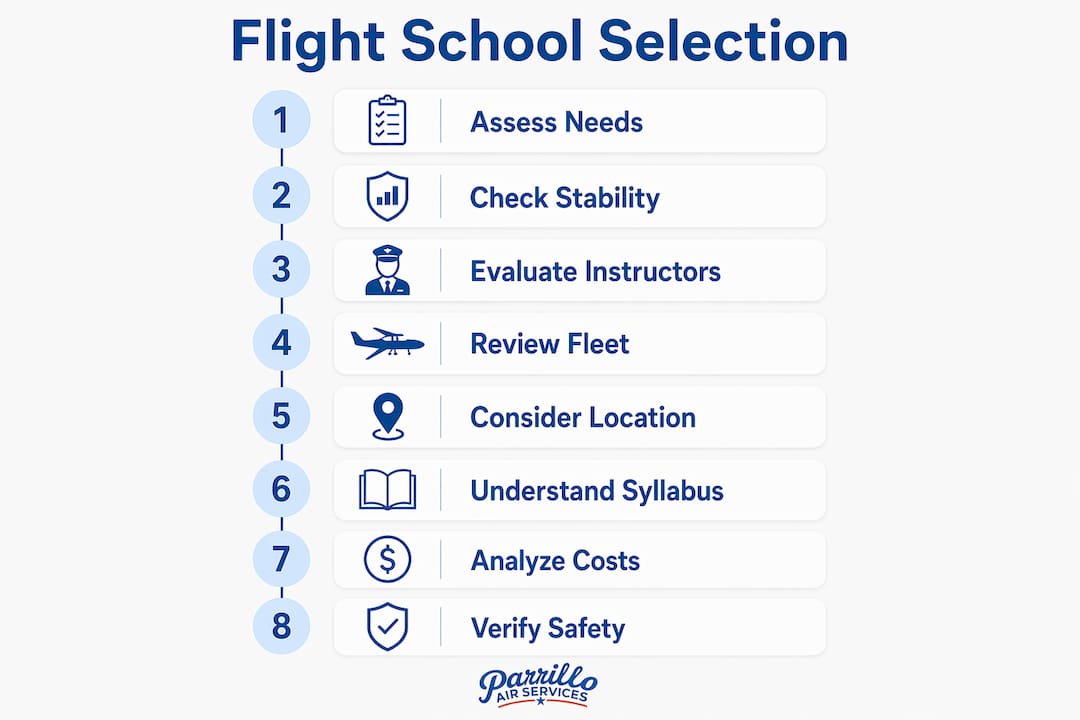
Seven factors consistently separate schools that produce career pilots from those that collect tuition and stall progress. Each one has a direct financial and practical consequence.
Financial stability is the foundation. A school that closes mid-training leaves you with partial hours, no refund, and a restart from scratch. Check whether the school has been operating for at least five years and whether it holds any accreditation from organizations like AOPA or NAFI.
Instructor quality and turnover rank just as high. Instructor turnover above 50% annually forces students to repeat lessons, rebuild rapport, and re-explain their learning style to a new CFI every few months. Consistency with one instructor accelerates skill development in ways that no syllabus can replace.
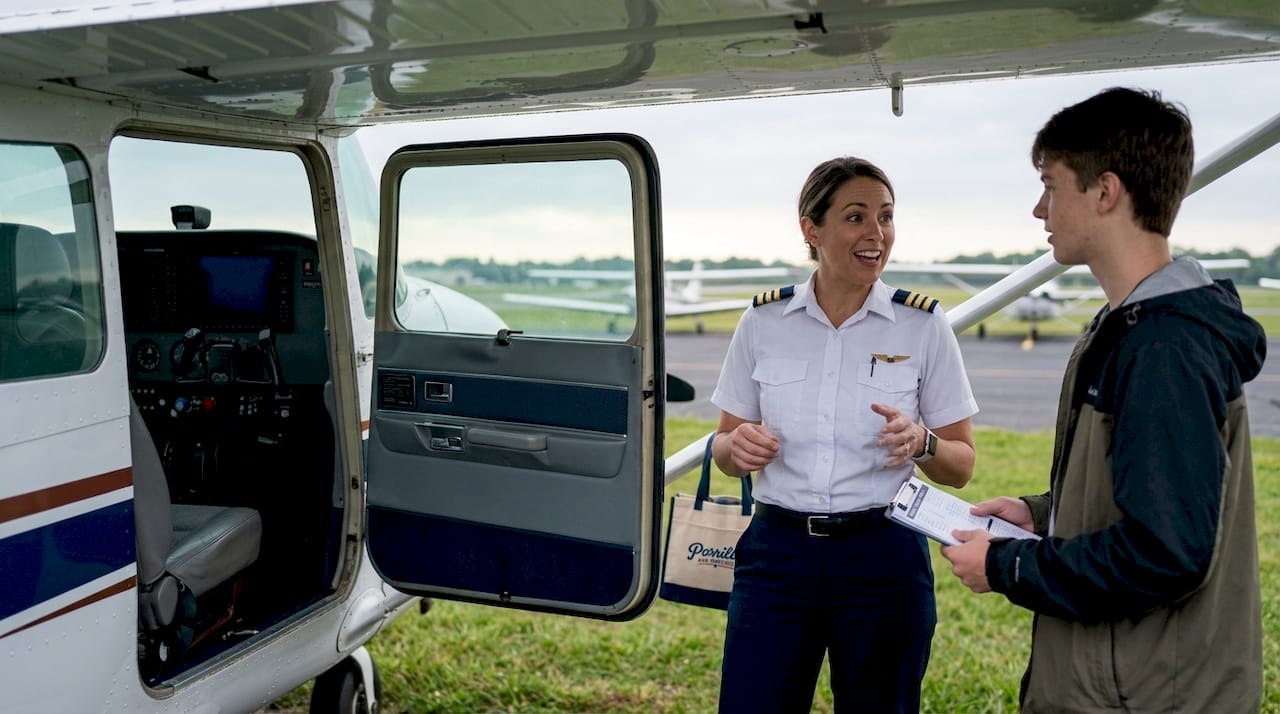
Fleet size and aircraft availability determine your actual flying frequency. Adequate aircraft-to-student ratios are necessary to maintain at least two flights per week. Fewer than that and skill regression sets in between sessions, extending your total hours and your total bill.
Location and weather affect how many flyable days you get per year. A school in Lynchburg, VA, for example, offers a different flying calendar than one in Seattle or Minneapolis. More flyable days means faster progression.
Training syllabus and FAA certification matter because structured training with documented stage checks leads to faster skill acquisition and better pilot quality. Loosely organized training wastes both time and money.
Cost and pricing transparency protect your budget. Many schools hide fees behind low hourly rates, so always ask about wet versus dry rates, instructor fees, checkride fees, and any surcharges before signing anything.
Safety culture and reputation round out the list. A school with a safety management system that empowers instructors to cancel unsafe flights is a school that takes its responsibility seriously.
Pro Tip: Ask the school directly: "What is your PPL completion rate?" If they cannot answer with a number, treat that as a red flag.
The FAA recognizes two primary regulatory frameworks for flight training, and understanding both is central to choosing a flight school that fits your goals.
Part 61 schools offer flexible, often lower-cost training without a fixed FAA-approved syllabus. Instruction is tailored to the individual student, which suits people with irregular schedules, career changers, or those pursuing flying recreationally. The minimum hours for a Private Pilot License under Part 61 is 40 hours, though most students finish closer to 60 to 70 hours. Parrillo Air Services operates under Part 61, which allows for the kind of personalized scheduling and instruction that rigid programs cannot offer.
Part 141 schools follow an FAA-approved, structured curriculum with defined stage checks and standardized lesson plans. The minimum PPL hours drop to 35 under Part 141, which sounds appealing on paper. In practice, the savings depend entirely on how well the school executes that structure and whether the student can keep pace with the fixed progression.
| Factor | Part 61 | Part 141 |
|---|---|---|
| Minimum PPL hours | 40 hours | 35 hours |
| Syllabus structure | Instructor-designed | FAA-approved, fixed |
| Schedule flexibility | High | Lower |
| VA benefits eligibility | Limited | Often eligible |
| Best suited for | Recreational pilots, career changers | Career-track students, GI Bill users |
Part 141 schools are often preferred by career pilots who need VA benefits or who are entering structured airline pipeline programs. Part 61 suits students who need flexibility and personalized pacing. For a deeper look at how these pathways compare in practice, the Part 61 vs. Part 141 breakdown at Parrillo Air Services walks through the real-world trade-offs.
Pro Tip: If you plan to use GI Bill benefits, confirm the school's VA approval status before enrolling. Not all Part 141 schools are VA-approved, and not all Part 61 schools are excluded.
Completion rates and instructor turnover are the two metrics most schools hope you never ask about. They are also the two metrics that most directly predict your experience.
The national PPL completion rate sits at roughly 20%. That means four out of five students who start training never finish. Choosing a school with an 80%+ completion rate can save between $5,000 and $20,000 in extra training costs alone. That figure reflects the hours students repeat when they lose momentum, change instructors, or fly too infrequently to retain skills.
Instructor turnover compounds the problem. When a CFI leaves mid-training, the incoming instructor needs time to assess where you are, rebuild trust, and adjust to your learning style. Students who experience two or more instructor changes during PPL training routinely log 15 to 25 extra hours. Those hours cost real money and erode confidence at the exact moment students need it most.
Here is what to look for when researching a school's stability:
Ask how long the average instructor has been at the school
Request the school's student-to-instructor ratio
Ask whether the same instructor handles ground and flight training
Find out what happens to your training plan if your primary CFI leaves
Check online reviews specifically for comments about instructor consistency
Poor instructor-to-student ratios cause infrequent flying schedules that prolong training and increase costs. A school with five aircraft and forty active students is a scheduling problem waiting to happen. The math matters.
Research online, then verify in person. That sequence is non-negotiable. An in-person visit during a normal training day reveals far more about a school's quality than any brochure or website ever will.
Follow these steps before committing to any program:
Check FAA safety records. The FAA's public database lists accident and incident reports by operator. A pattern of maintenance-related incidents is a serious warning sign.
Read reviews on multiple platforms. Look at Google, AOPA forums, and Pilot Edge communities. Prioritize reviews that mention specific instructors, scheduling issues, or hidden costs.
Visit on a regular training day, not an open house. Watch how instructors interact with students. Observe whether aircraft are being prepped and flown or sitting idle. Notice whether the scheduling board looks organized or chaotic.
Talk to current students, not just staff. Current students provide the most reliable insight into training pace, instructor continuity, and costs that do not appear in the brochure.
Book a discovery flight or introductory lesson. This is the single best way to assess instructor communication style, aircraft condition, and whether the school's culture fits your personality.
Request the full cost breakdown in writing. Ask about every fee category: aircraft rental, instructor time, fuel surcharges, checkride prep, and written test fees.
Review the refund policy before paying anything. Large upfront deposits without written refund policies pose real financial risk if the school closes or your training stalls unexpectedly.
Pro Tip: Bring a list of ten specific questions to every school visit. Schools that answer confidently and in detail are schools that have nothing to hide.
The minimum flight hours for a private pilot article from Parrillo Air Services gives useful context for evaluating whether a school's quoted timelines are realistic or optimistic.
Choosing the right flight school requires evaluating completion rates, instructor stability, training structure, cost transparency, and safety culture before signing anything.
| Point | Details |
|---|---|
| Completion rates matter most | Schools with 80%+ PPL completion rates save students $5,000 to $20,000 in avoidable extra hours. |
| Instructor turnover is a cost driver | Turnover above 50% annually forces lesson repetition and extends total training time significantly. |
| Part 61 vs. Part 141 affects your path | Career pilots often benefit from Part 141 structure; Part 61 suits flexible schedules and personalized pacing. |
| Visit in person, unannounced | A normal training day visit reveals scheduling culture, aircraft condition, and instructor engagement honestly. |
| Get refund policies in writing | Large deposits without written refund terms create financial exposure if a school closes or underperforms. |
The most common mistake I see is choosing a flight school based on price and proximity, then spending twice as much to fix the consequences. A student who picks the cheapest school in town, loses two instructors mid-training, and flies once every three weeks will spend more money and more time than a student who paid a premium for a stable, well-run program from day one.
Price is a legitimate factor. It just cannot be the primary one. The same logic applies to location. Driving 45 minutes to a school with a 75% completion rate beats walking across the street to one where four out of five students quit.
The hidden value in this process is the instructor relationship. A CFI who knows your tendencies, your weak points, and your learning pace is worth more than any aircraft or simulator. That relationship compounds over time. Students who train with one consistent instructor from private pilot through instrument rating develop a level of situational awareness that students who bounce between instructors rarely match.
Set your career goals before you visit a single school. If you want to fly for a regional airline within five years, your selection criteria look completely different than if you want a recreational license for weekend flying. Knowing your destination makes it far easier to evaluate whether a given school can actually get you there.
Do the due diligence. Ask the hard questions. Visit twice if you need to. The school you choose will shape your entire aviation career, and that decision deserves more than a Google search and a price comparison.
— Gm

Parrillo Air Services is an FAA Part 61 flight training school in Lynchburg, VA, offering personalized instruction from private pilot through commercial and flight instructor ratings. The school's flexible scheduling, experienced CFIs, and transparent pricing address the exact selection criteria that matter most to serious students. Every program is built around consistent instructor relationships and a structured curriculum that keeps students progressing efficiently toward their aviation goals. If you are ready to evaluate a school that can answer every question on your list with confidence, explore the flight training programs at Parrillo Air Services or schedule a discovery flight to see the operation firsthand.
Flight school selection works by evaluating seven core factors: instructor quality, completion rates, fleet availability, training structure, cost transparency, safety culture, and financial stability. The goal is to find a school where your training will progress efficiently and consistently toward your certification goals.
Part 61 schools offer flexible, instructor-designed training with a 40-hour minimum for the PPL, while Part 141 schools follow an FAA-approved syllabus with a 35-hour minimum. Part 141 programs are often preferred by career pilots and those using VA benefits.
Look for schools that report an 80% or higher PPL completion rate. The national average sits around 20%, so a school that significantly exceeds that benchmark indicates better instruction, scheduling, and student support.
The three biggest red flags are instructor turnover above 50% annually, large upfront deposits without written refund policies, and an inability to provide a clear completion rate. Any one of these signals financial or operational problems that will cost you time and money.
Yes. A discovery flight or introductory lesson lets you assess the instructor's communication style, the aircraft's condition, and the school's overall culture before committing any significant money. It is the most reliable single step in the evaluation process.
Flight Training Programs | Part 61 & 141 Guide | Parrillo Air Services
Parrillo Air Services
How to Choose an FAA Part 61 School for Your Career
Parrillo Air Services
How to Choose an FAA Part 61 Flight School | Parrillo Air Services
Parrillo Air Services
How flight training programs work: your path to FAA certification
Parrillo Air Services