Picking the right flight school shapes everything that follows: how fast you earn your certificates, how much you spend, and whether you stay motivated long enough to see it through. When you decide to choose an FAA Part 61 school, you're not just picking a place to fly. You're selecting a training philosophy, a scheduling structure, and a community that will either accelerate your path to the cockpit or slow you down considerably. This guide cuts through the noise and gives you the specific factors, questions, and steps you need to make a confident, well-informed decision.
| Point | Details |
|---|---|
| Part 61 offers real flexibility | Self-paced training suits students balancing work or family commitments better than rigid Part 141 programs. |
| Instructor quality is everything | The CFI you fly with consistently matters more than whether the school is Part 61 or Part 141 certified. |
| Budget beyond the minimum | Real training costs often run 20 to 30 percent above advertised hourly rates, so plan your finances accordingly. |
| Verify completion rates | Industry pass rates hover around 20 to 30 percent, making a school's student support track record a critical selection factor. |
| Visit before you commit | A discovery flight or school tour reveals training culture and aircraft condition far better than any website description. |
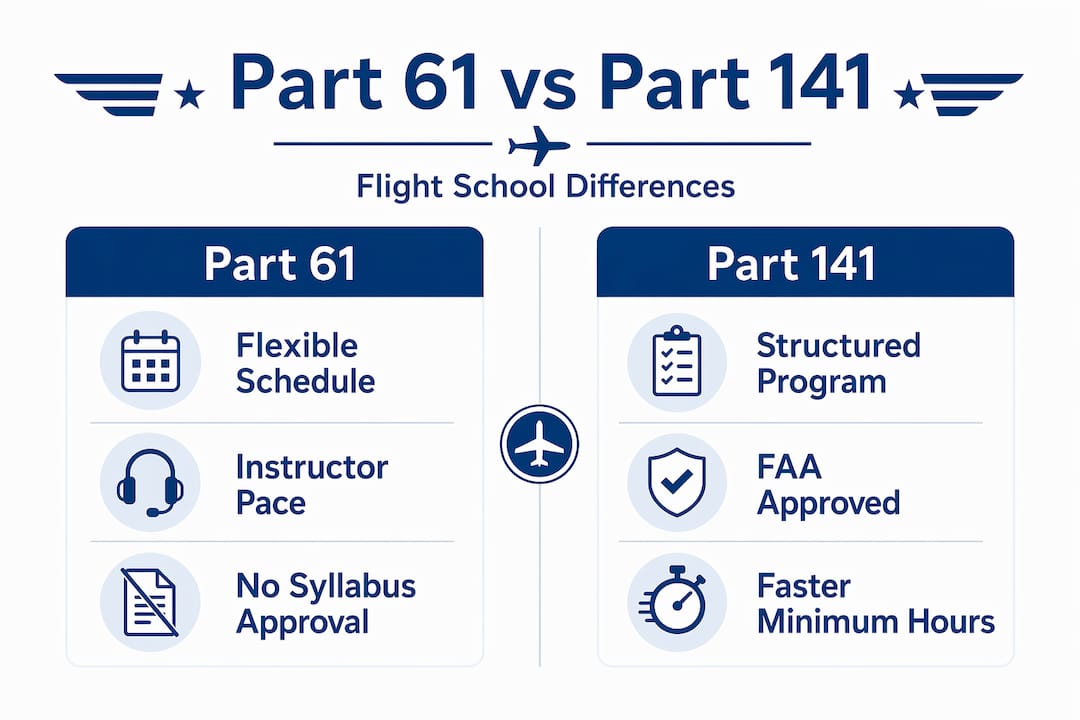
Before you can make a smart choice, you need to understand what separates a Part 61 school from a Part 141 program. Both pathways lead to the same FAA pilot certificates, and both earn identical ratings evaluated by the same FAA examiners. The certificate in your wallet won't say which path you took. What differs is how you get there.
A Part 61 school operates under FAA regulations that give instructors wide latitude in designing and pacing your training. There is no mandated FAA-approved syllabus. Your CFI can adapt lessons to your learning speed, schedule lessons around your work calendar, and focus extra time on skills you find harder. This flexibility is why Part 61 suits part-time students balancing families, full-time jobs, or irregular schedules.

Part 141 programs are different by design. The FAA audits their syllabi, sets stage-check requirements, and allows a lower minimum flight hour count. For a Private Pilot License, Part 61 requires 40 hours while Part 141 requires only 35. That said, most students at both types of schools exceed the minimums significantly in practice.
| Feature | Part 61 | Part 141 |
|---|---|---|
| FAA syllabus approval | Not required | Required |
| Minimum PPL hours | 40 hours | 35 hours |
| Training pace | Student-driven | Program-driven |
| Scheduling | Flexible | Structured |
| Best for | Part-time or self-paced learners | Full-time accelerated training |
| Oversight | Moderate | High |
The bottom line: if your life demands flexibility and you cannot commit to a rigid schedule, Part 61 is almost certainly the better match for you. If you are a full-time student who can dedicate every morning to training and wants a tightly structured progression, Part 141 may get you to checkride faster.
Once you've confirmed Part 61 is the right structure, you need a practical checklist to separate good schools from great ones. Here's what actually matters:
High CFI turnover disrupts student progress. Ask: how long have your current instructors been on staff? What is your average CFI tenure?
Ask about average aircraft downtime and what happens when your usual plane is grounded.
Schools offering five to six lessons per week produce the best training outcomes. Confirm the school can actually accommodate that frequency given your availability.
Real training costs typically run 20 to 30 percent above advertised rates. Ask for an all-in estimate, not just the wet aircraft rate.
Industry-average PPL completion rates are only 20 to 30 percent. A school that tracks and shares its own pass rates is a school that holds itself accountable.
Some schools restrict training in student-owned aircraft. If you own a plane or plan to buy one, verify upfront whether the school's instructors will fly with you in it.
Talk to current students. Visit the flight line. A school where pilots help each other study and instructors remember your name matters more than most people realize.
Pro Tip: Search the AOPA's school reviews for candid student feedback. It takes 20 minutes and saves you from scheduling a visit to a school that doesn't pass basic screening.
Knowing what to look for is one thing. Having a process is another. Here's how to move from "thinking about it" to confidently enrolled:
Even after choosing a great school, Part 61 training has specific pitfalls that catch students off guard. The flexibility that makes Part 61 appealing is also what makes it easy to stall.
Students who train sporadically end up re-reviewing skills each session instead of building on them. Treat your flight lessons like a fixed work appointment, not an optional activity.
The 40-hour minimum is a legal floor, not a realistic target. Plan your finances around 65 hours as a baseline for your private pilot certificate.
Part 61's lack of mandatory stage checks means no built-in accountability. Schedule periodic reviews with your CFI to assess where you stand and what needs focused work before your checkride.
CFIs leave schools. If your primary instructor moves on, ask the new instructor to review your logbook and training records before your first lesson.
Pro Tip: Keep your own training log with notes after every session: what you worked on, what clicked, and what you want to revisit. When a new instructor picks up your training, your personal notes are often more useful than the school's records.
I've seen students get their private pilot certificate in three months and others spend three years still working toward it. The difference almost never came down to whether they trained at a Part 61 or Part 141 school. It came down to the relationship they built with their instructor and the consistency they brought to the process.
Part 61's flexibility is genuinely valuable. It's also genuinely dangerous for students who mistake "flexible schedule" for "no real commitment required." The students who thrive in Part 61 programs are the ones who treat each lesson as non-negotiable and push back when scheduling slips.
Here's the contrarian advice most articles skip:
Don't let school branding or impressive facilities fool you. A polished lobby and a large fleet mean nothing if the instructors rotate every six months. The CFI sitting next to you in that cockpit is your actual training program. Ask about that person's background, their teaching philosophy, and how long they've been at the school. If the answer feels vague, look elsewhere.
Training quality depends on school culture more than any regulatory designation. Find a school where instructors talk to each other about students' progress, where the front office actually answers the phone, and where someone will flag a concern before it becomes a problem.
— Gm

If you're ready to move from researching to flying, Parrillo Air Services in Lynchburg, VA offers structured FAA Part 61 flight training built around your schedule, your goals, and your pace.
From your first discovery flight through private pilot, instrument, commercial, and flight instructor ratings, the instructors at Parrilloair bring real-world experience and personal investment to every lesson. There are no massive class cohorts, no rigid group schedules, and no mystery about what training actually costs.