The airline interview process is a structured, multi-stage evaluation designed to assess a candidate's technical skills, emotional intelligence, and cultural fit within an airline's operation. Airlines like Emirates, United, and Southwest run candidates through anywhere from four to six distinct stages before extending a conditional job offer. The full process, formally called airline pilot selection or cabin crew recruitment, spans 2–8 months from application to offer. Understanding each phase before you walk in the door is the difference between a confident performance and a costly surprise.

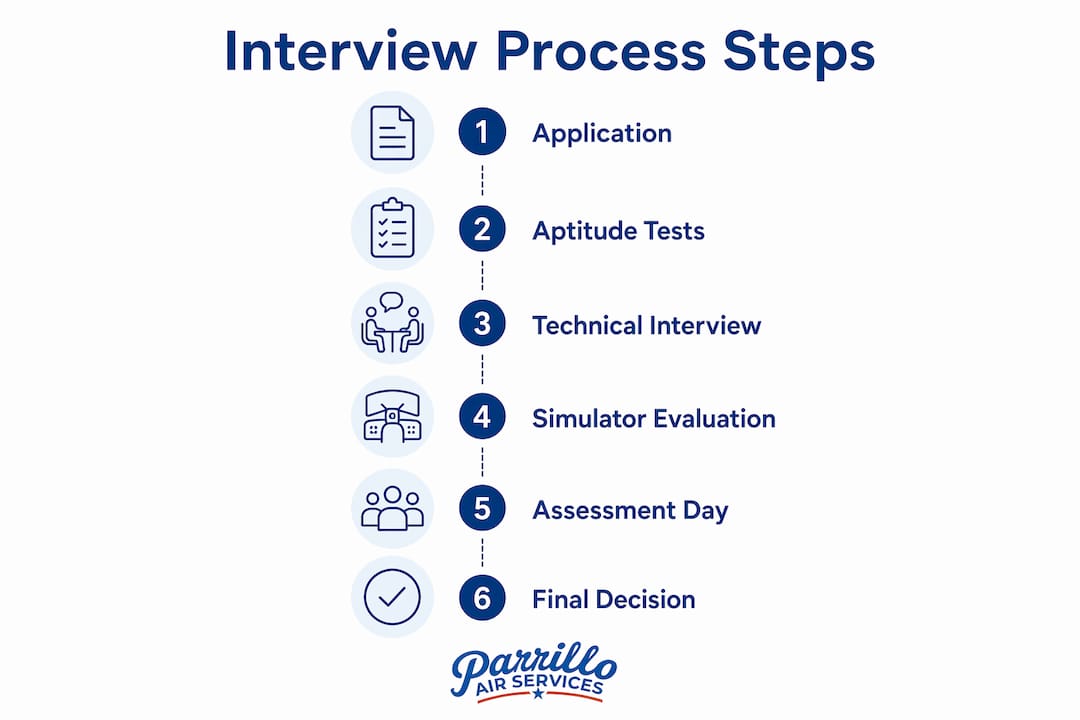
The airline hiring process follows a predictable sequence, even though timelines and specific formats vary by carrier. Knowing the order of events lets you allocate your preparation time where it counts most.
Online application and document screening. Every airline starts here. You submit your resume, logbook records, licenses, and personal documents. United Airlines requires a valid passport with at least 12 months of remaining validity and a minimum of two blank consecutive pages at the time of submission. Missing or expired documents cause immediate disqualification, regardless of your qualifications.
Preliminary aptitude and video interviews. Candidates who pass document screening move to psychometric tests and, increasingly, recorded video interviews through platforms like HireVue. These assess cognitive ability, personality traits, and initial communication skills before any human recruiter invests time in you.
Assessment day. This is the core of the process. Assessment days run 6–8 hours and include psychometric tests, group exercises, simulator sessions, and panel interviews. Groups typically contain 4–8 candidates, and up to 40–50% are eliminated at this stage alone. The day is deliberately intense to simulate real operational pressure.
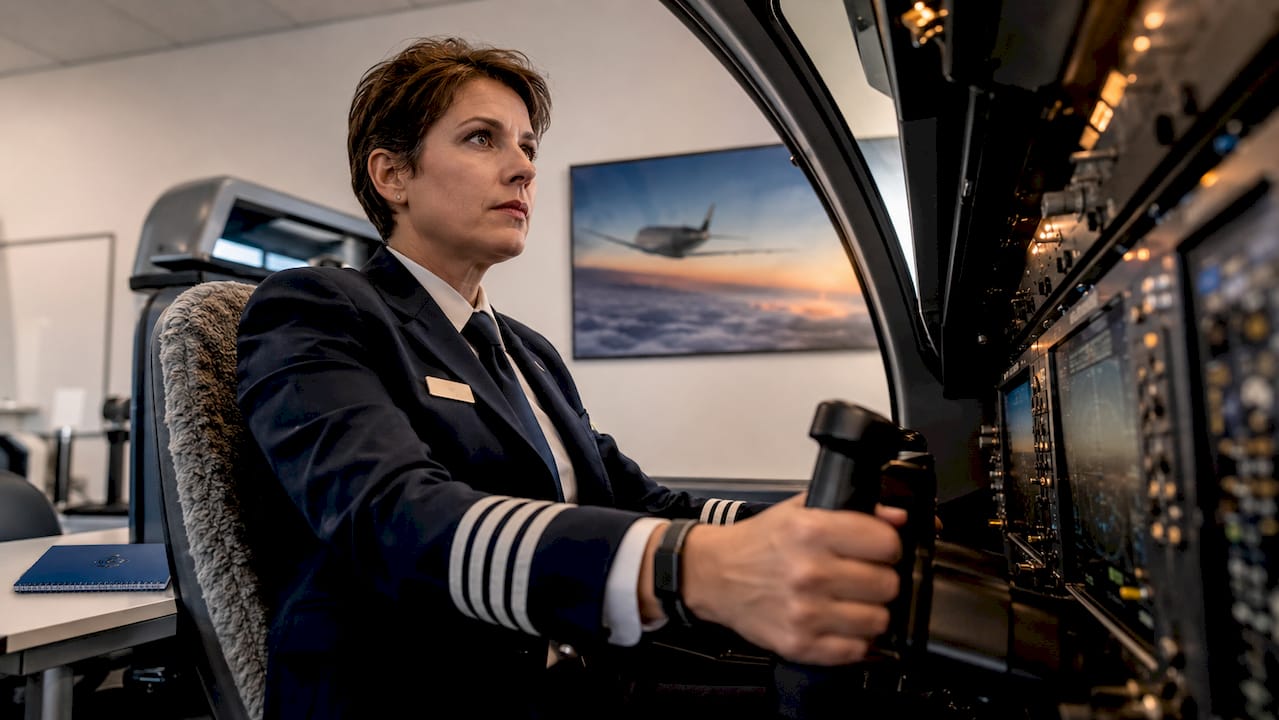
Simulator or technical check ride. Pilot candidates face a simulator evaluation that tests aircraft systems knowledge, workload management, and Crew Resource Management (CRM) under realistic scenarios. This is not just about stick-and-rudder skill. Assessors watch how you handle uncertainty and ask for help.
Final panel or senior management interview. Candidates who clear the simulator move to a formal panel interview with senior staff or chief pilots. This stage focuses heavily on motivation, judgment, and how well you represent the airline's values.
Conditional job offer and pre-employment checks. Background checks, medical evaluations, and reference verification follow before any offer becomes firm.
Pro Tip
Emirates runs a six-stage process that includes both remote and in-person phases. Research your target airline's specific format before you apply so you know exactly what is coming at each gate.
Airlines use several distinct evaluation methods, and each one tests something different. Walking in without knowing the format is the fastest way to underperform.
Airlines use psychometric tests to measure stress tolerance, teamwork orientation, rule-following versus independent judgment, and customer service mindset. The goal is to identify candidates who might become safety or team risks before they ever sit in a cockpit or cabin. These tests are not passable through cramming. They reveal patterns in how you think and respond under pressure.
Pilot technical sections combine aircraft systems knowledge, simulator evaluations, and CRM competencies tested under realistic scenarios. Assessors specifically test workload management, your willingness to request clarification, and how you manage uncertainty. Knowing your systems cold is the floor, not the ceiling.
Behavioral questions follow the STAR method format: Situation, Task, Action, Result. Airlines ask things like "Tell me about a time you disagreed with a crew member about safety" or "Describe a situation where you had to adapt quickly under pressure." Concise STAR answers of 60–90 seconds focused on safety and teamwork consistently outperform long, unfocused responses. Keep your stories tight and always anchor them to safety or crew coordination.
Group exercises evaluate how you communicate, collaborate, and handle disagreement in real time. Assessors are not just watching who leads. They are watching who listens, who builds on others' ideas, and who stays composed when the group disagrees.
Pro Tip
Avoid dominating group exercises. Airlines want crew members, not solo performers. Contribute clearly, acknowledge others, and let the group reach conclusions together.
| Assessment type | What it measures | Format |
|---|---|---|
| Psychometric test | Stress tolerance, teamwork, rule orientation | Online or paper test |
| Technical interview | Systems knowledge, CRM, workload management | Panel or simulator |
| Behavioral interview | Safety judgment, adaptability, communication | STAR-format questions |
| Group exercise | Collaboration, listening, conflict resolution | Facilitated group task |
| Simulator check ride | Aircraft handling, decision-making under pressure | Full-motion or fixed-base sim |
Airlines do not score candidates on a single impression. They use a structured rubric across four weighted pillars.
"Technical skills are the baseline. Personality traits and emotional intelligence are the final differentiators."
— Emerald Coast Interview Consulting
Candidates are scored on technical proficiency (30%), decision-making (30%), CRM and communication (25%), and company fit (15%). That breakdown tells you something important: soft skills account for 40% of your total score. Two candidates with identical flight hours can produce very different outcomes based on how they communicate and carry themselves.
The evaluation does not pause between formal assessments. Assessors observe candidate behavior across a 72-hour window that includes airport arrivals, hotel interactions, and waiting room conversations. Candidates who are polished in the interview room but dismissive toward ground staff have failed before the panel even convenes.
Common mistakes that sink otherwise qualified candidates include giving generic motivation answers ("I've always loved flying"), poor interpersonal conduct in informal settings, and failing to demonstrate genuine knowledge of the airline's operations. Attitude and communication are frequently the deciding factor when technical skills between finalists are comparable.
Preparation for the airline job application process is not just about reviewing aircraft manuals. The candidates who succeed treat the entire recruitment experience as a performance.
Build your STAR stories before you arrive. Prepare five to seven concise stories covering safety decisions, crew conflict, high-pressure situations, and moments of adaptability. Each story should land in under 90 seconds and connect clearly to a safety or teamwork outcome. Generic answers about "working well with others" do not score well.
Research the airline's culture and fleet. Know what aircraft types the airline operates, what routes it flies, and what its stated safety culture looks like. Motivation questions grounded in operational reality score higher than answers built around travel perks or personal passion. Recruiters want to hear that you understand the responsibility of the role.
Verify your documentation early. Check your passport validity and blank pages well before your application date. Review regional airline hiring requirements to confirm you meet all paperwork standards before submitting. A disqualification over a passport technicality is entirely avoidable.
Treat every interaction as part of the evaluation. The 72-hour evaluation window is real. Be professional with every person you encounter from the moment you arrive. Assessors compare notes on informal behavior.
Manage stress visibly. Airlines want crew members who stay composed under pressure. If you feel anxious during a group exercise or simulator session, acknowledge it briefly and refocus. Showing self-awareness is far better than pretending stress does not exist.
Prepare motivation answers that reflect the job, not the lifestyle. Answers that emphasize service, safety, and professional responsibility land better than answers about seeing the world. Recruiters have heard the travel fantasy hundreds of times.
Pro Tip
Practice your STAR stories out loud with a timer. Hearing yourself go over 90 seconds is the fastest way to identify what to cut. A well-structured pilot interview prep routine makes the difference between a polished answer and a rambling one.
The airline interview process rewards candidates who combine solid technical preparation with genuine professionalism, clear communication, and self-awareness across every stage of evaluation.
| Point | Details |
|---|---|
| Multi-stage process | The full hiring timeline runs 2–8 months and includes application, assessments, simulator checks, and panel interviews. |
| Scoring is balanced | Technical proficiency and decision-making each account for 30%; soft skills and company fit make up the remaining 40%. |
| Documentation matters | A valid passport with 12 months of validity and two blank pages is mandatory; missing documents cause immediate disqualification. |
| Evaluation never stops | Assessors observe candidate behavior across a 72-hour window, including informal interactions outside the interview room. |
| STAR answers win | Concise, 60–90 second behavioral answers focused on safety and teamwork consistently outperform long or generic responses. |
I have seen technically excellent candidates walk out of assessment days without an offer, and I have seen candidates with modest flight hours land regional airline positions. The difference is almost never the logbook.
The pilots who succeed treat the airline interview as a communication test, not a knowledge test. They know their systems, yes. But they also know how to tell a story, how to listen in a group exercise, and how to stay calm when a simulator scenario goes sideways. Those are skills you build deliberately, not skills you show up with automatically.
The biggest mistake I see is candidates who prepare for the formal interview and ignore everything around it. They rehearse answers for the panel but then complain loudly in the waiting room or check their phone while another candidate is speaking in a group exercise. Assessors are watching all of it. The 72-hour window is not a metaphor.
My honest advice: treat your preparation the same way you treat your flight training. You would not show up to a checkride having only reviewed the oral portion. Do not show up to an airline interview having only prepared your STAR stories. Know the airline, know your documentation, know how you present yourself when no one appears to be watching. That is when the real evaluation happens.
Authenticity also matters more than most candidates realize. Recruiters interview hundreds of people. They recognize a memorized answer immediately. The candidates who stand out are the ones who give real answers grounded in real experience, even when those experiences are not perfect. A story about a mistake you learned from is more compelling than a story about a flawless performance.
— Gm

The strongest airline interview candidates arrive with more than preparation notes. They arrive with real flight experience, verified credentials, and the confidence that comes from structured training. Parrillo Air Services, based in Lynchburg, VA, offers FAA Part 61 flight training programs from discovery flights through commercial and flight instructor certifications, all designed to put you on a direct path toward regional and major airline roles. If you are serious about competing in the airline hiring process, the right training foundation is where it starts. Explore flight training programs at Parrillo Air Services and take the first concrete step toward your airline career.
The airline hiring process spans 2–8 months from application to conditional job offer, depending on the airline and position. Emirates and major carriers typically run longer timelines due to more evaluation stages.
Most airlines require a valid passport with at least 12 months of remaining validity and two blank consecutive pages. Missing or expired documents result in immediate disqualification, regardless of qualifications.
The STAR method structures behavioral answers around Situation, Task, Action, and Result. Airlines score concise, 60–90 second STAR answers focused on safety and teamwork higher than long or generic responses.
Soft skills account for 40% of a candidate's total score across CRM, communication, and company fit categories. When two finalists have comparable technical ability, attitude and communication decide the outcome.
An assessment day is a 6–8 hour evaluation session that includes psychometric tests, group exercises, simulator sessions, and panel interviews. Up to 40–50% of candidates are eliminated at this stage alone.