
If you're working toward a pilot certificate, the FAA knowledge test is one of the first major milestones standing between you and the cockpit. Officially called the Airman Knowledge Test, this computer-based exam is not the formality many students assume it to be. It tests your grasp of real aeronautical concepts that directly affect how you fly and how safe you are in the air. This guide breaks down exactly what the exam covers, how to register, what test day looks like, and how to prepare so you walk in confident and walk out with a score that makes your checkride easier.
| Point | Details |
|---|---|
| Formal name matters | The official term is Airman Knowledge Test, not just the written exam or FAA written test. |
| Minimum passing score | You need at least 70% to pass, but higher scores significantly reduce your oral exam burden at the checkride. |
| Test results expire | Your Airman Knowledge Test Report is valid for 24 calendar months, so time your test with your training schedule. |
| Scheduling has prerequisites | You need an FAA Tracking Number, an instructor endorsement, and a valid government-issued photo ID before you can book. |
| Preparation strategy matters | Studying the Airman Certification Standards beats raw question memorization every time. |
The Airman Knowledge Test is a computer-based, multiple-choice exam that measures your aeronautical knowledge before you're cleared to take the practical test, which most pilots call the checkride. Every certificate level has its own test code, its own question bank, and its own time limit. You cannot sit for a checkride without a passing score on record.
The core content areas the exam assesses include:
The specific content mapped to your certificate level comes directly from the Airman Certification Standards (ACS). Think of the ACS as the master blueprint for what you're expected to know and do as a certificated pilot.
Here's how the format varies by certificate:
| Certificate | Test Code | Approximate Questions | Time Limit |
|---|---|---|---|
| Private Pilot | PAR | 60 questions | 2.5 hours |
| Instrument Rating | IRA | 60 questions | 2.5 hours |
| Commercial Pilot | CAX | 100 questions | 3 hours |
| ATP (Airline Transport) | ATP | 125 questions | 3.5 hours |
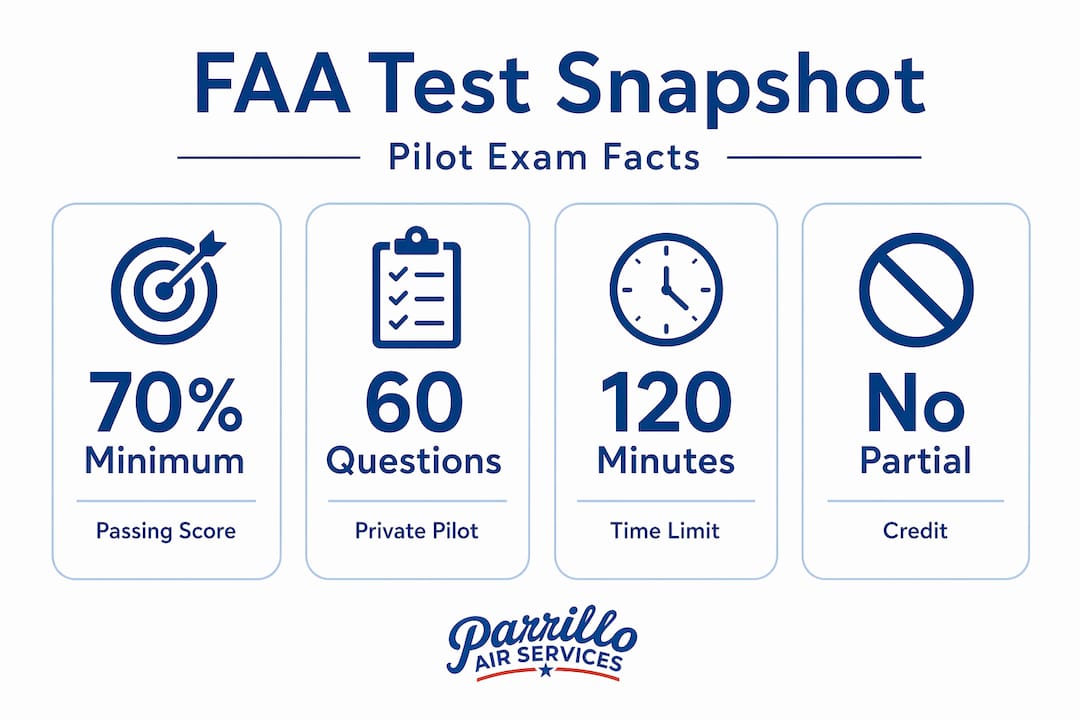
The minimum passing score across most certificates is 70%, and no partial credit is awarded. Every question is either right or wrong. At the end of your test session, you receive an Airman Knowledge Test Report, known as the AKTR, which becomes one of the most important documents you carry to your checkride.
Getting seated at a testing terminal requires more than just signing up online. There are three prerequisites you need to nail down before you book your appointment.
Pro Tip: Make sure your name is spelled identically on your FTN account, your instructor endorsement, and your government-issued ID. Even a middle name discrepancy can cause problems at check-in. Verify all three before you finalize your booking.
If you need to cancel, do it more than 24 hours before your appointment to avoid forfeiting the full fee.
Test day is procedural and calm when you know what to expect. The proctor at the testing center will check your identification, verify your test authorization, and walk you through a brief orientation before you sit down at the terminal.
Once you're at the computer, here's what the experience looks like:
When you finish and submit, your score is calculated immediately. The proctor prints your AKTR on the spot. This document shows your score, the date, the test code, and your Learning Statement Codes. Those codes identify which knowledge areas you missed, and your designated pilot examiner (DPE) will use them to guide oral exam questions at your checkride.
Pro Tip: Review your flagged questions before submitting, but don't second-guess every answer. Research consistently shows that your first instinct is correct more often than a switched answer. Only change a response if you spot a clear reason why your original choice was wrong.

Preparation is where most student pilots either set themselves up for a strong checkride or create unnecessary problems for themselves. The biggest mistake is treating this like a memorization exercise.
For students aiming at a commercial pilot certificate, the preparation volume increases substantially. Start earlier and budget more study time than you think you'll need.
Your test results don't last forever, and your score has real consequences beyond the pass or fail threshold.
| Score Range | Likely Checkride Impact |
|---|---|
| 90% and above | Shorter oral exam, focused on missed LSCs |
| 80-89% | Moderate oral review of weak areas |
| 70-79% | Extended oral exam on all flagged topics |
| Below 70% | Failure, new endorsement required to retest |
Build a target score rather than just aiming to pass. The work you put into pushing from 78% to 88% during preparation pays dividends when you're sitting across from a DPE on checkride morning.
I've watched a lot of students treat the knowledge test as a box to check before the "real" training starts. That mindset creates problems that follow them through their entire checkride and beyond.
The material on this exam is not arbitrary trivia. Knowing how to read a METAR accurately, understanding weight and balance limits, and being able to interpret sectional charts are things you will need in the cockpit. Students who memorize their way to a 74% tend to hit those same gaps during oral exams and, more critically, during actual flight operations.
What I've found consistently is that the students who score well aren't necessarily smarter. They're the ones who treat the ACS as a real standard instead of a syllabus to rush through. They take practice exams under realistic conditions. They ask their instructor to explain the why behind every topic they miss, not just the correct answer.
The knowledge test also gives you momentum. Students who pass with strong scores walk into their first cross-country lessons with genuine confidence because they understand what they're doing at the navigation and weather level. That confidence is not just psychological. It translates directly to better decision-making in the airplane. If you want your checkride to feel manageable, start building that foundation here.
— Gm

At Parrillo Air Services in Lynchburg, VA, ground school and flight training aren't treated as separate tracks. The structured programs are designed to build your aeronautical knowledge alongside real flight hours, so when test day arrives, you're not cramming. You're applying what you already know. Whether you're pursuing your private pilot certificate or working toward a commercial rating, the team at Parrillo Air Services provides the personalized instruction and resources you need to pass the FAA Airman Knowledge Test with a score that makes your checkride straightforward. Explore training programs and take the first step toward your certificate today.
Get in Touch Today