Consistent, applied study habits are the single most reliable way to shorten your training time, improve in-flight decision-making, and reduce what you spend getting to your certificate. That is not motivational advice. The FAA says it plainly: haphazard study habits usually result in unsatisfactory scores on the knowledge test. AOPA instructor research confirms that students who study between lessons and arrive prepared progress faster. Parrillo Air Services builds these habits directly into its Part 61 programs for exactly that reason.
Start tonight: run a 20-minute spaced-repetition loop on one procedure, then chair fly it from memory.
Flight training is application-first, not theory-first. That one distinction changes everything about how you should study.
In a college course, you can read a chapter, absorb the concept, and demonstrate it on a written exam weeks later. In a Cessna at pattern altitude, you need to recall, decide, and act in seconds. The application-first nature of flight training means that a student who memorized the textbook but never mentally rehearsed a procedure will still fumble it under time pressure. Motor skills, checklist flows, and radio calls all require a different kind of encoding than factual recall.
Procedural memory builds through repetition in context, not passive reading. When you chair fly a maneuver before the lesson, you are rehearsing the physical sequence in your working memory so the cockpit is not the first time your brain has run that program. When you study a scenario instead of a chapter, you expose the gaps in your knowledge before they cost you aircraft time.
Pro Tip: Convert any textbook topic into a mini-scenario before you close the book. Ask yourself: "I'm at 3,500 feet, 15 miles from the field, and this situation just happened. What do I do?" If you can't answer, that's your study target for tonight.
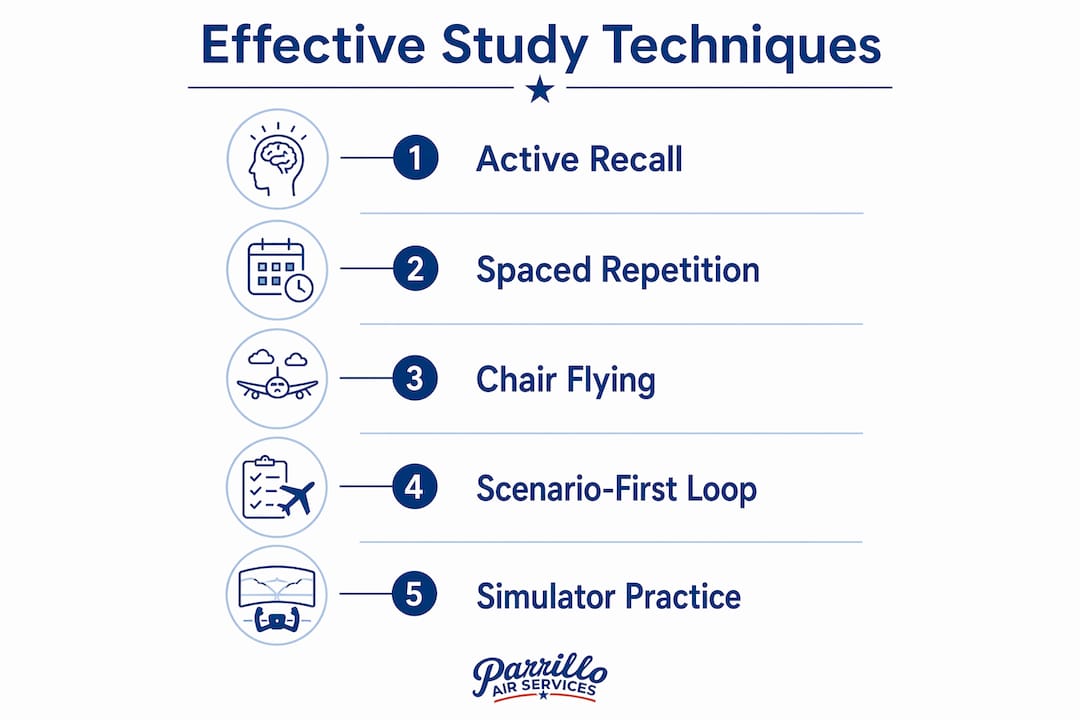
The highest-impact techniques for flight training are active recall, spaced repetition, chair flying, the scenario-first study loop, and low-cost simulator practice. Passive re-reading ranks last.
Close the book and write down everything you just read from memory. Then check. The act of retrieval itself strengthens the memory trace. Active study strategies consistently predict higher exam scores compared to passive review, and students who use a greater variety of active strategies outperform those who rely on fewer.
Review material at increasing intervals: tonight, tomorrow, in three days, in a week. The science behind why this works is straightforward. Without review, retention falls off sharply:

| Time since learning | Approximate retention |
|---|---|
| 20 minutes | 58% |
| 1 hour | 44% |
| 1 day | 33% |
| 1 week | 25% |
| 1 month | 21% |
Scheduled spaced repetition reverses that curve, pushing retention back above 90%. Use a flashcard app (Anki is free and well-suited to this) and build a deck of procedures, regulations, and weather concepts as you cover them in ground school.
Sit in a chair, close your eyes, and run through a procedure from memory: engine start, runup, departure, a specific maneuver, an emergency flow. Chair flying builds procedural memory so you are not figuring out controls or checklist sequences during expensive rental time. Use it for every lesson, every time.

The VectoredOps Study Loop replaces cover-to-cover reading with a five-stage cycle: start with a concrete flight decision, find the FAA handbook sections that justify it, identify what you got wrong, write a one-line rule, and repeat. This approach exposes knowledge gaps immediately and keeps study tied to real decisions rather than abstract chapters.
Desktop simulators and aviation apps let you rehearse cockpit flows, instrument scans, and navigation scenarios without aircraft rental costs. Parrillo Air Services supports simulator-based practice as part of its training approach, so students can log meaningful repetitions between lessons. Familiarizing yourself with avionics and cockpit procedures through a sim before you fly them live cuts down on the "where is that button" moments that eat into lesson time.
Session format: 15–30 minutes per loop. Longer sessions with wandering focus produce less than half the retention of a sharp, focused short session.
Five short sessions per week beats one long weekend cram every time: three theory loops, two chair or simulator sessions, plus a pre-flight review the night before each lesson.
Consistency is the mechanism. Distributed practice outperforms massed study for long-term retention, and for pilots, that retention needs to last months, not just until the written exam. AOPA instructors report that students who fly and study frequently maintain motor skills better and make faster overall progress.
Here is what a realistic week looks like for a working adult flying two to three times per month:
Monday (20 min): Active recall on the previous lesson's topic. Write down the procedure from memory, check the Pilot's Handbook of Aeronautical Knowledge, add errors to your flashcard deck.
Wednesday (25 min): Scenario-first loop on the next lesson's topic. Start with a flight decision, work through the relevant FAA sections, write your one-line rules.
Friday (20 min): Flashcard review using spaced repetition. Focus on cards due for review; do not re-study what you already know.
Saturday (30 min, night before a lesson): Chair fly the planned maneuvers in sequence. Review the lesson objective and write two or three questions to ask your instructor.
Sunday (post-lesson, 15 min): Debrief notes. What did you do well? What needs work? Convert each weakness into a new flashcard or a chair-flying target.
That is roughly 110 minutes per week. Spread across five sessions, it compounds fast. Students who build their knowledge base consistently rather than in bursts arrive at each lesson ready to advance, not review.
Pre-lesson checklist (the night before): Review the lesson objective, chair fly the key maneuvers, check NOTAMs and weather for the area, write your questions. Post-lesson debrief: Note what clicked and what did not, update your flashcard deck, schedule the next review.
Students who study consistently between lessons spend less time in the aircraft relearning what they forgot, and that translates directly into dollars. Aircraft rental and instructor fees add up fast, and every lesson spent on remediation is a lesson you paid for twice.
The mechanism is straightforward: fewer remedial flights, faster skill acquisition, and a lower chance of a checkride failure or re-examination. Pilots using spaced repetition scored higher on knowledge tests six months after training and showed better retention of emergency procedures compared to those who did not use the technique.
Consider a conservative example. If disciplined study habits eliminate four remedial lessons over the course of a private pilot program, and each lesson runs two hours of aircraft time plus instruction, the savings are meaningful. Multiply that by the hourly rates in your area and the number adds up quickly. Beyond cost, a student who passes the checkride on the first attempt avoids re-examination fees and the scheduling delay of a second attempt.
The pilot training stages checklist makes clear how many distinct skill milestones a student must clear. Every one of those milestones goes faster when the underlying knowledge is already solid before the flight.
Students who arrive prepared get more useful flight time and more engaged instructors. That is not a soft claim. AOPA instructor research is direct: nothing motivates a CFI more than a student who shows up with good, relevant questions and has clearly done the work.
Before each lesson, brief yourself on the objective. Know what maneuver or procedure is planned, chair fly it at least once, and write down two or three specific questions. Not "how does this work?" but "during a power-off stall recovery, when exactly do I add full power relative to releasing back pressure?" That kind of question signals ownership of learning and shifts the lesson from remediation to refinement.
After the flight, debrief with your instructor before you leave the ramp. Ask for one specific thing to work on before the next lesson. That feedback becomes your study target for the week: a new flashcard, a chair-flying sequence, a scenario to run through the VectoredOps loop.
Pro Tip: Keep a running question list in a notes app on your phone. Every time you hit a gap during study, add it. Bring the three most pressing questions to each lesson. Your instructor will notice, and the answers will stick because they came from a real gap you identified yourself.
Adopt a growth mindset that treats every mistake as data for the next targeted study loop, not as evidence you are not cut out for this.
The most common study mistakes in flight training are not about effort. They are about method. Here is what actually slows students down:
Each of these has a one-line fix: replace cramming with a weekly spaced-repetition schedule; replace re-reading with active recall; replace skipping chair flying with a 10-minute pre-lesson rehearsal; replace chapter-finishing with scenario-first loops; replace distracted study with phone-off, timed sessions.
Aviation careers require genuine dedication, and the students who internalize that early are the ones who progress without stalling. The mindset required for an aviation career is not about talent. It is about building systems that keep you improving between lessons.
Parrillo Air Services builds applied-study techniques into every training plan to shorten timelines and improve checkride readiness from day one.
The school's Part 61 programs pair each flight lesson with structured ground preparation. Before a lesson, students receive a briefing on the objective and a preparation checklist that covers the relevant procedures, airspace, and decision points. After the flight, instructors conduct a debrief that converts lesson errors into targeted homework, whether that is a chair-flying sequence, a flashcard set, or a scenario to run through before the next session. Simulator and app-based practice is supported between lessons so students can log repetitions without aircraft rental costs.
At Parrillo Air Services, the students who progress fastest are the ones who treat the time between lessons as seriously as the flight itself. Preparation is not optional — it is part of the training.
That approach reflects what the research supports: spaced repetition, active recall, and scenario-first study are not study hacks. They are the evidence-based practices that convert short-term learning into the procedural knowledge you actually need in the cockpit.
Consistent, applied study habits are the most direct lever a student pilot has over training time, cost, and safety outcomes.
| Point | Details |
|---|---|
| Spaced repetition reverses forgetting | Without review, retention falls to about 21% after one month; scheduled reviews push it back above 90%. |
| Active strategies beat passive ones | Students using more active study strategies score higher on exams; self-quizzing outperforms re-reading. |
| Chair flying saves aircraft time | Rehearsing procedures on the ground means flight time goes toward refinement, not discovery. |
| Consistency beats duration | Five short weekly sessions outperform one long cram for long-term procedural retention. |
| Parrillo Air Services | Structures Part 61 training with pre-lesson prep, instructor debrief, and simulator practice to accelerate student progress. |
A prepared student changes the entire dynamic of a flight lesson. When a student arrives having chair flown the maneuver, reviewed the procedure, and written a real question, the lesson can start at a higher level. The instructor does not spend the first 15 minutes re-explaining what was covered last time. Instead, the flight moves directly into refinement, edge cases, and the kind of nuanced feedback that actually accelerates progress.
Students who study between lessons also recover from mistakes faster. When an error happens in the air, a prepared student already has the mental framework to understand why. The debrief takes minutes instead of a full re-teach. That compounds over dozens of lessons into a meaningfully shorter training timeline.
The students who reach their certificates fastest are rarely the most naturally talented. They are the ones who treat the ground time as seriously as the flight time, show up with questions, and use every piece of instructor feedback as a study target. That habit is learnable, and it starts before the first lesson.

Parrillo Air Services is the training partner for student pilots who want structured support, not just aircraft rental and a logbook signature. The school's Part 61 programs in Lynchburg, VA are built around the principle that flight time and ground preparation work together. Students get pre-lesson prep checklists, instructor-led debriefs that convert errors into homework, and guidance on spaced-repetition and simulator practice between sessions.
For students targeting a private pilot certificate, instrument rating, or a full professional pathway, that structure means fewer remedial lessons, a cleaner path to the checkride, and a foundation of study habits that carries through every rating. Flexible scheduling makes it realistic for working adults, and the personalized instruction means your study plan is tied to your actual gaps, not a generic syllabus.
Ready to train with a school that takes your ground preparation as seriously as your flight time? Schedule a discovery flight or reach out to speak with an instructor about which program fits your goals.
The sources below are the ones worth bookmarking. Each one goes deeper on a specific technique covered in this article.
The common thread across all five resources: passive consumption of aviation material does not build the procedural knowledge you need in the cockpit. Every one of these sources points toward active, scenario-based, spaced practice as the method that actually works.
Build study habits that shorten your training timeline and get you checkride-ready. Parrillo Air Services pairs every Part 61 flight lesson with structured ground preparation, instructor-led debriefs, and simulator practice — so your aircraft time goes toward refinement, not review.
Schedule a Discovery Flight