Night flying certification is the combined legal and practical training requirement that enables pilots to fly safely after dark and carry passengers at night. The FAA integrates night privileges directly into the Private Pilot Certificate rather than issuing a separate night rating, which means your night training is built into your core certification from day one. Understanding why night flying certification is required protects you from regulatory violations, prepares you for real operational conditions, and opens doors to commercial aviation careers. Parrillo Air Services builds FAA-compliant night training into every private pilot program so students meet both the letter and the spirit of the regulations.
Night flying certification is required because flying after dark introduces hazards that daylight training simply does not cover. The FAA mandates specific night training under FAR 61.109, and those requirements exist for good reason.
Under FAR 61.109, private pilot applicants must complete a minimum of 3 hours of night flight training. That training must include at least 10 takeoffs and 10 full-stop landings at night, plus one cross-country flight of at least 100 nautical miles. Each element targets a specific skill gap that darkness creates.
The requirements for night flying do not stop at the certificate level. Once you hold a private pilot certificate, FAR 61.57(b) governs your ongoing legal authority to carry passengers after dark. You must complete 3 takeoffs and 3 full-stop landings within the past 90 days, performed between one hour after sunset and one hour before sunrise, in the same category and class of aircraft. Miss that window and you are legally grounded for night passenger flights until you rebuild currency.
Commercial pilot applicants face a higher bar. FAA regulations require 5 hours of night VFR flight time, including at least 2 hours of dual night instruction. That additional requirement reflects the professional standard airlines and charter operators expect. You can read more about those milestones in the commercial pilot requirements breakdown.
Sport pilots occupy a separate category. Under FAA Amendment 61-159, night flying became an optional privilege for sport pilots, but it requires a Part 67 FAA medical certificate or BasicMed compliance. The standard driver's license medical exemption that sport pilots normally use is not valid for night operations. That rule aligns sport pilot physiological standards with private pilot standards for night flight.
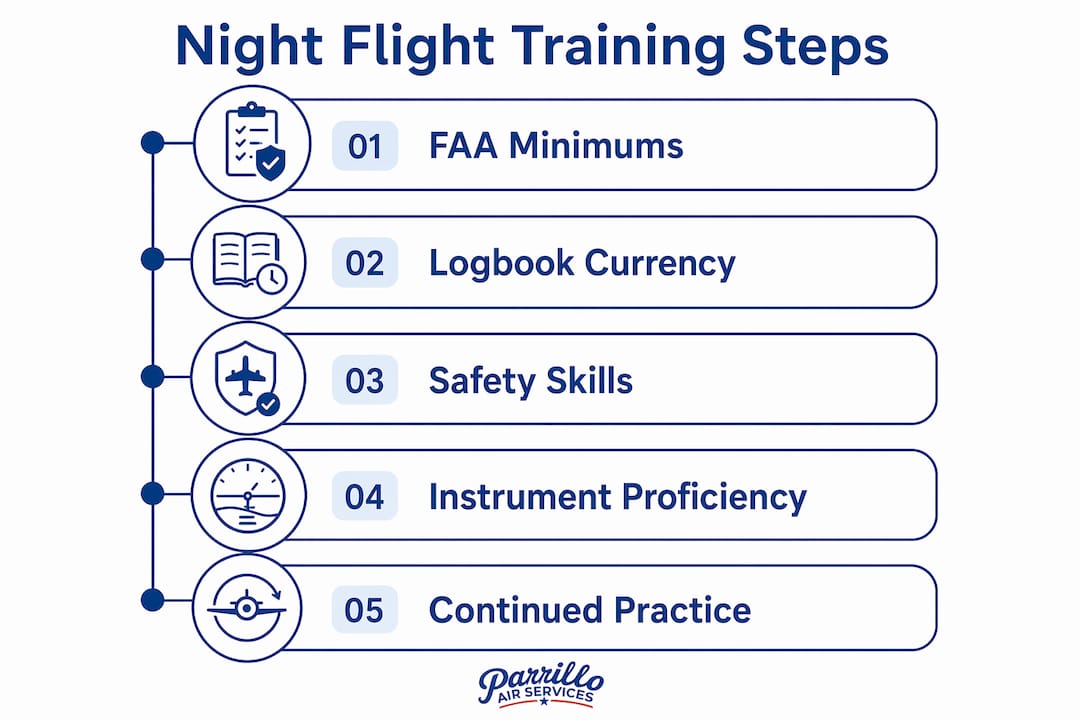
The legal minimums satisfy the FAA. They do not guarantee you are safe. That gap is the core reason the importance of night flying certification extends well beyond a checkmark on your application.
NTSB data shows that night flights account for roughly 25% of general aviation flights but contribute to approximately 50% of fatal accidents involving spatial disorientation. That ratio is striking. It means the risk per flight hour at night is dramatically higher than during the day, and three hours of training barely scratches the surface of what you need to manage it.
Spatial disorientation is the primary killer. Without a visible horizon, your vestibular system feeds your brain false information about aircraft attitude. Pilots have entered fatal spirals while genuinely believing they were flying straight and level. Instrument proficiency is the direct countermeasure. Pilots who can trust their instruments and ignore false sensory inputs survive situations that kill others.
Night VFR is not a relaxed version of daytime flying with the lights off. It is a physiologically demanding environment where your eyes, inner ear, and brain actively work against you. The minimum 3 hours of training introduces you to that environment. Genuine proficiency requires deliberate practice well beyond that threshold.
Cockpit fixation is a related hazard that instructors see constantly. Pilots focus on the instrument panel and stop scanning outside, losing situational awareness entirely. The N.I.G.H.T. preflight protocol, which covers NOTAMs, Illusions, Ground lighting, Human factors, and Terrain/traffic, gives pilots a structured mental framework to manage these risks before every night departure.
The FAA uses three separate definitions of night, each serving a different regulatory purpose. Confusing them is one of the most common compliance mistakes pilots make.
| Definition | Time Period | Regulatory Purpose |
|---|---|---|
| Sunset to sunrise | From official sunset to official sunrise | Position lights required on aircraft |
| Civil twilight to civil twilight | End of evening civil twilight to start of morning civil twilight | Logging official night flight time in your logbook |
| 1 hour after sunset to 1 hour before sunrise | The narrower window within the night period | Passenger currency requirement under FAR 61.57(b) |
The practical consequences of mixing these up are serious. You can legally log night flight time starting at the end of civil twilight, which occurs roughly 30 minutes after sunset. But your passenger currency window does not open until one hour after sunset. A landing at 45 minutes after sunset counts toward your logbook night hours but does not count toward your night passenger currency. Many pilots do not realize this until they are already in violation.
The full-stop landing rule adds another layer. Touch-and-go landings do not satisfy night currency requirements. Only full-stop landings count. The FAA's reasoning is straightforward: a full-stop landing requires you to complete the entire landing sequence, taxi back, and set up for departure again, which builds the complete operational proficiency that night passenger flights demand.
Understanding all three definitions protects your certificate and your passengers. The FAA night flight training guide covers these distinctions in detail if you want a deeper reference.
Night flying certification is not just a regulatory hurdle. It delivers real, career-shaping advantages for aspiring pilots.
The benefits of night flying training compound over time. Every hour you log at night builds the scan discipline, situational awareness, and instrument confidence that advanced certifications like the ATP require. You can see how night experience feeds into long-term career goals in the ATP certification guide.
Night flying certification is required because FAA regulations mandate specific training and ongoing currency to operate safely and legally after dark, and the physiological risks of night flight demand proficiency well beyond the minimum 3 hours.
| Point | Details |
|---|---|
| FAR 61.109 training minimums | Private pilots must complete 3 hours of night training, 10 full-stop landings, and a 100 nm cross-country. |
| Night passenger currency | FAR 61.57(b) requires 3 full-stop landings within 90 days, between 1 hour after sunset and 1 hour before sunrise. |
| Three definitions of night | Logging time, position lights, and passenger currency each use a different FAA definition of night. |
| Safety risk beyond minimums | Night flights represent roughly 25% of GA flights but about 50% of fatal spatial disorientation accidents. |
| Career and skill benefits | Night certification expands flying hours, builds instrument discipline, and meets commercial operator requirements. |
My honest view is that most student pilots treat night training as a box to check. They fly the required 3 hours, log the 10 landings, and move on. That approach is legal. It is not safe.
The pilots I have seen struggle most in advanced training are the ones who never pushed past the minimum night hours. When they hit instrument training or start flying cross-countries in marginal conditions, the gaps show up fast. Night flying teaches you to trust your instruments over your instincts. That lesson does not stick after three hours. It sticks after thirty.
The currency rules trip up even experienced pilots. I have watched certificated pilots show up for a night flight and realize mid-preflight that their last three landings were touch-and-goes, which means they are not current for passengers. That is an embarrassing and avoidable mistake. Build the habit of logging full-stop landings from your very first night flight.
My recommendation is simple: treat night training as a skill-building block, not a regulatory hurdle. Fly at least 10 hours at night before your checkride if your schedule allows. Your instrument training will go faster, your confidence will be higher, and you will be a genuinely safer pilot from day one of your certificate.
— Gm
Parrillo Air Services integrates FAA-compliant night flight training directly into its private pilot and commercial pilot programs in Lynchburg, VA.

Every student works with experienced instructors in aircraft equipped for night operations, covering the full FAR 61.109 requirements and the currency rules that protect you after certification. Scheduling is flexible, which means night training sessions fit around your availability rather than forcing you into a rigid calendar. If you are ready to meet the requirements for night flying and build the skills that carry you into a commercial career, explore the training programs at Parrillo Air Services and take the next step toward your certificate.
FAR 61.109 requires a minimum of 3 hours of night flight training, including 10 full-stop landings and one cross-country flight of at least 100 nautical miles.
No. The FAA integrates night flying privileges into the Private Pilot Certificate rather than issuing a standalone night rating, unlike some international aviation systems.
Touch-and-go landings do not satisfy FAR 61.57(b) night currency requirements. Only full-stop landings count toward the 3 landings needed within 90 days to carry passengers at night.
Each definition serves a distinct purpose: sunset to sunrise governs position light requirements, civil twilight governs flight time logging, and one hour after sunset to one hour before sunrise governs passenger currency.
Sport pilots can obtain night flying privileges under FAA Amendment 61-159, but they must hold a Part 67 FAA medical certificate or meet BasicMed requirements. The standard driver's license medical exemption does not apply to night operations.