Flight simulators are defined as ground-based devices that replicate aircraft cockpits, flight dynamics, and environmental conditions to train pilots without leaving the ground. They are the most widely used tool in professional pilot education, and understanding why flight simulators are used in training explains a great deal about how modern aviation maintains its safety record. The FAA recognizes approved flight training devices (FTDs) and aviation training devices (ATDs) as legitimate substitutes for a portion of required flight hours. Parrillo Air Services integrates simulator training into its FAA Part 61 programs precisely because the evidence for their effectiveness is overwhelming.
Flight simulators improve training efficiency by giving student pilots a controlled environment to build procedural knowledge before they ever touch an aircraft's controls. Research shows transfer effectiveness ratios between 0.3 and 0.7, meaning one hour in a simulator saves 20–40 minutes of actual flight instruction time. That is not a marginal gain. It means a student who completes ten hours in a simulator arrives at the aircraft having already banked the equivalent of four to seven hours of flight-level learning.
The reason this works comes down to cognitive load. Starting training directly in the aircraft forces students to manage multiple simultaneous tasks: controlling the aircraft, reading instruments, communicating with ATC, and navigating. A simulator isolates each task. Students can practice radio calls without worrying about altitude, or nail a checklist without the distraction of actual turbulence. Once each skill is solid in isolation, combining them in the aircraft becomes far less overwhelming.
Simulators also allow repeated practice without fuel or maintenance costs, which means students can drill a maneuver twenty times in a single session. Repetition builds muscle memory. Muscle memory is what keeps a pilot's hands moving correctly when stress narrows their attention to a single problem.
Pro Tip: Before each simulator session, write down one specific skill you want to master. Purposeful practice in a simulator outperforms unfocused "flight time" every time.
The benefits of flight simulators extend beyond individual skill building. They give instructors a tool to observe student behavior under pressure without any actual risk. An instructor can freeze the simulation mid-approach, debrief the student on a specific error, and reset the scenario immediately for another attempt. That kind of immediate feedback loop does not exist in a real aircraft.
The single most compelling argument for simulator training is emergency practice. Certain critical failures simply cannot be safely replicated in a real aircraft during initial training. Engine failures at low altitude, severe icing encounters, and inadvertent entry into instrument meteorological conditions (IMC) are all scenarios that simulators are the only practical environment to rehearse safely.
The list of emergencies a student can practice in a simulator includes:
Each of these scenarios would be dangerous or impossible to replicate in a training aircraft. In a simulator, they become routine practice.
"Simulators turn high-stress emergencies into instinctive responses before pilots ever face those situations in real aircraft. The goal is not to make emergencies feel comfortable. The goal is to make the correct response feel automatic."
— Aviation training research, 2026
That distinction matters. A pilot who has practiced an engine failure thirty times in a simulator does not need to think through the checklist when it happens for real. The hands move while the brain focuses on the bigger picture: where to land, who to call, what comes next. Simulation preparation produces that kind of instinctive response, and it is the reason airlines require recurrent simulator training for every line pilot, every year.
Pilots who participate in recurrent simulator-based training may also qualify for insurance premium discounts of around 10% annually. Insurers recognize that simulator-trained pilots present lower accident risk. That financial signal reinforces what the safety data already shows.
Simulator sessions cost roughly half the price of aircraft rental. A typical aircraft rental runs around $180 per hour, while a comparable simulator session runs around $85–90 per hour, according to flight training cost research. For a student working toward a private pilot certificate, that difference compounds quickly across dozens of training hours.
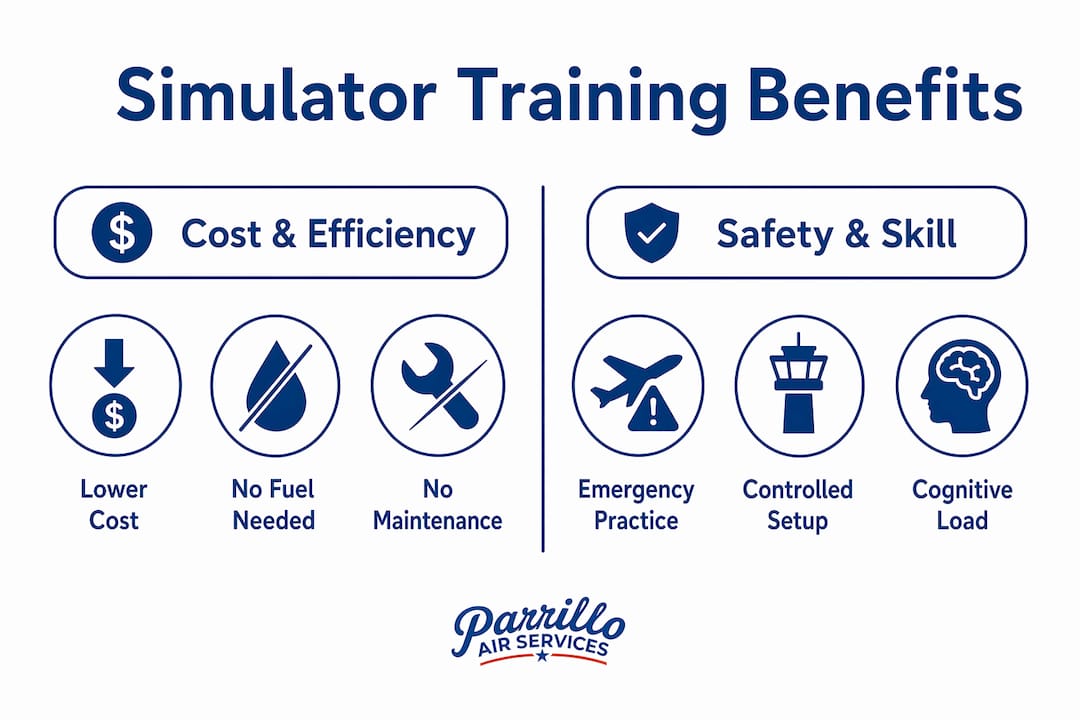
The cost advantage is only part of the picture. Simulators are immune to weather cancellations and aircraft maintenance delays. A student scheduled for a cross-country navigation lesson does not lose that session because of a low ceiling or a grounded aircraft. The simulator runs regardless. That scheduling reliability matters enormously for students trying to maintain training momentum.
| Training factor | Aircraft | Simulator |
|---|---|---|
| Hourly cost (approximate) | $180 | $85–90 |
| Weather dependency | High | None |
| Maintenance delays | Possible | Rare |
| Emergency scenario practice | Very limited | Full range |
| Pause and reset capability | None | Yes |
Flight schools benefit from this reliability too. Simulator sessions provide predictable revenue even when flying is grounded by weather or maintenance. That financial stability allows schools to invest in better equipment and retain experienced instructors. Students benefit indirectly from a school that is not constantly scrambling to recover lost revenue from canceled flights.
Pro Tip: Ask your flight school about a simulator-first scheduling approach. Completing procedural training in the simulator before each aircraft lesson means your aircraft time focuses on judgment and feel, not memorizing checklists.
For a detailed breakdown of how simulator and aircraft costs compare across different certificate levels, the 2026 pilot training cost guide from Parrillo Air Services covers the numbers in full.
Simulators occupy the middle ground between classroom theory and actual flight. Cognitive Load Theory explains why this matters: students learn best when new information is introduced in manageable pieces. A ground school lesson teaches the theory of instrument approaches. A simulator session lets the student practice the procedure without the full cognitive demand of flying a real aircraft. The actual flight then becomes a refinement exercise rather than a first attempt.
VR-based simulators and full-motion flight simulators each serve different roles in this progression. VR is best suited for early-stage training focused on procedural familiarization, such as learning cockpit layout, checklists, and basic maneuvers. Full-motion simulators are preferred for advanced instrument and avionics training, where realistic motion cues and high-fidelity avionics matter. Neither replaces the other, and neither replaces actual flight.
The practical limits of simulation are real. VR and simulators enhance skill acquisition and spatial awareness but show limits with theoretical knowledge retention. A student who only simulates without engaging with ground school material will have gaps. Simulation is a bridge, not a shortcut.
The best training curricula use simulators in a structured sequence:
Practicing maneuvers in simulators before actual flight shifts aircraft lessons away from procedure memorization and toward the higher-order skills that make a safe pilot. That shift is where the real flight simulator training benefits show up. For students curious about how avionics training devices fit into this progression, Parrillo Air Services covers the topic in depth in their guide on avionics in pilot training.
Flight simulators are the most cost-effective and safety-critical tool in pilot training, reducing required aircraft time, enabling emergency practice, and building instinctive responses before real flight.
| Point | Details |
|---|---|
| Transfer effectiveness is measurable | One simulator hour saves 20–40 minutes of real flight time, with ratios between 0.3 and 0.7. |
| Emergency practice requires simulation | Engine failures, icing, and IMC entry cannot be safely replicated in training aircraft. |
| Cost savings are significant | Simulator sessions cost roughly half the price of aircraft rental, saving money across dozens of training hours. |
| Structured sequencing matters | Ground school, then simulator, then aircraft produces faster and safer skill development. |
| Scheduling reliability adds value | Simulators run regardless of weather or maintenance, keeping training on track. |
Students who treat simulator sessions as optional almost always spend more money and more time reaching the same proficiency. I've watched students arrive at their first instrument approach in the aircraft having never practiced the procedure on the ground. The lesson becomes a scramble. The instructor spends half the hour just getting the student oriented, and the aircraft time is wasted on tasks that a simulator session would have handled in twenty minutes.
The students who progress fastest are the ones who show up to simulator sessions with a plan. They know which procedure they are practicing, they brief it beforehand, and they debrief it afterward. They treat the simulator like a real lesson, not a video game. That mindset shift is the single biggest predictor of training efficiency I have seen.
The importance of flight simulators goes beyond cost and scheduling. A student who has practiced an engine failure fifty times in a simulator carries a different kind of confidence into the aircraft. Not overconfidence. Readiness. There is a meaningful difference, and it shows up in how calmly they handle unexpected situations. If you are an aspiring pilot, the simulator is not a warm-up for real training. It is real training.
— Gm
Parrillo Air Services builds simulator training into every stage of its FAA Part 61 programs, from private pilot through instrument and commercial ratings.

Students at Parrillo Air Services in Lynchburg, VA, use simulator sessions to master procedures before aircraft lessons, which means aircraft time focuses on the judgment and real-world skills that matter most. The result is faster progress, lower total costs, and better preparation for the demands of professional aviation. If you are ready to see how a structured, simulator-integrated training program works in practice, Parrillo Air Services is the place to start. Check out the flight training time breakdown to understand exactly how simulator hours fit into your path to certification.
Get in Touch Today