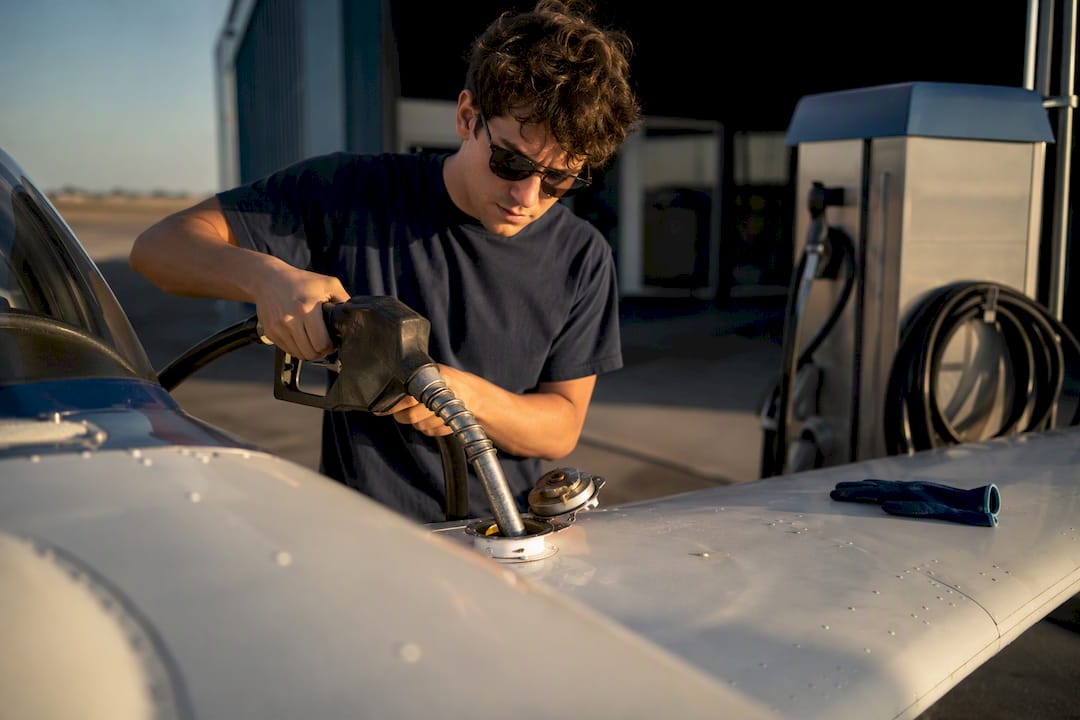
A wet rental bundles fuel (and usually oil) into the hourly aircraft rate; a dry rental strips fuel out and bills it separately. Either way, instructor time is almost always charged on top of the aircraft rate, not folded into it. Confirm this with the flight school before you book, because the wording on a price sheet can hide which one you're actually getting.
TL;DR:
- Wet rentals include fuel and oil in the hourly rate, offering cost predictability, while dry rentals charge separately for fuel, often benefiting frequent flyers with cheaper fuel.
- Fuel reimbursement caps are standard for away-field landings and should be confirmed in writing to prevent disputes about added costs.
- Instructor time is billed separately from aircraft rental, with dual hours paid at a different rate, and minimum flight times often apply.
- Booking should involve direct questions about whether the rate includes fuel, instructor costs, and reimbursement policies, with written agreement crucial for clarity.
- Overall, focusing on total predictable costs and written policies is more important than simply comparing hourly rates to choose the best rental option.
The core difference comes down to who absorbs fuel-price risk. In a wet arrangement, the flight school pays for fuel and builds an average cost into the hourly Hobbs rate you're quoted. In a dry arrangement, you pay the school for the aircraft and pay for fuel yourself, at whatever the pump reads that day. Oil is typically bundled with fuel under a wet rate too, since it's a minor cost the school absorbs rather than itemizes.
Wet rentals win on simplicity. You know your total cost before you take off, and there's no fuel receipt to chase down afterward. That predictability also removes a bad incentive: a renter trying to save fuel money on a dry rate might lean the engine more aggressively than they should, and Aviatize's glossary points out this is exactly why schools favor wet billing for training aircraft.
Dry rentals can save money for renters who fly often enough to shop for cheap fuel, or who fly efficiently and don't want to subsidize less careful renters through an averaged wet rate.
Pro Tip: Ask for the wet rate first even if you're quoted dry. Comparing the two side by side is the fastest way to spot whether a "cheaper" dry rate is actually cheaper for your flying pattern.
Aircraft rental runs on the Hobbs meter, not a stopwatch or the clock on the wall. The Hobbs meter ticks whenever the engine is running (some are wired to oil pressure, others to a switch on the throttle), which means taxi time and a long engine warmup both cost you money before you've left the ground. That's the standard billing unit across nearly every U.S. flight school, and it's what your final invoice will be built on.
Fuel handling depends entirely on which model you're in:
Reimbursement caps exist because away-field fuel is frequently more expensive, and a school can't absorb an open-ended fuel bill on a flat wet rate. Aviatize notes this cap-and-receipt structure is standard practice, not a red flag.
Instructor time is its own line item in almost every case. Expect a separate hourly rate for dual instruction, and know that "dual" hours (with an instructor aboard) are billed differently from solo or PIC hours you log once you're cleared to fly alone. Flying Magazine confirms this split billing is the norm for training, not the exception. On top of the base numbers, watch for fuel surcharges during price spikes, applicable taxes, and minimum billable time per session, often 0.5 to 1.0 hours even for a short flight.
Run through this before you hand over a card number, ideally on the phone or in person, not just from a website price sheet.
Ask directly:
Check the paperwork:
The written rental agreement should show a line-item breakdown, not a single bundled number. Confirm how Hobbs start and stop times get recorded (engine start to engine shutdown is standard) and ask how disputes over recorded time get resolved. Jettly's rental guide recommends treating this document review as a non-negotiable step before any first flight.
Red flags worth walking away from: a vague fuel policy with no written cap, no receipt requirement paired with no reimbursement limit (a setup that invites disputes later), instructor billing that isn't clearly separated from aircraft time, or a Hobbs measurement practice that changes depending on who you ask.
Pro Tip: Get the fuel reimbursement cap in writing, even if it's just an email. Verbal promises about "we'll work it out" rarely survive a disagreement over a $40 fuel receipt.
Here's how the math plays out for a typical trainer, using illustrative numbers based on the ranges Flying Magazine and Jettly report for piston trainers like a Cessna 172.
Trainer wet rates commonly land within a broad range per Hobbs hour, and that range is wide enough that a school's "cheaper" dry rate can flip into the more expensive option the moment fuel prices move. The gap widens fast if you're flying cross-country legs and refueling somewhere other than home base, since that's exactly where reimbursement caps and price spikes hit hardest.
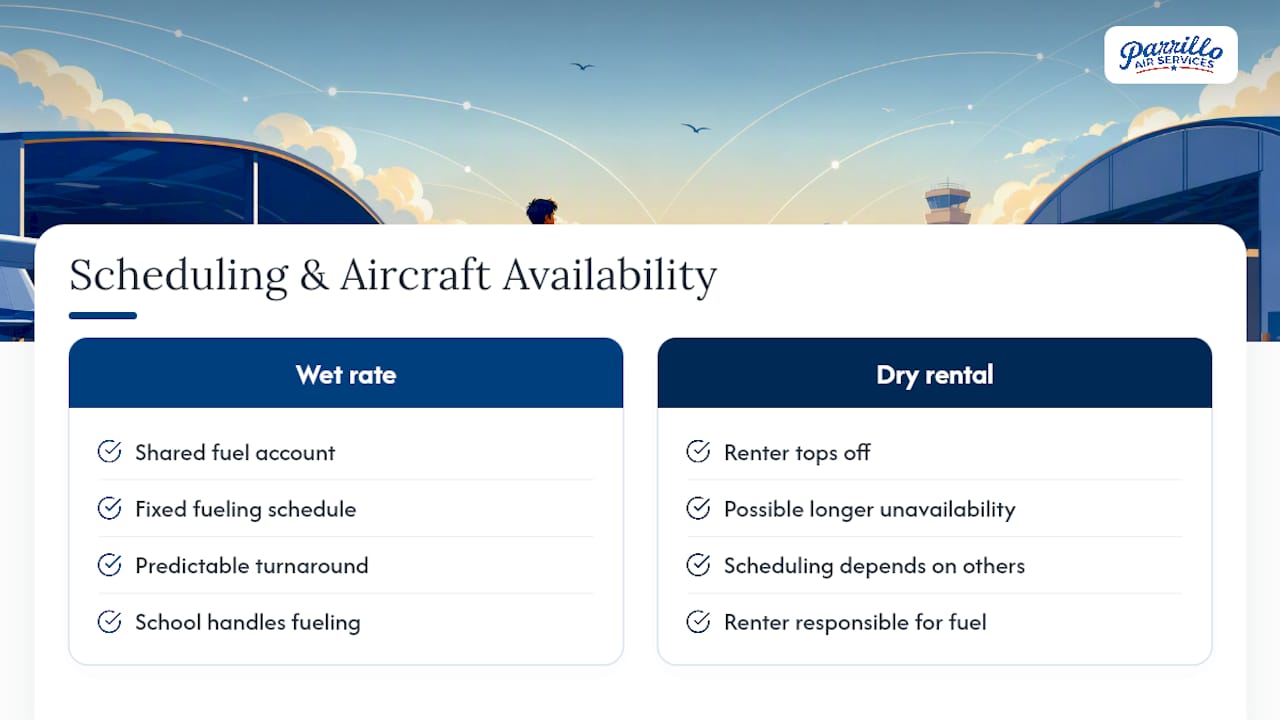
Wet and dry billing don't just change your invoice. They can change how easily you get on the schedule in the first place. Schools running wet rates tend to manage a shared fuel account and fixed fueling schedule for their fleet, which keeps aircraft turnaround predictable between lessons. That predictability is part of why block scheduling for students works as smoothly as it does.
Dry arrangements shift more responsibility onto the renter, including making sure the aircraft has enough fuel before a flight and topping off (or arranging to) after. For club-style dry rentals, that can mean an aircraft sits unavailable a little longer between flights if the previous renter didn't refuel promptly, or if fuel needs to be trucked in rather than pumped from the field's own tanks.
Weather adds another layer regardless of billing model. A scrubbed lesson still eats into your booked slot and can shift billed Hobbs time if the aircraft was run up before a go/no go call, a factor worth understanding regardless of how weather affects your flight training schedule more broadly. For students on a tight training timeline, a wet-rate school with dedicated trainers on a fixed schedule generally offers fewer scheduling surprises than a dry, shared-fleet club arrangement where fuel logistics and aircraft turnaround depend on other renters.
A regional flight training school runs FAA Part 61 flight instruction with a focus on personalized teaching and flexible scheduling across various certification stages. Billing clarity matters most to students right at the start, before they've committed to a full program, which is why cost breakdowns are part of the conversation from the first discovery flight onward.
Students working with Parrillo can expect straightforward answers to the same questions covered in the checklist above:
| What students want to know | Where it gets addressed |
|---|---|
| Total cost per training stage | Program cost breakdowns and consultation |
| Wet/dry billing structure | Discussed directly during scheduling and discovery flights |
| Instructor rate transparency | Itemized on invoices, reviewed before booking |
Most guidance on wet vs dry treats the decision like a simple math problem: compare the two hourly rates and pick the lower one. That's backwards for a student pilot. The number that matters isn't the rate on the price sheet, it's your total predictable cost across a training block, and wet rentals win on predictability almost every time you're flying scheduled lessons rather than long, self-planned cross-countries.
The conventional wisdom also underweights the safety angle. A dry rate quietly rewards fuel-stingy flying, and a nervous student trying to save money on gas is not a habit worth building early in training. That's a real cost, even if it never shows up on an invoice.
What should you prioritize first? Not the rate itself, but whether the school will put its fuel policy, reimbursement caps, and instructor billing in writing before you fly. A school that answers those questions without hesitation is telling you more about how they'll treat you as a renter than either rate ever could.
— Gm
Some flight training schools provide a real cost breakdown before program commitment, clarifying whether rates include fuel, how instructor time is billed, and total lesson costs from Hobbs start to shutdown.

If you're weighing training costs across programs, the flight training cost breakdown is a useful starting point before you talk numbers with any school. When you're ready to see the billing structure firsthand, visit the training programs page to schedule a discovery flight or request a cost consultation. It's the fastest way to get a real answer instead of a guess based on a price sheet.