
If you are not a U.S. citizen, you must get a TSA Determination of Eligibility through the Flight Training Security Program before starting covered flight training. Apply early at Fts, since complete applications take roughly 30 days to process and carry a security threat assessment fee. Once approved, the Determination is portable across multiple training events for up to five years.
TL;DR:
The old Alien Flight Student Program (AFSP) name is gone. TSA replaced it with the Flight Training Security Program (FTSP) under a final rule effective July 30, 2024, and the acronym "AFSP" still shows up constantly in search results and older flight school paperwork. They describe the same underlying vetting system: a security threat assessment that non‑U.S. citizens must clear before training in an aircraft.
The rule exists because flight training touches national security in a way that, say, driving lessons never will. It replaced a clunky per‑event application process with something closer to a standing clearance.
Covered training generally includes:
Excluded activities include glider, balloon, and ultralight instruction, ground‑only academic courses, flight simulation used purely for entertainment, and DoD‑sponsored training. A "candidate" is the applicant seeking a Determination; the "flight training provider" is the school or instructor delivering it.
U.S. citizens are exempt outright. Everyone else training toward a covered certificate or rating is a "candidate" under 49 CFR part 1552 and must clear the security threat assessment before the first lesson.
There's one other carve-out worth knowing:
Providers carry real verification duties here, not just paperwork formalities. If your school can't produce documentation confirming your DoD endorsement or your Determination, that's a red flag about how carefully they're tracking compliance.
The FTSP application asks for more than a name and address. Under 49 CFR part 1552, candidates submit full biographic data, identity documents, and biometric information, then pay the applicable fee.
Gather these before you start the application, not after:
If any document is not in English, get a certified translation rather than a casual one. Names that don't match exactly between your passport, visa, and application (a middle name dropped, a hyphen missing) are one of the most common, most avoidable causes of processing delays.
Pro Tip: Scan every document at the resolution the portal requests before you start the application. A blurry passport photo page or a cropped visa stamp will bounce your submission back and cost you days you didn't need to lose.
Everything runs through the TSA FTSP portal, and the sequence matters. Skipping steps or doing them out of order is how applications stall.
On the provider side, your school has its own portal account, a designated security coordinator, and a duty to log your training events and confirm your Determination before you fly. If your school hasn't walked you through how they'll pull up your record, ask before you show up for your first lesson.
TSA's stated goal is to process complete applications within 30 days, according to 49 CFR part 1552. Incomplete submissions, mismatched names, or fingerprint rejections push that timeline out considerably, so don't book a flat arrival date around a 30‑day estimate.
A Determination of Eligibility is valid for multiple years and covers multiple training events under a single approval, a major improvement over the old per‑course applications the AFSP required, according to TSA's own announcement of the final rule.
That five‑year window isn't unconditional. A visa expiration, a new disqualifying record, or a change in immigration status can shorten it or end eligibility outright, even mid‑term. TSA also runs recurrent vetting continuously in the background, meaning your clearance isn't a one‑time checkbox. It stays under review for as long as it's active.
Your flight school carries just as much regulatory weight in this process as you do. Under the FTSP, every provider, including individual certificated flight instructors, must maintain a provider account on the FTSP portal, designate a named security coordinator, and put staff through security awareness training initially and again every two years.
Providers also must verify your Determination of Eligibility before training starts, and if TSA issues a Determination of Ineligibility or flags a security concern, the provider must stop training you immediately.
Before you commit to a school, ask directly:
Flight training providers work through these questions with international students up front, walking through document checklists and FAA student pilot certificate steps alongside the FTSP timeline so nothing gets discovered the week training is supposed to start.
Pro Tip: Ask your school for their security coordinator's name in writing. A school that can't answer that question on the spot likely hasn't finished its own FTSP registration.
Most delays trace back to a handful of preventable mistakes rather than anything TSA does slowly on purpose.
If TSA issues a Determination of Ineligibility based on a record you believe is wrong, you generally have 180 days from the initial determination to submit corrected documentation. Miss that window and the ineligibility determination stands.
For portal‑specific questions, contact the FTSP helpdesk directly rather than your flight school, which has no ability to fix backend TSA processing issues. Reserve questions about training schedules and document prep for your provider. Apply at least 60 to 90 days before your intended training start date, and confirm your school's own portal readiness before you book flights or housing.
Non‑U.S. citizen applicants clear the same core FTSP process as anyone else, but several steps carry extra weight for this group specifically, and skipping them is where most avoidable delays happen.
Immigration status verification sits at the top of that list. TSA cross‑checks your visa or status information against government immigration records, so any discrepancy between what you entered on the FTSP portal and what's on file with immigration authorities can stall your Determination indefinitely. Bring your I-94 record, your visa approval notice, and your passport, and make sure the dates and names line up exactly across all three.
Document authentication matters more too. If your passport or a supporting civil document was issued outside the United States and isn't in English, submit a certified translation rather than a personal or informal one. TSA reviewers aren't equipped to interpret foreign‑language documents on their own, and an uncertified translation is a common reason applications get sent back for more information.
Non‑U.S. citizens should also expect closer scrutiny of training purpose and duration. If your visa category limits the type or length of study you're authorized to pursue, that limitation can affect how long a Determination remains valid, independent of the standard five‑year term. Students on tighter visa timelines should plan their training calendar around their authorized stay, not the other way around, and loop their flight school in on that timeline from day one so the provider isn't caught off guard mid‑course.
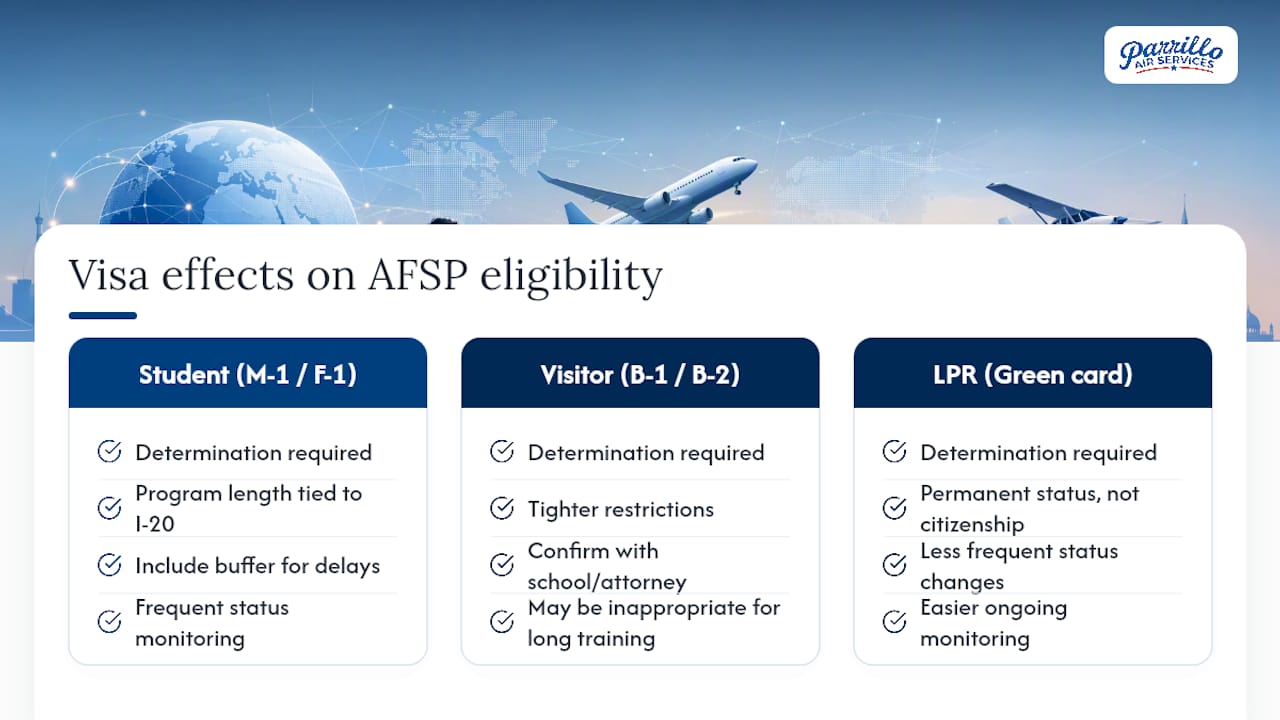
Visa category doesn't determine whether you need a Determination of Eligibility. Nearly every non‑U.S. citizen candidate does. But it does affect how much runway you have to complete training and how closely your status needs monitoring.
Student visa holders (M‑1 is the category most commonly used for vocational flight training, with some pilots training under F‑1 status tied to a broader academic program) generally have a defined program length tied to their I‑20 or equivalent authorization. That authorized period needs to comfortably cover your entire training plan, including any buffer for weather cancellations or maintenance downtime, which every flight student runs into eventually.
Visitors on B‑1/B‑2 status face tighter restrictions and should confirm with their school and, where questions arise, an immigration attorney, whether their specific travel purpose supports the flight training they intend to pursue. Some visa categories are not appropriate for extended flight training at all, and using the wrong one can create problems well beyond TSA's process.
Green card holders and other lawful permanent residents still need a Determination of Eligibility since permanent residency does not equal citizenship for FTSP purposes, but their status changes less frequently than a student or visitor visa, which simplifies the ongoing monitoring TSA expects.
Whatever your category, the visa's expiration date matters more than its type. A Determination of Eligibility can't outlast your authorized presence in the country, so a visa expiring in eighteen months caps your practical training window regardless of the standard five‑year Determination term.
Your Determination of Eligibility is tied to the immigration status you held when it was issued, so any material change on that front needs to reach TSA and your flight school quickly, not after the fact.
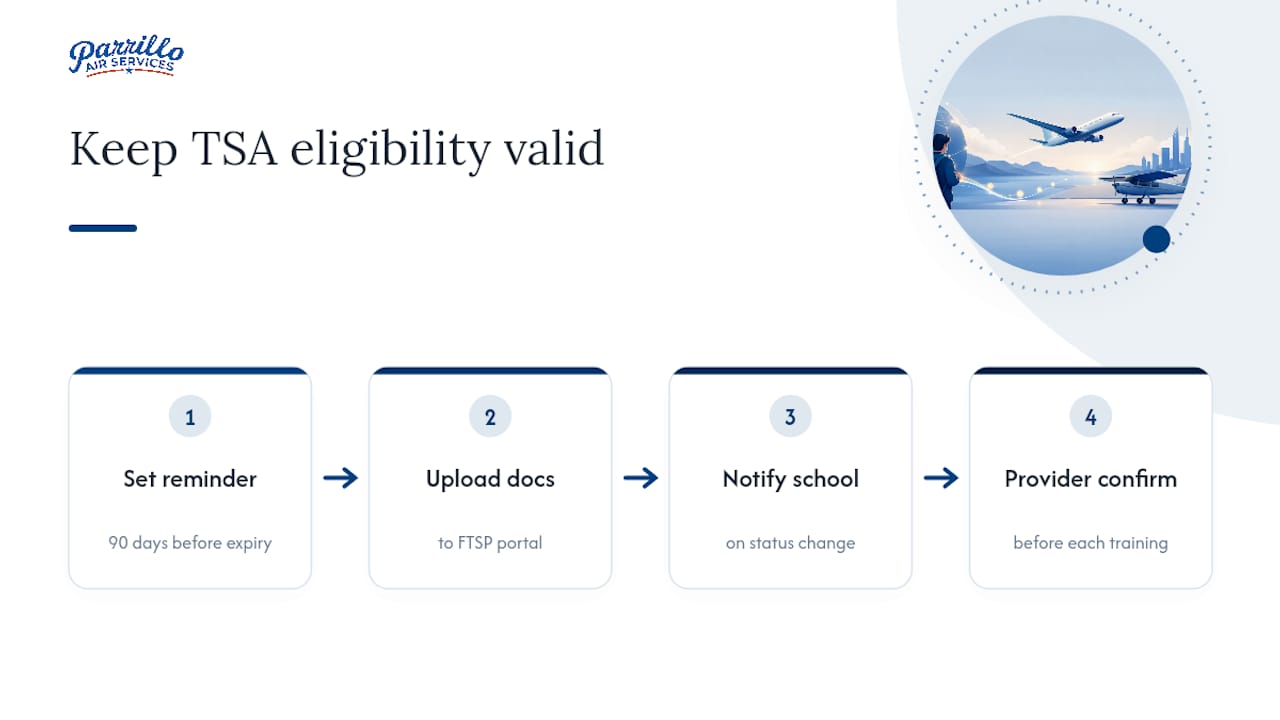
If you renew or extend your visa, upload the new documentation to your FTSP portal account as soon as it's issued. Don't wait for TSA to notice a gap. If you change visa categories entirely, say, moving from a visitor status into a student visa, treat that as a new immigration event that could require an updated Determination, and check with the FTSP helpdesk about whether your existing approval still applies.
Lapses are the real danger here. A visa that expires before you've secured a renewal or extension can suspend your eligibility immediately, even with years remaining on your five‑year Determination window. TSA's recurrent vetting process checks status continuously in the background, so this isn't something that only surfaces at renewal time.
Practically, that means treating your immigration paperwork as an active part of your training plan, not a box checked once at enrollment. Set your own reminders 90 days ahead of any visa expiration. Tell your flight school the moment your status changes, since providers have their own obligation to confirm your Determination remains valid before every training event, and a lapsed status they don't know about creates liability for them and a training interruption for you.
The move from AFSP to FTSP is a genuine improvement in portability. One Determination now covers five years and multiple training events instead of forcing a new application for every course change. But that convenience comes with a catch: providers now carry more compliance weight, and a school still finishing its own portal registration can leave you stuck even after TSA approves you.
Treat your Determination like an operational document, not a one‑time hurdle. Track your visa expiration, keep your immigration paperwork current, and tell your provider immediately if anything changes. A flight school that asks about your FTSP status before you ask them is the one worth training with.
— Gm
Some flight training providers run FAA Part 61 training and work with international students through every step of the FTSP process, from document prep to confirming Determination before the first flight.

You get personalized instruction and flexible scheduling built around your FAA and immigration timelines, not a generic course calendar that ignores visa constraints. Parrillo Air Services helps you assemble your document checklist before you ever touch the FTSP portal, and its team can walk you through FAA student pilot certificate requirements alongside your security threat assessment so both processes move in parallel instead of stalling each other. For students pursuing advanced certifications after their private pilot rating, career pathways including ATP certification training are worth mapping out early too.
If you're ready to see how a discovery flight or full certification program fits your timeline, get the details on Parrillo Air Services' flight training programs and start the conversation before you finalize your FTSP application.
This article is general information, not a substitute for advice from a qualified lawyer. Consult a qualified legal professional about your own circumstances before acting on anything here.
Create a candidate account on the FTSP portal, submit your biographic and immigration documents, complete fingerprinting through a TSA‑accepted enrollment provider, and pay the security threat assessment fee. Approval typically takes around 30 days for a complete application.
The FTSP charges a one‑time security threat assessment fee paid through Pay.gov during the application, and that single fee now covers a Determination valid for up to five years across multiple training events rather than a separate fee per course.
Dropout concerns are common in flight training generally, but FTSP delays specifically are usually caused by preventable paperwork issues, like name mismatches or poor fingerprints, not the training itself. Working with a provider that actively manages your compliance timeline reduces the risk of a stalled or abandoned certification.
The security vetting itself happens through the online FTSP portal and a fingerprinting appointment, not at a specific training location. Actual flight instruction happens at your chosen FAA Part 61 school, such as Parrillo Air Services in Lynchburg, Virginia, once your Determination of Eligibility is confirmed.
Your Determination of Eligibility can be suspended immediately if your visa lapses, regardless of how much time remains in the standard five‑year term. Renew or extend your status well before expiration and update your FTSP portal documentation as soon as new paperwork is issued.
Parrillo Air Services works with international students through every step of the FTSP process — document prep, verification, and FAA student pilot certificate requirements — so your training starts on time.
Explore Flight Training Programs