Before you can fly a solo cross-country, you need two distinct endorsements: one in your logbook and, for the repeated-flight exception, one on your student pilot certificate. Both are required under 14 CFR §61.93, and neither is optional. The logbook endorsement must name the specific make and model of aircraft you'll fly, confirm your preflight planning is correct, and state that you're prepared to make the flight safely. Your student pilot certificate endorsement covers the repeated-flight privilege under the 50-nautical-mile exception — more on that below.
The legal bottom line: Under 14 CFR §61.93, no student pilot may conduct a solo cross-country flight greater than 25 nautical miles from the departure airport without a current, make-and-model-specific logbook endorsement from an authorized flight instructor who has personally reviewed the flight plan, weather, and the student's proficiency.
Here's what each endorsement must include and where it must be kept:
A student pilot cross-country endorsement requires two separate authorizations under 14 CFR §61.93: a make-and-model-specific logbook endorsement for each flight and, for the 50-NM repeated-flight exception, an additional endorsement on the student pilot certificate.
| Point | Details |
|---|---|
| Two endorsements required | Logbook endorsement for each specific flight; student pilot certificate endorsement for the 50-NM repeated-flight exception. |
| Make and model must be named | A generic endorsement does not satisfy §61.93 — the specific aircraft make and model must appear in every cross-country endorsement. |
| Instructor must personally verify | Under §61.93(d), the CFI must review your planning, weather, and proficiency before signing — not after, and not by proxy. |
| Carry your logbook in the aircraft | FAR §61.51 requires endorsement records to be available during flight; a phone photo does not substitute for the physical logbook. |
| Parrillo Air Services training path | Parrillo's Part 61 program structures dual cross-country flights, nav-log reviews, and instructor sign-off to meet §61.93 requirements step by step. |
The regulation is more specific than most students expect. Here's a plain-English breakdown of the key provisions, in the order they matter to you.
1. Training requirements first. Before any solo cross-country endorsement, your instructor must have given you ground and flight training in cross-country procedures for the category, class, and make and model of aircraft you'll fly. This isn't a formality — the training must cover navigation, weather, fuel planning, diversions, and emergency procedures specific to that aircraft.
2. The endorsement must name the make and model. A generic endorsement ("cleared for solo cross-country in a single-engine aircraft") does not satisfy §61.93. The regulation requires the endorsement to specify the exact make and model. If you switch from a Cessna 172 to a Piper Archer, you need a new endorsement.
3. The instructor must make specific determinations. Under §61.93(d), your CFI must determine that your planning is correct, that the weather at the departure, en route, and destination airports is acceptable, and that you're proficient in the make and model. This is a substantive safety check, not a signature on a form.
4. Instructor limitations apply. The endorsement may include limitations the instructor imposes — specific routes, weather minimums, or time-of-day restrictions. Those limitations are legally binding on you during the flight.
5. The 50-NM repeated-flight exception is separate. Under §61.93(b)(2)(iv), repeated solo flights to the same airport within 50 NM require both a logbook endorsement and a student pilot certificate endorsement. A single endorsement doesn't cover both.
Cross-references you need to know:
| §61.93 Paragraph | What It Governs |
|---|---|
| §61.93(a) | General requirement for endorsement before solo cross-country |
| §61.93(b) | Specific flight categories and the 50-NM repeated-flight exception |
| §61.93(c) | Training areas the instructor must cover before endorsing |
| §61.93(d) | Instructor determinations and limitations before each flight |
| §61.93(e) | Specific maneuvers and procedures the student must demonstrate |
Not every instructor signature is legally sufficient. Under §61.93, the endorsement must come from an authorized flight instructor — specifically, a certificated flight instructor (CFI) who holds the appropriate category and class rating for the aircraft you'll fly.
The CFI who conducted your cross-country training is the natural choice, and most students get their endorsement from the same instructor who flew the dual cross-country legs with them. That continuity matters: the endorsing instructor must personally know your proficiency level, not rely on another instructor's assessment.
What the endorsing instructor must verify before signing, per §61.93(d):
Common CFI errors that create compliance problems:
The FAA's AC 61-65H provides sample endorsement language and instructor guidance. It's the primary reference CFIs use when wording endorsements, and students benefit from reading it too — you'll know exactly what your instructor is supposed to write.
Non-U.S. citizen students should note that TSA Flight Training Security Program (FTSP) approval is a separate process from the FAA logbook endorsement. FTSP clearance doesn't appear in your logbook — it's a federal security determination that must be in place before training begins.
The e-CFR version of §61.93 and AC 61-65H together give instructors the framework for compliant endorsement language. The samples below reflect that framework — they are illustrative examples, not legal forms, and your CFI should adapt them to the specific flight.
Sample 1 — Specific one-time cross-country flight:
What this covers: make and model (Cessna 172S), planning review (specific flight, specific date), preparedness statement, and instructor limitations (VFR, day, wind restriction).
Sample 2 — Repeated flights to the same airport within 50 NM (logbook entry):
Sample 3 — Student pilot certificate endorsement for the 50-NM exception:
Sample 4 — Endorsement with additional instructor limitations:
Key annotation: Every compliant endorsement contains three elements: (1) the make and model, (2) a statement that preflight planning is correct, and (3) a statement that the student is prepared to make the flight safely. Limitations are added when the instructor determines they're warranted — they are not optional boilerplate.
Pro Tip: CFIs should date every endorsement and keep a personal record of what they reviewed before signing. If the FAA ever questions an endorsement, the instructor's own notes showing weather products reviewed, nav log checked, and proficiency verified are the best defense.
The preflight planning review is where most students either earn the endorsement or get sent back to the drawing board. Your CFI isn't just glancing at your route — they're making a legal determination under §61.93(d) that your planning is correct. AOPA's cross-country training guidance reinforces that this phase is where student autonomy is built, and instructors take it seriously.

Here's what a thorough preflight review covers:
Route and navigation. Your nav log should show checkpoints, headings (true and magnetic), distances, and estimated times between each checkpoint. Instructors want to see that you've selected identifiable landmarks and that your headings account for magnetic variation and wind correction.
Weather. You need a standard weather briefing — not just a quick app check. Most CFIs expect you to pull a standard briefing from 1800wxbrief.com or ForeFlight's briefing function, and to be able to explain the significant weather, winds aloft, and any AIRMETs or SIGMETs affecting your route. Showing up with only a screenshot of the current METARs isn't enough.
Fuel calculations. Calculate fuel burn for each leg, add reserve fuel (FAR §91.151 requires 30 minutes VFR day, 45 minutes VFR night), and show total fuel required versus fuel on board. Your instructor will check the math.
Alternates and diversions. Identify at least one alternate airport per leg and know the fuel and distance to reach it. Be ready to explain your diversion decision criteria — at what point would you divert, and to where?
Weight and balance, performance. Complete a weight and balance calculation for the specific aircraft you'll fly, with actual passenger and fuel weights. Compute takeoff and landing distances using the POH performance charts for the expected conditions.
Airspace and communications. Mark all airspace on your chart or in your EFB. Know the frequencies for each airport, relevant approach controls, and any FSSes along the route. Identify where you'll need to make position reports.
Emergency planning. Know the nearest airports along each leg. Have a plan for engine failure, unexpected IMC, and lost communications.
AOPA notes that many CFIs still require manual chart plotting and a paper nav log even when students use ForeFlight or Garmin Pilot. The EFB is a backup tool in training — your instructor wants proof that you can navigate without it.
Pro Tip: Bring your planning to the review in a logical order: weather first, then route, then fuel, then performance. Instructors who see a student present information in a structured sequence trust that the student has actually thought through the flight, not just filled in a form.
FAR §61.51 requires that you have available the records that document the privileges you're exercising. For a solo cross-country, that means specific documents must be in the aircraft with you.
Required documents to carry:
A practical note on digital backups: ForeFlight and other EFBs let you photograph your logbook endorsements, and many students keep a PDF backup on their iPad. That's smart for reference, but it doesn't replace the physical logbook for FAA compliance purposes. If an FAA inspector or law enforcement officer asks to see your endorsement during a ramp check, the physical logbook is what satisfies §61.51. A photo on your phone is not the legal equivalent.
For correctly logging your flight hours and endorsements, the logbook entry should record the date, aircraft make and model, registration, departure and destination airports, flight time, and the nature of the flight (solo cross-country). The endorsement itself is separate from the flight log entry — both must be present.
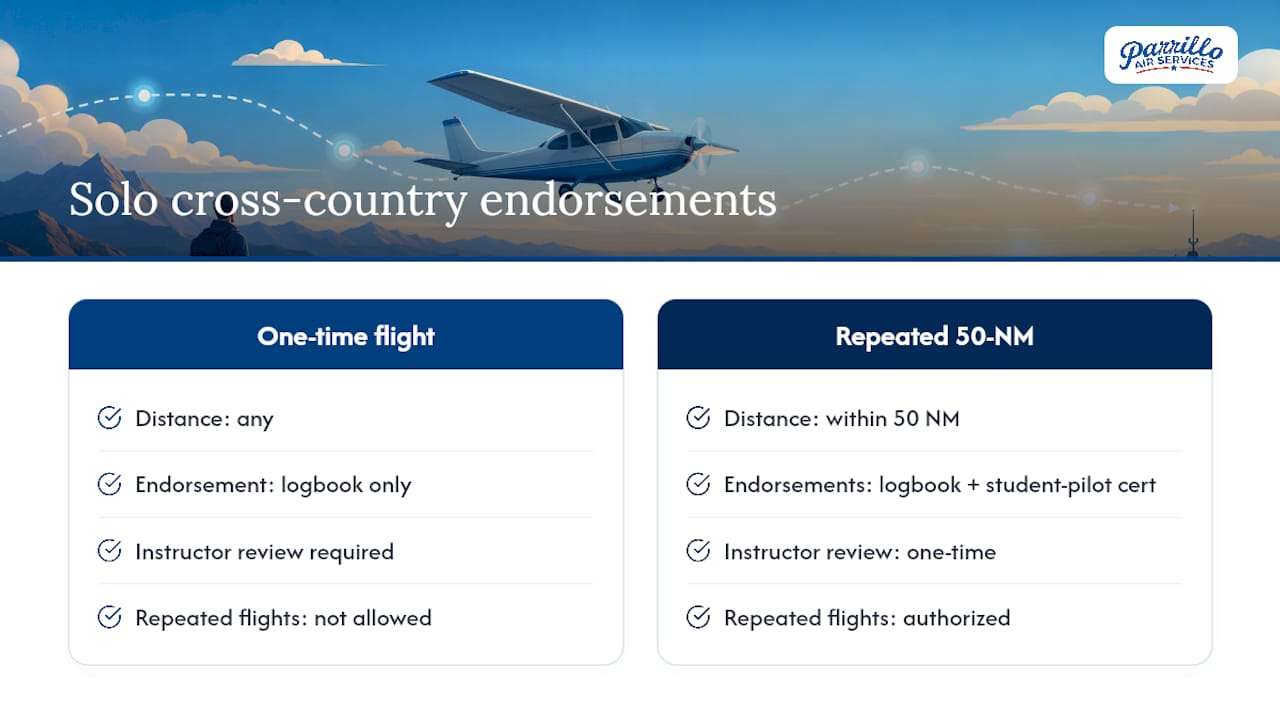
Most solo cross-country flights require a fresh endorsement for each specific flight. The 50-NM repeated-flight exception under §61.93(b)(2)(iv) is the narrow carve-out that allows a student to make repeated solo flights to the same airport without a new endorsement each time — but the conditions are strict.
How the exception works in plain language:
The exception applies when a student makes repeated solo flights between their home airport and a specific destination airport that is within 50 NM. The instructor reviews the route once, endorses the student for that specific route, and the student can then make multiple flights on that route without a new endorsement for each one.
What the FAA interpretation adds:
The FAA's legal interpretation at faa.gov/media/13051 clarifies that for the 50-NM repeated-flight exception, a student must have both the logbook endorsement and the student pilot certificate endorsement. One without the other is not sufficient to exercise the repeated-flight privilege.
This is a point many students and even some CFIs miss. The logbook endorsement alone covers a one-time specific flight. The student pilot certificate endorsement is what authorizes the repeated-flight privilege. Both must be current and present.
Scenario 1 — One-time cross-country to a new airport:
You're flying from your home airport to an airport 85 NM away for the first time. You need a logbook endorsement for that specific flight, signed after your CFI reviews your planning for that date and route. No student pilot certificate endorsement is required for this flight.
Scenario 2 — Repeated training hops within 50 NM:
You're flying regularly between your home airport and a practice airport 35 NM away. After the first instructor review and endorsement, you want to make that flight independently on multiple days. You need both the logbook endorsement for the route and a student pilot certificate endorsement authorizing the repeated-flight privilege. Without both, each flight requires a new instructor review.
The skills your CFI is testing aren't just about whether you can follow a line on a map. Cross-country training exposes students to the full complexity of real-world flight, and the endorsement review is a practical competency check.
Critical skills CFIs evaluate:
Scenario-based training is how most CFIs test these skills before endorsing a student. A common drill: the instructor calls out a simulated weather change mid-flight and asks the student to select an alternate, compute a new heading, and brief the diversion. Another: the instructor covers the GPS and asks the student to navigate the next leg by pilotage alone.
Pilot Workshop's cross-country training materials highlight that weather judgment, ATC communications, and diversion decision-making are the areas where students most often show gaps — and where scenario-based practice makes the biggest difference.
Pro Tip: When you present your planning to your CFI, walk them through your decision logic, not just your calculations. Say "I chose this alternate because it has fuel, a control tower, and it's upwind of the weather" — not just "my alternate is [Airport X]." Demonstrating reasoning is what separates a student who's ready from one who's memorized a checklist.
At a Part 61 school like Parrillo Air Services, the path to a solo cross-country endorsement follows a structured sequence that maps directly to §61.93's requirements.
A typical training flow looks like this:
Parrillo Air Services's cross-country flight planning resources give students a structured checklist to prepare before the instructor review — so you arrive at that meeting with a complete, organized package rather than a stack of printouts.
The school's Part 61 structure also means training timelines are flexible. You progress when you're ready, not on a fixed schedule, which matters when weather or scheduling delays push back a planned cross-country.
For students who want to understand the full endorsement landscape, Parrillo's blog post on what endorsements mean for student pilots is a useful companion to the regulatory text — it covers the distinction between pre-solo endorsements and cross-country authorizations in plain language.
The students who get their solo cross-country endorsement on the first review share one habit: they treat the planning session like a professional dispatch briefing, not a homework assignment. Every number is checked. Every contingency has an answer. The weather decision is made before the CFI asks about it.
That standard isn't about impressing your instructor. It's about building the habits that keep you safe when you're 60 miles from home, the weather is changing, and there's no one in the right seat. Manual navigation practice, rehearsed radio calls, and diversion decision drills done on the ground translate directly to better decisions in the air. The endorsement is a legal authorization, but what it really represents is your CFI's professional judgment that you're ready to manage a flight independently. Earn that judgment by showing up prepared.
Parrillo Air Services's Part 61 training program in Lynchburg, VA takes you from your first dual cross-country leg to a fully documented solo cross-country endorsement through a structured, instructor-led process. Every step maps to §61.93: dual navigation flights, nav-log review sessions, weather briefing practice, and a final instructor sign-off that meets the make-and-model specificity the regulation requires.

When you're ready to move from ground study to actual flight time, the next step is straightforward. Schedule a discovery flight or reach out to discuss your training timeline at Parrillo Air Services's flight training programs page. The school's instructors work with your schedule and pace, so endorsement readiness isn't a fixed date on a calendar — it's a standard you meet when you're genuinely prepared.
The following primary sources contain the authoritative text and interpretations referenced throughout this article:
When a regulatory question goes beyond what these sources answer clearly, contact your local FSDO or consult a CFI with current knowledge of FAA interpretations for your specific situation.
This article is general information, not a substitute for advice from a qualified lawyer. Consult a qualified legal professional about your own circumstances before acting on anything here.