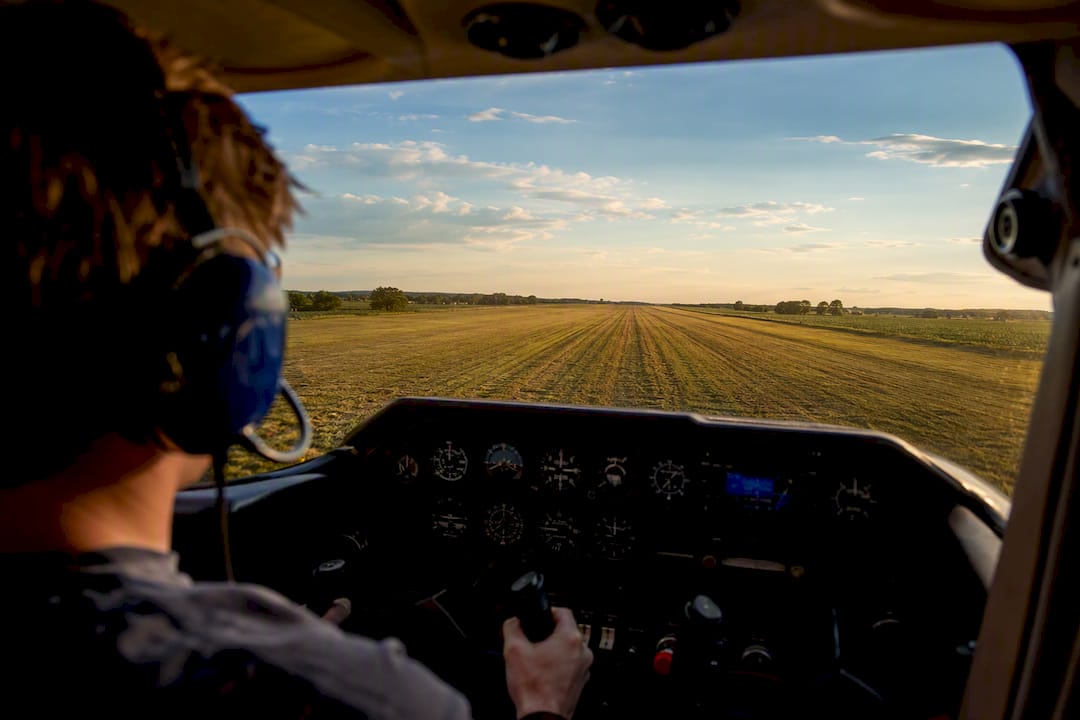
A soft field landing means touching down at minimum controllable airspeed on grass, dirt, gravel, or snow while keeping the nosewheel off the ground as long as possible. The single control action that makes or breaks the maneuver is holding a small amount of power through the flare to stay in ground effect, roughly 1 to 2 feet above the surface, while you bleed off airspeed with back pressure until the main wheels settle gently. Examiners are watching for a stabilized approach and a clear go-around decision just as much as they're watching your flare.
TL;DR:
- Using power solely to manage descent in ground effect prevents floating and ensures a gentle, controlled touchdown on soft surfaces.
- The POH provides specific approach speeds and flap settings for soft-field landings, which should be strictly followed and adjusted based on surface conditions.
- Wet grass or muddy surfaces can increase landing distances by up to 60 percent, requiring more conservative touchdown points and minimums.
- Softer or rougher than expected surface conditions should trigger an immediate go-around rather than attempting to land.
- Examiners evaluate the entire decision process, emphasizing stabilized approaches, precise speeds, proper technique, and the ability to abort if conditions deteriorate.
Table of Contents
- How Do You Fly a Soft Field Landing Step by Step?
- What Approach Speed and Flap Setting Should You Use?
- What Happens the Instant the Wheels Touch Down?
- When Should You Go Around Instead of Landing?
- What Do Examiners Look for on a Soft Field Checkride?
- Where Do Soft Field Landings Go Wrong for Students?
- How Parrillo Air Services Structures Soft Field Practice
- One Lesson That Changed How a Student Flared
- Ready to Practice Soft Field Landings With an Instructor?
- Sources
How Do You Fly a Soft Field Landing Step by Step?
Getting this maneuver right starts before you ever turn onto final. If you're landing at a strip you haven't used before, plan a low pass over the runway first. Check for ruts, standing water, wildlife, or soft spots you can't see from altitude. Pulling NOTAMs and calling ahead to local pilots who fly the field regularly beats guessing every time, and unfamiliarity with hidden surface hazards is behind a good share of accidents at unpaved strips, according to EAA's guidance on soft-field operations.
Once you're set up, work through the sequence below.
- Configure early. Select the flap setting your POH recommends for soft-field landings, usually full flaps, and run your pre-landing checklist before turning base.
- Pick your touchdown point deliberately. Favor firmer-looking ground, avoid obstacles, and give yourself margin if the surface quality is uncertain.
- Stabilize on final. Fly a constant airspeed, on centerline, correcting for crosswind, no lower than about 300 feet AGL according to FlightTrainingCentral's soft-field approach breakdown.
- Control the flare with pitch and power. As you enter ground effect, hold a touch of power and let the airplane settle to 1 to 2 feet above the surface, letting speed dissipate naturally rather than forcing the airplane down.
- Touch down on the mains first. Keep the nose light and let the main wheels absorb the landing at minimum controllable airspeed.
- Hold the nose off. Maintain back-elevator pressure after touchdown for as long as it's aerodynamically effective, easing the nosewheel down only when you have to.
- Stay off the brakes. Let the airplane roll to a natural stop or taxi speed. Braking on soft ground digs the wheels in rather than slowing you down.
The Airplane Flying Handbook describes this exact sequence: fly the airplane onto the surface using power to control descent, hold it in ground effect until it can no longer fly, and keep the nosewheel elevated as long as practical. That last part is where most students lose points. The instinct to relax back pressure the moment the mains touch is strong, and it's exactly wrong.
What Approach Speed and Flap Setting Should You Use?
Your POH is the final word on soft-field speeds and flap settings, and it overrides any generic rule you've heard in a hangar. Most manufacturers publish a specific soft-field or short-field approach speed, and that number accounts for the airplane's actual stall characteristics and flap effectiveness at your weight and configuration.
If your POH doesn't list a dedicated soft-field speed, the safe fallback is to use the short-field final approach speed and never exceed 1.3 times VSO. In a Cessna 172, that typically lands somewhere in the 60 to 65 knot range depending on model year and weight, but verify that figure against your specific POH rather than assuming it carries over from another airplane.
A few other adjustments matter once you're actually on final:
- Apply only half the gust factor to your approach speed rather than the full gust value, since carrying too much extra speed defeats the purpose of a minimum-controllable-airspeed touchdown.
- Full flaps are usually correct for soft fields, but muddy or wet grass can throw mud and debris into flap tracks on low-wing airplanes, which is worth factoring into your flap decision on genuinely bad surfaces.
- Heavier airplanes, tailwheel configurations, and badly uneven terrain all call for more conservative touchdown points and a lower tolerance for surprises.
Surface condition is often the real limiting factor, not the airplane's performance numbers. Wet grass can increase landing distance by as much as 60% compared to dry, firm turf, according to EASA/CAA grass runway guidance, which means the POH distance you memorized for dry grass may not apply at all after a rainy week. That single fact changes how conservative you should be about grass height, moisture, and personal minimums every time you plan a landing on an unfamiliar field.
What Happens the Instant the Wheels Touch Down?
The moments right after touchdown are where soft-field landings are won or lost. Staying in ground effect and touching down at minimum speed matters because it keeps weight off the nosewheel, and that single detail is what prevents the nose gear from digging into mud or a rut and slamming to a stop.
Once the mains are down, ease the nosewheel toward the ground gradually rather than letting it drop. A touch of power can help ease that transition if the surface is soft enough that the nose wants to settle fast. From there:
- Keep rolling. Stopping on genuinely soft ground can mean you don't get moving again without help.
- Avoid tight turns during rollout and taxi. A sharp turn concentrates weight on one wheel and can bog it down.
- Hold aft elevator pressure throughout the taxi to keep weight off the nosewheel for as long as you're on soft ground.
- Choose the firmest visible path when taxiing, even if it means a slightly longer route to parking.
- Call for ground assistance or your instructor's guidance if the airplane bogs down or the surface feels worse than expected once you're rolling.
AOPA's soft-field landing technique guide is blunt about brakes here: don't use them. On grass, mud, or gravel, braking does more to bury a wheel than it does to slow you down.
When Should You Go Around Instead of Landing?
The go-around decision on a soft field needs to happen earlier than it would on pavement, because you often can't fully evaluate the surface until you're already committed to ground effect. A few cues should trigger an immediate go-around without debate.
- The approach isn't stabilized. If you're not on speed, on centerline, and configured by short final, don't try to salvage it low to the ground.
- You spot a hazard you didn't see on your overflight. A rut, a puddle, an animal, or a soft patch that looks worse up close all justify bailing out.
- The surface feels wrong the moment you enter ground effect. If it looks rougher or softer than expected, go around before committing to touchdown.
- An obstacle appears where you didn't expect one. Fences, equipment, or wildlife near the touchdown point are enough reason to abort.
If you do decide to go around, the sequence is smooth full power, pitch for a positive climb attitude at your POH's climb speed, and flap retraction per the POH schedule, usually in stages rather than all at once. Keep your feet active on the rudder since full power at a low airspeed generates a strong yaw tendency, especially close to the ground.
Brief this before you ever start the approach. Tell your instructor or examiner your touchdown point, your planned airspeed and flap setting, and exactly what conditions will make you go around. AOPA's technique writeup notes that examiners expect pilots to keep a hand near the throttle through the entire flare specifically so the go-around option stays live until the wheels are firmly down, per its soft-field landing guidance.
What Do Examiners Look for on a Soft Field Checkride?
Examiners aren't just grading the touchdown. They're grading the whole decision chain: how you picked your touchdown point, whether you used available information about the field, whether your approach stayed stabilized, and whether you'd have gone around if conditions demanded it.
The specific elements an examiner checks typically include:
- A stabilized approach at the correct airspeed with proper crosswind correction
- Demonstrated knowledge of where your POH speeds come from and why you chose them
- A main-wheel-first touchdown with the nosewheel held off through the flare and after
- Smooth transition to rollout without abrupt braking or nose-down inputs
- A clear, decisive go-around if the approach or surface conditions warrant one
Before the maneuver, brief your examiner out loud: your intended touchdown point, your target airspeed and flap configuration, and the specific conditions that would make you go around. Examiners frequently ask why you chose a particular speed or flap setting, and "because my POH specifies it" backed by the actual number is a far stronger answer than a guess.
The most common downgrade isn't a bad landing. It's relaxing back pressure the instant the mains touch, or riding the brakes out of habit from pavement landings. Both read as a lack of understanding of what the maneuver is actually protecting against.
Where Do Soft Field Landings Go Wrong for Students?
Most soft-field mistakes trace back to one habit: approaching too fast and "driving" the airplane onto the surface with power instead of letting it settle. That extra speed either floats the airplane past the intended touchdown point or forces a firmer landing than the maneuver calls for.
- Too fast on final leads to a long float and a hard touchdown. Fix it by re-flying the approach at the correct POH speed.
- Relaxing elevator too early lets the nosewheel drop hard right after touchdown. Fix it by consciously holding back pressure through the rollout.
- Riding the brakes on soft ground can dig a wheel in and yaw the airplane. Fix it by trusting the surface and the airplane's rolling resistance to slow you down.
Good instructors isolate the float skill by itself, low passes held in ground effect with small power adjustments, before ever combining it with a full landing. Pairing that with go-around drills and a "drag" pass over an unfamiliar field builds the exact judgment examiners are checking for. Log each attempt with a note on airspeed control and nosewheel timing, and you'll see the pattern of your own mistakes fast.
How Parrillo Air Services Structures Soft Field Practice
Soft-field technique training is best done in stages, not in one attempt at proficiency. FAA Part 61 students typically start with simulator rehearsal to build the sight picture for ground effect, move into pattern work focused purely on approach speed control, and finish with supervised soft-field landings once the fundamentals are solid.
A useful pre-lesson briefing script sounds like this: "My touchdown point is the first third of the runway, my target speed is short-field approach speed per the POH, full flaps, and I'll go around if I'm not stabilized by 300 feet or if the surface looks worse than expected." Bringing that script into a lesson or a checkride briefing shows exactly the kind of decision-making instructors and examiners want to see, and it takes the guesswork out of a maneuver that's easy to overthink under pressure.
One Lesson That Changed How a Student Flared
A student once kept relaxing back pressure the instant the mains touched, out of habit from pavement landings. One dedicated ground-effect float drill, holding 1 to 2 feet above the runway with power alone, fixed it within a single lesson. The nosewheel stayed off through rollout on every attempt after that. The takeaway: isolate the skill before you ever combine it with a full landing.
— Gm
