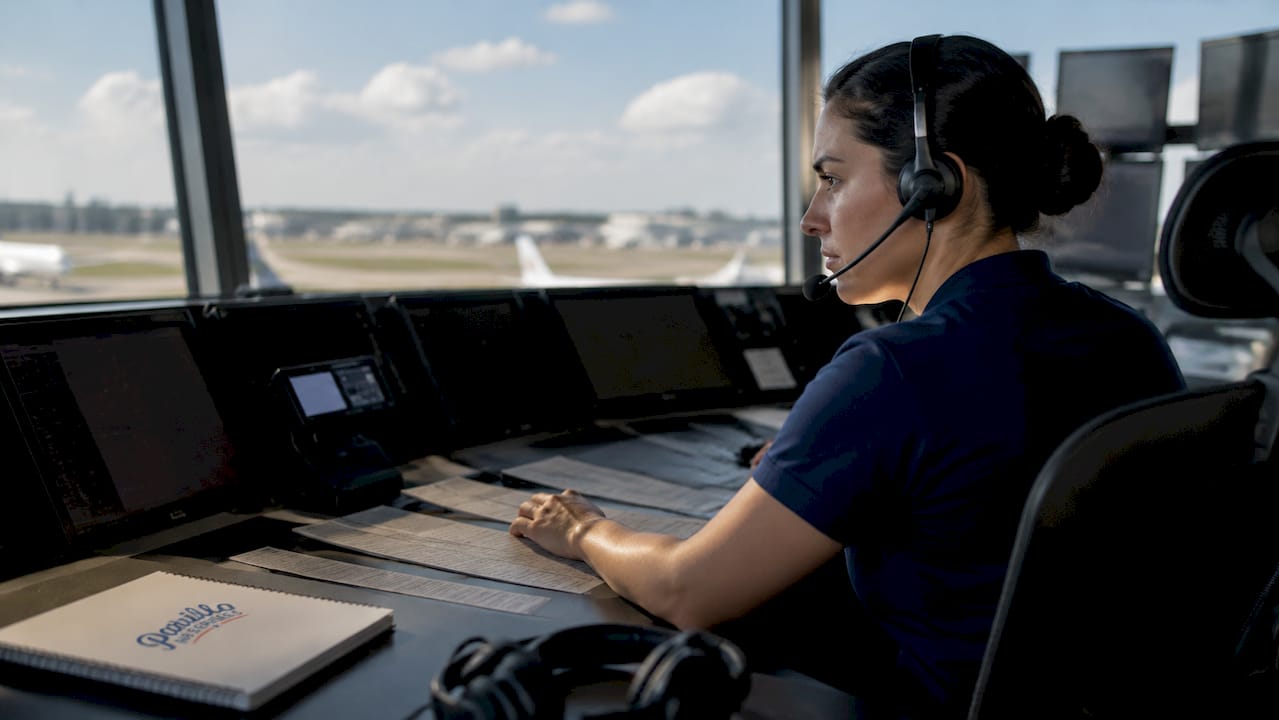
Air traffic control (ATC) specialists, commonly called air traffic controllers, manage the safe and orderly movement of aircraft through every phase of flight, from pushback at the gate to touchdown at the destination. The role of air traffic control pilots in the broader aviation system is to provide real-time instructions, issue clearances, and coordinate with flight crews and adjacent facilities to prevent conflicts and keep traffic flowing. The FAA reports that over 70,000 flights move through U.S. airspace every single day. That number makes the controller's job one of the most consequential in transportation. If you are exploring an aviation career, understanding how controllers and pilots work together is foundational knowledge.
Air traffic controllers hold full professional authority over their assigned airspace sectors after certification, and they carry legal responsibility for every separation decision they make. FAA Order JO 7110.65 governs their standard operating procedures, covering radar separation, clearance issuance, traffic handoffs, weather monitoring, and safety analyses. The scope of those duties shifts significantly depending on which type of facility a controller works in.
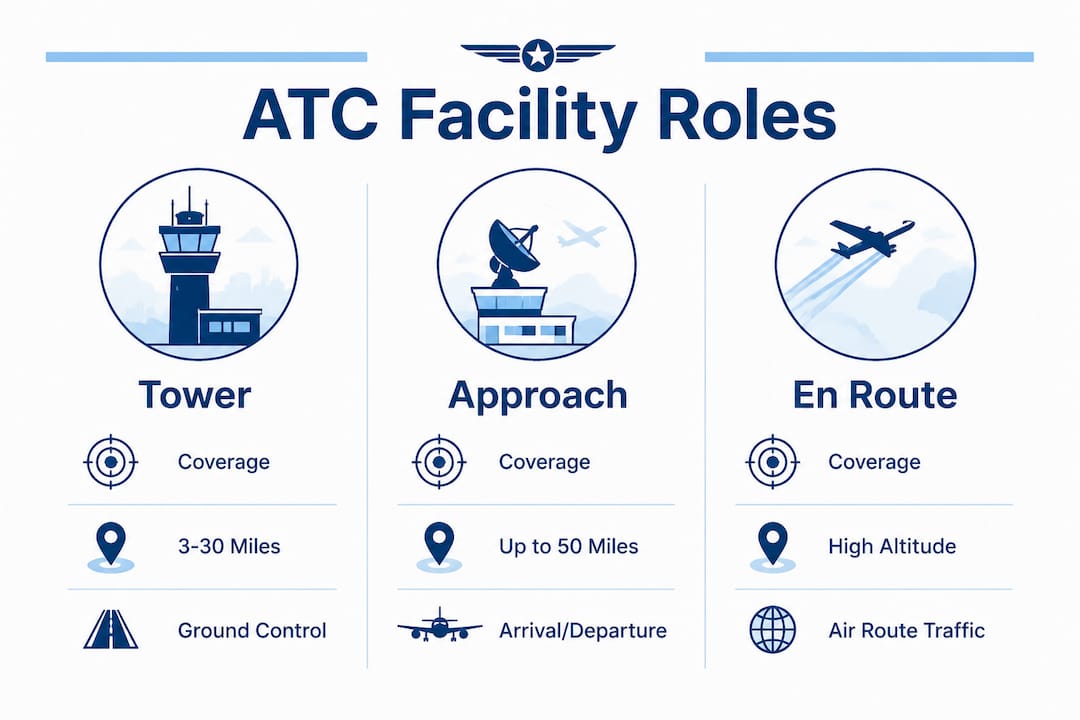
Airport tower controllers work within a 3 to 30-mile radius of the airport. They manage ground movement, runway crossings, takeoff sequences, and initial departures using direct visual observation. On a busy morning at a major hub like Chicago O'Hare, a tower controller might sequence a departure every 45 seconds while simultaneously clearing an arrival to land on a parallel runway.
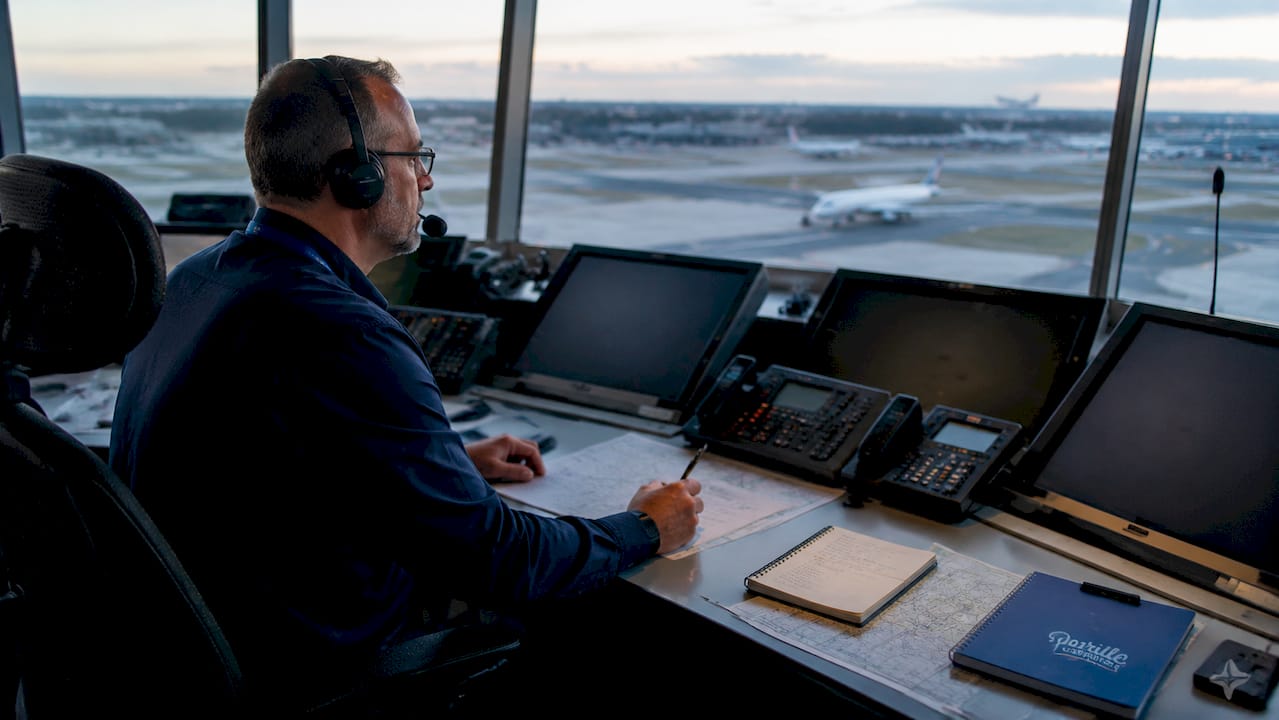
Approach controllers take over once an aircraft climbs out of the tower's immediate area. They handle traffic up to 50 miles from the airport and up to 17,000 feet altitude, sequencing arrivals into a single orderly flow and managing altitude assignments to keep aircraft separated. En route controllers cover the largest territory, with individual sectors spanning over 100,000 square miles of airspace. They work in semi-dark radar rooms with no visual contact with aircraft, relying entirely on radar returns and radio communication.
The table below summarizes the key differences across facility types.
| Facility Type | Coverage Area | Primary Duties | Work Environment |
|---|---|---|---|
| Airport Tower | 3–30 miles | Ground control, runway management, departures | Visual observation cab |
| Approach Control | Up to 50 miles, 17,000 ft | Sequencing arrivals, altitude management | Radar room |
| En Route Center | 100,000+ sq miles | Long-range separation, sector handoffs | Semi-dark radar room |
Pro Tip: If you are considering a career in air traffic control, research which facility type matches your strengths. Tower work rewards strong visual situational awareness, while en route control demands exceptional abstract spatial reasoning.
Controllers communicate real-time instructions to pilots across every phase of flight, from taxi clearance before departure to the final approach handoff before landing. This is not a one-way command structure. It is a coordinated exchange where both parties share responsibility for safety.
Here is how a typical flight coordination sequence unfolds:
One critical point that surprises many aviation students: the pilot retains ultimate legal responsibility for the safe operation of the aircraft at all times. Controllers provide instructions and information. The pilot in command (PIC) decides whether to comply or declare an emergency if compliance would create a hazard. That distinction matters enormously when you are studying for your own certificates.
Pro Tip: When you fly as a student pilot, practice reading back every ATC clearance completely and correctly. Controllers notice sloppy readbacks, and clean communication builds the professional habits that carry you through a full aviation career.
Controllers must possess strong spatial reasoning, multitasking ability, and calm judgment under pressure, often managing multiple aircraft simultaneously in dynamic conditions. These are not soft skills. They are measurable competencies that the FAA tests rigorously during the hiring and training process.
The core skill set breaks down into four areas:
Ongoing training is mandatory throughout a controller's career. The FAA requires regular proficiency checks, and controllers must recertify on each position they work. The professional culture actively values error reporting as a learning tool, which is a direct contrast to industries where admitting mistakes carries career penalties. That culture of shared learning is part of what makes the U.S. airspace system as safe as it is.
Air traffic control is the primary system that prevents mid-air collisions and runway incursions across the entire national airspace. Controllers' ability to see conflicts before they happen is the defining characteristic of the job. It is a proactive role, not a reactive one.
The numbers make the stakes concrete. The FAA's system handles over 70,000 flights daily, carrying millions of passengers and billions of dollars in cargo. A single runway incursion at a major hub can cascade into hours of delays across the entire network. Controllers prevent those cascades by managing spacing, sequencing, and flow rates before problems develop.
Emergency coordination is another dimension of the job that rarely gets attention. When a pilot declares an emergency, controllers immediately clear airspace and coordinate with ground teams to handle the incident without disrupting surrounding traffic. That requires the ability to transition instantly from routine traffic management to complex emergency coordination, a skill that takes years to develop.
"Controllers must transition between managing routine instructions and complex emergency coordination, requiring flexible multitasking and communication skills." — FAA operational standards documentation
The table below puts the scale of air traffic management into perspective.
| Metric | Data Point | Significance |
|---|---|---|
| Daily U.S. flights managed | 70,000+ | Equivalent to one flight every 1.2 seconds |
| Tower controller coverage | 3–30 miles | Requires direct visual and radio coordination |
| En route sector coverage | 100,000+ sq miles | Demands pure radar and radio situational awareness |
| Emergency response | Immediate airspace clearing | Prevents secondary incidents during active emergencies |
The importance of air traffic control extends beyond safety statistics. Reliable air traffic management directly supports the economics of commercial aviation. Airlines build schedules around predictable flow rates. When controllers manage traffic efficiently, on-time performance improves across the entire system. For cargo carriers like those using air transportation networks, ATC efficiency translates directly into supply chain reliability.
Air traffic controllers are the operational backbone of aviation safety, managing over 70,000 daily U.S. flights through precise separation, real-time coordination, and proactive conflict prevention.
| Point | Details |
|---|---|
| Three facility types | Tower, approach, and en route controllers each cover distinct airspace with different tools and cognitive demands. |
| Pilot retains command | Controllers issue instructions, but the pilot in command holds ultimate legal responsibility for flight safety. |
| Core skills are measurable | Spatial reasoning, multitasking, and stress management are tested and certified, not assumed. |
| Emergency coordination | Controllers clear airspace and coordinate ground teams instantly when a pilot declares an emergency. |
| Safety at scale | Managing 70,000+ daily flights requires proactive conflict detection, not just reactive response. |
Most people assume air traffic controllers command pilots. They do not. The pilot in command holds the final authority on every flight, and that distinction is not a technicality. It shapes every interaction between the cockpit and the radar room.
I have seen student pilots freeze up on the radio because they treat ATC like a boss giving orders. That mindset creates hesitation. When you understand that a controller is a highly trained coordinator providing information and guidance, not a superior officer, your radio work gets cleaner and your decision-making gets faster. You stop waiting for permission and start managing information.
The other misconception worth addressing: controllers do not just talk to pilots. A significant portion of the job involves coordination between facilities, weather analysis, and traffic flow management that pilots never hear. The aviation careers that require dedication include ATC for exactly this reason. The cognitive load is relentless.
What I find genuinely underappreciated is the error-reporting culture inside ATC facilities. Controllers are trained to report their own mistakes. That practice, which feels counterintuitive to outsiders, is precisely why the system catches problems before they compound. Aviation as a whole has built safety on that principle, and ATC is where it runs deepest.
The future of the role will involve more automation and data integration, but the human judgment component is not going away. Machines can flag conflicts. Only a trained controller can weigh the full context of a developing situation and make a call that keeps everyone safe.
— Gm
Understanding how controllers and pilots work together is one of the first things that separates serious aviation students from casual enthusiasts. If this article has you thinking about your own path in the cockpit, Parrillo Air Services offers FAA Part 61 flight training in Lynchburg, VA, covering everything from your first discovery flight to commercial and flight instructor ratings.

Every certificate you earn deepens your understanding of the ATC system you will work within every flight. Parrillo Air Services builds that knowledge into training from day one, with personalized instruction and flexible scheduling designed around your goals. Explore flight training programs to see which path fits where you want to go, or visit Parrillo Air Services to learn more about getting started.
Explore Flight Training ProgramsAir traffic controllers manage the safe, orderly, and efficient movement of aircraft through U.S. airspace by issuing clearances, maintaining separation, and coordinating with pilots and adjacent facilities. The FAA system handles over 70,000 flights daily under their oversight.
Controllers do not command pilots. The pilot in command retains ultimate legal responsibility for the safe operation of the aircraft and may deviate from ATC instructions when safety requires it.
The three main types are tower controllers, approach controllers, and en route controllers. Each covers a distinct area of airspace and uses different tools, ranging from direct visual observation in towers to pure radar work in en route centers.
When a pilot declares an emergency, controllers immediately clear the surrounding airspace and coordinate with airport ground teams to support the aircraft without disrupting other traffic in the system.
Understanding ATC coordination and avionics makes pilots more effective communicators and safer operators. Some pilots transition into ATC roles, while others use that knowledge to sharpen their cockpit performance throughout their flying careers.