Get a private pilot certificate if you can pass an FAA medical and want full flexibility with passengers, night flying, and career options. Choose a sport pilot certificate if you have medical limits or want a faster, cheaper route into daytime recreational flying. The decision comes down to three things: your medical situation, the flying privileges you actually want, and your budget. The FAA's MOSAIC update makes the sport route more capable than it used to be, which is exactly why this comparison looks different than it did a few years ago.
TL;DR:
- The sport pilot certificate is limited to daytime visual flying with one passenger and excludes night flying and instrument conditions, unlike a private pilot license.
- MOSAIC regulation changes allow some aircraft previously off-limits, like certain Cessnas, to now qualify for sport pilot training based on stall speed, expanding options.
- Private pilot training typically requires 60 to 75 hours, while sport pilot training averages 25 to 30 hours, with hours logged as a sport pilot counting toward a private certificate.
- Medical eligibility for sport pilots can be based on a driver's license or BasicMed, but if you have ever been denied an FAA medical, you cannot use the driver's license privilege.
- Cost differences are significant, with sport pilot generally being less expensive due to fewer required hours and no medical exam, but your choice should depend on your flying goals.
The gap between these two certificates isn't about skill level. It's about what the FAA lets you legally do once you have the paper in hand.
A private pilot certificate lets you carry as many passengers as your aircraft seats, fly at night, and pursue an instrument rating for flying in clouds. A sport pilot certificate caps you at one passenger, restricts you to daytime visual flying, and keeps you out of instrument conditions entirely. That's not a technicality. It shapes whether you can take your whole family up on a Saturday or fly home after a late dinner.
Here's how the operational limits break down in practice:
The MOSAIC rule change matters most here. Sport pilots used to be boxed into aircraft under 1,320 pounds with a fixed weight ceiling. Now eligibility runs on stall speed, capped at 59 knots. That single change opens the door to airplanes that never used to qualify as "light sport," including some configurations of the Cessna 150 and 172.
FAA minimums under Part 61 are about twenty hours for sport pilot and about forty hours for private pilot. Almost nobody finishes at the minimum, though. Real-world averages run closer to 25 to 30 hours for sport pilot and 60 to 75 hours for private, according to AOPA. Weather delays, scheduling conflicts, and the simple fact that flying skills need repetition to stick all push totals higher than the legal floor.
Here's roughly how those hours get spent on the private track:
Both certificates require a written knowledge test and a practical flight test, and the core subject matter overlaps heavily between them, according to Private Pilot Exams. The private exam adds more depth on weather interpretation, airspace, and cross-country planning.
One detail changes the calculation for a lot of students: every hour logged as a sport pilot counts toward the private pilot certificate, according to the EAA. Nothing is wasted if you start sport and decide to upgrade later.
Pro Tip: Book your lessons in consistent, frequent blocks rather than spreading them out. Students who fly twice a week tend to finish in fewer total hours than those flying once every two weeks, because skills fade between sessions and you end up re-learning instead of advancing.
Medical eligibility is where a lot of people self-select before they even open a syllabus. Three pathways exist, and they don't overlap the way most people assume.
The catch that trips people up: if you've ever applied for an FAA medical and been denied, you cannot fall back on the driver's-license privilege. That door is closed once it's been opened and shut on you. Anyone unsure of their status should check directly with an AME before assuming the sport pilot route is available to them.
The MOSAIC rule, finalized in October 2025, shifted sport pilot aircraft eligibility from a fixed weight limit to a stall-speed threshold of 59 knots or less. Practically, that means some Cessna 150 and 172 configurations now qualify for sport pilot operation. These aircraft were completely off-limits before. If you're weighing sport pilot training partly because of aircraft availability, this is the reason the math looks better in 2026 than it did a couple of years ago.
Costs stack up from a handful of predictable line items: aircraft rental by the hour, instructor fees, ground school materials, and test fees. Sport pilots skip one cost private pilot candidates often carry: the medical exam, if they're using the driver's-license privilege instead of a 3rd-class medical or BasicMed.
Rough budget ranges, using real-world average hours rather than FAA minimums:
Aircraft type matters too. A trainer with high demand at a busy flight school books up fast, and instructor availability during peak season can stretch your timeline even if your budget hasn't changed at all.
Three quick profiles cover most people asking this question:
Answer these questions before you commit to either path:
Once you have those answers, the next move is concrete: schedule a discovery flight, talk to an AME about your medical status, or book an intro lesson. And if you start sport and change your mind later, nothing is lost. Every hour you've logged applies directly toward the private pilot certificate.
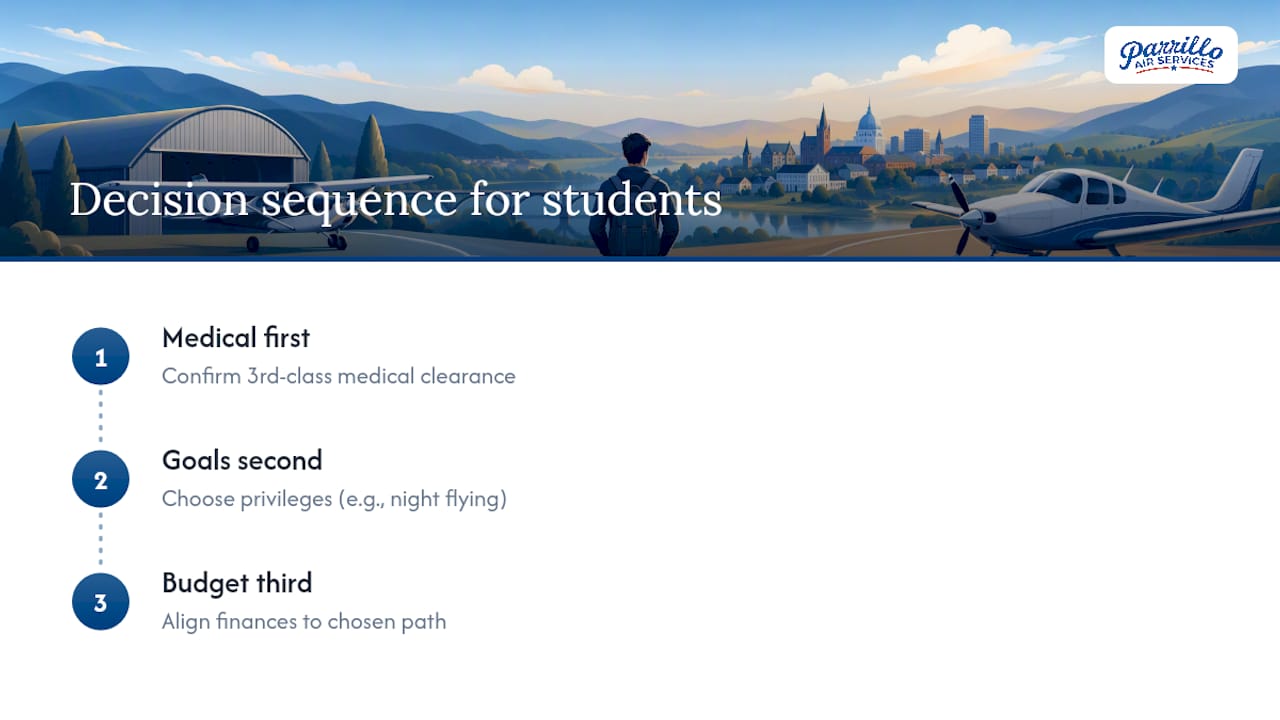
We walk every prospective student through the same sequence: medical first, goals second, budget third. That order matters because it eliminates guesswork. A student who can't clear a 3rd-class medical doesn't need to spend time weighing night-flying privileges they won't be using anyway.
Our FAA Part 61 programs cover both paths, and flexible scheduling means a part-time student and a full-time career candidate can train side by side without either one waiting on the other. When a sport pilot student decides to upgrade, we track logged hours directly so nothing gets lost in the transition and no flight time goes unclaimed. Personalized instruction means your instructor adjusts around your actual medical and career situation, not a generic syllabus.
— Gm
Whether you're leaning sport pilot for a lower-cost entry or private pilot because a career in the cockpit is the real goal, Parrillo Air Services runs both pathways under one roof in Lynchburg, VA, with instructors who track your hours toward whichever certificate you're building on.

A discovery flight is the fastest way to find out how you actually handle the controls before committing to a full program, and it costs far less than guessing from behind a keyboard. Our flight training programs page lays out what a first lesson looks like, how scheduling works around your job or school calendar, and what to bring to your first visit. If you're a Liberty University student, we also coordinate credit transfer directly with the school, so your training hours count twice: once toward your certificate, once toward your degree. Reach out through the More Info page to book a discovery flight or ask about program costs before you decide anything.