The FAA, not the Commonwealth of Virginia, issues every pilot certificate in the country, so there's no separate "Virginia pilot license" to apply for. To qualify for a private pilot certificate you need to be at least 17, read and speak English, hold a valid medical certificate, log the required flight hours, and pass a written knowledge test and checkride. Your first move is simple: schedule a discovery flight or book a medical exam, then get into ground school.
TL;DR:
Because pilot certification is federal, the pilot license requirements in Virginia are identical to the requirements in Texas, Montana, or anywhere else. The FAA regulates certification under 14 CFR Part 61, and every applicant nationwide follows the same rulebook.
Here's what that rulebook actually demands:
A 3rd class medical typically stays valid for 60 months if you're under 40 and 24 months if you're 40 or older, so timing your AME visit early avoids a scheduling bottleneck later. The FAA's pilot handbook lays out the full knowledge and skill standards you'll eventually be tested on, and it's worth skimming before you commit to a training schedule.
Most students in Virginia flying school programs move through six recognizable stages. None of them require a medical certificate to start.
The other decision that shapes your timeline is Part 61 versus Part 141 training. Both lead to the exact same private pilot certificate, but Part 141 schools follow an FAA-approved syllabus and can reduce the minimum to 35 hours, while Part 61 programs offer more scheduling flexibility at a 40-hour minimum, a better fit for adults juggling work and family.
Expect to spend a typical amount in the range generally estimated by the FAA for a private pilot certificate in Virginia, plus additional non-training fees for the written exam, checkride, and medical exam.
That 40 hour FAA minimum is a floor, not a realistic target. Most students actually need 60 to 80 hours to reach checkride-ready proficiency, depending on how often they fly and how quickly skills stick between lessons.
That gap between 40 and 80 hours is where budgets blow up. A few things keep costs in check:
Virginia doesn't issue its own pilot license, and it doesn't run its own certification exam either; the FAA owns that process entirely. What the Commonwealth does offer is money.
The Virginia Department of Aviation reimburses eligible residents up to $1,000 for ground school or flight training. It's a reimbursement, not a grant paid upfront, so documentation matters from day one.
To qualify, keep these on hand:
You'll also want to identify the Flight Standards District Office (FSDO) and DPE serving your area early, since DPE availability can be the single biggest scheduling bottleneck near your checkride date.
Parrillo Air Services trains students under Part 61 out of Lynchburg, offering discovery flights, the full private pilot certificate program, and pathways into instrument and commercial ratings for those aiming further. Instruction is personalized rather than classroom-based, with scheduling built around each student's calendar and access to well-maintained aircraft.
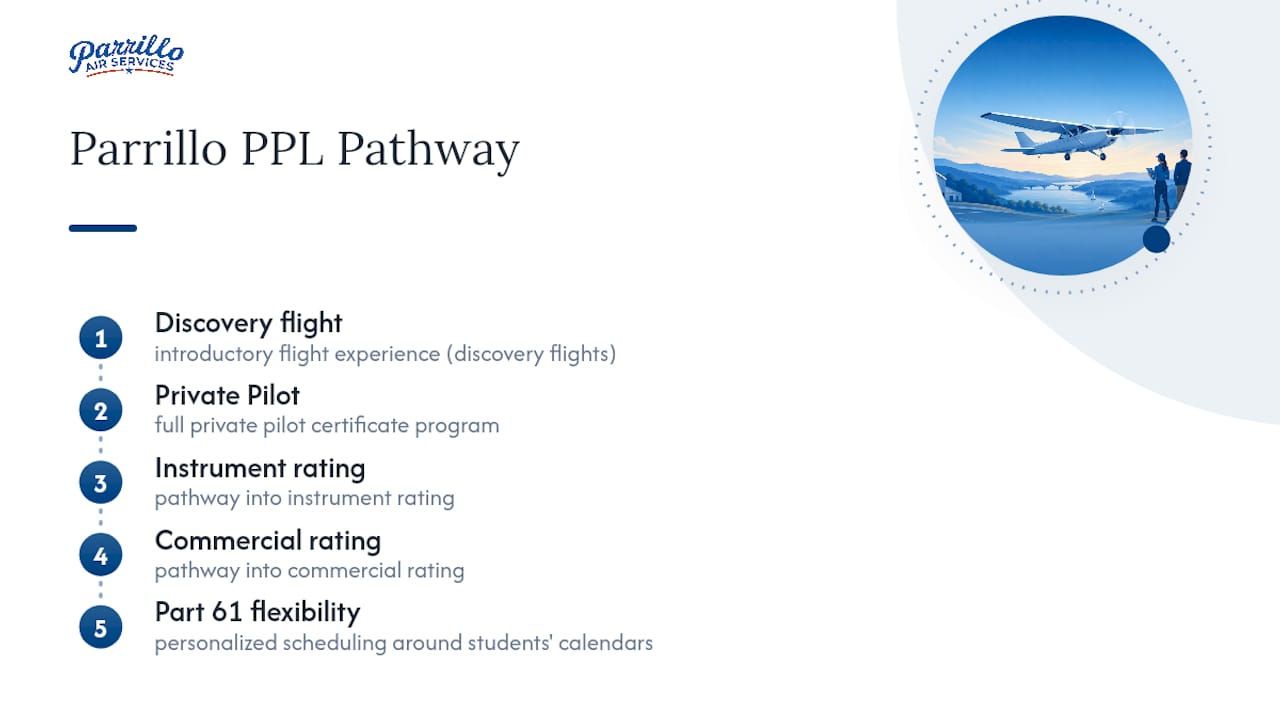
Because Part 61 allows that flexibility, students juggling jobs or Liberty University coursework can train without forcing their life around a rigid syllabus. Parrillo also helps students organize the paperwork DOAV reimbursement requires and coordinates checkride timing with local DPEs. Cost specifics for each program live on the Parrillo Air Services site rather than in generic estimates.
Start with structure: does the school run Part 61 or Part 141, and does that match how much flexibility you need? From there, look at instructor experience, aircraft condition, and whether pricing is published or hidden behind a phone call.
When you're on a discovery flight or enrollment call, ask directly:
Your first-week checklist looks like this: book a discovery flight, get medical or BasicMed guidance from an AME, open an IACRA account for your student pilot certificate, start ground school, and begin saving every receipt for a potential DOAV claim. For more on how Part 61 training actually works day to day, it's worth reading before you commit.
Virginia's mix of metro-area and regional airports gives students real variety in traffic patterns and airspace without long drives to find it. The biggest mistakes I see aren't about aptitude, they're logistics: flying once every three weeks instead of twice a week, and losing receipts that would have qualified for DOAV reimbursement. Take the discovery flight early, track every hour, and ask about DPE availability before you're ready for your checkride, not after.
— Gm
Some Part 61 flight schools offer instruction that bends around your schedule instead of the other way around. Limited enrollment may mean more time with your instructor and the aircraft, reducing waitlists.

A Discovery Flight costs $199 and requires no paperwork or medical exam, it's the easiest way to find out if flying is for you. From there, flight schools can guide you through the private pilot certificate, instrument rating, and commercial pathways, plus help organize receipts and logbook documentation Virginia's DOAV reimbursement requires. Aircraft rental runs $165 per hour and instruction $55 per hour, with full pricing detail on the program cost page. Book your discovery flight now and get a real answer on your timeline instead of a guess.
No paperwork, no medical exam required. Meet an instructor, ask about scheduling around your life, and find out if flying is for you.
Book Your Discovery FlightVerify every requirement directly before you commit money or time. Start with the FAA's certification page and the FAA pilot handbook for federal rules, the Virginia DOAV scholarship brochure for reimbursement details, and this Part 61 vs Part 141 comparison for a side-by-side look at training structures.
Most students spend $10,000 to $18,000 on flight training in Virginia, plus $875 to $1,575 in non-training fees for the written exam, checkride, and medical exam. Parrillo Air Services publishes its hourly rental and instruction fees directly on its program cost page.
No age limit stops you from starting private pilot training at 40 or beyond; the FAA only requires you to be at least 17 to hold the certificate. Medical certificate renewal cycles shorten to 24 months once you turn 40, but that's a scheduling detail, not a barrier.
Virginia doesn't cover the full cost, but the Department of Aviation reimburses eligible residents up to $1,000 for ground school or flight training, provided you submit receipts, logbook proof, and required documentation. It's a reimbursement claimed after training expenses, not upfront funding.
Pilot pay varies widely depending on whether you're flying for a regional airline, a major carrier, or building hours as a flight instructor first. Most career pilots start as instructors or in entry-level commercial roles before moving toward the higher earning potential regional and major airlines offer.
Both paths lead to the identical FAA private pilot certificate; Part 141 follows an FAA-approved syllabus and can lower the minimum hours to 35, while Part 61, the structure Parrillo Air Services uses, offers more flexible scheduling at a 40 hour minimum.