Private pilot requires a 40-hour regulatory minimum. Instrument rating requires 50 hours of cross-country pilot-in-command time plus 40 hours of instrument time. Commercial pilot requires 250 total hours with strict composition rules. Those three numbers, backed by §61.109, §61.65, and §61.129, are the floor Part 61 sets, not a promise of how long training takes.
The FAA is explicit that these numbers are a regulatory minimum, not an average. Real-world private pilot completion in the United States runs closer to 75 hours, almost double the legal floor.
Meeting Part 61 minimums requires tracking three distinct hour totals, precise dual/solo/PIC labeling, and endorsements timed correctly before every test.
| Point | Details |
|---|---|
| Private minimum is a floor | §61.109 sets 40 hours (20 dual, 10 solo), but average completion runs closer to 75 hours. |
| Instrument time has two parts | You need 50 hours cross-country PIC and 40 hours instrument time, 15 with a CFII. |
| Commercial hours are structured | 250 hours total under §61.129, split across PIC, cross-country, and training buckets. |
| Logbook labeling prevents delays | Mark dual, solo, and PIC clearly, and tie entries to specific FAR areas of operation. |
| Parrillo Air Services supports the process | Personalized instruction and logbook review help students document Part 61 minima correctly. |
Here's the quick-lookup version before you get into the weeds on each certificate.
The private certificate minimum under §61.109 is 40 hours total aeronautical experience. Inside that number, at least 20 hours must be flight training from an authorized instructor, and at least 10 hours must be solo. That solo time isn't unstructured either. It includes specific cross-country solo requirements and landings at towered and non-towered airports, so a chunk of your solo bucket has to match particular tasks, not just stick time.
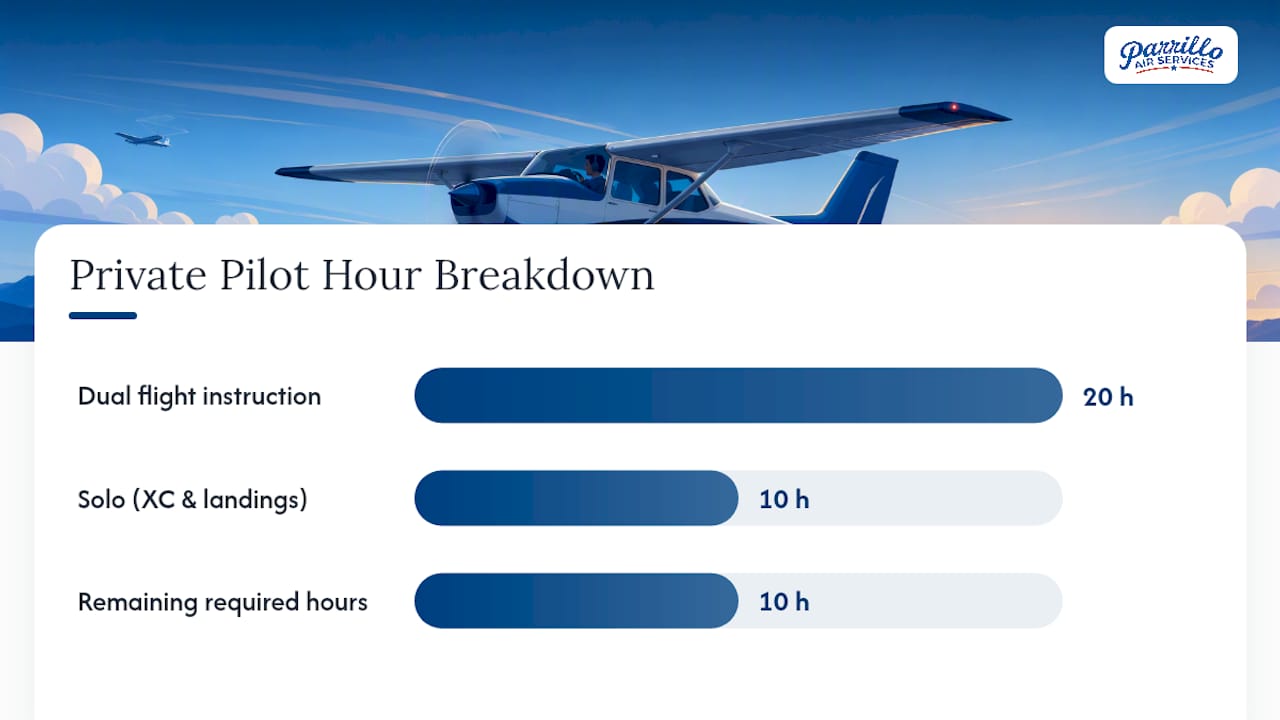
Night training, instrument introduction, and test-prep flying all live inside that same 40-hour bucket rather than stacking on top of it. That's a common point of confusion for student pilots who assume every category of flying adds separately to the total.
For logging, mark each entry as dual received, solo, or PIC. Never leave that column blank or write something vague like "training flight." A logbook that just says "practice" with no task breakdown gives a designated pilot examiner nothing to verify against §61.109's specific line items.
Under §61.65, an airplane instrument rating requires 50 hours of cross-country PIC time, with at least 10 of those hours in an airplane. Separately, you need 40 hours of actual or simulated instrument time, and at least 15 of those hours must come from an authorized instrument instructor.
One flight inside that instrument time has to be a long cross-country: filed and flown under IFR, covering a straight-line distance of at least 250 nautical miles, with an instrument approach at each airport along the route and three different kinds of approaches somewhere in the flight. That single flight often trips up students who plan a route that technically covers 250 nautical miles in total distance flown but doesn't meet the straight-line requirement.
A pilot's log entries for the 250-NM flight need to show the filed IFR route, the airports where approaches were flown, and the approach types. A DPE checking this flight against §61.65(c) wants to see it documented clearly, not reconstructed from memory during the oral exam.
Simulator, FTD, and ATD time counts toward part of that 40-hour instrument total, but the caps are real: AOPA notes that part 141 programs can even drop the instrument-time minimum to 35 hours, while part 61 stays at 40. As with the private certificate, you'll need a specific instructor endorsement within two calendar months of your checkride confirming recent training.
The commercial certificate under §61.129 sets a 250-hour total, but the real work is in the sub-buckets. You need 100 hours in powered aircraft, with 50 of those in airplanes. You need 100 hours as pilot in command, including 50 in airplanes and 50 cross-country, with 10 of that cross-country time in airplanes specifically. On top of that sits 20 hours of training covering specific commercial maneuvers and instrument work.
Two flights matter more than any others in this list: a pair of 2-hour cross-country flights, each covering a straight-line distance greater than 100 nautical miles from the original point of departure. You also need 10 hours of solo flight time in a single-engine airplane, or 10 hours of PIC time with an authorized instructor if you're training in a complex or technically advanced aircraft, plus 5 hours of night VFR cross-country with 10 night takeoffs and landings at a towered airport.
Multiengine applicants get a variation here. Instead of the standard solo requirement, they can log 10 hours of solo in a multiengine airplane or 10 hours of PIC time with an instructor aboard, which matters if your training plan runs through a twin from the start.
Part 142 approved courses can shrink that 250-hour total to 190 hours for eligible applicants, which is worth asking about if you're weighing accelerated commercial programs.
Not every certificate follows the airplane numbers, and Part 61 sets separate minima for other categories under the same §61.129 structure.
Simulator credit rules and specific flight-count alternatives vary by category, so treat these numbers as a planning baseline and confirm exact wording in §61.129 for the certificate you're actually pursuing.
A usable logbook entry needs the date, aircraft make and model, registration number, and a clear label for dual received, solo, or PIC. It also needs a total time figure and, where relevant, a breakdown showing cross-country distance or simulated instrument time.
A minimal but complete entry might read: date, N12345, Cessna 172, 1.4 dual received, 0.6 simulated instrument, cross-country to KXYZ (112 NM). That single line ties directly to a FAR bucket instead of leaving a DPE guessing.
Endorsements are required before both the knowledge test and the practical test, and instructors have to certify specific readiness within defined time windows, generally within two calendar months of the test for recent training. Miss that window and the endorsement goes stale.
Instructors who review student logs regularly, rather than waiting until checkride prep, catch mismatched dual-versus-solo entries early. That habit alone prevents most of the last-minute scrambling that delays practical tests.
Keep a habit early: annotate flights with the specific FAR area of operation they satisfy, not just a generic task name. It saves hours of reconstruction later.
Before you schedule a checkride, run your own audit against what a designated pilot examiner will check. They're looking at total hours against the certificate's FAR bucket, solo and PIC entries with proper signatures, cross-country distances that meet the straight-line rule, instrument time tied to specific §61.65(c) areas of operation, and every required endorsement dated correctly.
The most common errors are simple: dual time logged as solo, a missing aircraft registration number, an instructor signature left off a training flight, or a cross-country entry that doesn't specify distance. Each one is fixable in minutes if caught early, but discovered the week of a checkride, it can force a reschedule.
Every number in this breakdown traces back to a specific FAR section, and it's worth reading the actual text rather than relying on secondhand summaries.
For a deeper look at what Part 61's structure actually means for your training pace, Parrillo Air Services breaks down what Part 61 means for aspiring pilots and how solo hours specifically affect your logbook and readiness.
Students often treat the logbook as paperwork to deal with after the flying is done. That's backward. A logbook built correctly from lesson one saves weeks at the far end, because checkride delays almost always trace back to sloppy entries made months earlier, not to actual flight-time shortfalls.
Parrillo Air Services gives you what a spreadsheet and a stack of FARs can't: an instructor who reviews your logbook alongside every lesson, so mislabeled entries get caught in week two, not month eight. Training happens on a schedule built around your availability, not a fixed cohort calendar, which matters when you're trying to hit private, instrument, or commercial minima without long training gaps that inflate your total hours.

Programs cover everything from a first discovery flight through commercial and CFI certification, with simulator time built in to help you use device credit correctly under §61.65's limits. If you're ready to see how your timeline and budget line up with these requirements, request more information about Parrillo Air Services' training programs and get a straight answer on what your path looks like.