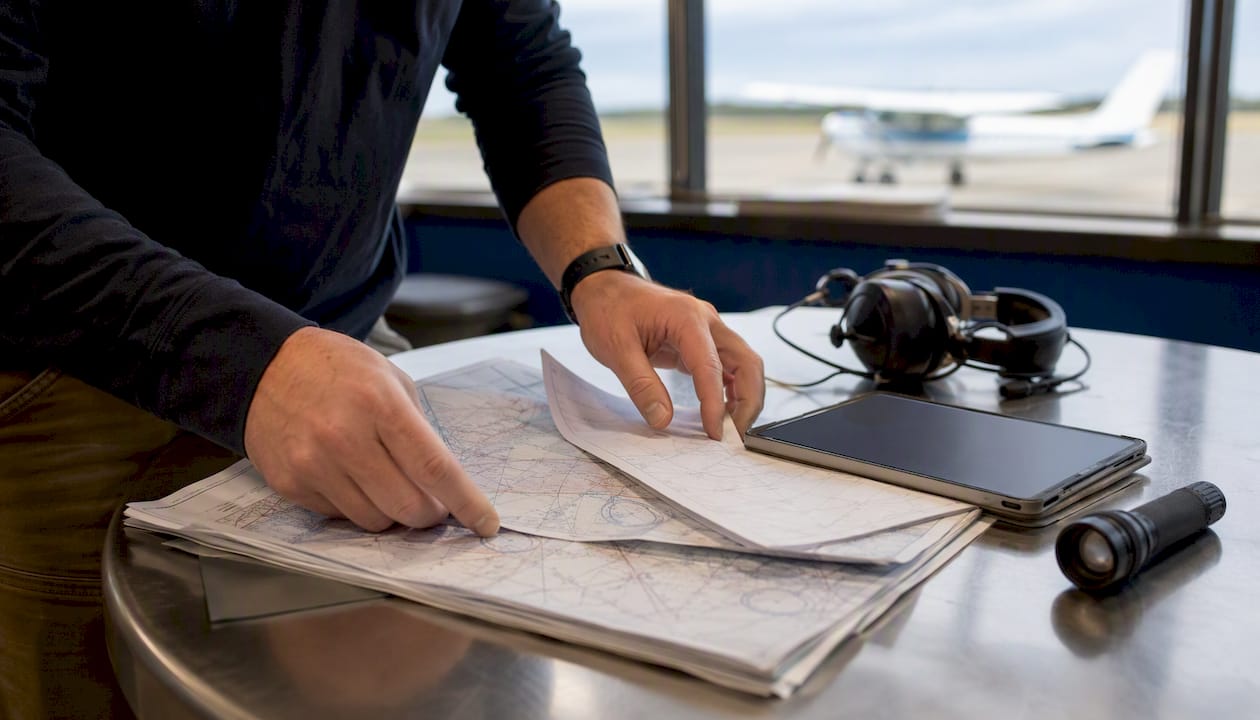
To act as pilot in command under IFR, you must meet the FAA's instrument recent-flight experience standard, commonly called IFR currency. The governing rule is 14 CFR §61.57(c): within the preceding six calendar months, you must have performed and logged at least six instrument approaches, holding procedures and tasks, and intercepting and tracking courses using electronic navigation systems. Miss that window, and you cannot legally act as PIC under IFR or in weather below VFR minimums until you reestablish currency.
The good news is that the FAA gives you several lawful paths to get back:
Under 14 CFR §61.57(c), IFR currency requires all three task groups — six approaches, holding procedures, and course intercept/tracking — within the preceding six calendar months, and an IPC is mandatory if more than 12 calendar months have passed without meeting those tasks.
| Point | Details |
|---|---|
| The legal trio | Six approaches, a hold, and course tracking are all required — approaches alone do not satisfy §61.57(c). |
| Calendar-month math | Currency runs through the last day of the sixth month after the activity month, not 180 rolling days. |
| The 6+6 timeline | After 6 months you enter a grace window to reestablish; after 12 months an IPC is required before acting as PIC under IFR. |
| Fastest regain path | A simulator session covering all three task groups under authorized instruction is often the quickest legal route back. |
| Parrillo Air Services | Offers Part 61 CFII instruction, simulator sessions, and IPC prep in Lynchburg, VA, with flexible scheduling to fit your timeline. |
14 CFR §61.57(c) requires three distinct task groups, all completed within the preceding six calendar months before you act as PIC under IFR. Think of them as a trio, not a single number:
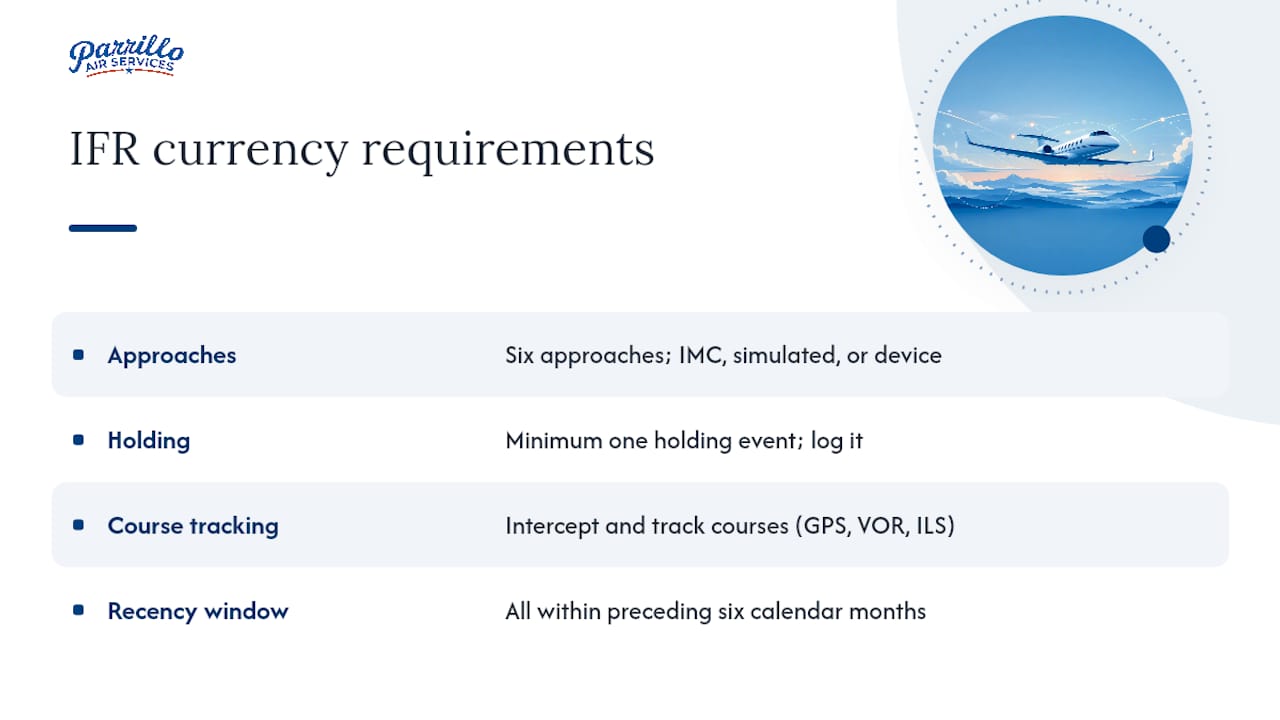
1. Six instrument approaches. These can be flown in actual IMC, under simulated instrument conditions with a safety pilot, or in an approved training device. The approaches must be appropriate to the aircraft category.
2. Holding procedures and tasks. The regulation specifically names this as a separate requirement. One holding event is the minimum, but logging it clearly matters.
3. Intercepting and tracking courses using electronic navigation. This includes GPS, VOR, ILS, and other electronic nav systems. Many approaches inherently involve course tracking, but the regulation names it separately to make sure pilots don't skip it.
"Calendar months" means the window extends through the last day of the sixth month after the month in which you logged the activity. If you flew approaches on April 15, your currency runs through October 31, not just 180 days from April 15. That distinction catches pilots off guard regularly.
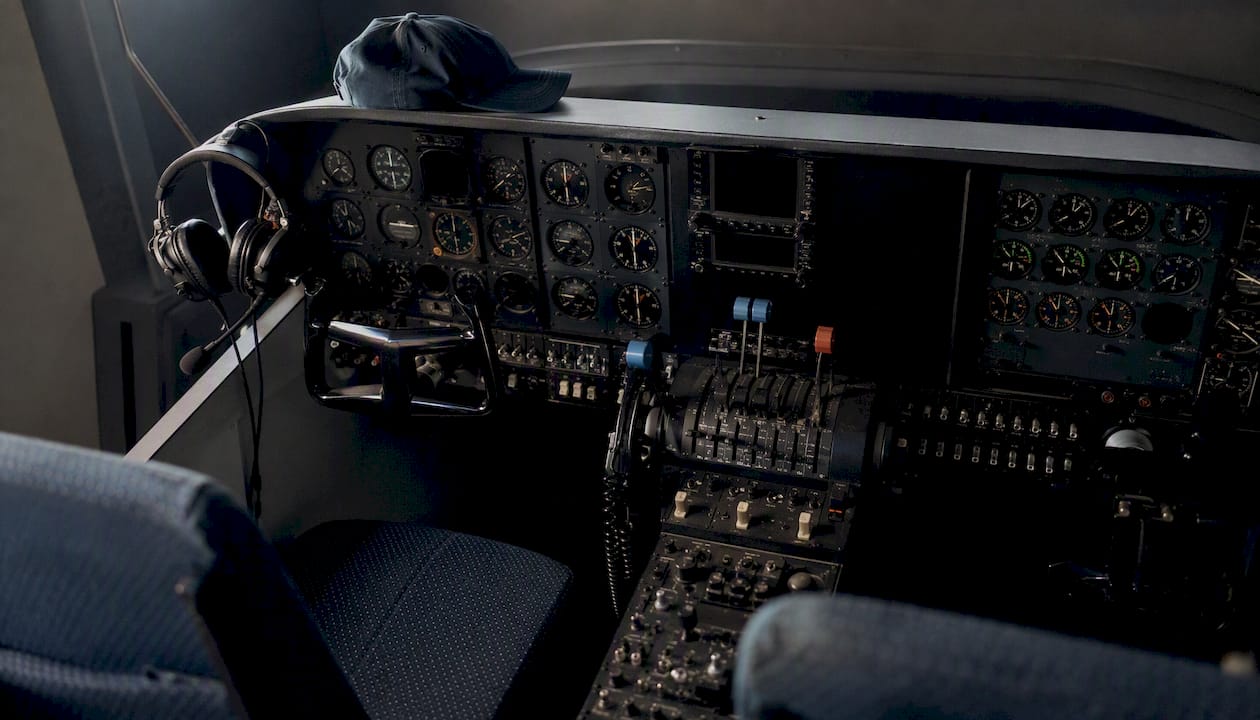
Approved environments for logging these tasks include actual IMC, simulated IMC with a qualified safety pilot on board, or an FAA-approved Full Flight Simulator (FFS), Flight Training Device (FTD), or Aviation Training Device (ATD) operated under authorized instruction. The 2018 Part 61 rulemaking broadened acceptance of training devices for currency credit, though device representativeness to the aircraft category remains a firm condition.
For logbook entries, FAA InFO 15012 clarifies what recordkeeping is expected, including how training device credits should be documented. When a safety pilot is used, you must log that person's name per §61.51. For practical guidance on logging flight hours correctly, clean, consistent logbook entries are your best protection if your currency is ever questioned.
The fastest legal path back depends on how long you've been out of currency and what resources you have available. Here's a ranked, practical sequence:
Step 1: Audit your logbook. Before scheduling anything, pull your logbook and identify exactly which tasks are missing and when they were last logged. Use this quick checklist:
Step 2: Choose your regain method.
Scheduling tip: Combine a simulator session with a short aircraft flight on the same day. The sim handles the repetitive approach practice; the aircraft flight confirms real-world execution. This pairing minimizes total time and cost while covering all three task groups cleanly.
The FAA's timeline creates three distinct states, and knowing which one you're in determines what you can and cannot do legally.
| State | Time Since Last Currency Event | What You Can Do |
|---|---|---|
| Current | Within 6 calendar months | Act as PIC under IFR |
| Grace window | More than 6 but not more than 12 calendar months | Reestablish currency with required tasks; cannot act as PIC under IFR until tasks are complete |
| IPC required | More than 12 calendar months | Must complete an IPC before acting as PIC under IFR |
Dated example: You logged your last qualifying approaches on April 15.
The most common misunderstanding is treating the 6-month window as a rolling 180-day count. It is not. Calendar months end on the last day of the month, which can give you a few extra days depending on when in the month you logged the activity. April 15 gives you through October 31, not October 15.
No. Six approaches alone do not satisfy the IFR currency requirements under §61.57(c). The regulation requires all three elements: approaches, holding procedures and tasks, and intercepting and tracking courses. Logging six approaches without a documented holding event and a course intercept/tracking task leaves you short of the legal standard.
Some approaches naturally include course tracking. An ILS approach, for example, involves intercepting and tracking the localizer and glideslope. A GPS approach involves tracking a course to the final approach fix. But the regulation names each element separately, and an FAA inspector or examiner reviewing your logbook will look for all three. A PAR or ASR approach (radar-vectored to final) may not satisfy the tracking requirement on its own because the controller is doing the navigation work.
Logging guidance: A logbook entry for currency purposes should clearly identify the type of approach (ILS, RNAV/GPS, VOR), the location or simulator used, whether a hold was performed, and whether course intercept/tracking was accomplished. A single line reading "6 ILS approaches, 1 hold, course tracking — simulated IMC, safety pilot [Name]" gives an examiner everything needed to verify currency at a glance.
Currency is a legal minimum, not a proficiency guarantee. The FAA's own advisory guidance and AOPA's instrument currency resources both emphasize that meeting the six-approach threshold does not mean a pilot is ready for a challenging real-world IFR flight. Recurrent practice beyond the minimum is what builds actual safety margins.
An IPC is evaluated against the full scope of the Instrument Rating ACS, which means the instructor or examiner will assess your performance across all instrument task areas, not just approaches. Treating it as a surprise test is the wrong frame. Treat it as a structured debrief with a qualified instructor who can identify gaps and endorse your return to IFR currency.
Pre-IPC checklist:
Combining an IPC with a Flight Review: AOPA guidance confirms this is possible, but each requirement needs a separate endorsement in your logbook. The IPC endorsement satisfies §61.57(d); the Flight Review endorsement satisfies §61.56. One flight can accomplish both, but the instructor must document them separately. Don't assume one endorsement covers both.
A practical two-session plan: Session one is a two-hour simulator block covering holds, course intercepts, two precision approaches, two non-precision approaches, and a missed approach. Session two is a 1.5-hour aircraft flight with one ILS, one RNAV approach, a hold, and a partial-panel segment. The IPC debrief happens after session two. This structure lets you arrive at the aircraft session already sharp on procedures, which is where most pilots lose points.
Pilots who stay continuously current don't do it by flying six approaches every six months. They do it by flying one or two approaches every month, logging a hold whenever the opportunity arises, and treating the logbook as a living document rather than a post-hoc record.
The pilots who end up needing an IPC are almost always the ones who let currency slide during busy seasons and then scramble in month five. A 45-minute simulator session once a month costs far less in time and money than an IPC prep cycle. Schedule it the same way you schedule an oil change: on the calendar before you need it, not after.
Keep a quick-reference page at the front of your logbook showing your last approach date, last hold date, and last tracking task. One glance tells you where you stand. The FAA's WINGS Pilot Proficiency Program also tracks currency-relevant activities and can prompt you when a task category is aging out.
Pilots who need to reestablish IFR currency or prepare for an IPC have a direct path at Parrillo Air Services in Lynchburg, VA. The school offers FAA Part 61 CFII instruction, targeted simulator training sessions, and structured IPC preparation syllabi built around the Instrument Rating ACS. Whether you need a single simulator session to knock out the required tasks or a full two-day IPC prep program, the instruction is personalized to your logbook gaps, not a generic syllabus.

Parrillo Air Services also provides logbook review and endorsement services, so you arrive at your IPC with documentation that holds up to scrutiny. Flexible scheduling means you can book around your work week rather than waiting for a fixed class slot. If you're within the grace window and need to move fast, a combined simulator-plus-aircraft session can reestablish full IFR currency in a single day.
Ready to get current? Schedule your IFR training session at Parrillo Air Services and get back in the left seat legally and confidently.