Weather is the single biggest external force that will change your flight training schedule, and 74.26% of system-impacting airspace delays greater than 15 minutes in the FAA's OPSNET data from June 2017 through May 2023 were caused by weather. For student pilots, that number translates directly into scrubbed lessons, postponed solos, and checkrides that slide weeks down the calendar. Experienced students and schools typically budget a significant portion of planned flying days as weather losses, which varies depending on location. The ripple effects hit your timeline and your wallet.
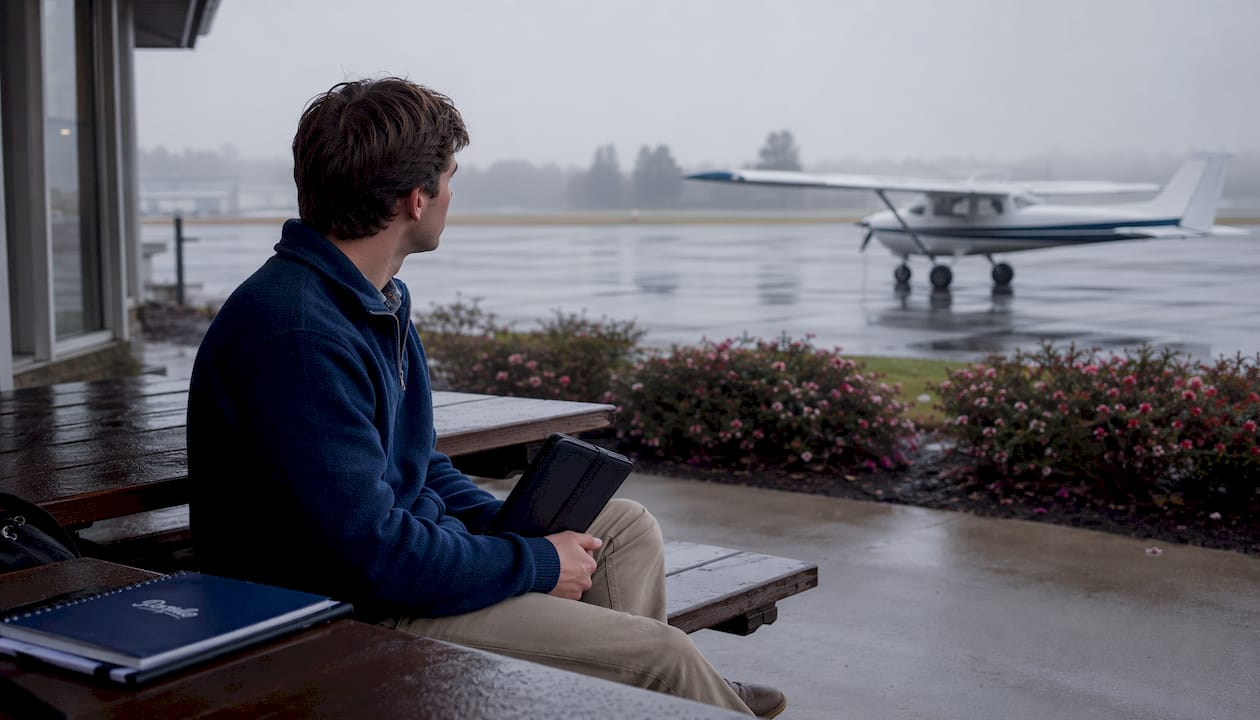
When a lesson gets scrubbed, the worst thing you can do is just wait. Use the time:
Pro Tip: Keep a simple weather log. Every scrubbed day, note the cause (fog, thunderstorm, crosswind) and the forecast product that called it. After a month, you'll see patterns at your home airport that no textbook will teach you.
Not every gray sky grounds a flight. The conditions that consistently force cancellations or restrictions fall into a handful of categories, each with its own operational fingerprint.
| Weather Element | Typical Schedule Impact | Common Trigger Threshold |
|---|---|---|
| Low ceilings / fog | Delayed departure or full cancellation | Below 1,000 ft ceiling or 3 SM visibility (basic VFR minima) |
| Crosswind / gusts | Lesson shortened or airport changed | Crosswind component exceeding ~15 knots for many training aircraft |
| Thunderstorms / convective activity | Afternoon blocks cancelled; route changes | Any convective SIGMET or CB within 20 NM |
| Icing / freezing precipitation | Multi-day grounding for non-FIKI aircraft | Any forecast or reported icing in the training altitude band |
| Low-level wind shear | Approach/departure phase cancelled | LLWS advisory or PIREP within the terminal area |
| High density altitude / heat | Performance-limited; lesson restructured | DA significantly above field elevation; aircraft POH limits |
| Heavy rain / reduced visibility | Takeoff delayed; pattern work only | Visibility dropping below 3 SM or runway visual range advisories |
Ceilings and visibility are the most frequent culprits for student pilots flying under Visual Flight Rules. Basic VFR minimums require at least 3 statute miles of visibility and a ceiling above 1,000 feet in most controlled airspace. Fog is particularly disruptive because it can form overnight and still be sitting on the runway at your 7 AM lesson time.
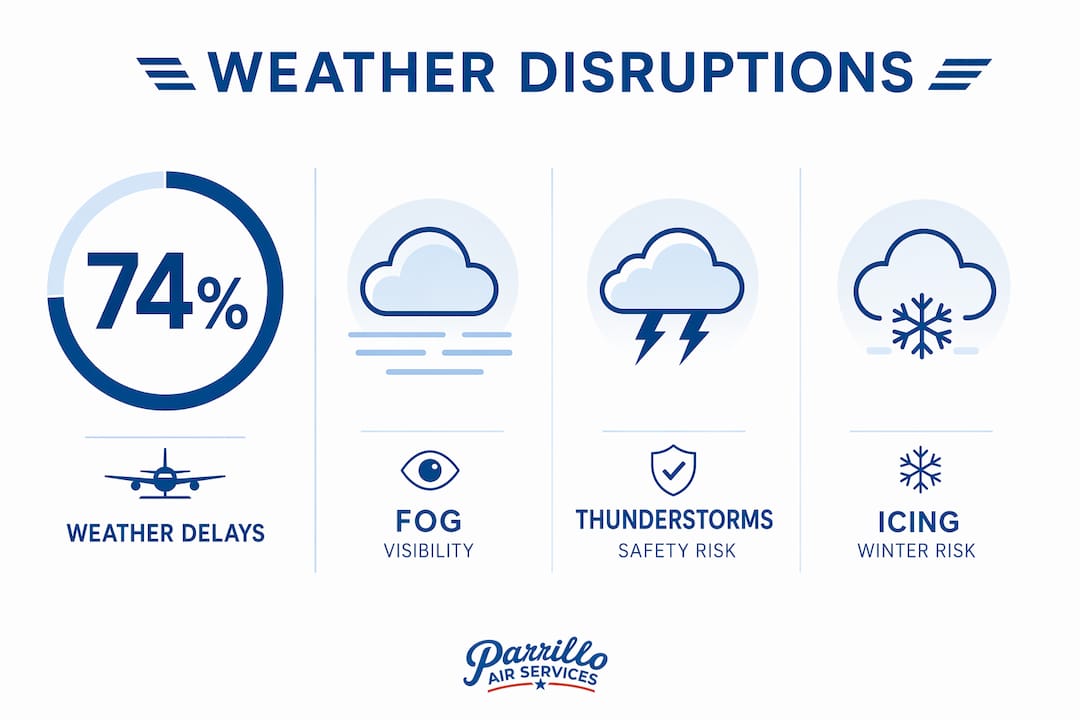
Thunderstorms are the most dangerous and least negotiable. Low ceilings, fog, rain, and thunderstorms can stop takeoffs or landings and may force runway use changes. Crosswind limits and wind shear are frequent operational constraints even when the sky looks passable from the ground.
Icing is the quiet schedule-killer in winter. A non-FIKI training aircraft cannot legally or safely enter known icing conditions, so a single freezing-level forecast can wipe out an entire week of lessons in the Northeast or Midwest.
Density altitude rarely cancels a flight outright, but on a hot summer afternoon at a high-elevation airport, your aircraft's climb performance drops enough that your instructor may restructure or shorten the lesson to avoid the worst of the heat.
Pro Tip: In a METAR, the two-letter sky condition codes tell the story fast. "BKN010" means a broken ceiling at 1,000 feet AGL — that's your VFR floor. If you see "OVC" at anything below 010 in the TAF for your lesson time, start planning your ground session instead.
Weather delays are not all the same length. Understanding the difference between a two-hour fog burn-off and a five-day frontal system changes how you plan your week.
The FAA's data makes the scale of weather's influence clear. Weather accounted for 74.26% of system-impacting delays across the National Airspace System — and this applies to professional operations with full dispatch support. Student training operations, with smaller aircraft and no instrument capability, face even tighter weather windows.
Where you train matters almost as much as when. The United States has enough geographic variety that a student in San Diego and a student in Minneapolis are essentially training in different weather regimes.
By season:
By region:
| Region | Primary Disruption | Peak Disruption Period |
|---|---|---|
| Pacific Northwest / Northern California | Marine fog, low ceilings | June–August (marine layer) |
| Southern California | Morning coastal fog ("June Gloom") | May–July |
| Northeast / Great Lakes | Icing, nor'easters, low IFR | December–March |
| Southeast / Gulf Coast | Afternoon thunderstorms, humidity | June–September |
| Great Plains | Severe convective weather, wind | April–August |
| Mountain West / Southwest | High density altitude, afternoon convection | June–September |
| Mid-Atlantic (Virginia, Carolinas) | Mixed: summer convection, winter icing, coastal fog | Variable |
Students training in the Mid-Atlantic, including the Lynchburg, VA area, deal with a mix of summer afternoon convection, occasional winter icing events, and spring fog. No single season is completely clear, which makes flexible scheduling and simulator availability especially valuable.
The biggest misconception student pilots carry into training is that weather is evaluated once, before the flight, and then the decision is locked in. It isn't. Weather decision-making in training is a continuous mental process, and instructors rehearse "what if" diversion scenarios on every flight rather than treating weather as a preflight formality.
Here's what a CFI is actually evaluating before and during a lesson:
In flight, the re-evaluation never stops. Rising static in the headset, a darkening horizon, or radar echoes building upwind are all triggers to reassess. Technology like ADS-B and radar overlays gives more data, but not judgment — the goal of training is to build the judgment to act early, before hard minima are hit.
Ask your school these questions before your first solo:
Pro Tip: Ask your CFI to walk you through a go/no-go decision on a marginal day, even if you end up not flying. Watching an experienced instructor work through METAR, TAF, radar, and PIREPs in real time is worth more than a chapter in a textbook.
You cannot control the weather, but you can control how exposed your schedule is to it. Most of the students who finish training on time and on budget do a few things consistently.
Scheduling tactics:
Daily weather habits:
Administrative steps:
Pro Tip: Build a "bad-weather routine" and stick to it every time a lesson gets scrubbed. Thirty minutes of chair flying the next maneuver, thirty minutes of FAR/AIM review, and fifteen minutes of weather trend analysis. Students who do this maintain proficiency and need fewer makeup hours when flying resumes.
A scrubbed flight day doesn't have to be a lost training day. Simulators and structured ground work can carry real momentum, especially during extended weather stretches.
What simulators do well:
Credit toward FAA hour minimums:
This is where students often get surprised. Whether simulator time counts toward your FAA-required flight hours depends entirely on the device's qualification level. A full-motion Level C or D simulator counts differently than a basic Aviation Training Device (ATD) or a Flight Training Device (FTD). Under FAA Part 61 program structures, an ATD can substitute for a limited number of instrument hours, but it generally cannot replace required solo or total flight time for a private pilot certificate. Confirm the specifics with your school before assuming simulator hours will count.
Ground training that actually moves the needle:
The key is treating ground time as training time, not waiting time. Students who adopt a structured bad-weather routine consistently report shorter overall training timelines than those who simply wait for the sky to clear.
A well-run flight school doesn't just react to weather. It builds weather management into the training structure from day one.
Parrillo Air Services, based in Lynchburg, VA, operates under FAA Part 61 and emphasizes personalized instruction and flexible scheduling as core parts of its training model. When weather grounds the fleet, students have access to simulator sessions and structured ground work to keep momentum. The school's communication workflow aims to give students as much advance notice as possible, so a scrubbed morning lesson doesn't mean a wasted drive to the airport.
Pro Tip: Before you commit to any flight school, ask specifically: "What happens to my lesson if weather cancels it?" The answer tells you a lot about how the school values your time and money. A clear, written makeup policy is a sign of a professional operation.
Weather is the primary cause of flight training delays, and students who plan for it, rather than around it, finish training faster and at lower cost.
| Point | Details |
|---|---|
| Weather dominates delays | 74.26% of system-impacting FAA delays are weather-caused — student training faces even tighter windows. |
| Budget for lost days | Plan for a significant portion of scheduled flying days to be lost to weather, depending on your region. |
| Morning slots win | Book morning VFR blocks to avoid afternoon convection; keep one flexible makeup slot per week. |
| Simulator time has limits | ATDs and FTDs can substitute for some instrument hours but generally not solo or total flight time under Part 61. |
| Parrillo Air Services | Offers flexible rescheduling and simulator options under FAA Part 61 in Lynchburg, VA, to help students stay on track through weather disruptions. |
Here's what most students don't hear until they're well into training: weather isn't the enemy of your schedule. It's part of the curriculum. Every scrubbed lesson, every marginal-day go/no-go call you watch your instructor make, every METAR you read on a day you can't fly — that's all building the judgment that separates competent pilots from dangerous ones.
The students who struggle most with weather delays are the ones treating training like a fixed timeline with weather as an interruption. The ones who finish well treat every weather event as data. They keep the log, they study the forecast products, they chair-fly the missed maneuver, and they show up to the next lesson sharper than if they'd flown on a marginal day just to log the hour.
There's also a mindset shift worth making early: your instructor's go/no-go call is not a setback. It's a demonstration of exactly the judgment you're paying to develop. A CFI who cancels on a genuinely bad day is showing you what good decision-making looks like. That's the lesson.
Weather will disrupt your training. The question is whether your school has the structure to absorb it without derailing your progress.

Parrillo Air Services in Lynchburg, VA trains student pilots under FAA Part 61 with a direct focus on flexible scheduling, personalized instruction, and clear communication when weather changes the plan. Simulator sessions and structured ground work fill the gaps when VFR flying isn't available, so a scrubbed lesson becomes a productive training day rather than a lost one. If you're weighing your options and want to understand exactly how makeup lessons, simulator credits, and scheduling work before you commit, the details are on the More Info page. Policies vary by school, so confirm the specifics with the admissions team for your own situation.
The following sources informed this article and are worth bookmarking as you progress through training.
For official weather briefings before every flight, use 1800wxbrief.com or the FAA's Aviation Weather Center at aviationweather.gov. These are your primary sources — no app replaces a standard weather briefing.