Yes, meaningful flight training scholarships exist for U.S. applicants, and the money is real, not theoretical. Start with three national sources: EAA, the AOPA Foundation, and The Ninety-Nines. Most flight training scholarships apply only at non-university flight schools, so confirm your program type and residency before you invest hours in an application. Your move this week:

Winning a flight training scholarship depends less on the size of the award and more on matching your career stage to the right program and finishing within its time limit.
| Point | Details |
|---|---|
| Start with three national sources | Check EAA, the AOPA Foundation, and The Ninety-Nines application pages this week for current cycles. |
| Confirm program eligibility first | Most flight training scholarships apply only at non-university schools, not collegiate aviation degree programs. |
| Expect milestone-based payouts | Funds often disburse in stages like 40/40/20, tied to training benchmarks rather than a single check. |
| Local chapters matter more than people assume | Chapter nomination and mentorship, especially through EAA's Ray Scholarship, often decide who gets funded. |
| Coordinate your school before you apply | Parrillo Air Services helps scholarship recipients schedule training blocks and estimate costs that fit 12-month completion windows. |
Not every scholarship deserves equal time on your calendar. Some are chapter-nominated with narrow local competition; others draw thousands of national applicants for a handful of awards. Here's where your effort pays off fastest.
Pro Tip: AOPA's own guidance points out that the right scholarship often matches your career stage, not just the dollar amount. A beginner chasing a $12,000 award competing against commercial-track applicants is fighting the wrong fight; a chapter-nominated Ray Scholarship with built-in mentorship is usually the better first move.
Flight training scholarships don't behave like college financial aid, and assuming otherwise costs applicants time. The biggest structural difference: EAA states its scholarships can be used at any flight training school in the United States or Canada that is not a university program. If you're enrolled in a collegiate aviation degree, you're generally looking at separate university financial aid channels instead.
Eligibility criteria vary by program but commonly include:
Disbursement rarely arrives as one check. A common pattern splits funds roughly 40% at the start, 40% after a documented benchmark, and 20% on completion, sometimes delivered through a prepaid expense card and sometimes paid directly to the school. Most programs also set a completion window, commonly 12 months from the award date. Miss that window and you can forfeit the remaining balance. Funds typically cover flight instruction, aircraft rental, and knowledge or checkride testing fees. They almost never cover housing, food, or transportation to the airport.
National competitions get the attention, but chapter-level and regional awards often have far fewer applicants chasing them. A little outreach goes a long way here.
A strong flight training scholarship application looks less like a college essay packet and more like a training proposal. Reviewers want to see that you'll actually finish, not just that you want to start.
Gather these before you open any application form:
Most national programs open their cycles in the fall, roughly October through December, though some run spring cycles too. Verify current dates directly on each organization's page rather than trusting last year's calendar. Once you know your realistic training block, confirm your flight school's invoice and disbursement process before you submit, so the milestone schedule and your actual training pace line up.
Pro Tip: Include a simple hour-by-hour training timeline in your application when the format allows it. A plan that names your target checkride date and estimated flight hours signals to reviewers that the money won't sit unused.
Generic advice like "write a strong essay" doesn't tell you much. Here's what actually shifts your odds with EAA, AOPA, and The Ninety-Nines reviewers.
Pro Tip: Read our piece on mentorship in aviation careers if you're weighing chapter involvement against a purely national application strategy. Mentorship relationships built through chapter volunteering often outlast the scholarship cycle itself.
Parrillo Air Services works with scholarship recipients to schedule training around milestone-based disbursement, not against it. That's a genuine scheduling challenge many applicants underestimate.
Start with the organizations most aligned to your situation rather than applying everywhere at once. If you're new to flying, the Ray Scholarship's chapter-nomination path and AOPA's entry-level tracks make more sense than competing for a $14,000 advanced-rating award you're not yet eligible for.

Once you've picked your targets, work backward from each deadline. Give yourself at least six weeks before the closing date to request references, since instructors and chapter leaders are often juggling their own busy seasons. Draft your personal statement early, then set it aside for a few days before final edits. A statement written in one sitting the night before a deadline reads that way to reviewers.
Submit required documents in the exact format requested. Scholarship committees reviewing dozens or hundreds of applications will disqualify an otherwise strong candidate over a missing transcript or an unsigned reference form. After submission, follow up once, politely, to confirm your materials were received, particularly for chapter-level awards where communication tends to be less automated than a national portal.
If you're rejected, ask for feedback when the program offers it. Many chapters will tell you directly what a stronger application would have included, and that information is worth more heading into next year's cycle than a generic rejection letter.
Winning is the easy part compared to staying compliant through completion. Most flight training scholarships require some form of progress reporting, whether that's a logbook update, a signed instructor verification, or a simple email check-in at each milestone.

Because funds are rarely paid as a single lump sum, your job is to trigger each disbursement stage on schedule. That usually means notifying the scholarship administrator once you've hit a documented benchmark, such as solo flight or a stage check, rather than waiting for them to ask.
Keep copies of every receipt, invoice, and logbook entry tied to the award. If your training pace slips due to weather cancellations or aircraft availability, contact the administering organization before your completion window closes rather than after. Most chapters and foundations would rather extend a deadline for a communicative scholar than claw back funds from someone who went silent. Treat the relationship as ongoing, not transactional. A scholar who checks in periodically and eventually completes training within the award's terms builds the kind of track record that makes future scholarships, references, and chapter mentorship easier to secure.
Flight training scholarships generally fall into three categories, and knowing which type you're applying to changes what reviewers expect from you.
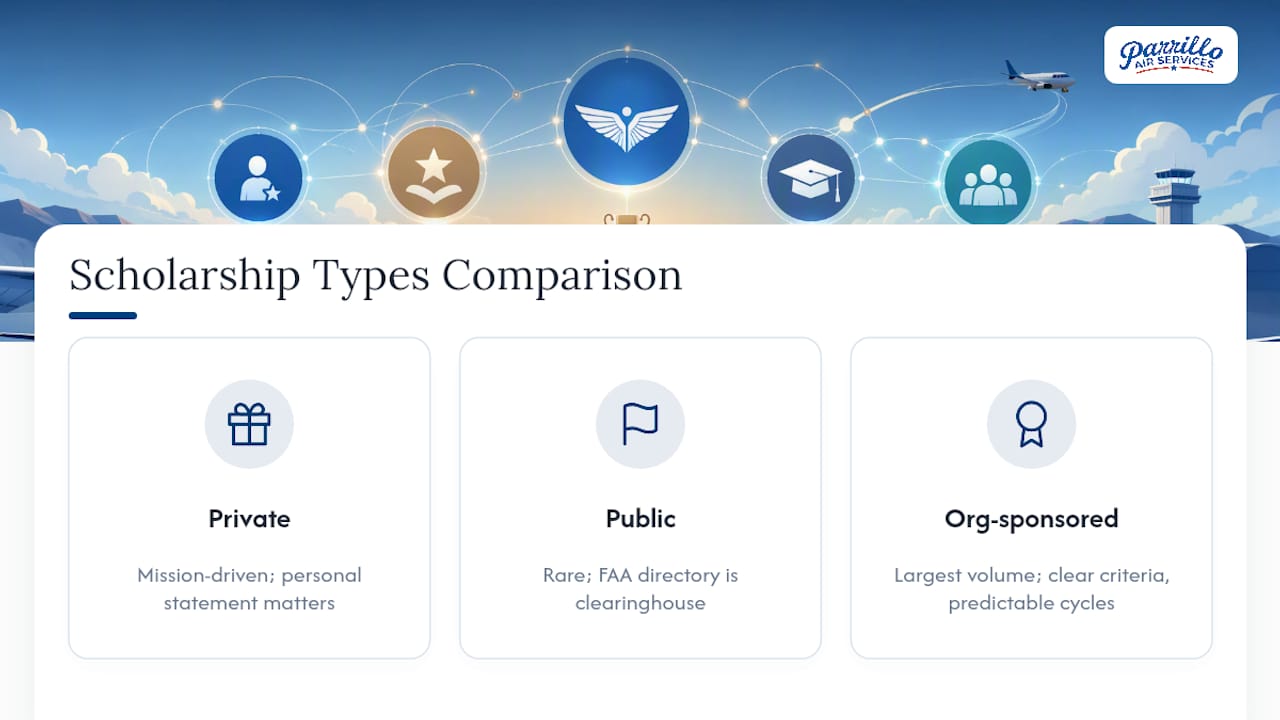
Private, donor-funded scholarships come from individual philanthropists or family foundations, often channeled through EAA chapters or similar organizations. These tend to have the most personal, mission-driven criteria, meaning a heartfelt, specific personal statement often outweighs a polished but generic one.
Public or government-adjacent programs are rarer at the flight-training level since most federal aviation funding flows through the FAA's oversight rather than direct scholarship dollars. The FAA's scholarship directory exists precisely because the agency itself isn't the primary funder. It's a clearinghouse pointing you toward the organizations that are.
Organization-sponsored scholarships, the largest category by volume, come from aviation nonprofits like EAA, AOPA, and The Ninety-Nines, plus industry groups and unions tied to specific career pipelines. These typically have the clearest published criteria and the most predictable annual cycles, which makes them the easiest to plan around if you're organizing a multi-scholarship application strategy.
Scholarships rarely cover a full certificate path from private pilot through commercial, so most successful students combine them with other funding. Federal and private student loans remain available for aviation training at eligible schools, though terms and eligibility vary significantly by lender and program type, so check directly with your school's financial aid resources rather than assuming college-style rules apply.
Employer sponsorship is worth investigating if you're already working, particularly in aviation-adjacent industries where a company might fund training in exchange for a service commitment. Some regional airlines and flight schools also run cadet-style pathway programs that combine reduced-cost training with a hiring pipeline, though these function differently than a standalone scholarship. Our guide on financing flight training as an adult breaks down how to layer a scholarship with a loan or payment plan without overextending yourself financially. Veterans should also check GI Bill eligibility for flight training programs at approved schools, which can cover a substantial portion of costs independent of any scholarship award.
The smartest applicants treat a scholarship as the first piece of a funding stack, not the whole solution. Applying for a scholarship while also lining up a backup financing plan means a rejection doesn't stall your training timeline entirely.
A $12,000 Ray Scholarship sounds like a lot until you map it against the actual cost of a private pilot certificate, which frequently runs well beyond that figure once checkride fees, ground school materials, and unexpected extra flight hours are factored in. Build your budget before you apply, not after the award letter arrives.
Start by asking your flight school for a realistic total cost estimate for your specific rating, including a buffer for weather delays and additional practice hours beyond the FAA minimum. Compare that figure against your scholarship's disbursement schedule so you know exactly which milestone unlocks which payment, and whether you'll need personal funds to bridge any gap between stages.
Track spending against your logbook progress rather than against the calendar alone. Treating scholarship money as a finite, milestone-locked resource, rather than a lump sum to draw on freely, keeps you from hitting month ten of a twelve-month window with more training left than funds remaining.
The applicants who finish training on time are usually the ones who showed up at chapter meetings months before they applied, not the ones who submitted the strongest essay cold. Local mentorship catches scheduling problems early. Coordinating with a flight school before the award letter arrives prevents the exact milestone forfeitures this article warns about.
— Gm
If you've won a scholarship or you're building your application around a realistic training plan, Parrillo Air Services turns that award into logged hours instead of a stalled account balance. Based in Lynchburg, Virginia, the school runs FAA Part 61 instruction from your first discovery flight through private, instrument, commercial, and CFI ratings, with personalized scheduling built around milestone-based disbursement rather than a rigid classroom calendar.

That flexibility matters most in the exact scenario this article covers: a 40/40/20 payment structure with a 12-month completion clock. Parrillo Air Services can map a training block and cost estimate to your scholarship's own timeline before you commit funds to a school, so you're not guessing whether the schedule actually works. If you're a Liberty University student, the school also coordinates credit transfer scheduling alongside your certificate path. Visit the flight training programs page to book a discovery flight or request a cost estimate matched to your scholarship's disbursement schedule.
Parrillo Air Services in Lynchburg, Virginia builds FAA Part 61 training blocks around your scholarship's disbursement schedule — so milestone payments aren't at risk.
Book a Discovery Flight